
In 2026, a Disability Benefits Questionnaire is no longer just a form. It’s a strategic investment in high-fidelity medical evidence designed to withstand the VA’s increasingly sophisticated fraud-detection tools. When you evaluate the cost of a private dbq, you aren’t just paying for a signature; you’re securing a detailed clinical roadmap that connects your conditions to your service. This level of meticulous documentation is essential as the VA moves toward automated systems that often overlook the nuances of complex cases.
We understand the anxiety that comes with spending money on your claim without a guaranteed result. It’s frustrating to see “cookie-cutter” providers offering generic templates that may not survive a rigorous review. This article will help you understand the factors driving private DBQ costs today and show you how to ensure your investment leads to a successful VA rating increase. We’ll provide a clear framework to identify legitimate partners and explain how solid evidence protects your benefits against the latest regulatory changes. 🇺🇸
Key Takeaways
- Learn why high-quality medical evidence is the most effective defense against the VA’s 2026 fraud-detection and automated screening tools.
- Discover how medical complexity and record volume influence the cost of a private dbq and why thoroughness is vital for claim success.
- Identify critical red flags to avoid “cookie-cutter” providers who use repetitive templates that trigger modern VA AI flags.
- Understand the long-term ROI of professional medical evidence by comparing initial costs to the lifetime value of a higher disability rating.
Why Veterans Invest in a Private DBQ
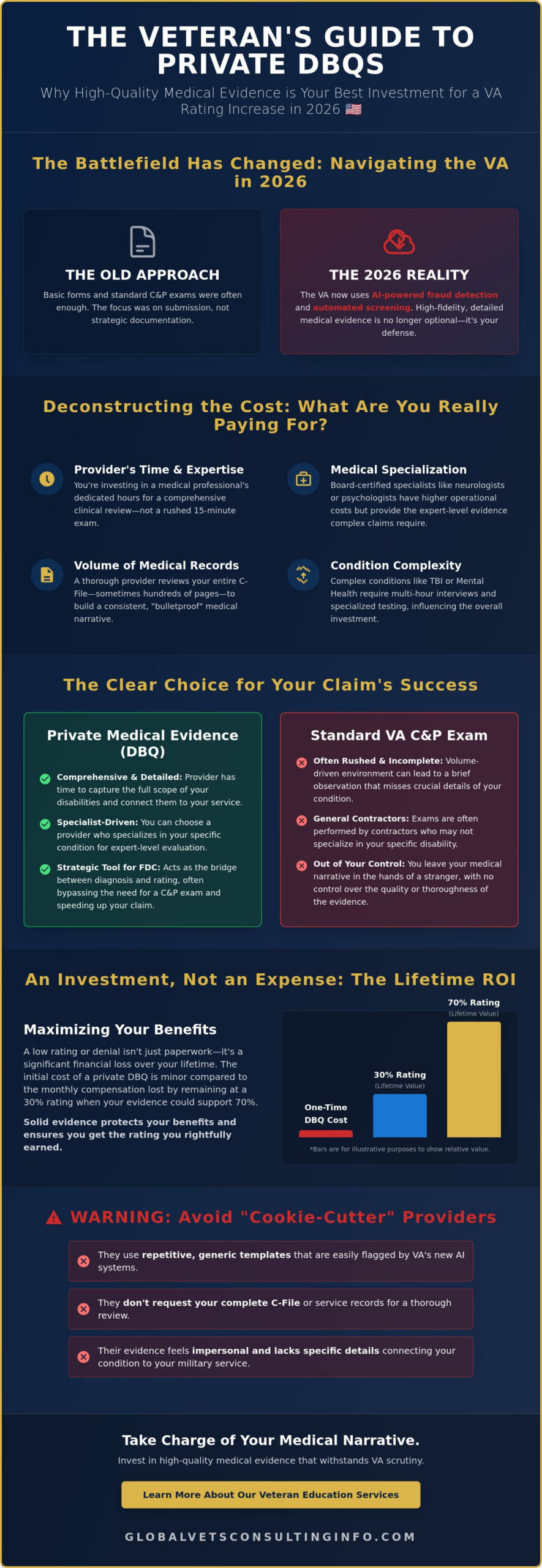
Many veterans start their journey expecting the VA’s Compensation & Pension (C&P) exam to capture the full scope of their disabilities. While these exams are free, they often feel rushed or incomplete. Investing in the cost of a private dbq allows you to take charge of your medical narrative by working with a provider who has the time to review your entire history. Precision matters now. The VA has implemented advanced fraud-detection tools to flag generic evidence. High-quality, independent evidence acts as a shield, ensuring your claim is grounded in clinical facts rather than a 15-minute observation.
Using Disability Benefit Questionnaires (DBQs) from your own clinician can often bypass the need for a standard C&P exam. This is a primary component of a Fully Developed Claim (FDC). If you are wondering what is a dbq and how it helps, remember that it serves as the bridge between your diagnosis and your rating. It speeds up the process by giving the rater everything they need upfront.
Private Evidence vs. VA Contracted Exams
Standard exams are often performed by contractors who may not specialize in your specific condition. Private DBQs provide a comprehensive snapshot that includes nuanced details often missed in the volume-driven C&P environment. Under the 2025 Elizabeth Dole Act, the VA’s ability to share and process electronic DBQs has been streamlined for 2026. This makes private evidence more accessible and harder to ignore during the adjudication process.
The Cost of Doing Nothing
A low rating or a denial isn’t just a paperwork hurdle; it’s a significant financial loss over your lifetime. When you consider the cost of a private dbq, compare it to the monthly compensation lost by remaining at a 30% rating when your symptoms justify 70%. A private DBQ is a veteran’s strategic tool for claim accuracy, providing the meticulous documentation needed to secure the benefits you earned. Don’t leave it to chance.
Breaking Down the Cost: Factors That Influence Private DBQ Pricing
Understanding the cost of a private dbq starts with recognizing that you aren’t just paying for a signature on a form. You’re investing in a medical professional’s time, clinical expertise, and the administrative overhead required to produce high-quality evidence. Every claim has different requirements. A simple musculoskeletal evaluation for a single joint generally requires less clinical time than a complex neurological review or a multi-condition claim. These variations in labor and expertise are what drive the final price.
- Medical Complexity: Mental health, TBI, and complex systemic conditions often involve multi-hour interviews and extensive testing.
- Volume of Medical Records: Reviewing a 500-page C-File takes significant time. A physician must read every entry to ensure the DBQ is consistent with your history.
- Provider Specialization: Board-certified specialists, such as psychologists or neurologists, have higher operational costs than general practitioners.
- Nexus Integration: Some providers include a nexus opinion within the package, while others treat the medical opinion and the DBQ as separate educational resources.
The U.S. Government Accountability Office has highlighted ongoing concerns regarding the quality of contracted exams, noting that inadequate reviews often lead to claim denials. This oversight is a primary reason veterans choose to invest in private evidence. It ensures that every symptom is documented with the precision required to survive VA scrutiny. If you’re unsure where to start, reviewing veteran benefits education can help you identify which conditions require the most documentation.
Mental Health vs. Physical Condition DBQs
A dbq for mental health conditions is typically more labor-intensive than most physical exams. It requires a detailed clinical interview to assess social and occupational impairment. In 2026, with the VA’s shift toward functional impairment models, these intensive clinical hours are a major driver of the total investment. Specialized diagnostic testing may also be necessary to establish the severity of symptoms like PTSD or chronic depression.
Comprehensive Record Reviews
Independent Medical Evidence education emphasizes that a provider’s opinion is only as strong as the data they review. You should be extremely cautious of any provider who agrees to sign a form without requesting your complete C-File. A deep file dive ensures the resulting evidence is bulletproof and consistent. This thoroughness is a key factor in the cost of a private dbq, as it prevents the “cookie-cutter” flags that trigger VA automated denials.
Avoiding ‘Cookie-Cutter’ Risks: How to Vet a DBQ Provider in 2026
Vetting your provider is the only way to protect your investment and your future rating. In 2026, the VA has increased its focus on the quality and authenticity of private medical evidence. When you evaluate the cost of a private dbq, you must look beyond the price tag and examine the provider’s methodology. A “claim mill” that churns out identical forms for every veteran is a liability, not an asset. Legitimate providers prioritize a “Veterans Helping Veterans” ethos, focusing on thorough clinical interviews and individualized documentation. To make an informed choice, take the time to research the best dbq service for veterans so you can distinguish trustworthy allies from predatory claim sharks.
- Guaranteed Ratings: Stay away from anyone promising a specific percentage or “guaranteed” results. No one can predict a rater’s final decision.
- Template Language: Ask if the provider uses unique clinical observations. Repetitive phrasing is a major red flag for modern VA reviewers.
- Medical Licensing: Verify that the professional is licensed in their state and has experience with VA-specific terminology like “at least as likely as not.”
- Record Access: A credible provider will insist on reviewing your C-File before completing any paperwork.
The 2026 Fraud-Detection Landscape
The VA now utilizes sophisticated AI tools to scan for repetitive, identical language across thousands of submissions. If your medical evidence looks exactly like five other claims on a rater’s desk, it will likely be flagged for extra scrutiny or an outright denial. Understanding how to get a dbq from a private doctor involves finding a clinician who focuses on your specific functional impairments. This individualized approach is the best defense against automated fraud flags.
Credentialing and Authority
High-quality evidence must be strong enough to withstand a Higher-Level Review (HLR) or a Board appeal. A legitimate DBQ cost covers the physician’s liability and expertise while ensuring the document adheres to strict clinical standards. This professional weight gives your claim the authority it needs to succeed. If you are ready to build a stronger case, explore our veteran benefits education and resource awareness programs to ensure your evidence meets the mark.
Maximizing Your Rating: The ROI of Professional Medical Evidence
When you evaluate the cost of a private dbq, you have to look at the long-term math. A one-time investment in medical evidence can lead to a lifetime of increased monthly compensation. Many veterans find themselves stuck in a cycle of denials because their initial evidence was insufficient. By securing a high-quality DBQ upfront, you create a solid foundation that often bypasses the need for the multi-year appeals backlog. This strategic approach saves you from the stress and potential legal expenses associated with fighting a decision later.
Professional medical evidence also plays a critical role in establishing secondary service connections. For example, documenting how a service-connected physical injury has led to a secondary mental health condition can significantly impact your combined rating. High-fidelity documentation ensures these links are clear to the rater, helping you achieve a va rating increase that reflects your true level of impairment. Once your evidence is complete, knowing how to submit a dbq to the va correctly ensures your documentation reaches the rater without technical errors or formatting issues that could delay your claim.
Calculating the Value of an Increase
The financial difference between a 10% and a 70% disability rating represents a substantial shift in your monthly household income. For 2026, the cost-of-living adjustment (COLA) is projected to increase VA benefits by approximately 2.5% to 3.2%. When you consider these annual increases over several decades, the initial cost of a private dbq becomes a small fraction of the total value you recover. Investing in documentation today protects your financial future against inflation and changing VA regulations.
The Global Vets Difference
We approach every case with a “Veterans Helping Veterans” mindset. Our team understands the va disability claims process step by step and ensures your medical evidence is mission-ready. We provide the educational resources you need to navigate a complex system with confidence and clarity. 🇺🇸
- 24/7 National Client Services Hotline: 📞 813-553-3330
- Worldwide Support: Access expert resources regardless of your location.
- Mission-Driven Focus: We prioritize meticulousness to ensure your contributions are respected.
Don’t leave your hard-earned benefits to chance. Contact Global Vets Consulting to secure your medical evidence.
Take Charge of Your VA Claim Strategy
Securing the benefits you earned requires a shift from reactive filing to proactive evidence building. You now understand that the cost of a private dbq is an investment in clinical accuracy that protects your claim from the VA’s modern automated screening tools. High-quality documentation doesn’t just describe your symptoms; it establishes the medical authority needed to survive rigorous reviews and avoid lengthy appeals. By prioritizing individualized findings over generic templates, you ensure your medical narrative remains bulletproof in 2026.
Global Vets Consulting is a veteran-owned and operated business dedicated to your success 🇺🇸. We specialize in 2026 VA compliance standards to make sure your evidence is mission-ready from day one. Our team is standing by to help you navigate these administrative complexities with steady confidence. You don’t have to face the system alone.
24/7 National Client Services Hotline: 📞 813-553-3330
Secure Your VA Rating with Professional DBQ Documentation
Your service is a vital part of your history, and your benefits should reflect that contribution. You’ve earned this support, and we’re here to help you claim it. 🇺🇸
Frequently Asked Questions
Is a private DBQ worth the cost if the VA already provides a C&P exam?
Yes, a private DBQ is often worth the investment because it offers a more comprehensive clinical snapshot than a standard C&P exam. Contracted examiners may only spend 15 minutes reviewing your condition during a volume-driven appointment. A private provider takes the time to document your symptoms in the context of your entire service history. This level of detail helps ensure the rater has a complete picture of your functional impairment before making a final decision.
Can I get my private doctor to fill out a DBQ for free?
You can ask your primary care physician to complete the form, but most private doctors don’t do this for free. Completing these questionnaires requires a significant amount of administrative time and a deep dive into your medical records. Many clinicians also feel uncomfortable with VA-specific terminology. Because of this, veterans often choose specialized services that understand how to meet strict 2026 compliance standards without risking claim delays.
What happens if the VA rejects a DBQ I paid for?
If the VA rejects your evidence, you have the right to file a Supplemental Claim or request a Higher-Level Review. Rejections usually happen if the medical evidence lacks a clear rationale or doesn’t follow specific adjudication procedures. Working with a reputable provider reduces this risk. They ensure the document is signed, complete, and supported by valid clinical data that proves your condition is “at least as likely as not” related to your service.
Do private DBQ costs vary depending on the disability type?
The cost of a private dbq varies significantly based on the complexity of the condition being evaluated. Mental health conditions, such as PTSD or depression, require extensive clinical interviews and diagnostic testing. Physical conditions like tinnitus or simple joint issues involve less administrative labor. Providers set their rates based on the hours required to review your C-File and produce a document that survives modern fraud-detection scans.
How do I know if a DBQ service is legitimate in 2026?
Legitimate services in 2026 prioritize transparency and a “Veterans Helping Veterans” approach. You should verify that the provider is a licensed medical professional and avoid anyone promising a “guaranteed” rating. A trustworthy service will always ask for your medical records before starting the process. They focus on individualized findings rather than using templates that look identical to other claims, protecting you from automated flags and extra scrutiny. Learning what separates the best dbq service for veterans from low-quality alternatives can help you make a confident, informed decision before committing to any provider.

Article by
Willie Daniel
Willie Daniel is the Founder and Chief Executive Officer (CEO) of Global Vets Consulting (GVC) – National Veterans Disability Services, a veteran-led educational and medical evidence support organization dedicated to helping veterans better understand VA disability rating increases, DBQ medical evidence, secondary claims education, and C&P examination preparation.
He is a retired U.S. Army Medical Service Corps Officer with more than 27 years of honorable military service, a decorated Iraq combat veteran, and a retired federal official with the U.S. Department of Veterans Affairs. Throughout his military and federal career, Willie Daniel served in leadership, healthcare administration, operational, and veteran-support roles focused on improving services and support systems for servicemembers, veterans, and their families.
Drawing from decades of military leadership, healthcare administration, veteran advocacy, and federal government experience, Willie Daniel brings a practical, veteran-centered perspective to Global Vets Consulting’s educational articles, AI-powered veteran resources, video education initiatives, and outreach programs. His experience navigating military systems, medical documentation processes, and veteran-related administrative operations provides valuable insight into many of the challenges veterans face when seeking to better understand VA disability rating criteria, medical evidence, documentation strategies, and secondary condition education.
Through GVC’s “Veterans Helping Veterans” mission, his focus is on delivering clear, educational, and easy-to-understand information designed to empower veterans with knowledge, resources, and educational tools that may help them make more informed decisions regarding their individual VA disability journeys.
The information provided through GVC is intended for educational and informational purposes only and should not be considered legal or medical advice.
Disclaimer
Disclaimer: Global Vets Consulting, LLC (“GVC”) is a veteran-led educational and medical evidence support organization. GVC is not a law firm, is not a Veterans Service Organization (VSO), and is not affiliated with the U.S. Department of Veterans Affairs (VA) or any government agency.
Global Vets Consulting does not provide legal advice, medical advice, medical treatment, or healthcare services. GVC does not prepare, file, or submit VA disability claims on behalf of veterans. All information provided through this website, blog articles, videos, educational materials, AI tools, dashboards, templates, and communications is intended solely for general educational and informational purposes.
Veterans are encouraged to consult with accredited representatives, licensed attorneys, qualified medical providers, or Veterans Service Organizations regarding their specific legal, medical, or VA-related matters. VA disability decisions, ratings, and outcomes are determined solely by the U.S. Department of Veterans Affairs based on applicable laws, regulations, medical evidence, and individual circumstances. Past results do not guarantee future outcomes.