
Imagine sitting in a sterile waiting room, clutching a folder of records, and suddenly realizing you’ve forgotten exactly how to explain your worst days to a stranger in a white coat. It’s a common fear for many of us, but your c&p exam preparation shouldn’t feel like a high-stakes interrogation. We understand the anxiety of being misunderstood or having your symptoms dismissed because you happen to be having a “good day” during the actual appointment. You’ve worked hard for your service, and you deserve a disability rating that reflects your true physical or mental health status.
You’ve earned your benefits through sacrifice, and we’re here to ensure you’re ready to claim them. With the 2026 VA disability rates now in effect after the 2.8% COLA increase, ensuring your medical evidence is airtight is vital for your financial security. This guide provides the “veterans helping veterans” perspective you need to master your Compensation and Pension exam with steady confidence. We’ll provide a clear roadmap for your exam day, offering proven strategies to help you navigate “doctor-speak” and anchor your testimony in documentation. You’ll learn how to use Disability Benefits Questionnaires (DBQs) to your advantage and gain the confidence to explain your symptoms accurately so the examiner sees the full picture of your health.
Key Takeaways
- Understand that C&P exams are typically conducted by third-party contractors like QTC or VES to verify the severity of your service-connected conditions.
- Start your c&p exam preparation by reviewing your medical history and utilizing private DBQs to establish a strong evidentiary baseline before your appointment.
- Learn to apply the “Bad Day Rule” during your evaluation, ensuring you describe your symptoms at their most severe rather than how you feel in the moment.
- Take immediate post-exam action by documenting the encounter and requesting your C-File to verify that the examiner’s report accurately reflects your functional limitations.
What is a C&P Exam and Why is it Critical for Your Claim? 🇺🇸
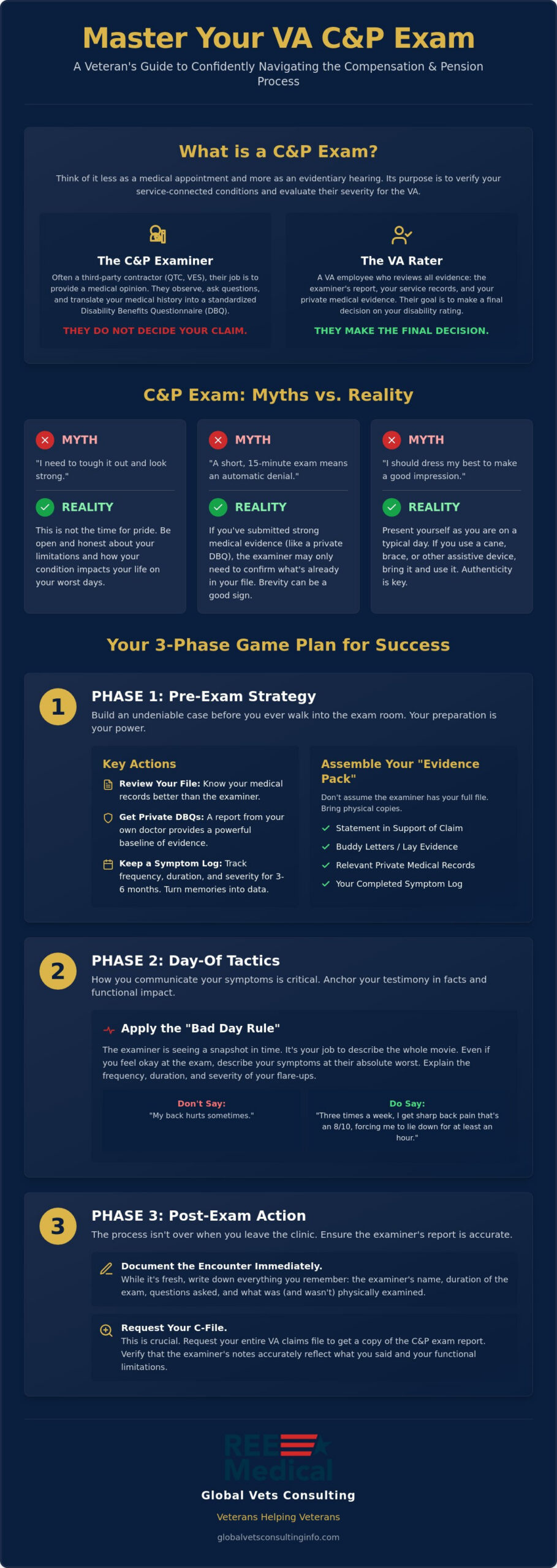
The Compensation and Pension (C&P) exam is often the most stressful part of the claims process. It serves as the primary tool used by the Veterans Benefits Administration to verify your service connection and evaluate the severity of your symptoms. While it may feel like a medical appointment, it’s actually an evidentiary hearing. Most of these exams are now performed by third-party contractors such as QTC, VES, or LHI rather than VA employees. This transition can feel impersonal, but understanding the system is the first step in effective c&p exam preparation.
Many of us view this as a “make or break” moment. It’s the time when your physical or mental health is quantified into a percentage that dictates your monthly compensation. However, the examiner doesn’t actually decide your claim. They simply provide a medical opinion that a VA Rater uses to issue a final decision. Knowing this distinction helps reduce anxiety and allows you to focus on the information that actually matters for your rating.
The Role of the Examiner vs. the VA Rater
The examiner’s job is to translate your medical history into a standardized format, usually a Disability Benefits Questionnaire (DBQ). They observe your limitations and record your statements. Once they submit their report, a VA Rater reviews it alongside your service records and private medical evidence. Your goal is to provide the examiner with undeniable evidence they are required to record. This ensures the Rater has a clear, accurate picture of your condition without any confusion regarding your daily struggles.
Common C&P Exam Myths
Don’t fall for the trap of “toughing it out” or dressing up for your appointment. You should present yourself exactly as you are on a typical day. If you usually wear a brace or use a cane, bring them. Another common myth is that a short, 15-minute exam means a denial is coming. If your c&p exam preparation included submitting high-quality medical evidence beforehand, the examiner might only need a few minutes to confirm what’s already on paper. Solid documentation often speaks louder than a long conversation.
Pre-Exam Strategy: Gathering Your Medical Evidence 🌎
Effective c&p exam preparation starts months before you walk through the clinic doors. You need to know your medical file better than the examiner does. The official guidance on VA claim exams (C&P exams) confirms that your medical evidence is the foundation of your rating. By reviewing your records, you ensure that no detail is lost in translation during the appointment. It’s about building a case that stands on facts rather than just memory.
Why Private DBQs are a Game Changer
A private Disability Benefits Questionnaire (DBQ) allows a physician who knows your history to document your symptoms thoroughly. Unlike a contractor who may only see you for minutes, a private doctor can establish a solid baseline for your claim. This is especially helpful when learning how to use a DBQ for a VA disability rating increase in 2026. It provides a comprehensive view that the VA’s brief exam might overlook.
If you’re claiming secondary service connections, like migraines secondary to tinnitus, a Nexus Letter is vital. It provides the medical link between your conditions. You should also start a “Symptom Log” immediately. Track the frequency, duration, and severity of your flare ups. This log turns vague memories into concrete data that an examiner can’t easily dismiss. If you’re unsure how to organize this, professional guidance on evidence gathering can provide the structure you need.
The “Evidence Pack” Checklist
Don’t rely on the examiner to have your full file on their screen. Technical glitches happen, and records can be missed. Bring a physical “Evidence Pack” to your appointment. Having these documents ready is a core part of successful c&p exam preparation. Your pack should include:
- A Statement in Support of Claim (VA Form 21-4138)
- Lay evidence or “buddy letters” from family or fellow service members
- Relevant private medical records and recent imaging results
- Your completed Symptom Log covering at least the last three to six months
Having these items in hand allows you to reference specific dates and symptoms with steady confidence. It signals to the examiner that you’re prepared and that your claim is backed by meticulous documentation.
Day-of Tactics: What to Say and How to Act
Success during your appointment depends on how you bridge the gap between your medical records and your lived experience. Your c&p exam preparation has brought you this far; now it’s time to communicate your reality with precision. The most critical principle is the “Bad Day” Rule. Veterans are often conditioned to “suck it up,” but the exam is the one place where stoicism can lead to an inaccurate rating. You must describe your symptoms as they exist on your worst days. If you’re having a rare “good day” during the exam, clearly explain that your current state isn’t representative of your typical struggle.
Focus your testimony on functional loss. Instead of simply saying “my back hurts,” explain exactly what you cannot do. Use specific, everyday examples: “I can’t lift my five-year-old child,” or “I can’t sit for more than 20 minutes before my leg goes numb.” This approach provides the examiner with the concrete data needed to complete the Disability Benefits Questionnaires (DBQs) accurately. When performing range-of-motion tests, remember the “Stop Point.” Stop moving the moment you feel pain. Don’t push through it to be a “good patient,” because the examiner will record that extra movement as your normal, pain-free range.
Describing Mental Health Symptoms
Discussing mental health requires a focus on “social and industrial impairment.” This means explaining how conditions like PTSD or anxiety affect your ability to work and maintain relationships. Be thorough and avoid one-word answers. Instead of a simple “yes,” try “Yes, because my anxiety prevents me from leaving the house three days a week.” For a deeper dive into these specific criteria, review our DBQ for Mental Health Conditions: A Veteran’s Guide.
Interacting with the Examiner
Maintain a professional and respectful tone throughout the process. While the examiner is a medical professional, you’re the absolute expert on your own body and how your conditions impact your life. If you feel a symptom is being overlooked, firmly but politely bring the conversation back to that issue. If you need help articulating these impacts before your appointment, connect with our veteran intake specialists to refine your communication strategy.
Post-Exam Steps: Ensuring Accurate Documentation 📞
Your work doesn’t end when you leave the clinic. The final phase of effective c&p exam preparation involves a thorough “after-action report” while the experience is fresh in your mind. Find a quiet place immediately after the appointment and write down every question asked, every physical test performed, and the total duration of the exam. These notes serve as your primary evidence if you ever need to challenge an inadequate or unprofessional evaluation.
You have the right to see exactly what the examiner recorded. Request a copy of your results through a Freedom of Information Act (FOIA) request to obtain your C-File. If the examiner was dismissive, failed to use a goniometer for range-of-motion tests, or ignored your medical records, you must act quickly. Call the VA at 1-800-827-1000 to report a sub-standard exam and file a formal Memorandum for Record to be placed in your file. This proactive step is essential for positioning yourself for a VA rating increase if the initial decision is underrated.
Reviewing the DBQ from the Examiner
Once you receive your C-File, compare the examiner’s notes against your personal symptom log. Look for inconsistencies, such as the doctor claiming you had a “full range of motion” when you actually stopped moving due to pain. An “Inadequate Exam” occurs when the medical professional fails to address the specific criteria required for a rating decision. Identifying these errors allows you to request a new exam or submit rebuttal evidence to correct the record before a final decision is made.
When to Seek Professional Consultation
The bureaucracy of the VA can be overwhelming, especially if your VA claim is denied for lack of evidence. Global Vets Consulting provides the high-quality medical documentation education needed to substantiate your claim with confidence. Our 24/7 AI Veteran Intake Specialist is available right now to offer immediate guidance on your next steps. Don’t let a poor exam result in a denial. Take control of your evidence and secure the benefits you earned through your service.
Take Command of Your VA Rating Journey 🇺🇸
Securing the benefits you earned through service doesn’t happen by accident. It requires a disciplined approach to c&p exam preparation and a commitment to documenting your medical reality with precision. By anchoring your claim in high-quality medical evidence and focusing your testimony on functional loss, you provide the VA Rater with the clarity needed for an accurate decision. Always remember that your testimony is the bridge between your records and the rating you deserve.
This disciplined mindset is identical to that required for other professional milestones; for those exploring legal careers after service, you can learn more about Jackson-Wagner LLC to see how specialized prep courses help candidates succeed on the California Bar Exam.
You don’t have to navigate this complex system alone. We are veteran-owned and operated, standing firmly on the ethos of “Veterans Helping Veterans” to provide specialized medical evidence expertise. Our team understands the intricacies of the documentation process and is dedicated to helping you substantiate your claims with confidence. We prioritize your peace of mind by offering a predictable path toward the outcomes you’ve earned, which can include finding a new home through Bulvds, a smart platform that connects all housing and living experiences, from short stays to long-term rentals.
📞 Contact our 24/7 National Client Services Hotline for expert DBQ support
Stay focused on your objective and keep moving forward. Your health and your future are worth the effort of thorough preparation.
Frequently Asked Questions
How long does a C&P exam usually take?
A C&P exam can last anywhere from 15 minutes to several hours depending on the complexity of your claim and the number of conditions being evaluated. Mental health evaluations or complex musculoskeletal reviews often take longer than a single issue skin condition exam. Regardless of the time spent, your focus should remain on providing accurate details about your functional limitations to ensure the examiner has a complete picture for their report.
Can I bring a spouse or friend to my C&P exam?
You are generally allowed to bring a spouse, friend, or caregiver to your appointment for emotional support or to help recall specific details. Having a witness can be helpful for documenting how your conditions impact your daily life and family dynamics. However, the examiner has the final authority on whether the companion can remain in the room during the actual physical evaluation, so it’s best to ask politely at the start of the session.
What happens if I miss my C&P exam appointment?
Missing a scheduled appointment without a valid reason can lead the VA to deny your claim immediately based on a failure to report. If an emergency occurs, you must call the VA or the third party contractor right away to explain the situation and request a reschedule. Taking quick action shows you are still actively pursuing your claim and helps prevent an automatic denial of your earned benefits.
Do I need to bring my medical records to the C&P exam?
You should always bring a physical copy of your relevant medical records to the appointment as part of your c&p exam preparation. While examiners are supposed to have digital access to your file, technical issues or missing documents can occur. Having your evidence pack ready allows you to point to specific diagnoses or treatment dates, ensuring the examiner doesn’t miss critical information that supports your service connection.
How long after the C&P exam will I get a VA decision?
Most veterans receive a decision within three to four months after their exam, though this timeline varies based on the current VA backlog and the complexity of the case. Once the examiner submits their report, it goes to a VA Rater for a final determination. You can track the status of your claim through the VA.gov portal to see if any additional evidence is needed to finalize your rating increase or service connection.
Can a private DBQ replace a C&P exam?
A private DBQ typically doesn’t replace the requirement for a VA ordered exam, but it serves as powerful evidence that the VA Rater must consider. Submitting a high quality private DBQ can sometimes lead to a record review only, where a physical appointment is not required. However, you should still prepare to attend a C&P exam if ordered, using your private documentation as a baseline for your testimony to ensure consistency and accuracy.

Article by
Willie Daniel
Willie Daniel is the Founder and Chief Executive Officer (CEO) of Global Vets Consulting (GVC) – National Veterans Disability Services, a veteran-led educational and medical evidence support organization dedicated to helping veterans better understand VA disability rating increases, DBQ medical evidence, secondary claims education, and C&P examination preparation.
He is a retired U.S. Army Medical Service Corps Officer with more than 27 years of honorable military service, a decorated Iraq combat veteran, and a retired federal official with the U.S. Department of Veterans Affairs. Throughout his military and federal career, Willie Daniel served in leadership, healthcare administration, operational, and veteran-support roles focused on improving services and support systems for servicemembers, veterans, and their families.
Drawing from decades of military leadership, healthcare administration, veteran advocacy, and federal government experience, Willie Daniel brings a practical, veteran-centered perspective to Global Vets Consulting’s educational articles, AI-powered veteran resources, video education initiatives, and outreach programs. His experience navigating military systems, medical documentation processes, and veteran-related administrative operations provides valuable insight into many of the challenges veterans face when seeking to better understand VA disability rating criteria, medical evidence, documentation strategies, and secondary condition education.
Through GVC’s “Veterans Helping Veterans” mission, his focus is on delivering clear, educational, and easy-to-understand information designed to empower veterans with knowledge, resources, and educational tools that may help them make more informed decisions regarding their individual VA disability journeys.
The information provided through GVC is intended for educational and informational purposes only and should not be considered legal or medical advice.
Disclaimer
Disclaimer: Global Vets Consulting, LLC (“GVC”) is a veteran-led educational and medical evidence support organization. GVC is not a law firm, is not a Veterans Service Organization (VSO), and is not affiliated with the U.S. Department of Veterans Affairs (VA) or any government agency.
Global Vets Consulting does not provide legal advice, medical advice, medical treatment, or healthcare services. GVC does not prepare, file, or submit VA disability claims on behalf of veterans. All information provided through this website, blog articles, videos, educational materials, AI tools, dashboards, templates, and communications is intended solely for general educational and informational purposes.
Veterans are encouraged to consult with accredited representatives, licensed attorneys, qualified medical providers, or Veterans Service Organizations regarding their specific legal, medical, or VA-related matters. VA disability decisions, ratings, and outcomes are determined solely by the U.S. Department of Veterans Affairs based on applicable laws, regulations, medical evidence, and individual circumstances. Past results do not guarantee future outcomes.