
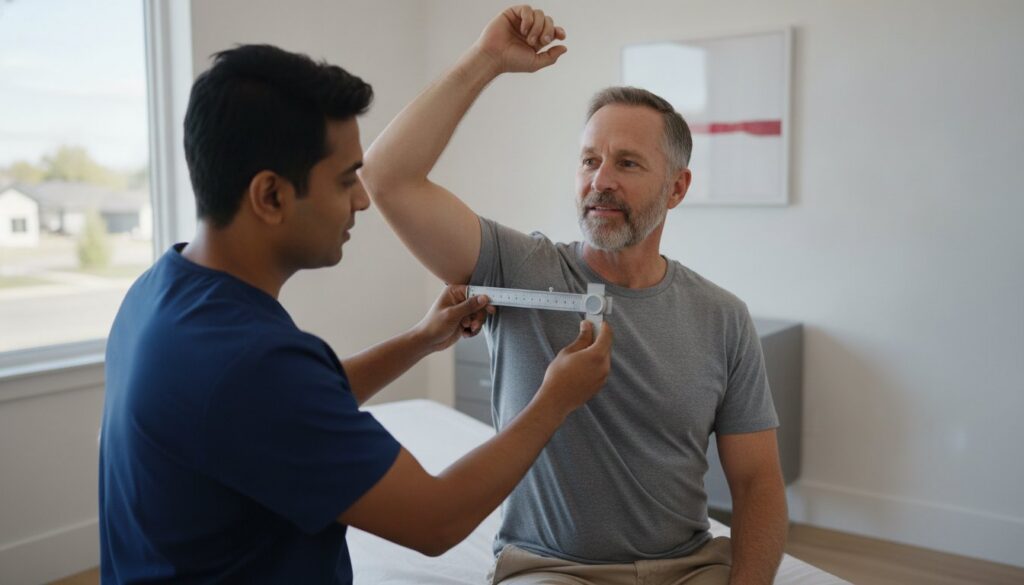
A ten-minute C&P exam often fails to capture the reality of your daily pain. You know that your shoulder doesn’t always hurt the same way every day, and it’s frustrating when a doctor ignores the flare-ups that actually limit your life. Documenting your condition correctly on a dbq for shoulder impingement is the most effective way to bridge the gap between a brief clinical observation and your lived experience as a veteran. You’ve earned your benefits through service, and your medical evidence should reflect that truth.
We’re here to help you understand how to document functional loss and range of motion so the VA doesn’t lowball your rating. You’ll learn how to navigate the 2026 evidence requirements, including the April 15, 2025, version of the Shoulder and Arm Conditions form. This guide also previews how the VA’s new fraud detection tools impact private evidence and what you can do to ensure your documentation remains actionable and sufficient for a successful claim. By the end of this article, you’ll have the confidence to present evidence that accurately reflects your physical limitations and secures the compensation you deserve. 🇺🇸
Key Takeaways
- Identify the specific ICD codes and diagnostic requirements needed to verify a shoulder impingement diagnosis on the official VA form.
- Learn how to ensure your doctor accurately completes a dbq for shoulder impingement by using a goniometer to measure flexion and abduction.
- Understand how to describe functional loss so the VA evaluates your shoulder’s performance during painful flare-ups, not just on a good day.
- Discover why private medical evidence offers a more thorough and controlled alternative to the unpredictable nature of a brief C&P exam.
- Prepare for your claim with the knowledge required to secure the maximum disability rating your medical evidence supports.
What is a DBQ for Shoulder Impingement? 🛡️
A Disability Benefits Questionnaire (DBQ) is a standardized medical form that serves as the primary evidence tool for your VA claim. It’s designed to provide VA raters with the specific data points they need to assign a disability percentage. For veterans suffering from Shoulder Impingement Syndrome, this evidence is captured on the “Shoulder and Arm” musculoskeletal questionnaire.
Submitting a private dbq for shoulder impingement gives you a significant advantage. Instead of relying on a brief exam with a VA-contracted doctor, your own healthcare provider can take the time to document your diagnosis and range of motion accurately. This is vital because a high-quality DBQ that is “actionable and sufficient” can often replace the need for a standard C&P exam. This saves you time and ensures that the person evaluating your shoulder actually understands your medical history.
Why This Form Matters for Your Claim
The DBQ standardizes your medical evidence so that VA raters can easily apply the rating criteria found in 38 CFR Part 4. Without this structure, a rater might miss the specific functional limitations that would qualify you for a higher percentage. The form creates a direct, undeniable link between your service-connected injury and your current physical struggles.
Properly completing this document is a critical part of the va disability claims process step by step. It ensures that every limitation, from painful motion to decreased strength, is recorded in a way the VA recognizes. When you provide a thorough dbq for shoulder impingement, you are handing the VA a roadmap to your earned rating. This level of meticulous documentation is what separates a successful claim from a frustrating denial. 🇺🇸
Key Sections of the Shoulder and Arm DBQ 📋
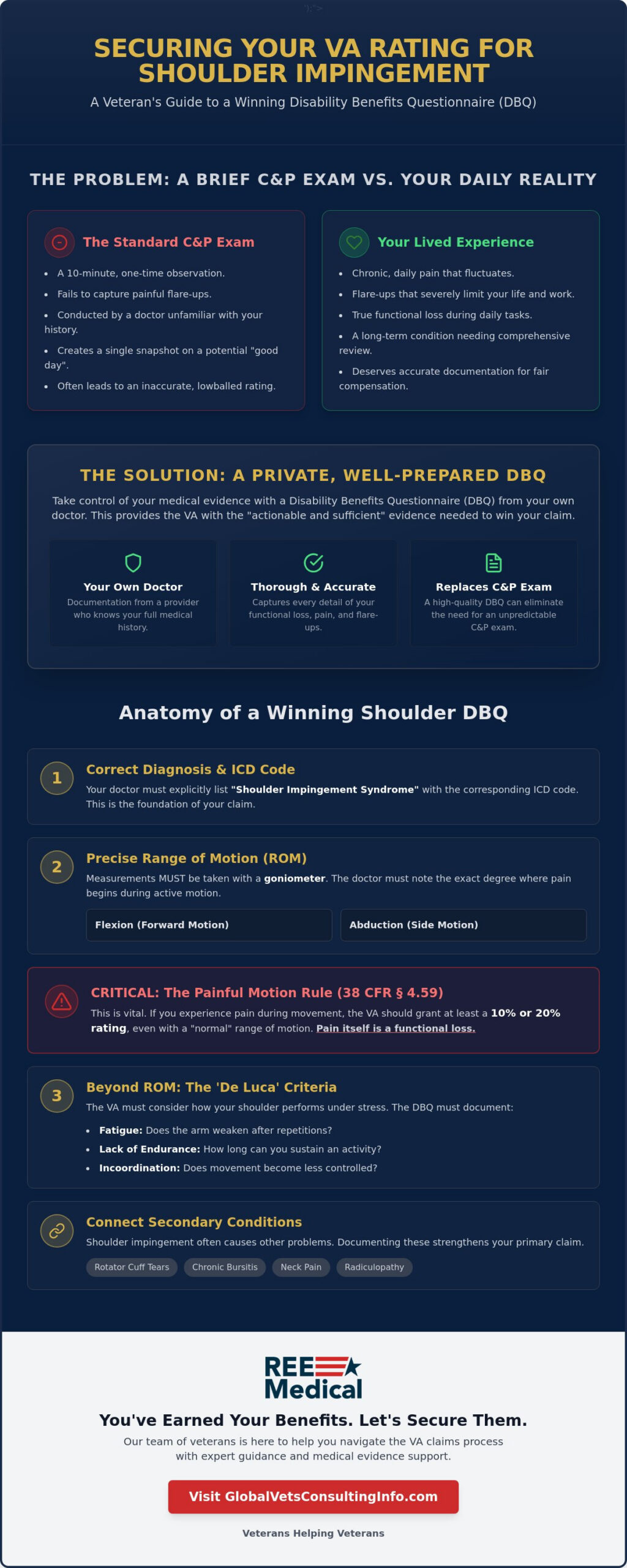
The official VA DBQ form for shoulder and arm conditions is a technical document that requires extreme precision. For your dbq for shoulder impingement to be effective, your doctor must explicitly list the diagnosis along with the appropriate ICD code. Without this specific label, the VA rater might misinterpret your symptoms or apply the wrong rating schedule. Beyond the diagnosis, the examiner is required to use a goniometer to measure your flexion and abduction. These measurements represent how far you can move your arm before the impingement physically stops you.
One of the most vital aspects of a successful claim is the Painful Motion Rule under 38 CFR § 4.59. Many veterans receive a low rating because they can physically move their arm through a full range of motion during the exam, even if it causes significant distress. This regulation states that if you experience pain during movement, the VA should grant at least a 10% or 20% rating. It doesn’t matter if you have a “normal” range of motion on paper. If movement hurts, it’s a disability.
Documenting Range of Motion Corrected for Pain
Accuracy depends on the distinction between active and passive range of motion. Active motion is what you can do yourself, while passive is when the doctor moves your arm for you. Your doctor should prioritize active motion and note the exact degree where pain begins. The VA is also legally required to consider the ‘De Luca’ criteria. This means your dbq for shoulder impingement must account for how your shoulder performs under stress, including fatigue, lack of endurance, and incoordination. If your arm gets weaker or less coordinated after five repetitions, that must be documented.
Secondary Conditions to Include
Shoulder impingement rarely exists in a vacuum. It often leads to rotator cuff tears or chronic bursitis, which should be listed as secondary evidence to bolster your primary claim. The way you compensate for a bad shoulder can also cause neck pain or radiculopathy. If the chronic physical pain has impacted your emotional well-being, you might also consider looking into a dbq for mental health conditions to ensure every aspect of your service-connected health is evaluated.
Understanding these technical requirements is the first step toward a successful rating. For more specialized education on your medical evidence, explore the resources at Global Vets Consulting. The right documentation ensures you don’t leave the benefits you earned on the table. 🇺🇸
Documenting Functional Loss and Flare-Ups ⚠️
Functional loss is the cornerstone of a high disability rating. It means your shoulder fails to perform daily tasks reliably, whether you’re reaching for a seatbelt or lifting a grocery bag. When your doctor fills out the Shoulder and Arm Conditions DBQ, they must look beyond a single static measurement. They need to document if your shoulder “catches” during overhead motion or if it feels like it’s going to give way. This instability is a major component of your physical limitation and must be recorded clearly.
Repetitive use testing is another critical factor that examiners often overlook. Does your range of motion decrease after you move your arm five or ten times? If your shoulder fatigues, loses coordination, or experiences increased pain during repeated activity, your dbq for shoulder impingement must reflect that decline. A rater shouldn’t just see your first movement. They need to understand how your shoulder functions after the tenth repetition when the impingement truly takes its toll.
The ‘It Doesn’t Hurt Today’ Problem
Many veterans walk into an exam on a “good day” and end up with a rating that doesn’t reflect their reality. If you aren’t currently experiencing a flare-up, you must clearly describe your history of pain to the examiner. A va claim denied for lack of evidence often occurs because the medical record only shows the snapshot of a pain-free day. Don’t let a single appointment dictate your future.
You should encourage your doctor to provide an “Estimated” range of motion for your worst days. If you can only lift your arm halfway during a flare, that estimate belongs on your dbq for shoulder impingement. Documentation of functional loss is what transforms a standard medical record into winning evidence. If you’re ready to ensure your paperwork accurately reflects your service-connected limitations, contact Global Vets Consulting for expert education on your medical evidence. We’re dedicated to making sure your voice is heard and your evidence is complete. 🇺🇸
Why Private DBQs are the Best Strategy for 2026 🇺🇸
Choosing a private provider gives you the control that a standard exam often lacks. In 2026, the VA’s reliance on third-party contractors frequently leads to rushed evaluations that miss the nuance of your chronic pain. A private dbq for shoulder impingement ensures your doctor actually listens to your history of service-connected injuries. This meticulous approach results in detailed medical notes that are essential for a rater to see the full scope of your functional limitations.
Submitting your own medical evidence allows you to file a Fully Developed Claim (FDC). This process can lead to faster decisions because the VA doesn’t have to spend months hunting for your records. When you provide an actionable dbq for shoulder impingement, you reduce the likelihood of the VA ordering a redundant and potentially inaccurate C&P exam. Accuracy and speed are the two greatest benefits of taking charge of your own evidence.
Global Vets: Your Partner in Evidence
We understand the physical toll of military service because we’ve lived it. As a veteran-owned organization, our mission is to ensure our brothers and sisters receive the accurate documentation they’ve earned. We specialize in educating you on how to use a dbq for a va disability rating increase, focusing on the specific musculoskeletal details raters look for. Our team provides round-the-clock support through modern technology and dedicated peer advocacy.
- 📞 24/7 National Client Services Hotline: 833-211-1411
- 🤖 24/7 AI Veteran Intake Specialist
- 🌎 Global Vets Consulting: Worldwide
- 🌐 GlobalVetsConsultingInfo.com
Secure the Rating Your Service Deserves
Your journey toward a fair disability rating depends on evidence that speaks the truth about your physical limitations. We’ve explored how documenting painful motion and functional loss ensures the VA doesn’t overlook the daily reality of your condition. By focusing on a precise dbq for shoulder impingement, you provide the clear medical rationale needed to satisfy 2026’s rigorous evidence standards. Private medical evidence isn’t just about speed; it’s about accuracy and ensuring your voice is heard in a system that often feels impersonal.
Global Vets Consulting has been veteran-owned and operated since 2021. We specialize in musculoskeletal DBQ preparation to help our brothers and sisters navigate these complex requirements with confidence. If you’re ready to stop guessing and start building a stronger claim, we’re here to help. You can reach our 24/7 National Client Services Hotline at 833-211-1411 to take the next step toward the rating you’ve earned.
Get Your Accurate Shoulder DBQ with Global Vets Consulting Today! 🇺🇸
You’ve already done the hard work of serving our country. Let’s make sure your documentation reflects the sacrifices you made. You’ve earned these benefits, and we’re honored to stand by you as you claim them.
Frequently Asked Questions
Can I get a VA rating for shoulder impingement even if I have full range of motion?
You can receive a VA disability rating even with a full range of motion if you experience pain during movement. Under the Painful Motion Rule, the VA must grant a minimum rating, usually 10% or 20%, when pain is present during the exam. Your provider must document exactly where the pain begins on the dbq for shoulder impingement to ensure the rater applies this regulation. You don’t want the VA to ignore your distress. Document it correctly.
How much does a private DBQ for shoulder impingement cost?
The cost of a private medical evaluation varies based on the complexity of your medical history and the provider’s fees. While the VA doesn’t reimburse veterans for private DBQs, many find the investment worthwhile for the thoroughness provided. You should check with individual medical consulting services or private physicians to understand their specific fee structures. This ensures you receive a comprehensive assessment that accurately reflects your service-connected condition without any hidden surprises.
What is the difference between shoulder impingement and a rotator cuff tear on a DBQ?
Shoulder impingement involves the compression of tendons, whereas a rotator cuff tear involves an actual rip in the tissue. On the Shoulder and Arm DBQ, these conditions are evaluated using distinct diagnostic codes. However, both are rated primarily on limitation of motion. It’s common for impingement to be listed as a secondary condition to a rotator cuff injury. Accurate diagnosis ensures you’re evaluated under the correct musculoskeletal criteria for your specific injury.
What happens if my C&P examiner disagrees with my private shoulder DBQ?
If a C&P examiner disagrees with your private evidence, the VA must consider all documentation and provide a clear rationale for their decision. When two medical opinions have equal weight, the benefit of the doubt rule generally favors the veteran. Ensuring your dbq for shoulder impingement is completed by a specialist with a strong medical rationale makes it much harder for the VA to dismiss your evidence. It’s a vital step in protecting your claim.
How do I submit my completed shoulder DBQ to the VA in 2026?
You can submit your completed documentation through the VA.gov portal using the Direct Upload tool. This is the fastest method for 2026 claims. It’s essential to ensure the form is signed and includes the provider’s credentials to avoid being flagged by the VA’s new automated data collection tools. You may also submit evidence through traditional mail or by bringing a physical copy to your local VA Regional Office. Digital submission remains the most reliable path.

Article by
Willie Daniel
Willie Daniel is the Founder and Chief Executive Officer (CEO) of Global Vets Consulting (GVC) – National Veterans Disability Services, a veteran-led educational and medical evidence support organization dedicated to helping veterans better understand VA disability rating increases, DBQ medical evidence, secondary claims education, and C&P examination preparation.
He is a retired U.S. Army Medical Service Corps Officer with more than 27 years of honorable military service, a decorated Iraq combat veteran, and a retired federal official with the U.S. Department of Veterans Affairs. Throughout his military and federal career, Willie Daniel served in leadership, healthcare administration, operational, and veteran-support roles focused on improving services and support systems for servicemembers, veterans, and their families.
Drawing from decades of military leadership, healthcare administration, veteran advocacy, and federal government experience, Willie Daniel brings a practical, veteran-centered perspective to Global Vets Consulting’s educational articles, AI-powered veteran resources, video education initiatives, and outreach programs. His experience navigating military systems, medical documentation processes, and veteran-related administrative operations provides valuable insight into many of the challenges veterans face when seeking to better understand VA disability rating criteria, medical evidence, documentation strategies, and secondary condition education.
Through GVC’s “Veterans Helping Veterans” mission, his focus is on delivering clear, educational, and easy-to-understand information designed to empower veterans with knowledge, resources, and educational tools that may help them make more informed decisions regarding their individual VA disability journeys.
The information provided through GVC is intended for educational and informational purposes only and should not be considered legal or medical advice.
Disclaimer
Disclaimer: Global Vets Consulting, LLC (“GVC”) is a veteran-led educational and medical evidence support organization. GVC is not a law firm, is not a Veterans Service Organization (VSO), and is not affiliated with the U.S. Department of Veterans Affairs (VA) or any government agency.
Global Vets Consulting does not provide legal advice, medical advice, medical treatment, or healthcare services. GVC does not prepare, file, or submit VA disability claims on behalf of veterans. All information provided through this website, blog articles, videos, educational materials, AI tools, dashboards, templates, and communications is intended solely for general educational and informational purposes.
Veterans are encouraged to consult with accredited representatives, licensed attorneys, qualified medical providers, or Veterans Service Organizations regarding their specific legal, medical, or VA-related matters. VA disability decisions, ratings, and outcomes are determined solely by the U.S. Department of Veterans Affairs based on applicable laws, regulations, medical evidence, and individual circumstances. Past results do not guarantee future outcomes.

