

Your specific diagnosis doesn’t actually determine your Mental Health VA Rating; the evidence of how that condition disrupts your daily life does. While many veterans walk into a C&P exam expecting the doctor to focus on their clinical history, the VA is actually looking for functional impairment across five specific life domains. It’s frustrating to feel like a checklist is ignoring the reality of your service-connected struggles, especially when the system feels designed to be confusing.
We understand that the complexity of VA math and the pressure of documenting your “worst days” can cause significant anxiety. You’ve earned your benefits through your service, and you deserve a rating that reflects the true impact of your symptoms. This guide will help you master the general rating formula for mental health and show you exactly how to use a Disability Benefits Questionnaire (DBQ) to document your functional impairment effectively.
We’ll break down the 0 to 100 percent scale, explain the major 2026 updates like the elimination of the 0 percent rating, and give you the tools to file for an increase with confidence. 🇺🇸
Key Takeaways
- Understand the major 2026 updates to the rating scale, including the elimination of the 0% rating for all service-connected mental health conditions.
- Learn how to identify and describe your symptoms within the five specific domains of life the VA uses to measure functional impairment.
- Master the use of a Disability Benefits Questionnaire (DBQ) to provide the precise medical evidence required for your Mental Health VA Rating.
- Follow a step-by-step strategy to gather updated treatment records and file for a rating increase that reflects your current level of social and occupational disruption.
Understanding the Mental Health VA Rating Scale in 2026
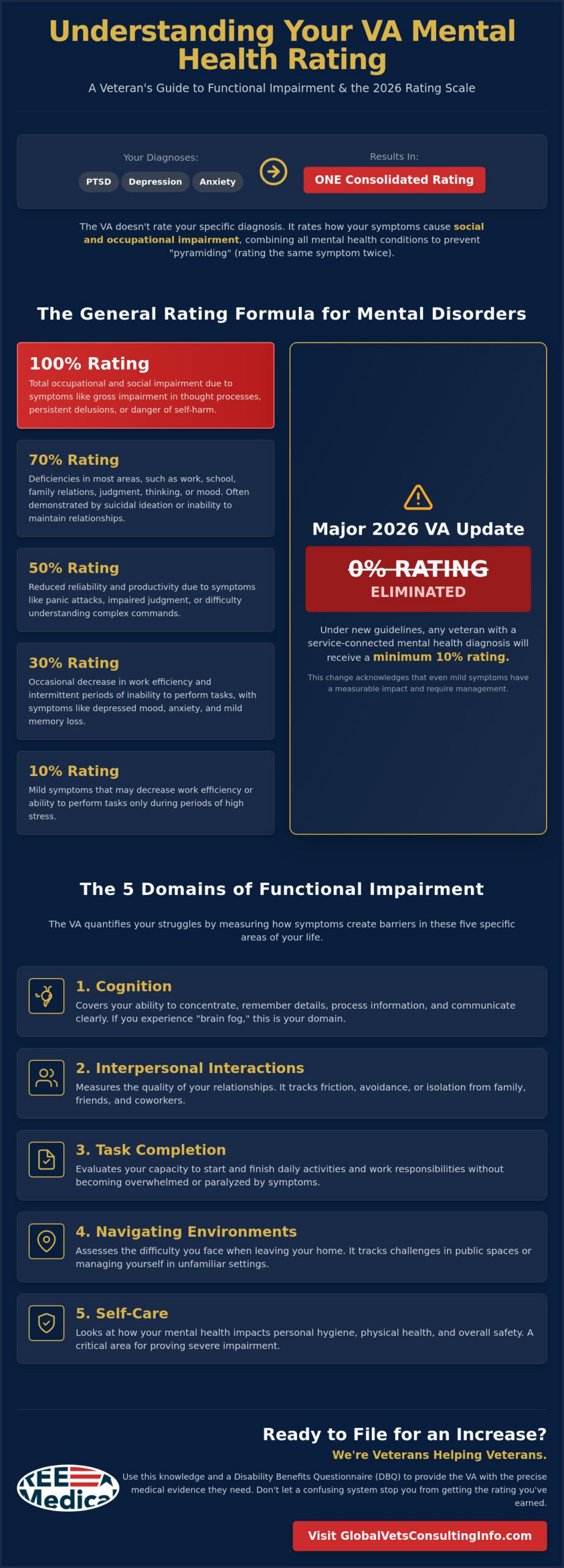
The VA evaluates mental health conditions using a specific set of criteria that measures your level of social and occupational impairment. Rather than rating each condition separately, the VA typically assigns one consolidated Mental Health VA Rating. This means if you struggle with PTSD, depression, and anxiety, the VA combines these symptoms into a single percentage. This prevents “pyramiding,” which is the practice of rating the same symptom twice under different diagnoses. By grouping these conditions, the VA focuses on the total impact on your life rather than the specific labels in your medical file.
The rating tiers are set at 0%, 10%, 30%, 50%, 70%, and 100%. A significant update in 2026 is the planned elimination of the 0% rating. Under these new guidelines, any veteran with a service-connected mental health diagnosis will receive at least a 10% rating. This change recognizes that even mild symptoms require management and have a measurable impact. The VA determines these levels using the General Rating Formula for Mental Disorders, which serves as the standardized blueprint for every examiner and rater in the system.
To secure the benefits you’ve earned, you must establish a service connection. This can be a direct connection, where an event in service caused the condition, or a secondary connection, where a physical service-connected disability, like chronic pain or tinnitus, led to your mental health struggles. Proving this link is the foundation of a successful claim and ensures your symptoms are properly recognized.
The Difference Between a Diagnosis and a Disability Rating
Many veterans feel confused when they have a clinical diagnosis but receive a lower rating than they expected. A diagnosis simply names the condition, but the rating reflects the severity of your “Social and Occupational Impairment.” For example, two veterans may both have a diagnosis of Major Depressive Disorder, but one might be rated at 30% for occasional work efficiency drops, while the other is at 70% due to near-continuous panic attacks and an inability to maintain relationships. Understanding this distinction is a vital part of the VA disability claims process. The VA isn’t just looking at the name of your condition; they’re looking at how it stops you from living your life, which is the core of your Mental Health VA Rating.
The Five Domains of Functional Impairment Explained
To understand your Mental Health VA Rating, you have to look past your diagnosis and focus on functional impairment. The VA’s 2026 update emphasizes how your symptoms create barriers in five specific areas of life. These domains allow examiners to quantify your struggles in a way that aligns with the current Schedule for Rating Disabilities. By focusing on these categories, the VA aims to provide a more holistic view of your daily reality.
- Cognition: This covers your ability to process information, maintain concentration, and remember important details. It also includes how clearly you communicate with others.
- Interpersonal Interactions: This domain measures the quality of your relationships. It looks at how you interact with family, friends, and coworkers, specifically noting any friction or avoidance.
- Task Completion: It evaluates your capacity to start and finish daily activities or work responsibilities. This includes your ability to handle life’s demands without becoming overwhelmed or paralyzed by symptoms.
- Navigating Environments: This involves the difficulty you face when leaving your home. It tracks challenges with being in public spaces or managing yourself in unfamiliar settings.
- Self-Care: This critical area looks at how your mental health impacts your personal hygiene, physical health, and overall safety.
Proactively managing your physical health and safety skills can be a significant part of this self-care domain; find out more about wellness training and certifications that support your overall preparedness.
It’s vital to remember that the VA is looking for “most likely” scenarios, not just how you feel on a good day. When you provide evidence for your Mental Health VA Rating, you must be honest about your worst days to ensure the rater sees the full scope of your impairment.
Caring for an emotional support animal or service pet is often a vital part of a veteran’s mental health strategy and daily routine. If you are a veteran living in or visiting the UK, you can discover London Veterinary Surgeries to find award-winning care for the animals that help you navigate your service-connected challenges.
Translating Your Daily Struggles into VA Language
When you speak with an examiner, you need to bridge the gap between how you feel and how they document it. For instance, if you describe “brain fog,” you’re actually describing a deficit in the Cognition domain. If you find yourself “isolating” or avoiding phone calls from friends, you’re providing direct evidence for the Interpersonal domain. Consistently using these categories helps you build a stronger case for the rating you’ve earned. You can explore more through our veteran benefits education resources to better prepare for these conversations.
How to Document Your Symptoms for an Accurate Rating
Securing an accurate Mental Health VA Rating depends heavily on the quality of your medical evidence. While the VA uses the VA’s General Rating Formula for Mental Disorders to categorize your symptoms, they can only rate what they see in your file. If you’re aiming for a 100% Mental Health VA Rating, the evidence must show “Total Occupational and Social Impairment.” This means your symptoms aren’t just making life difficult; they’re making it impossible to work or maintain any stable social connections.
Evidence isn’t limited to just doctor’s notes. Buddy Statements from a spouse, family member, or battle buddy can provide a perspective a clinical exam often misses. These statements describe how your symptoms manifest at home or in social settings, providing the “on the ground” proof of the functional domains we discussed earlier. They help paint a complete picture of your life outside of a controlled medical environment.
The Power of a Private Disability Benefits Questionnaire (DBQ)
A primary tool for success is the DBQ for mental health conditions. Many veterans rely solely on a C&P exam, but these appointments can sometimes be brief and impersonal. It’s difficult to capture years of complex trauma or depression in a short session with a stranger. A private DBQ, completed by a professional who understands your history, ensures every symptom is documented thoroughly over time rather than just in a single snapshot.
Detailed medical documentation is your best defense against a VA claim denied for lack of evidence. When your file is complete and precise, the rater has a clear path to assign the rating you’ve earned. If you’re ready to strengthen your evidence, you can explore our Mental Health Ratings Education to ensure your documentation is mission-ready.
Steps to File for a Mental Health VA Rating Increase
If your current Mental Health VA Rating doesn’t reflect your daily reality, you have the right to request a review. The first step is to analyze your symptoms against the functional domains we’ve discussed. Look for specific areas where your condition has worsened since your last exam. Whether it’s increased social isolation or a significant drop in work productivity, these changes are the foundation of your VA rating increase request.
Next, you’ll need to gather new and relevant medical evidence. This involves more than just a recent diagnosis; it requires documentation that proves your impairment has reached a higher tier on the rating scale. Utilizing a DBQ for a VA disability rating increase ensures your symptoms are captured in the precise language the VA rater needs to see. Once your evidence is ready, you can submit your claim through the VA.gov portal or with an accredited representative.
The final step is preparing for your C&P exam. Review your medical history and be ready to discuss your “worst days” with the examiner. Don’t minimize your struggles out of habit or pride. If you mask the severity of your symptoms during the exam, the resulting Mental Health VA Rating won’t provide the level of support you actually need.
Veterans Helping Veterans: How Global Vets Consulting Can Help 🌎
Global Vets Consulting is a mission-driven team dedicated to streamlining the evidence-gathering process. We specialize in professional DBQ preparation education to ensure your medical paperwork is thorough and accurate before you file. We understand the stress of the claims process and provide a clear, predictable path forward for our fellow veterans. 🇺🇸
- 🌎 Worldwide Support: Global Vets Consulting
- 📞 24/7 National Client Services Hotline: [Verify Phone Number]
- 🤖 24/7 AI Veteran Intake Specialist: Available online for immediate support
- 🌐 Official Website: GlobalVetsConsultingInfo.com
Secure the Rating Your Service Deserves
You’ve earned your benefits through your service, and it’s time the system recognized the true impact of your symptoms. We’ve broken down how the 2026 updates and the five domains of functional impairment define your Mental Health VA Rating. You now understand that a clinical diagnosis is only the first step; the real strength of your claim lies in documenting how your condition disrupts your ability to work and maintain relationships.
Global Vets Consulting is a veteran-owned and operated team that specializes in professional DBQ preparation. We understand the complexities of the system because we’ve been in your boots. Our mission is to help you bridge the gap between your daily struggles and the medical evidence the VA requires. You don’t have to navigate this administrative maze alone. Our 24/7 National Client Services Hotline is always available to help you take the next step toward a successful rating increase.
Get Started with Global Vets Consulting for Your Mental Health DBQ
We’re ready to stand with you and ensure your sacrifices are properly honored. 🇺🇸
Frequently Asked Questions
Can I have more than one mental health VA rating?
No, you can’t have multiple mental health ratings. The VA groups all mental health conditions, such as PTSD, depression, and anxiety, into a single consolidated rating. They base this on your overall level of social and occupational impairment. This approach prevents pyramiding, which is the practice of rating the same symptom twice. If you have multiple diagnoses, the VA considers all symptoms together to assign the most accurate percentage.
What is the average VA rating for depression and anxiety?
Most veterans with service-connected depression and anxiety conditions receive a rating in the 50% to 70% range. A 50% rating typically indicates reduced reliability and productivity. A 70% rating reflects deficiencies in most areas of daily life, such as work, school, and family relations. If you are struggling to re-enter the workforce or explain gaps in your history, WorkReferences can help you manage professional references to secure new job offers. Ultimately, your specific Mental Health VA Rating depends on the medical evidence showing how these symptoms impact your daily ability to function.
How do I move from a 70% to a 100% mental health rating?
Moving from a 70% to a 100% rating requires medical evidence of total occupational and social impairment. You must demonstrate that your symptoms make it impossible to maintain gainful employment or manage basic social interactions. This often involves documenting severe symptoms like persistent delusions or a complete inability to care for yourself. Providing a detailed DBQ that highlights these extreme functional limitations is a critical step in proving your case.
Will the VA reduce my mental health rating if I seek treatment?
No, seeking mental health treatment doesn’t automatically lead to a rating reduction. Consistent treatment records actually provide the medical evidence needed to show your condition is persistent. The VA only reduces a rating if they find sustained improvement under ordinary conditions of life. Continuing your care ensures your symptoms are properly documented—you can even learn more about Neurobics to see how neurofeedback training helps regulate brain activity for improved focus. This documentation protects your rating from being lowered because of a lack of evidence.
Does a PTSD diagnosis automatically mean a 100% rating?
A PTSD diagnosis doesn’t automatically result in a 100% rating. While PTSD is the most common service-connected mental health condition, the VA assigns a percentage based on symptom severity rather than the diagnosis itself. PTSD ratings follow the same 0% to 100% scale used for all mental disorders. Your Mental Health VA Rating will depend on how much the condition impairs your social and occupational functioning in your daily life.

Article by
Willie Daniel
Willie Daniel is the Founder and Chief Executive Officer (CEO) of Global Vets Consulting (GVC) – National Veterans Disability Services, a veteran-led educational and medical evidence support organization dedicated to helping veterans better understand VA disability rating increases, DBQ medical evidence, secondary claims education, and C&P examination preparation.
He is a retired U.S. Army Medical Service Corps Officer with more than 27 years of honorable military service, a decorated Iraq combat veteran, and a retired federal official with the U.S. Department of Veterans Affairs. Throughout his military and federal career, Willie Daniel served in leadership, healthcare administration, operational, and veteran-support roles focused on improving services and support systems for servicemembers, veterans, and their families.
Drawing from decades of military leadership, healthcare administration, veteran advocacy, and federal government experience, Willie Daniel brings a practical, veteran-centered perspective to Global Vets Consulting’s educational articles, AI-powered veteran resources, video education initiatives, and outreach programs. His experience navigating military systems, medical documentation processes, and veteran-related administrative operations provides valuable insight into many of the challenges veterans face when seeking to better understand VA disability rating criteria, medical evidence, documentation strategies, and secondary condition education.
Through GVC’s “Veterans Helping Veterans” mission, his focus is on delivering clear, educational, and easy-to-understand information designed to empower veterans with knowledge, resources, and educational tools that may help them make more informed decisions regarding their individual VA disability journeys.
The information provided through GVC is intended for educational and informational purposes only and should not be considered legal or medical advice.
Disclaimer
Disclaimer: Global Vets Consulting, LLC (“GVC”) is a veteran-led educational and medical evidence support organization. GVC is not a law firm, is not a Veterans Service Organization (VSO), and is not affiliated with the U.S. Department of Veterans Affairs (VA) or any government agency.
Global Vets Consulting does not provide legal advice, medical advice, medical treatment, or healthcare services. GVC does not prepare, file, or submit VA disability claims on behalf of veterans. All information provided through this website, blog articles, videos, educational materials, AI tools, dashboards, templates, and communications is intended solely for general educational and informational purposes.
Veterans are encouraged to consult with accredited representatives, licensed attorneys, qualified medical providers, or Veterans Service Organizations regarding their specific legal, medical, or VA-related matters. VA disability decisions, ratings, and outcomes are determined solely by the U.S. Department of Veterans Affairs based on applicable laws, regulations, medical evidence, and individual circumstances. Past results do not guarantee future outcomes.

