

If you believe a “presumptive” condition means the VA will grant your rating automatically, you’re unfortunately facing one of the most common reasons for a claim denial in 2026. While the PACT Act and recent Gulf War extensions have opened doors for millions, the VA still requires you to prove the “what” and the “where” of your diagnosis. Understanding the specific evidence needed for va presumptive claim success is the difference between an efficient 75-day approval and a years-long appeal process. 🇺🇸
We know how exhausting it feels to navigate these complex systems while dealing with chronic health issues. It’s frustrating when C&P exams feel inconsistent or when you’re anxious about submitting the wrong paperwork. This guide simplifies the process by providing a clear checklist of medical and service documentation required to turn your condition into a winning rating. You’ll learn how to leverage Disability Benefits Questionnaires (DBQs) and service records to secure a faster decision through the Fully Developed Claim path, ensuring your rating accurately reflects your service-connected disability.
Key Takeaways
- Understand how “presumptive” status waives the requirement for a medical nexus letter, while still requiring proof of a current diagnosis.
- Identify the specific evidence needed for va presumptive claim success, such as DD214 records and specialty pay documentation for toxic exposure proof.
- Learn the importance of submitting an Intent to File early to preserve your effective date and maximize your earned disability compensation.
- Discover how private medical records and DBQs can supplement thin VA treatment files to provide a complete picture of your condition.
- Explore how a professionally documented Disability Benefits Questionnaire ensures your symptoms meet the specific VA rating criteria for a higher disability percentage.
What is a Presumptive Condition? Understanding the Evidence Burden 📄
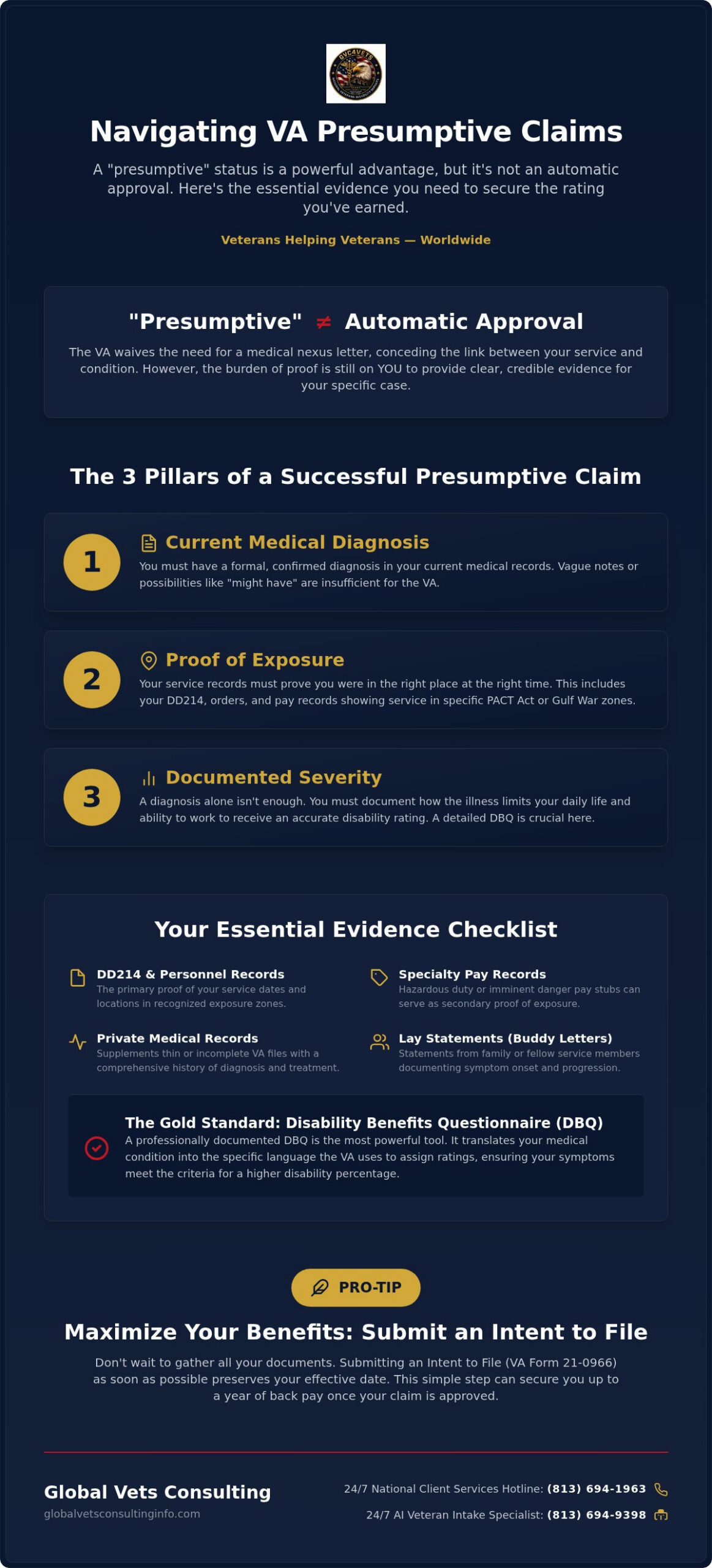
The term “presumptive” is often misunderstood as an automatic approval. In reality, it’s a legal shortcut that waives the requirement for a medical nexus letter. Normally, you’d have to prove your military service caused your condition. For presumptive illnesses, the VA concedes that link based on established laws like the Agent Orange Act of 1991 and the more recent PACT Act. It’s a significant advantage, but it doesn’t mean your claim is a “slam dunk” without documentation.
Don’t fall into the trap of thinking the VA will act as your private investigator. While they have a duty to assist, the responsibility to provide competent and credible medical evidence remains with you. In 2026, with the VA processing record numbers of claims, a file that lacks clear documentation will likely face delays or denials. You must show that you meet the specific legal criteria for that presumption to apply to your unique situation.
The ‘Presumptive Triangle’: What You Need to Submit
To secure your rating, you need to satisfy three specific requirements. If any side of this triangle is missing, the presumption fails. This is the core evidence needed for va presumptive claim success.
- Diagnosis: You must have a formal, current medical diagnosis. A doctor’s note saying you “might” have a condition won’t work. It needs to be a confirmed diagnosis currently present in your medical records.
- Exposure: You have to prove you were in the right place at the right time. This usually requires your DD214 or personnel records showing service in specific PACT Act zones, Gulf War theaters, or other recognized exposure sites.
- Severity: Knowing you have a condition isn’t enough for the VA to assign a percentage. You must document how the illness limits your daily life and ability to work. This is where a detailed Disability Benefits Questionnaire (DBQ) becomes a vital piece of your evidence package.
By focusing on these three pillars, you ensure the VA has no reason to question your eligibility. It’s about making the decision easy for the rater by presenting a complete, organized file from the start.
The Essential Evidence Checklist for Your Presumptive Claim 🇺🇸
Winning your claim requires more than just showing up to a C&P exam. You need a paper trail that connects your current health to your service history. While the VA has access to your records, they often miss the nuances of your exposure or the full extent of your symptoms. The specific evidence needed for va presumptive claim success includes a mix of military, medical, and personal documentation that leaves no room for doubt.
- DD214 and Personnel Records: These confirm your service dates and locations. They are the primary proof that you served in a recognized exposure zone.
- Specialty Pay Records: Documents showing hazardous duty pay or imminent danger pay can serve as secondary proof of exposure if your location records are vague.
- Private Medical Records: VA treatment files are often thin or incomplete. Private records provide a more comprehensive history of your diagnosis and ongoing treatment.
- Lay Statements (Buddy Letters): Statements from family, friends, or fellow service members help document exactly when your symptoms began and how they’ve progressed.
- Standardized DBQ: A Disability Benefits Questionnaire is the gold standard. It translates your medical condition into the specific language the VA uses to assign ratings.
If you’re unsure if your current records are sufficient, exploring medical evidence education can help bridge the gap between a denial and an approval.
Specific Evidence for PACT Act and Toxic Exposure
For veterans who served in Iraq, Afghanistan, or other burn pit locations, the burden of proof has shifted significantly. You should gather any orders, travel vouchers, or award citations that place you in these specific regions. Detailed information on The PACT Act and your VA benefits shows that over 20 new conditions are now presumptive. If you’re claiming a respiratory condition or a rare cancer, your medical evidence must clearly show a formal diagnosis to trigger these new protections.
Evidence for Agent Orange and Gulf War Illness
Agent Orange claims often hinge on proving “boots on the ground” or specific service in the Blue Water Navy. Deck logs and ship coordinates are vital here. For Gulf War veterans, the challenge is often documenting “undiagnosed illnesses” or chronic multi-symptom conditions. Since the presumptive period for these qualifying disabilities has been extended to December 31, 2026, it’s vital to document persistent symptoms like fatigue, headaches, or joint pain through consistent medical entries and lay statements.
How to File a VA Claim for Presumptive Illness: Step-by-Step 🌐
Filing your claim is a tactical operation that requires precision. While the VA’s online portal makes the process look simple, the strategy you choose determines whether you wait three months or three years for a decision. Following a methodical, step-by-step approach ensures you meet all VA Evidence Requirements while protecting your backpay from the very first day.
- Step 1: Submit an Intent to File. Do this immediately. It creates a placeholder for your effective date, ensuring that once your claim is approved, your backpay is calculated from this moment.
- Step 2: Gather your evidence. This is the most critical phase. You must compile your medical records, service records, and a professionally completed DBQ. The evidence needed for va presumptive claim success must be complete before you hit submit.
- Step 3: Select the Fully Developed Claim (FDC) path. By choosing this option, you certify that you have provided all necessary evidence. This bypasses the VA’s lengthy “evidence hunting” phase.
- Step 4: Review for rating increase potential. Before finalizing, ensure your documentation reflects the current severity of your symptoms. A well-prepared file can often lead to a higher initial rating.
Why the Fully Developed Claim (FDC) is the Best Strategy
The VA’s standard claim process is slow because raters must spend months searching for your records. You can cut this timeline significantly by submitting a private DBQ as part of an FDC. This qualifies you for the FDC program because you’ve done the work for them. When a rater sees a complete package with a clear medical diagnosis and proof of service, they can move straight to the decision phase.
Avoiding Common Filing Mistakes in 2026
Precision matters when you’re dealing with federal bureaucracy. One of the most frequent errors is using a diagnosis name that doesn’t match the VA’s presumptive list exactly. For example, if you’re claiming a respiratory condition under the PACT Act, ensure your doctor uses the specific terminology recognized by the VA. You should also double-check that your service dates align perfectly with the presumptive windows for your specific location. A one-day discrepancy in your DD214 can lead to an immediate denial of presumptive status.
If you’re ready to move forward with a claim that’s built to win, contact our experts for VA rating increase education today.
How a Private DBQ Strengthens Your Presumptive Evidence 📞
Relying entirely on a VA-contracted C&P examiner can be a significant gamble for your disability rating. These examiners often work under tight schedules and may not have specialized expertise in the complex respiratory or neurological conditions linked to toxic exposure. A private Disability Benefits Questionnaire (DBQ) acts as a professional safeguard. It ensures that every one of your symptoms is captured and measured against the specific legal criteria found in the VA Schedule for Rating Disabilities.
Global Vets Consulting positions itself as your partner in securing accurate medical documentation. We understand that the VA rater makes decisions based on the evidence on the page, not just the name of your diagnosis. If your file doesn’t clearly show the functional loss or the frequency of your symptoms, you won’t receive the rating you deserve. A professionally completed DBQ provides the evidence needed for va presumptive claim success by leaving no room for a rater to “guess” about the severity of your condition. 🇺🇸
Overcoming a ‘Lack of Evidence’ Denial
It’s a common frustration when a claim was denied despite the condition being on the presumptive list. These denials usually happen because the VA couldn’t find a current, formal diagnosis in your records or felt the service connection wasn’t clearly established by your location history. You don’t have to start over from scratch. By filing a Supplemental Claim, you can introduce a new, private DBQ that specifically addresses the gaps the VA identified in your initial denial letter. This targeted approach is often the most effective way to win an appeal and secure your earned benefits in 2026.
If you’re facing confusion or anxiety about your paperwork, our team is ready to assist. You can reach out through our 24/7 National Client Services Hotline or connect with our 24/7 AI Veteran Intake Specialist at GlobalVetsConsultingInfo.com for immediate guidance. 🌐
Take Command of Your VA Disability Rating 🇺🇸
You now understand that a presumptive status is a legal shortcut, not an automatic guarantee. Success requires a solid medical diagnosis, verified proof of qualifying service, and a detailed record of how your symptoms impact your daily life. By meticulously organizing the specific evidence needed for va presumptive claim success, you eliminate the guesswork for the VA rater and position yourself for a faster decision through the Fully Developed Claim path.
Don’t leave your future in the hands of a rushed C&P examiner who might miss the nuances of your condition. At Global Vets Consulting, we are a veteran-owned and operated team dedicated to helping you secure the expert medical documentation required for a rating increase. Our specialists focus on preparing standardized DBQs that accurately reflect the severity of your illness and meet strict VA criteria.
You can Secure Your Professional DBQ with Global Vets Consulting Today by connecting with our 24/7 AI Veteran Intake Specialist. We are here to support your mission around the clock. You’ve served your country with honor; now let’s ensure you receive every bit of the compensation you earned.
Frequently Asked Questions 🇺🇸
Do I need a nexus letter for a presumptive condition?
No, you don’t need a medical nexus letter for a presumptive condition. The VA legally concedes that your military service caused the illness based on your specific location and dates of service. This legal framework removes the heavy burden of proving a direct link between your duty and your diagnosis. However, you still must provide a current medical diagnosis and proof that you served in a qualifying area during the recognized timeframe.
What happens if I don’t have medical records from my time in service?
You can still win your claim even without treatment records from your time in service. Presumptive conditions are unique because the VA doesn’t require evidence that you were treated for the illness while you were on active duty. Instead, you need to provide your DD214 to prove your service location and current private medical records to show your diagnosis. Lay statements from family members can also help document when your symptoms first appeared.
Can the VA deny a presumptive claim?
Yes, the VA can and will deny a presumptive claim if you fail to provide the necessary documentation. Most denials occur because the veteran lacks a formal medical diagnosis or their service records don’t clearly place them in a recognized exposure zone. Ensuring you have the correct evidence needed for va presumptive claim approval is the only way to prevent these technical denials and secure your earned disability benefits without a long appeal process.
How long does it take for a presumptive claim to be approved in 2026?
In 2026, the average processing time for a VA disability claim is between 75 and 125 days. Specifically, the VA reported averages as low as 75.7 days in April 2026 and 78.6 days in May 2026. You can often speed up this decision by filing a Fully Developed Claim (FDC). By submitting all your medical evidence and a completed DBQ at the start, you allow the rater to make a decision without waiting for additional records.
Is a private DBQ better than a VA C&P exam for presumptive illnesses?
A private DBQ is often more effective because it ensures your symptoms are documented by a professional who understands your specific medical history. While a C&P exam is standard, the examiner may not be a specialist in your condition. A private DBQ acts as the “missing piece” of the evidence needed for va presumptive claim success, providing a thorough record that the VA rater can use to assign an accurate rating immediately.

Article by
Willie Daniel
Willie Daniel is the Founder and Chief Executive Officer (CEO) of Global Vets Consulting (GVC) – National Veterans Disability Services, a veteran-led educational and medical evidence support organization dedicated to helping veterans better understand VA disability rating increases, DBQ medical evidence, secondary claims education, and C&P examination preparation.
He is a retired U.S. Army Medical Service Corps Officer with more than 27 years of honorable military service, a decorated Iraq combat veteran, and a retired federal official with the U.S. Department of Veterans Affairs. Throughout his military and federal career, Willie Daniel served in leadership, healthcare administration, operational, and veteran-support roles focused on improving services and support systems for servicemembers, veterans, and their families.
Drawing from decades of military leadership, healthcare administration, veteran advocacy, and federal government experience, Willie Daniel brings a practical, veteran-centered perspective to Global Vets Consulting’s educational articles, AI-powered veteran resources, video education initiatives, and outreach programs. His experience navigating military systems, medical documentation processes, and veteran-related administrative operations provides valuable insight into many of the challenges veterans face when seeking to better understand VA disability rating criteria, medical evidence, documentation strategies, and secondary condition education.
Through GVC’s “Veterans Helping Veterans” mission, his focus is on delivering clear, educational, and easy-to-understand information designed to empower veterans with knowledge, resources, and educational tools that may help them make more informed decisions regarding their individual VA disability journeys.
The information provided through GVC is intended for educational and informational purposes only and should not be considered legal or medical advice.
Disclaimer
Disclaimer: Global Vets Consulting, LLC (“GVC”) is a veteran-led educational and medical evidence support organization. GVC is not a law firm, is not a Veterans Service Organization (VSO), and is not affiliated with the U.S. Department of Veterans Affairs (VA) or any government agency.
Global Vets Consulting does not provide legal advice, medical advice, medical treatment, or healthcare services. GVC does not prepare, file, or submit VA disability claims on behalf of veterans. All information provided through this website, blog articles, videos, educational materials, AI tools, dashboards, templates, and communications is intended solely for general educational and informational purposes.
Veterans are encouraged to consult with accredited representatives, licensed attorneys, qualified medical providers, or Veterans Service Organizations regarding their specific legal, medical, or VA-related matters. VA disability decisions, ratings, and outcomes are determined solely by the U.S. Department of Veterans Affairs based on applicable laws, regulations, medical evidence, and individual circumstances. Past results do not guarantee future outcomes.

