
Did you know that 67% of VA appeals succeed on the first review? While that statistic offers hope, it doesn’t always ease the anxiety of waiting months for a decision that affects your livelihood. It’s easy to feel like just another number in a massive machine when you’re stuck wondering if your file is actually moving forward or gathering dust on a digital shelf. You deserve a clear path and the peace of mind that comes with knowing exactly where you stand. In this guide, we’ll show you how to check the status of a va appeal using the most efficient tools available in 2026. 🇺🇸
We understand the confusion caused by “VA math” and the frustration of long wait times, which currently average between 4 and 7 months for Higher-Level Reviews. This article will help you decode every status term you encounter and explain the differences between the three appeal lanes. Beyond just tracking your file, you’ll learn how to strengthen your case with relevant medical evidence, such as Disability Benefits Questionnaires, to ensure you aren’t just waiting but winning. Let’s take the guesswork out of the process and get you the answers you’ve earned. 🌐
Key Takeaways
- Master the primary digital and telephonic methods for how to check the status of a va appeal to ensure you always have real-time updates on your claim’s progress.
- Decode complex VA terminology like “Preparation for Decision” to understand exactly where your file sits in the rater’s queue and what to expect next.
- Identify common bottlenecks, such as the “Evidence Gap” and C&P exam backlogs, that may be causing your appeal status to remain stagnant for months.
- Discover how utilizing private Disability Benefits Questionnaires (DBQs) can provide the robust medical evidence needed to potentially bypass lengthy C&P exam delays.
- Learn when to strategically pivot to a Supplemental Claim by submitting new and relevant evidence to accelerate your path toward a VA rating increase.
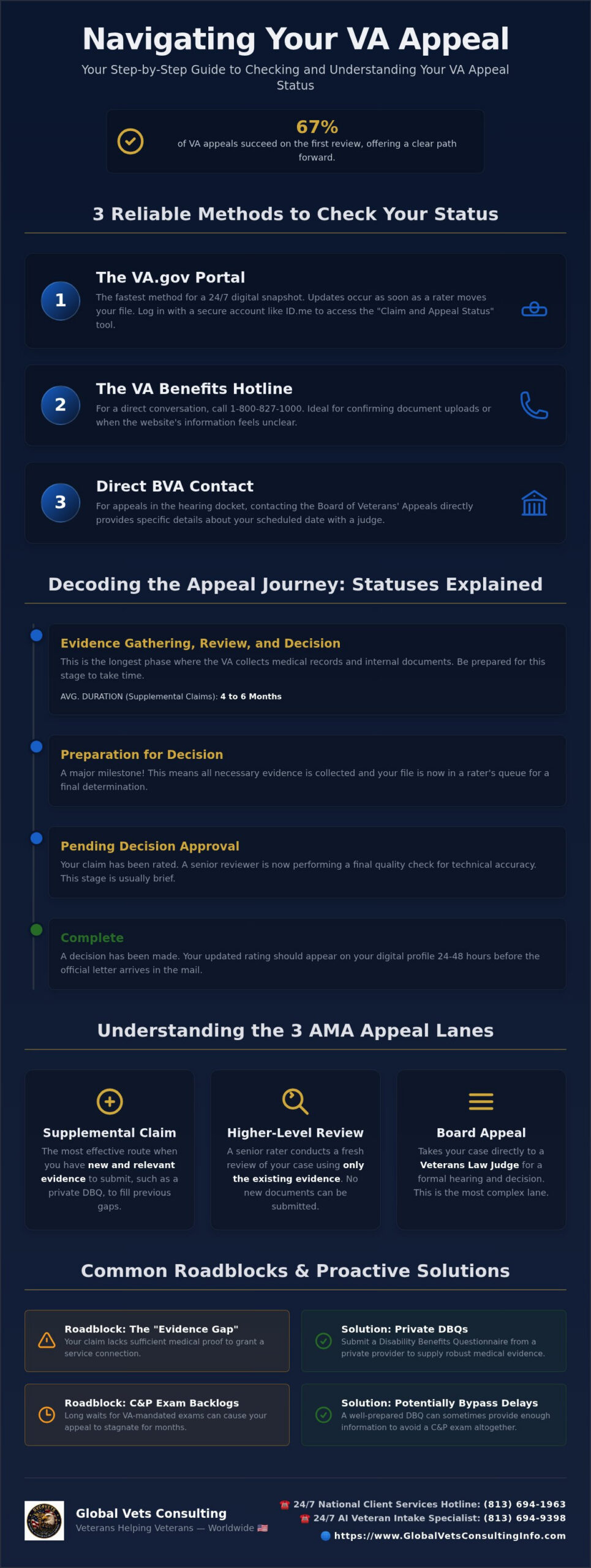
Checking Your VA Appeal Status: 3 Reliable Methods
Waiting for a decision on your VA disability claim can feel like standing in a fog. However, you don’t have to remain in the dark. Understanding how to check the status of a va appeal is the first step in regaining control over your journey toward the benefits you’ve earned. By using these three reliable methods, you can verify that your evidence is being reviewed and stay ahead of any potential requests for more information.
- Step 1: The VA.gov Portal. This is the fastest way to get a digital snapshot of your case. It’s available 24/7 and usually updates as soon as a rater moves your file to the next stage of the process.
- Step 2: The VA Benefits Hotline. If you prefer a human update, call 1-800-827-1000. This line is helpful when the website feels vague or if you need to confirm that a recently submitted document was successfully uploaded to your file.
- Step 3: Direct BVA Contact. For veterans who have chosen the hearing docket, contacting the Board of Veterans’ Appeals directly can provide specific details about your scheduled date with a judge that might not appear on the general dashboard.
Pro Tip: Always keep your original Decision Letter nearby. This document contains your specific appeal lane information, which is critical for ensuring you’re looking at the right data. If you’re tracking a Supplemental Claim but looking for Board Appeal updates, you’ll likely see conflicting information that leads to unnecessary stress.
Navigating the VA.gov Dashboard
Once you log in using a secure account like ID.me, locate the “Claim and Appeal Status” tool. This dashboard displays your claim type, the list of medical evidence you’ve filed, and any tracked items the VA is still waiting on. If you encounter login issues, don’t panic. Most errors stem from mismatched personal data. Ensure your contact information is updated across all systems to prevent these digital roadblocks from slowing down your progress.
Alternative Contact Methods for Legacy Appeals
Legacy appeals follow an older, more complex process than the modern Appeals Modernization Act (AMA) lanes. While the portal provides some data, these cases often require a more hands-on approach. If your status hasn’t changed in months, it’s time to contact your Veterans Service Officer (VSO). These representatives have access to internal systems that show granular details the public dashboard might miss, helping you see exactly where your case sits in the queue.
Understanding VA Appeal Statuses and What They Mean
Once you know how to check your VA appeal status online, the next challenge is decoding the administrative language used to describe your claim’s progress. These statuses aren’t just labels; they represent specific stages of the bureaucratic process that dictate how much longer you might have to wait. Understanding these phases helps reduce the anxiety of the unknown and allows you to plan your next steps effectively.
- Evidence Gathering, Review, and Decision: This is statistically the longest phase of the journey. During this time, the VA collects medical records and internal documents. In 2026, Supplemental Claims typically spend 4 to 6 months in this stage.
- Preparation for Decision: This is a major milestone. It signifies that all necessary evidence has been collected and your file is now on a rater’s desk for a final determination.
- Pending Decision Approval: Your claim has been rated, but a senior reviewer is performing a final quality check. This stage is usually brief but essential for ensuring technical accuracy.
- Complete: The VA has reached a decision. You don’t have to wait for the mail to see the result; your updated rating often appears in your digital profile 24 to 48 hours before the official letter arrives.
The Three Lanes of the Appeals Modernization Act (AMA)
The lane you choose determines how the VA handles your evidence. A Supplemental Claim is for veterans who have “new and relevant” evidence to add to their file. This is often the most effective route when you can provide expertly prepared medical documentation to fill previous evidence gaps. A Higher-Level Review (HLR) involves a de novo review by a senior rater using only existing evidence, while a Board Appeal takes your case directly to a Veterans Law Judge.
Wait Times: What is ‘Normal’ in 2026?
Wait times vary significantly by lane. As of August 2026, a Higher-Level Review takes an average of 4 to 7 months. If you chose a Board Appeal, the Direct Review docket is currently moving at a pace of just under 7 months. However, the Hearing docket remains the longest path, with an average wait time of 2.4 years. Your place in these lines is dictated by “Docket Order,” which is the date the VA received your Notice of Disagreement. Knowing how to check the status of a va appeal regularly ensures you know exactly where you sit in that queue.
Navigating Delays: Why Your VA Appeal Status Might Be Stuck
Seeing a “Pending” status for months is exhausting. You’ve already learned how to check the status of a va appeal, but now you’re seeing no movement on the dashboard. This often happens because of the “Evidence Gap.” The VA requires specific medical links to grant service connection. If your records don’t clearly show this, the system stalls while they request more information. If your VA claim was denied for lack of evidence previously, your appeal will likely face similar hurdles unless new data is added to your file.
C&P exam backlogs remain a primary reason for delays in 2026. The VA cannot rate your claim without a current evaluation of your symptoms. Additionally, simple administrative errors like a missing signature or an incorrectly filed Form 10182 under the Appeals Modernization Act can lead to months of wasted time. If you’re feeling overwhelmed by these bureaucratic hurdles, our 24/7 National Client Services Hotline is always available to help you find a clear path forward.
How to Identify a ‘Remand’ Status
A “Remand” occurs when a Veterans Law Judge determines your case isn’t ready for a final decision. It’s not a denial. Instead, the judge sends your case back to the Regional Office to gather more evidence or fix a procedural error. This often happens when the initial medical evidence was insufficient. While this adds time to your timeline, it’s a vital opportunity to provide the specific medical documentation the judge requested to grant your benefits.
Expediting Your Appeal for Hardship
If you’re facing severe financial hardship or a serious illness, you can request an “Advancement on the Docket” (AOD). This moves your case to the front of the line at the Board. You’ll need to provide proof, such as foreclosure notices or medical records showing a terminal condition, to qualify for this priority processing. It’s a critical tool for veterans who cannot afford to wait the standard 2.4 years for a hearing date.
Don’t let a “stuck” status discourage you from pursuing what you’ve earned. You can take proactive steps to move your case along by focusing on high-quality medical documentation. Our expert DBQ preparation education is designed to help you fill evidence gaps so the VA has everything they need to make a favorable decision. 🇺🇸
Taking Action: How to Strengthen Your Appeal While You Wait
While knowing how to check the status of a va appeal is essential, simply watching a progress bar won’t change the outcome of your claim. Proactive veterans use the waiting period to address the “Evidence Gap” mentioned earlier. If your status has been stagnant for months, it’s often a signal that the VA lacks the clear and unmistakable evidence required to grant a service connection or a VA rating increase.
One of the most effective ways to break this deadlock is by providing a private What is a DBQ?. Unlike waiting for a scheduled C&P exam, which can be delayed by significant backlogs, a private DBQ allows you to submit detailed medical evidence on your own terms. When you pair this with a Nexus Letter, you provide a professional medical opinion that directly connects your current condition to your service history. This combination creates a robust file that is much harder for a rater to overlook.
Why Professional Medical Documentation Matters
A detailed Disability Benefits Questionnaire (DBQ) provides the specific clinical data points the VA needs to assign a rating. Global Vets Consulting specializes in medical documentation education to help substantiate your claim. We understand the intricacies of the bureaucratic system and focus on streamlining your documentation process. Our goal is to ensure your evidence is meticulous, accurate, and ready for review the moment a rater opens your file.
Preparing for the Final Decision
If your appeal status eventually changes to “Denied”, stay calm and focused. Your next step is to use your “Notice of Disagreement” to plan a strategic response. This letter outlines exactly why the VA reached its conclusion, serving as a roadmap for your next move. If the denial was based on a lack of medical evidence, you can immediately pivot to a Supplemental Claim by submitting new and relevant documentation. Don’t wait for another denial to take your case seriously. Get your professional DBQ today and move one step closer to the benefits you’ve earned. 🇺🇸
Take Command of Your Appeals Journey
You now have a tactical understanding of how to check the status of a va appeal and what those specific administrative labels actually mean for your timeline. Whether you’re navigating the VA.gov portal or calling the benefits hotline, staying informed is half the battle. However, tracking a claim is only effective if you’ve provided the medical evidence necessary to win. If your status has stalled, it’s time to stop waiting and start strengthening your file with professional documentation.
At Global Vets Consulting, we offer veteran-owned expertise to help you substantiate your disability claim. Our team provides the education and resources you need to submit high-quality DBQs that fill the evidence gap and move your file toward a favorable decision. We’re here for you with a 24/7 National Client Services Hotline and a 24/7 AI Veteran Intake Specialist to ensure you never feel alone in this process. 📞
Ready to strengthen your appeal? Contact Global Vets Consulting for Professional DBQ Support. You’ve served your country with honor; now it’s our mission to ensure you receive the benefits you’ve earned. 🇺🇸
Frequently Asked Questions
How long does a VA appeal status stay in ‘Evidence Gathering’?
In 2026, this phase typically lasts between 4 and 6 months for Supplemental Claims. It is the most time-consuming stage because the VA is actively gathering medical records or waiting for C&P exam results. If your status remains unchanged for more than 180 days, contact the VA Benefits Hotline to ensure they aren’t waiting on a document from you.
Can I submit new evidence like a DBQ while my appeal is pending?
You can submit new evidence like a private DBQ if you are in the Supplemental Claim lane or the Evidence Submission docket of a Board Appeal. You cannot submit new evidence during a Higher-Level Review. Providing a Disability Benefits Questionnaire is an excellent way to address an evidence gap while you’re learning how to check the status of a va appeal and waiting for movement.
What does ‘Review of Evidence’ mean on my VA appeal status?
This status indicates that a rater has received all requested documents and is now evaluating your medical evidence. They are determining if your condition meets the criteria for a VA rating increase or service connection. It is the final step before your claim moves into the “Preparation for Decision” phase, where a final determination is drafted.
Why did my VA appeal status disappear from the portal?
A disappearing status usually indicates a temporary technical glitch or a data sync between VA regional systems. It rarely means your claim was deleted or denied without notice. If your status doesn’t return within 48 hours, use the 1-800-827-1000 hotline to get a verbal update. This ensures you’re still in the queue even when the digital dashboard is down.
How often is the VA.gov appeal status updated?
The portal updates whenever an administrative action is logged, which can happen at any time during business hours. While the system is designed for real-time tracking, digital lags of 24 to 48 hours are common. Checking once a week is the best way to monitor how to check the status of a va appeal without the stress of daily fluctuations that don’t reflect actual case movement.

Article by
Willie Daniel
Willie Daniel is the Founder and Chief Executive Officer (CEO) of Global Vets Consulting (GVC4Vets) – National Veterans Disability Services, a veteran-led educational and medical evidence support organization dedicated to helping veterans better understand VA disability rating increases, DBQ medical evidence, secondary claims education, and C&P examination preparation.
He is a retired U.S. Army Medical Service Corps Officer with more than 27 years of honorable military service, a decorated Iraq combat veteran, and a retired federal official with the U.S. Department of Veterans Affairs. Throughout his military and federal career, Willie Daniel served in leadership, healthcare administration, operational, and veteran-support roles focused on improving services and support systems for servicemembers, veterans, and their families.
Drawing from decades of military leadership, healthcare administration, veteran advocacy, and federal government experience, Willie Daniel brings a practical, veteran-centered perspective to Global Vets Consulting’s educational articles, AI-powered veteran resources, video education initiatives, and outreach programs. His experience navigating military systems, medical documentation processes, and veteran-related administrative operations provides valuable insight into many of the challenges veterans face when seeking to better understand VA disability rating criteria, medical evidence, documentation strategies, and secondary condition education.
Through GVC’s “Veterans Helping Veterans” mission, his focus is on delivering clear, educational, and easy-to-understand information designed to empower veterans with knowledge, resources, and educational tools that may help them make more informed decisions regarding their individual VA disability journeys.
The information provided through GVC is intended for educational and informational purposes only and should not be considered legal or medical advice.
Disclaimer
Disclaimer: Global Vets Consulting, LLC (“GVC”) is a veteran-led educational and medical evidence support organization. GVC is not a law firm, is not a Veterans Service Organization (VSO), and is not affiliated with the U.S. Department of Veterans Affairs (VA) or any government agency.
Global Vets Consulting does not provide legal advice, medical advice, medical treatment, or healthcare services. GVC does not prepare, file, or submit VA disability claims on behalf of veterans. All information provided through this website, blog articles, videos, educational materials, AI tools, dashboards, templates, and communications is intended solely for general educational and informational purposes.
Veterans are encouraged to consult with accredited representatives, licensed attorneys, qualified medical providers, or Veterans Service Organizations regarding their specific legal, medical, or VA-related matters. VA disability decisions, ratings, and outcomes are determined solely by the U.S. Department of Veterans Affairs based on applicable laws, regulations, medical evidence, and individual circumstances. Past results do not guarantee future outcomes.