What if the reason your VA claim was denied isn’t a lack of evidence, but simply choosing the wrong lane to submit it? Many veterans feel paralyzed by the complex terminology of the Appeals Modernization Act, fearing a single mistake could lead to years of waiting in a Board Appeal backlog. If you have new medical evidence, using a dbq for a supplemental claim is often the most direct path to a favorable decision. This is especially true in 2026, as the VA is currently processing these reviews in an average of 58.8 days. 🇺🇸
We understand the uncertainty that comes with trying to determine if your current documentation is enough to satisfy a rater. You deserve a predictable path forward that values your service and respects your time. This guide offers a clear framework for selecting the appeal lane that best fits your specific situation and evidence. We will compare your options side by side, ensuring you have the knowledge to turn a denial into a successful rating increase. By the end of this article, you’ll know exactly which “door” to walk through to secure the benefits you’ve earned.
Key Takeaways
- Identify the strategic differences between the three AMA review lanes to avoid the years-long Board Appeal backlog. 🇺🇸
- Learn how to audit your Decision Narrative to pinpoint the exact evidence gaps the VA used to deny your disability claim.
- Master the process of using a dbq for a supplemental claim to submit the “New and Relevant” medical evidence required for a rating increase. 🌐
- Differentiate between a Higher-Level Review for administrative errors and a Supplemental Claim for building a stronger medical record.
- Gain a clear framework for navigating 2026 processing times and securing the benefits you earned through your service.
Understanding the VA Decision Review Process in 2026 🇺🇸
The Legacy system is a relic of the past. Today, the Appeals Modernization Act (AMA) governs how you challenge a VA decision. It provides three distinct pathways, giving you more control over your strategy than ever before. You aren’t just stuck in a single line waiting for a judge; you can choose the lane that matches the evidence you have in hand. This framework was designed to reduce wait times, but it requires you to be proactive about your medical documentation.
The three primary review options include:
- Supplemental Claim: This is the lane for submitting “new and relevant” evidence that the VA hasn’t seen yet.
- Higher-Level Review (HLR): This is a “closed record” review where a senior rater looks for administrative errors or missed evidence already in your file.
- Board Appeal: This sends your case to a Veterans Law Judge, which offers the highest level of review but often takes years to complete.
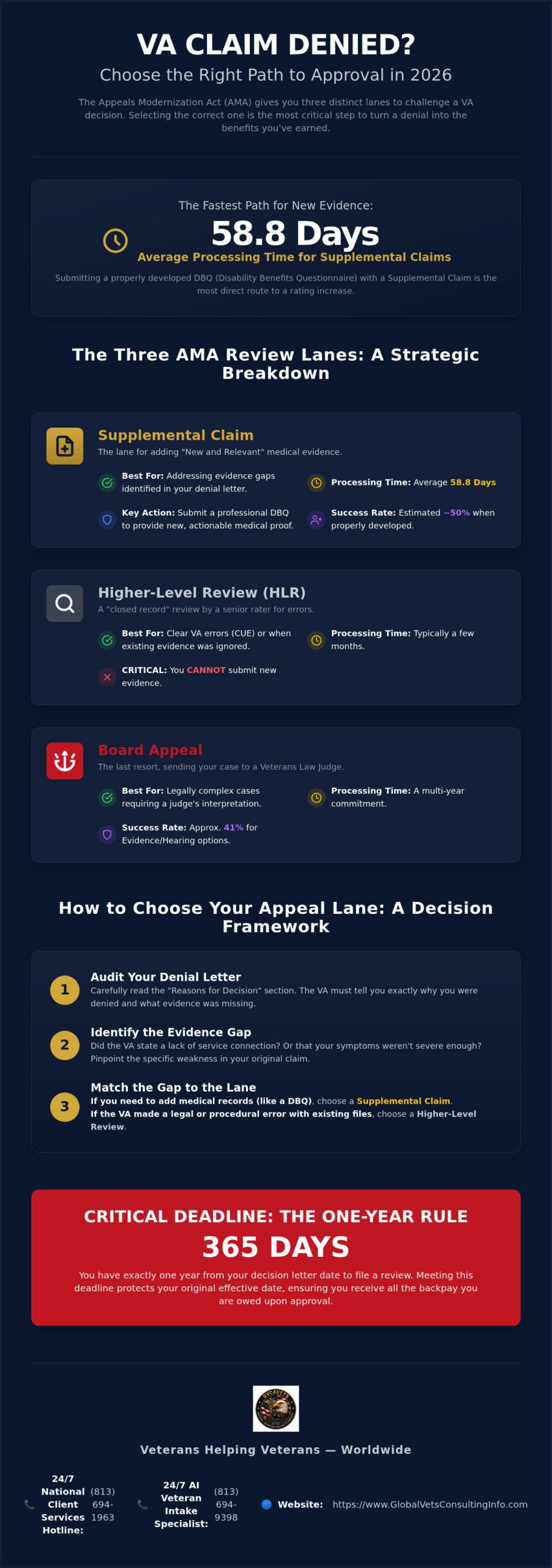
Choosing the right lane immediately after a va claim denied for lack of evidence is critical for your backpay. If you have a gap in your medical records, using a dbq for a supplemental claim allows you to fill that hole quickly. In 2026, Supplemental Claims are averaging about 58.8 days for completion, making them a much faster alternative to the Board of Veterans’ Appeals.
The One-Year Rule: Protecting Your Effective Date
You have exactly 365 days from the date on your decision letter to file a review. This one-year window is vital because it protects your effective date. If you win your appeal within this timeframe, the VA owes you backpay starting from that original date. If you miss this deadline, you’ll likely have to start over, losing months or even years of retroactive compensation. Staying organized and acting within this window ensures you don’t leave earned benefits on the table.
Common Reasons for VA Denials in 2026
Most denials today stem from a lack of service connection or an inadequate severity rating for chronic conditions. The VA’s “duty to assist” frequently falls short during initial claims, leaving veterans with rushed C&P exams that don’t reflect their daily struggles. By using a dbq for a supplemental claim, you take the initiative to provide the technical accuracy the VA missed. This peer-to-peer approach helps you navigate bureaucratic hurdles with the confidence that your evidence is “actionable and sufficient” for a rater to approve.
The Three Review Lanes: Comparative Strategic Breakdown
Strategic lane selection is the difference between a check in the mail and a multi-year wait. Under the official VA Supplemental Claim process, you have the opportunity to fix what the initial rater missed. In July 2026, the average completion time for a Supplemental Claim was just 58.8 days. This makes it the fastest route for veterans who can provide “new and relevant” evidence. By using a dbq for a supplemental claim, you are submitting a structured medical report that speaks the VA’s language. This strategy contributes to an estimated 50% success rate for this lane.
Higher-Level Review (HLR) vs. Supplemental Claim
Higher-Level Review (HLR) is a different beast. It is a “closed record” review. This means you cannot add any new medical evidence. It’s best used when the VA made a Clear and Unmistakable Error (CUE) or ignored records already in your file. If your denial was based on a lack of evidence, HLR will almost certainly fail. Instead, focus on using a dbq for a supplemental claim to address those specific gaps. For example, if you need a dbq for mental health conditions to prove the severity of your symptoms, the Supplemental lane is your only viable choice.
Board Appeals: The Last Resort
The Board of Veterans’ Appeals is usually a multi-year commitment. While approval rates for AMA Board options like Evidence Submission or Formal Hearings are approximately 41%, the backlog remains a significant hurdle. You have three choices: Direct Review, Evidence Submission, or a Formal Hearing. Direct Review has a lower approval rate of about 34% because it doesn’t allow for new evidence or testimony. Unless your case is legally complex, starting with a faster lane is usually the better move. You can always explore educational resources for VA rating increases before committing to the Board’s long timeline.
How to Choose Your Appeal Lane: A 5-Step Decision Matrix
Selecting the right appeal lane is a strategic exercise in matching your evidence to the VA’s specific reasons for denial. You shouldn’t guess which path to take. Instead, follow this methodical process to ensure your next submission is your final one. 🇺🇸
- Step 1: Analyze your Decision Narrative. Open your VA decision letter and find the “Reasons for Decision” section. This tells you exactly why the VA said “No.” Did they miss a service connection, or did they decide your symptoms weren’t severe enough for a higher rating?
- Step 2: Audit your medical evidence. Look for the “Big Three”: a current diagnosis, an in-service event, and a medical Nexus. If any of these are missing, you have an evidence gap that must be filled.
- Step 3: Determine if “New and Relevant” evidence exists. If you have new records or can obtain a professional medical opinion, you are using a dbq for a supplemental claim to override the previous denial.
- Step 4: Assess the need for an informal conference. Decide if your case is strong enough on paper or if you need to speak directly to a senior reviewer to point out mistakes. This option is exclusive to the Higher-Level Review (HLR) lane.
- Step 5: Select the lane that matches the gap. If you need to add facts, choose Supplemental. If the facts are there but the VA ignored them, choose HLR.
Scenario A: You have new medical documentation (DBQs)
The Supplemental Claim lane is the only choice when you are submitting new Disability Benefits Questionnaires (DBQ) to prove symptom severity. In 2026, the standard for “Relevant” evidence is low; it only needs to “tend to prove” a matter that wasn’t previously established. While the VA provides Publicly Available DBQ Forms, having them completed by an independent provider who understands VA rating criteria is often the deciding factor. Using a dbq for a supplemental claim ensures the rater has clear, actionable data to grant your increase.
Scenario B: The VA ignored your existing records
If your medical file already contains everything needed for a win but the rater made a mistake, choose Higher-Level Review. This lane allows you to argue that the VA failed its “Duty to Assist.” You can request an Informal Conference to walk a senior reviewer through the specific pages of your record they missed. It’s a powerful way to fix administrative errors without restarting the entire evidence-gathering process. 🌐
If you aren’t sure which evidence gap is holding you back, reach out to Global Vets Consulting for expert medical evidence education today.
Strengthening Your Appeal with Professional DBQs 🌐
Using a dbq for a supplemental claim is the most effective way to counter a negative C&P exam. Often, a VA examiner spends only minutes reviewing your history, which can lead to an “inadequate” or “not service-connected” finding. By providing a private Disability Benefits Questionnaire (DBQ), you present a comprehensive medical record that the rater must consider. This documentation is designed to be actionable and sufficient, ensuring the VA has the specific data points required to grant a va disability rating increase without further delay. 🇺🇸
Why Private DBQs Outperform C&P Exams in Appeals
A standard C&P exam is frequently a snapshot of your condition, but it rarely captures the full chronicity of your symptoms. Expert private medical reviews take the time to audit your entire service treatment record and current medical history. This thoroughness ensures that every box on the DBQ is checked accurately, reflecting the true severity of your service-connected conditions. When you are using a dbq for a supplemental claim, you are essentially providing the rater with a finished roadmap to approval. This reduces the need for the VA to rely on subjective interpretations from rushed third-party examiners.
Your Mission-Driven Support Team
Global Vets Consulting is veteran-owned and operated, rooted in a “Veterans Helping Veterans” ethos. We understand the frustration of a denial because we’ve been through the system ourselves. Our mission is to provide the medical evidence education you need to substantiate your claims with confidence. We specialize in identifying the “New and Relevant” documentation required to succeed in the Supplemental lane, helping you move past bureaucratic roadblocks.
Getting started is simple. You can connect with our 24/7 AI Veteran Intake Specialist to evaluate your documentation needs immediately 📞. Whether you need a professional medical evidence audit or education on specific conditions, we are ready to assist you worldwide. Don’t let a denial be the final word on your benefits. Reach us anytime at our 24/7 National Client Services Hotline or visit GlobalVetsConsultingInfo.com to take the next step toward the rating you’ve earned. 🌐
Securing Your Earned Benefits with Strategic Evidence 🇺🇸
Choosing the correct appeal lane is a strategic decision that directly impacts your timeline and your backpay. You now have a framework to audit your decision narrative and identify whether your case requires a Higher-Level Review for administrative errors or a Supplemental Claim for new medical facts. By using a dbq for a supplemental claim, you can bridge the gap between a denied initial filing and a successful rating increase. This methodical approach replaces uncertainty with a clear, predictable path forward.
Global Vets Consulting has been veteran-owned and operated since 2021. We specialize in medical evidence education and professional documentation to help you substantiate your claims with technical accuracy. Our mission is to ensure no veteran feels neglected or confused by the VA’s complex systems. Whether you’re navigating 2026 processing timelines or preparing for a secondary claim, our team is here to support you worldwide 24/7. Reach out to our National Client Services Hotline for assistance at any hour. 📞
Get the medical evidence you need to win your appeal; Contact Global Vets Consulting today! You’ve earned these benefits through your service, and we’re here to help you secure them with confidence.
Frequently Asked Questions
Can I switch appeal lanes if I change my mind later?
Yes, you can switch appeal lanes as long as you are within the 365-day window from your decision letter. However, you cannot have two active reviews for the same medical condition at the same time. If you filed for a Higher-Level Review and realize you need to submit new evidence, you must withdraw that request before using a dbq for a supplemental claim to address the issue.
How long does a VA Supplemental Claim take to process in 2026?
As of August 2026, the VA is completing Supplemental Claims in an average of 58.8 days. This is a significant improvement over previous years and remains the fastest option for veterans who have new medical evidence to present. In contrast, Board Appeals continue to face multi-year backlogs, making the Supplemental lane a much more efficient choice for those seeking a timely decision.
What qualifies as ‘New and Relevant’ evidence for a VA appeal?
Evidence is considered “new” if the VA hasn’t seen it before, and “relevant” if it tends to prove or disprove a matter at issue in your claim. This is a relatively low bar to clear. For example, using a dbq for a supplemental claim that documents a higher level of functional impairment than your previous C&P exam constitutes relevant evidence because it directly impacts your disability rating.
Do I need a lawyer or VSO to choose a VA appeal lane?
You don’t need a lawyer or a Veterans Service Organization (VSO) to select an appeal lane or manage your claim. Many veterans choose to represent themselves by focusing on medical evidence education and professional documentation. While legal counsel can be helpful for complex cases, you have the authority to audit your own records and submit the necessary DBQs to substantiate your service connection or rating increase.
Can I file a Higher-Level Review and a Supplemental Claim at the same time?
You cannot file both an HLR and a Supplemental Claim for the same specific condition simultaneously. The VA requires you to choose one pathway and see it through to a decision. However, if your decision letter denied multiple conditions, you can split them up. You might choose an HLR for a clear administrative error on one condition while filing a Supplemental Claim for another that requires new medical evidence.

Article by
Willie Daniel
Willie Daniel is the Founder and Chief Executive Officer (CEO) of Global Vets Consulting (GVC4Vets) – National Veterans Disability Services, a veteran-led educational and medical evidence support organization dedicated to helping veterans better understand VA disability rating increases, DBQ medical evidence, secondary claims education, and C&P examination preparation.
He is a retired U.S. Army Medical Service Corps Officer with more than 27 years of honorable military service, a decorated Iraq combat veteran, and a retired federal official with the U.S. Department of Veterans Affairs. Throughout his military and federal career, Willie Daniel served in leadership, healthcare administration, operational, and veteran-support roles focused on improving services and support systems for servicemembers, veterans, and their families.
Drawing from decades of military leadership, healthcare administration, veteran advocacy, and federal government experience, Willie Daniel brings a practical, veteran-centered perspective to Global Vets Consulting’s educational articles, AI-powered veteran resources, video education initiatives, and outreach programs. His experience navigating military systems, medical documentation processes, and veteran-related administrative operations provides valuable insight into many of the challenges veterans face when seeking to better understand VA disability rating criteria, medical evidence, documentation strategies, and secondary condition education.
Through GVC’s “Veterans Helping Veterans” mission, his focus is on delivering clear, educational, and easy-to-understand information designed to empower veterans with knowledge, resources, and educational tools that may help them make more informed decisions regarding their individual VA disability journeys.
The information provided through GVC is intended for educational and informational purposes only and should not be considered legal or medical advice.
Disclaimer
Disclaimer: Global Vets Consulting, LLC (“GVC”) is a veteran-led educational and medical evidence support organization. GVC is not a law firm, is not a Veterans Service Organization (VSO), and is not affiliated with the U.S. Department of Veterans Affairs (VA) or any government agency.
Global Vets Consulting does not provide legal advice, medical advice, medical treatment, or healthcare services. GVC does not prepare, file, or submit VA disability claims on behalf of veterans. All information provided through this website, blog articles, videos, educational materials, AI tools, dashboards, templates, and communications is intended solely for general educational and informational purposes.
Veterans are encouraged to consult with accredited representatives, licensed attorneys, qualified medical providers, or Veterans Service Organizations regarding their specific legal, medical, or VA-related matters. VA disability decisions, ratings, and outcomes are determined solely by the U.S. Department of Veterans Affairs based on applicable laws, regulations, medical evidence, and individual circumstances. Past results do not guarantee future outcomes.