
Did you know that the prevalence of Obstructive Sleep Apnea is more than twice as high among veterans compared to civilians? 🇺🇸 Research shows 21% of our community struggles with this condition. Yet, thousands of claims are denied annually because of a missing link. You’ve likely felt the frustration of receiving a denial letter despite having a diagnosis and a CPAP machine. It’s exhausting to fight the “VA math” and red tape when you’re just trying to get the benefits you earned. This guide will help you master the complexities of the Sleep Apnea Nexus to bridge the gap between your diagnosis and your military service.
We’ll provide a clear roadmap to help you:
- Identify secondary conditions linked to your service.
- Use correct DBQs to provide the clinical evidence required.
- Secure the medical rationale needed for a 50% rating.
By understanding the requirements for service connection, you can move forward with confidence. Our veteran-owned team is ready to help you navigate this complex system. Let’s get your claim on the right track for the success you deserve.
Key Takeaways
- Master the “at least as likely as not” legal standard to ensure your medical evidence meets the VA’s specific burden of proof.
- Identify common secondary pathways, such as linking your diagnosis to service-connected PTSD, sinusitis, or rhinitis.
- Learn how a completed DBQ provides the clinical structure required to establish a strong Sleep Apnea Nexus for your claim.
- Discover how veteran-led education can simplify the bureaucratic process and help you secure the 50% rating you’ve earned.
Understanding the Sleep Apnea Nexus: The Bridge to Your Benefits
Securing a VA disability rating requires a clear clinical link between your military service and your current health status. While this comprehensive overview of sleep apnea explains the physiological symptoms, the VA rater specifically looks for the Sleep Apnea Nexus. This medical nexus is the bridge that turns a standard medical diagnosis into a compensable disability. Without this link, the VA cannot legally grant service connection for your condition. 🇺🇸
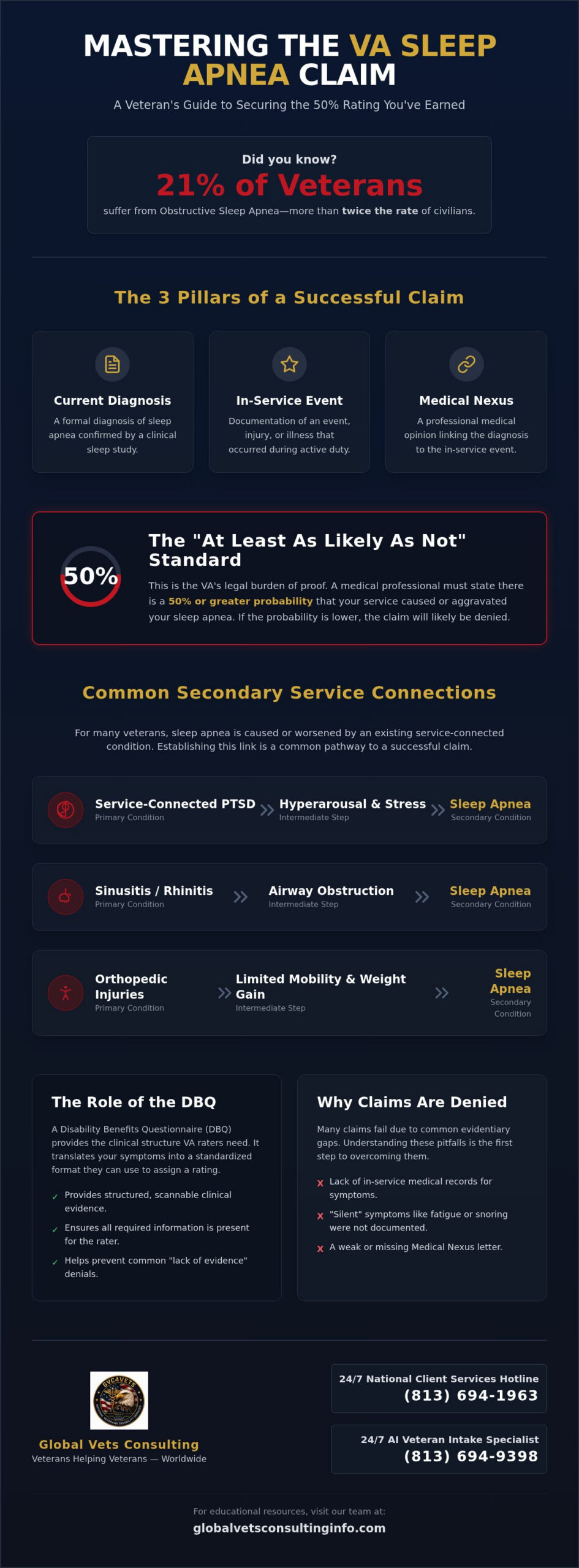
A successful claim relies on three essential pillars:
- Current Diagnosis: A formal diagnosis confirmed by a clinical sleep study.
- In-Service Event: Documentation of an event, injury, or illness that occurred during active duty.
- Medical Nexus: A professional medical opinion linking the diagnosis to the in-service event.
To meet the VA’s requirements, your evidence must satisfy the “at least as likely as not” legal standard. This means a medical professional concludes there’s a 50% or greater probability that your service caused or aggravated your sleep apnea. If the probability falls below this 50% threshold, the claim will likely be denied. It’s vital to ensure your medical evidence uses this specific VA-ready language.
Direct vs. Secondary Service Connection
- Direct Connection: This applies if your symptoms or official diagnosis began while you were still on active duty.
- Secondary Connection: This is common for veterans whose sleep apnea is caused or worsened by an existing service-connected condition.
Why Sleep Apnea Claims are Often Denied
Many veterans face denials due to common evidentiary gaps in their files:
- Lack of in-service medical records because symptoms weren’t reported to a medic or doctor.
- “Silent” symptoms, such as chronic fatigue or snoring, that weren’t documented while in uniform.
- Failure to provide a strong Sleep Apnea Nexus that connects post-service diagnosis to military stressors.
Secondary Service Connection: Common Pathways for Sleep Apnea
Many veterans find that their sleep apnea isn’t an isolated issue but rather a consequence of other service-connected disabilities. Establishing a Sleep Apnea Nexus often involves identifying these secondary pathways. One common “intermediate step” is weight gain. When a veteran suffers from service-connected orthopedic injuries, limited mobility often leads to weight gain, which is a primary risk factor for OSA. Additionally, medications used to treat mental health or physical pain can relax throat muscles or cause weight fluctuations, further contributing to sleep disorders. This complex web of symptoms requires a clear medical rationale to prove the connection to the VA.
The PTSD and Sleep Apnea Link
There’s a strong medical correlation between mental health conditions and sleep disturbances. According to the authoritative definition of sleep apnea, the condition involves repeated interruptions in breathing. For veterans with PTSD, hyperarousal and sleep fragmentation can worsen these interruptions. Peer-reviewed literature supports this psychiatric-respiratory connection, showing that the physiological stress of PTSD can directly impact respiratory stability during sleep. This creates a solid foundation for a secondary Sleep Apnea Nexus when your doctor explains how one condition aggravates the other.
Respiratory Synergy: Sinusitis and Rhinitis
Service-connected respiratory conditions like sinusitis and rhinitis frequently act as a catalyst for OSA. Upper airway obstruction from chronic inflammation or allergies makes it harder to breathe, directly increasing the severity of sleep apnea. In 2026, the VA places significant emphasis on documenting how these existing conditions “aggravate” sleep apnea symptoms. If you’re struggling to link these conditions, exploring secondary VA claims education can help you understand how to document this medical synergy effectively. Proper documentation ensures the VA understands the full scope of your respiratory health.
The Role of DBQs in Proving Your Sleep Apnea Nexus
While a nexus letter explains the medical link, Disability Benefits Questionnaires (DBQ) provide the clinical structure VA raters use to assign your percentage. These forms translate your symptoms into a standardized format. Accurate documentation in a DBQ prevents the common “lack of evidence” denial by checking every box the rater requires. It ensures that your functional impairment and medical history are presented with precision, leaving no room for bureaucratic guesswork.
What the VA Looks for in a Sleep Apnea DBQ
A formal sleep study, or polysomnography, is the foundational evidence required for any successful Sleep Apnea Nexus. Without it, the claim won’t move forward. The DBQ must specifically document the requirement for a CPAP or other breathing assistance device to secure a 50% rating. Raters look for clear confirmation that the device is medically necessary for your treatment. If this detail is missing or vague, you risk a lower rating despite the severity of your condition.
Independent Medical Evidence vs. C&P Exams
Relying solely on a standard C&P examination can be risky. These exams are often brief and may overlook the nuances of your service history. Preparing your own evidence package prevents denials before they happen. A professional medical opinion using VA-ready language provides a level of depth that a contractor exam rarely matches. When you submit independent evidence, you’re taking control of the narrative. If you’re ready to strengthen your file, our Sleep Apnea Claims Education resources can guide you through the process of gathering meticulous documentation.
Global Vets: Veterans Helping Veterans Navigate the Nexus 🌐
Global Vets Consulting is a mission-driven, veteran-owned organization dedicated to supporting our community since 2021. 🇺🇸 We operate on a “Veterans Helping Veterans” ethos, ensuring every client receives guidance from peers who have navigated the same challenges. The complexity of the VA disability claims process often leads to frustration, but our educational resources empower you to understand the requirements for a Sleep Apnea Nexus. We prioritize technical accuracy and transparency to reduce the anxiety often associated with these bureaucratic systems. Our approach is a partnership designed to provide you with a predictable path forward.
Our Approach to Sleep Apnea Evidence
We specialize in streamlining the collection of medical evidence and DBQs for rating increases. Our approach ensures that your Sleep Apnea Nexus is supported by meticulous documentation that meets current 2026 VA standards. We provide the educational tools necessary to bridge the gap between your diagnosis and your military service record. By focusing on standardized, high-quality evidence, we help you present a case that is difficult for raters to ignore. We don’t just provide forms; we offer a steady guide through the entire administrative process.
Take the Next Step in Your Claim Journey
Securing the benefits you earned is a mission we take seriously, and we are ready to assist you worldwide. 🇺🇸 We offer round-the-clock support through our 24/7 National Client Services Hotline 📞 and our 24/7 AI Veteran Intake Specialist. Don’t let a lack of information or complex paperwork delay the compensation you deserve for your service. Visit GlobalVetsConsultingInfo.com 🌐 to access our specialized sleep apnea claims education and take the next step in your claim journey today. We are committed to your well-being and the successful outcome of your VA rating increase.
Secure the VA Rating You Deserve
Establishing a Sleep Apnea Nexus is the most critical step in transforming a medical diagnosis into a successful VA disability claim. By identifying the correct secondary pathways and ensuring your DBQs are completed with clinical precision, you remove the guesswork from the rater’s desk. You’ve served your country with honor, and you shouldn’t have to navigate this bureaucratic maze alone. Global Vets Consulting is veteran-owned and operated, providing the specialized sleep apnea claims education you need to move forward with confidence. Our 24/7 AI Veteran Intake Specialist is available around the clock to start your journey. Don’t let a “lack of evidence” denial stand in your way. Contact Global Vets Consulting for Professional DBQ Support 🌐 to get the expert guidance you’ve earned. You’ve got the mission; we’ve got the map.
Frequently Asked Questions
How do I prove my sleep apnea is service-connected if I wasn’t diagnosed while on active duty?
You can establish service connection by filing a secondary claim or proving the condition was caused by an in-service event. A strong Sleep Apnea Nexus is required to bridge the gap between your current diagnosis and your service history. This often involves documenting symptoms that were present during service or showing how an existing service-connected condition, like a respiratory issue, led to your sleep apnea years after discharge.
Can I claim sleep apnea secondary to my service-connected PTSD?
Yes, you can claim sleep apnea as secondary to PTSD because medical literature supports a link between psychiatric conditions and respiratory disorders. The hyperarousal and sleep fragmentation associated with PTSD often aggravate sleep apnea symptoms. You’ll need a medical professional to provide a rationale explaining how your PTSD “at least as likely as not” caused or worsened your sleep apnea to satisfy the VA’s requirements for a secondary connection.
What medical evidence is required for a 50% sleep apnea VA rating?
To receive a 50% rating, the VA requires a formal diagnosis via a sleep study and documented medical necessity for a breathing assistance device. This usually means you must be prescribed a CPAP or BiPAP machine. Without a sleep study and a clear prescription for a device, the VA will likely assign a lower rating, such as 30% for persistent daytime sleepiness or 0% for an asymptomatic diagnosis.
Does the VA accept private DBQs for sleep apnea claims in 2026?
The VA continues to accept private Disability Benefits Questionnaires (DBQs) in 2026 as valid medical evidence for sleep apnea claims. These forms are essential because they provide the standardized data raters use to evaluate the severity of your condition. Using a private DBQ allows you to submit thorough, meticulous evidence from a provider who understands your history, which can often be more comprehensive than a standard contractor-led C&P examination.
What happens if my sleep apnea claim is denied for lack of a nexus?
If your claim is denied due to a missing Sleep Apnea Nexus, you can file a Supplemental Claim with new and relevant evidence. This usually involves obtaining an independent medical opinion that provides a stronger rationale linking your condition to your service. Reviewing your file for “silent” symptoms or identifying secondary pathways you may have missed is a critical step in overcoming a nexus-related denial and securing your earned benefits.

Article by
Willie Daniel
Willie Daniel is the Founder and Chief Executive Officer (CEO) of Global Vets Consulting (GVC4Vets) – National Veterans Disability Services, a veteran-led educational and medical evidence support organization dedicated to helping veterans better understand VA disability rating increases, DBQ medical evidence, secondary claims education, and C&P examination preparation.
He is a retired U.S. Army Medical Service Corps Officer with more than 27 years of honorable military service, a decorated Iraq combat veteran, and a retired federal official with the U.S. Department of Veterans Affairs. Throughout his military and federal career, Willie Daniel served in leadership, healthcare administration, operational, and veteran-support roles focused on improving services and support systems for servicemembers, veterans, and their families.
Drawing from decades of military leadership, healthcare administration, veteran advocacy, and federal government experience, Willie Daniel brings a practical, veteran-centered perspective to Global Vets Consulting’s educational articles, AI-powered veteran resources, video education initiatives, and outreach programs. His experience navigating military systems, medical documentation processes, and veteran-related administrative operations provides valuable insight into many of the challenges veterans face when seeking to better understand VA disability rating criteria, medical evidence, documentation strategies, and secondary condition education.
Through GVC’s “Veterans Helping Veterans” mission, his focus is on delivering clear, educational, and easy-to-understand information designed to empower veterans with knowledge, resources, and educational tools that may help them make more informed decisions regarding their individual VA disability journeys.
The information provided through GVC is intended for educational and informational purposes only and should not be considered legal or medical advice.
Disclaimer
Disclaimer: Global Vets Consulting, LLC (“GVC”) is a veteran-led educational and medical evidence support organization. GVC is not a law firm, is not a Veterans Service Organization (VSO), and is not affiliated with the U.S. Department of Veterans Affairs (VA) or any government agency.
Global Vets Consulting does not provide legal advice, medical advice, medical treatment, or healthcare services. GVC does not prepare, file, or submit VA disability claims on behalf of veterans. All information provided through this website, blog articles, videos, educational materials, AI tools, dashboards, templates, and communications is intended solely for general educational and informational purposes.
Veterans are encouraged to consult with accredited representatives, licensed attorneys, qualified medical providers, or Veterans Service Organizations regarding their specific legal, medical, or VA-related matters. VA disability decisions, ratings, and outcomes are determined solely by the U.S. Department of Veterans Affairs based on applicable laws, regulations, medical evidence, and individual circumstances. Past results do not guarantee future outcomes.