
What if the most important part of your VA claim isn’t actually the doctor’s final verdict, but the specific medical reasoning they used to get there? Mastering the distinction of a medical rationale vs conclusion in a nexus letter can be the difference between a granted claim and a multi-year appeal 🇺🇸. You’ve likely spent hours worrying that a single technicality or a missing phrase could lead to a frustrating denial. It’s common to feel overwhelmed when trying to explain complex VA requirements to a private doctor who doesn’t speak the language of the bureaucracy.
You deserve a clear path forward that replaces this confusion with steady confidence and a sense of partnership. While a conclusion provides the legal “what,” the rationale provides the medical “why” that the VA demands for a successful service connection. In this guide, we’ll demystify the specific phrases required by current 2026 standards, such as the “at least as likely as not” threshold. You’ll learn how to ensure your medical evidence is meticulous and persuasive, giving you the tools to submit your claim with total certainty.
Key Takeaways
- Understand why a medical conclusion alone is often insufficient and how a detailed rationale provides the “bridge of evidence” the VA requires.
- Learn how to strengthen your claim by ensuring your medical professional cites peer-reviewed literature and your specific clinical history.
- Master the specific legal phrasing needed to meet the “at least as likely as not” threshold for a successful service connection.
- Secure your earned benefits by identifying the critical differences in rationale vs conclusion in a nexus letter before submitting your evidence.
Understanding Nexus Letter Essentials: Rationale vs. Conclusion 🇺🇸
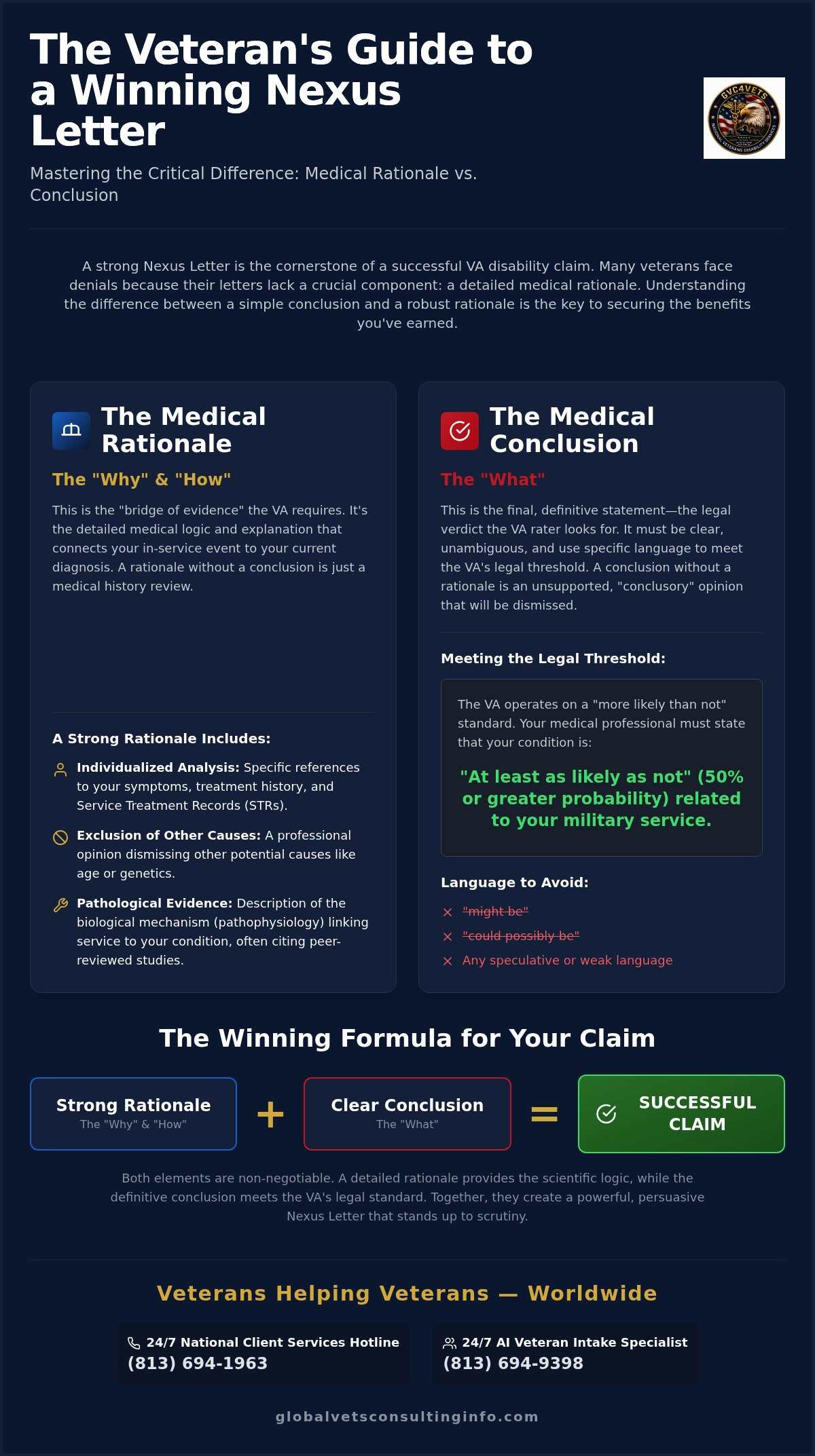
A nexus letter is the vital link between your military service and your current health challenges. Within this document, the conclusion serves as the final medical opinion. It’s the doctor’s definitive statement that your condition is service-connected. However, the rationale is the “how” and the “why.” It’s the medical logic that connects the dots between an in-service event and your diagnosis. Understanding the nuance of rationale vs conclusion in a nexus letter is essential. The Veterans Benefits Administration requires more than just a doctor’s signature; they require professional proof.
Many veterans face denials because their letters are labeled as “conclusory.” This happens when a doctor provides a conclusion but skips the detailed rationale. If a letter simply states a condition is related to service without explaining the underlying pathology or citing medical literature, the VA often views it as a weak, unsupported opinion. When evaluating the rationale vs conclusion in a nexus letter, the VA looks for a logical flow that justifies the rating you’ve earned. Following a VA disability claims process step by step guide helps you understand where this evidence fits into the larger hierarchy of documentation.
Why Both Elements are Non-Negotiable
You can’t have one without the other. A conclusion without a rationale is an “unsupported” opinion that raters will likely dismiss during the review. Conversely, a detailed rationale that doesn’t end with a clear legal conclusion fails to meet the specific nexus threshold required by law. Your doctor must provide a complete “bridge of evidence” that stands up to VA scrutiny. This ensures every claim has the weight of scientific logic behind it, moving you closer to a successful outcome.
The Medical Rationale: Building the ‘Bridge of Evidence’
A successful claim requires more than a doctor’s signature. Medical rationale is the logical link between service events and current diagnoses. While the conclusion states the “what,” the rationale explains the “how” by using your clinical history and medical literature. A doctor must describe the pathophysiology, or the biological mechanism, demonstrating how your military service directly caused your current impairment. This level of detail is often what separates an approval from a denial during a VA Claim Exam (C&P Exam).
Clinicians build this bridge by citing peer-reviewed studies that prove a known link between specific service conditions and secondary issues. They must also review your Service Treatment Records (STRs) to ensure the evidence is grounded in your actual military history. Understanding the balance of rationale vs conclusion in a nexus letter prevents the VA from dismissing your evidence as mere speculation. If you need help organizing your records, you can explore our educational resources to get started.
What a Strong Rationale Looks Like
A strong rationale is highly individualized. It applies medical facts to your unique journey rather than relying on templates. To be effective, it should include:
- Individualized Analysis: Specific references to your symptoms and treatment dates.
- Exclusion of Other Factors: Explanations that dismiss age or genetics as the primary cause.
- Pathological Evidence: Clear descriptions of how the condition developed over time.
Connecting DBQs to Your Rationale
Using a what is a dbq guide helps you see how standardized forms document the severity of your symptoms. When your rationale is paired with a Disability Benefits Questionnaire, the medical logic follows a structure that VA raters already trust. This combination ensures your evidence is both technically accurate and easy for the bureaucracy to process.
The Medical Conclusion: Meeting the VA’s Legal Threshold
Your nexus letter must culminate in a definitive judgment that leaves no room for ambiguity. While the rationale provides the medical “why,” the conclusion is the legal “what” that triggers your benefits. If a medical provider uses speculative language like “might be” or “could be,” the VA will categorize the opinion as weak or speculative. This often results in a swift denial. When you understand the balance of rationale vs conclusion in a nexus letter, you can better guide your doctor toward the specific language the VA requires. Raters look for a clear, definitive statement that meets the specific legal threshold for service connection.
A strong conclusion is especially critical when submitting a dbq for va disability rating increase. It ensures that the evidence of your worsening condition is legally anchored to your initial service-connected disability. Without this final, authoritative stamp, the most detailed medical logic remains just a theory in the eyes of the bureaucracy. You’ve earned these benefits through your service; don’t let a vague ending stall your progress. Connect with our team to learn more about meticulous documentation.
The ‘At Least As Likely As Not’ Language
The VA operates on four distinct tiers of probability when evaluating medical opinions. These range from “is due to” (100% certainty) to “is not likely” (less than 50% certainty). The phrase “at least as likely as not” represents a 50% or greater probability. It’s the veteran’s best friend in a tie-break situation. Under VA rules, if the evidence for and against a claim is equal, the rater must give the benefit of the doubt to the veteran. Using this exact phrasing ensures your claim meets the minimum legal standard required for approval.
Winning Your Claim: Combining Rationale and Conclusion 🌎
To win your VA disability claim, you must ensure your documentation follows the “Golden Thread” strategy. This means your medical rationale must lead naturally and undeniably to your final conclusion. When evaluating the rationale vs conclusion in a nexus letter, raters look for a seamless narrative where the medical facts support the legal standard. If there’s a disconnect, the rater may view the evidence as contradictory or insufficient. Your goal is to present a unified front that leaves no room for doubt.
Before you submit your evidence, take a moment to review your doctor’s letter against this final checklist:
- Current Diagnosis: Is the medical condition clearly identified and medically coded?
- In-Service Event: Does it cite a specific injury, illness, or event from your service records?
- The Nexus: Does it combine a detailed rationale with a definitive conclusion?
- Record Review: Does the doctor explicitly state they reviewed your entire C-File?
If your va claim was denied for lack of evidence, don’t lose hope. This often happens because the nexus was missing one of these four pillars or lacked a clear link between them. You can always strengthen your evidence and resubmit.
Avoiding Common Evidence Gaps
A frequent pitfall is a doctor writing a letter without reviewing your entire C-File. VA raters prioritize opinions from professionals who have seen the full scope of your military and medical history. Additionally, your medical rationale shouldn’t contradict the findings in your dbq for mental health conditions or other physical DBQs. Consistency across all forms is vital. When the rationale vs conclusion in a nexus letter aligns with your DBQ findings, you present a meticulous case. This structured approach provides the clarity you need to secure the rating you’ve earned through your service.
Secure Your Earned Benefits with Meticulous Evidence 🇺🇸
Mastering the nuance of rationale vs conclusion in a nexus letter is your most powerful tool for navigating the complex VA claims system. You now understand that while a conclusion meets the legal threshold, it’s the medical rationale that proves your case through clinical logic and peer-reviewed literature. By ensuring your documentation includes a clear diagnosis, a specific service event, and the “at least as likely as not” threshold, you significantly reduce the risk of a technical denial. Meticulous evidence is the key to turning a “maybe” into a “granted.”
Ready to secure the evidence you need? Connect with Global Vets Consulting for DBQ Education today! Our veteran-owned firm provides expert national support for all VA disability types. You can get started anytime with our 24/7 AI Veteran Intake Specialist to ensure your documentation stands up to scrutiny. You served our country with honor and duty. We’re here to stand by you as a reliable ally until you receive the benefits you’ve earned.
Frequently Asked Questions
What happens if my nexus letter has a conclusion but no rationale?
If your letter contains a conclusion without a supporting rationale, the VA will likely label the opinion as “conclusory” and dismiss it as weak evidence. Raters need to see the medical logic that explains why the doctor reached that specific decision. Without this “why,” the letter lacks the probative value required to establish service connection. This often leads to a denial because the rater can’t verify the professional reasoning behind the claim.
Can a DBQ serve as both a rationale and a conclusion for my VA claim?
A Disability Benefits Questionnaire (DBQ) primarily documents the severity of your symptoms rather than providing a full medical nexus. While some DBQs include a section for a medical opinion, they often lack the space for a detailed rationale vs conclusion in a nexus letter. It’s best to use a DBQ to show symptom severity and a separate nexus letter to provide the deep medical logic and peer-reviewed literature citations.
Is ‘at least as likely as not’ the only phrase the VA accepts for a conclusion?
No, the VA recognizes several tiers of probability, but “at least as likely as not” is the standard 50% threshold for approval. Other phrases include “is due to” for 100% certainty or “is likely due to” for greater than 50% probability. You should avoid phrases like “could be” or “may be” because they’re considered speculative. Using the standard 50% phrasing ensures you meet the minimum legal requirement for your claim.
How much medical literature should be included in a strong nexus rationale?
A strong rationale doesn’t need dozens of pages, but it should cite at least two or three relevant, peer-reviewed medical studies. These citations provide objective evidence that your condition is medically linked to your service events. Quality is more important than quantity. The doctor should specifically explain how the findings in the literature apply to your unique clinical history and the rationale vs conclusion in a nexus letter you’ve submitted.
What is the difference between a secondary nexus and a direct service connection nexus?
A direct service connection nexus links a current disability to a specific event that happened during your active duty service. A secondary nexus connects a new condition to an existing service-connected disability. For example, if your service-connected knee injury causes a back condition, that’s a secondary nexus. Both require a clear medical rationale and a definitive conclusion to prove the relationship between the two conditions to the VA.

Article by
Willie Daniel
Willie Daniel is the Founder and Chief Executive Officer (CEO) of Global Vets Consulting (GVC4Vets) – National Veterans Disability Services, a veteran-led educational and medical evidence support organization dedicated to helping veterans better understand VA disability rating increases, DBQ medical evidence, secondary claims education, and C&P examination preparation.
He is a retired U.S. Army Medical Service Corps Officer with more than 27 years of honorable military service, a decorated Iraq combat veteran, and a retired federal official with the U.S. Department of Veterans Affairs. Throughout his military and federal career, Willie Daniel served in leadership, healthcare administration, operational, and veteran-support roles focused on improving services and support systems for servicemembers, veterans, and their families.
Drawing from decades of military leadership, healthcare administration, veteran advocacy, and federal government experience, Willie Daniel brings a practical, veteran-centered perspective to Global Vets Consulting’s educational articles, AI-powered veteran resources, video education initiatives, and outreach programs. His experience navigating military systems, medical documentation processes, and veteran-related administrative operations provides valuable insight into many of the challenges veterans face when seeking to better understand VA disability rating criteria, medical evidence, documentation strategies, and secondary condition education.
Through GVC’s “Veterans Helping Veterans” mission, his focus is on delivering clear, educational, and easy-to-understand information designed to empower veterans with knowledge, resources, and educational tools that may help them make more informed decisions regarding their individual VA disability journeys.
The information provided through GVC is intended for educational and informational purposes only and should not be considered legal or medical advice.
Disclaimer
Disclaimer: Global Vets Consulting, LLC (“GVC”) is a veteran-led educational and medical evidence support organization. GVC is not a law firm, is not a Veterans Service Organization (VSO), and is not affiliated with the U.S. Department of Veterans Affairs (VA) or any government agency.
Global Vets Consulting does not provide legal advice, medical advice, medical treatment, or healthcare services. GVC does not prepare, file, or submit VA disability claims on behalf of veterans. All information provided through this website, blog articles, videos, educational materials, AI tools, dashboards, templates, and communications is intended solely for general educational and informational purposes.
Veterans are encouraged to consult with accredited representatives, licensed attorneys, qualified medical providers, or Veterans Service Organizations regarding their specific legal, medical, or VA-related matters. VA disability decisions, ratings, and outcomes are determined solely by the U.S. Department of Veterans Affairs based on applicable laws, regulations, medical evidence, and individual circumstances. Past results do not guarantee future outcomes.