
Have you ever wondered why the VA denies a claim even when your symptoms are clearly documented in your service records? It’s common to feel anxious about C&P examiners overlooking the reality of your condition, especially with 2026 regulations like the update to 38 CFR 4.10 regarding medication impact. Mastering the art of citing medical literature in a va claim is the most effective way to bridge the gap between your personal history and the clinical proof the VA requires for a successful rating increase. 🇺🇸
We’ll walk you through a clear framework for finding peer-reviewed studies and building a professional-looking claim package that’s difficult for any rater to ignore. You deserve a rating that reflects your actual functional impairment, not just a snapshot from a brief exam. By the end of this guide, you’ll have the tools to turn complex medical jargon into a powerful argument for the benefits you’ve earned and the peace of mind you deserve.
Key Takeaways
- Understand how peer-reviewed journals provide the objective clinical data needed to establish a nexus and overcome unfavorable C&P exam results.
- Learn the specific search strategies for citing medical literature in a va claim using the PubMed database to find evidence that supports your service connection.
- Follow a step-by-step process for summarizing your research on VA Form 21-4138 so the rater sees a clear link between your symptoms and the science.
- Discover how to integrate your medical evidence into Disability Benefits Questionnaires (DBQs) to help your doctor provide a more professional and persuasive medical opinion.
The Importance of Medical Literature in Establishing a VA Nexus
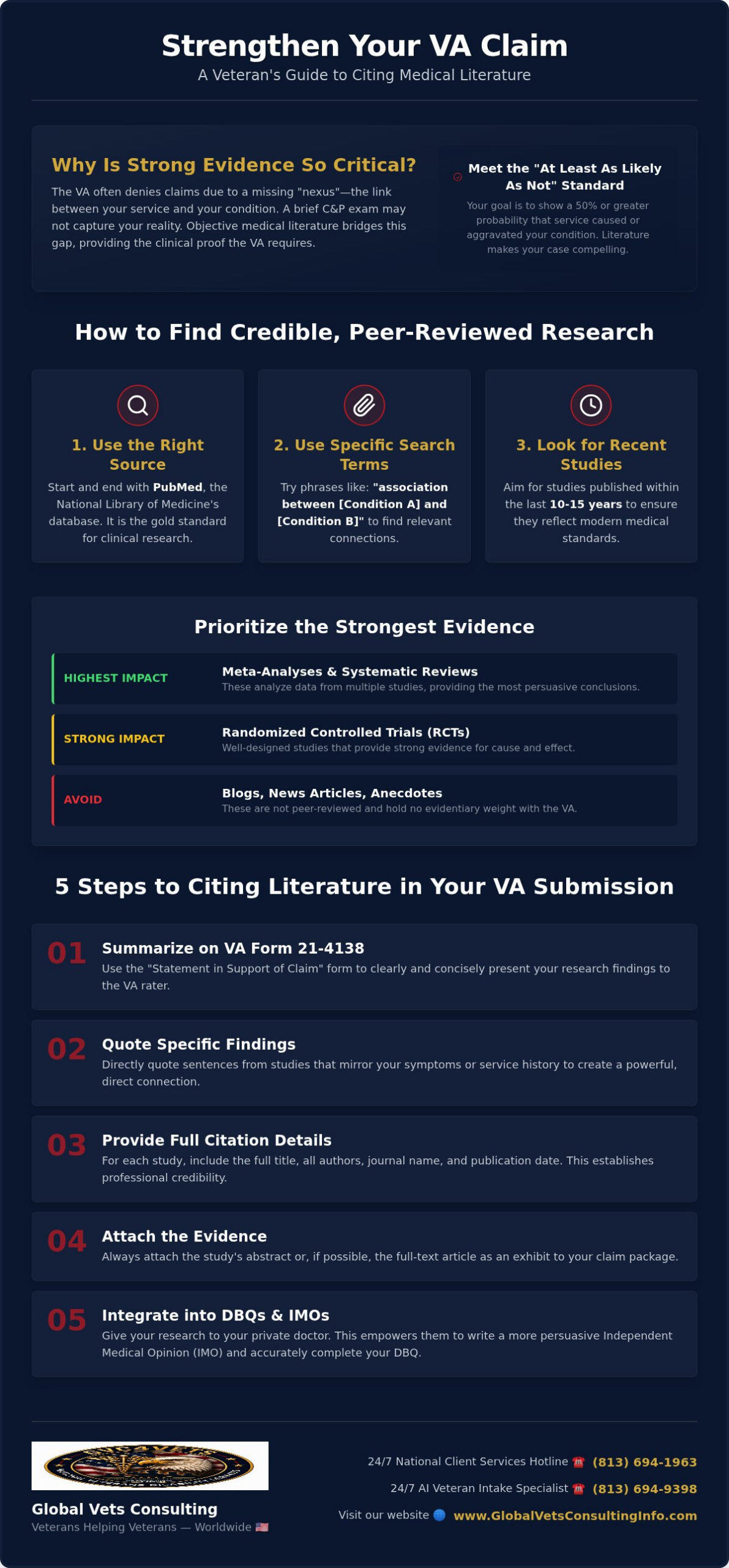
Medical literature consists of peer-reviewed journals and clinical studies that provide scientific proof for your claim. When you’re citing medical literature in a va claim, you’re building a “nexus,” or a direct link between your service and your current disability. This is vital because the Veterans Benefits Administration (VBA) is required to evaluate all relevant evidence you submit. If a C&P examiner gives a negative opinion, objective clinical data can serve as a powerful counter-argument.
Research helps you meet the “at least as likely as not” standard. This means there is a 50% or greater probability that your service caused or aggravated your condition. You’ll find this evidence most helpful for secondary conditions, rare diseases, or filling gaps in presumptive service connections. It turns a medical theory into a clinically supported fact. 🇺🇸
Bridging the Gap Between Service and Diagnosis
Literature allows you to prove that Condition A, which is already service-connected, is medically known to cause Condition B. For example, if you have service-connected PTSD and develop migraines, research can show the physiological link. This approach is essential if your va claim denied for lack of evidence in the past. It provides the “missing link” that personal statements alone cannot provide.
The Evidentiary Weight of Clinical Research
The VA must consider medical treatises as part of the evidentiary record. Clinical research provides a solid foundation for your private doctor when they draft an Independent Medical Opinion (IMO). By citing medical literature in a va claim, you give your physician the tools to write a more persuasive letter that aligns with modern medical standards. This meticulousness makes your claim package much harder for the VA to dismiss. It ensures your evidence meets the professional scrutiny required for a rating increase.
How to Find Credible Peer-Reviewed Research for Your Claim
Finding the right evidence requires a structured approach. You shouldn’t rely on general search engine results that might lead to biased or outdated information. Instead, turn to PubMed. This database is managed by the National Library of Medicine and represents the gold standard for clinical research. When you’re citing medical literature in a va claim, the quality of your source determines how much weight the VA rater gives your evidence.
Start by using specific search terms. Phrases like “association between [Condition A] and [Condition B]” or “prevalence of [Condition] in veterans” often yield the most relevant results. Aim for studies published within the last 10 to 15 years. This ensures the data reflects modern medical understanding and current diagnostic standards. When citing medical literature in a va claim, you should always look for “Full Text” available articles. Having the complete study on hand allows you to provide the entire document to the VA if they request more than just an abstract.
Evaluating the Hierarchy of Evidence
Not all studies carry the same weight. You should prioritize Meta-Analyses and Systematic Reviews. These documents analyze data from multiple individual studies to provide a more comprehensive conclusion. They are far more persuasive than single case studies, which only look at one patient. Always verify the peer-review status of a journal. This confirms that other medical experts have vetted the research before publication.
Avoiding Junk Science and Non-Credible Sources
The VA generally disregards blog posts, news articles, and anecdotal stories. These aren’t considered legitimate medical literature. Stick to reputable journals like JAMA, The Lancet, or the New England Journal of Medicine. If you’re feeling overwhelmed by the research process, you can explore educational resources for gathering medical evidence to help streamline your claim package. Focus on professional, clinical data to build a foundation that’s hard to deny. 🇺🇸
Step-by-Step Guide to Citing Literature in Your VA Submission
Once you’ve gathered your research, you must present it in a way that a VA rater can easily digest. Use a Statement in Support of Claim (VA Form 21-4138) to summarize your findings. Citing medical literature in a va claim is most effective when you quote specific findings that mirror your own service history or symptoms. For every citation, include the full title, all listed authors, the journal name, and the publication date. This level of detail establishes your claim’s professional credibility. Always attach the study abstract or the full text as an exhibit to your claim package. 🇺🇸
Drafting the ‘Medical Abstract’ Summary
You don’t need to be a doctor to summarize research effectively. Write a concise sentence such as: “According to [Study Name], there is a statistically significant link between [X] and [Y].” It’s vital to explain how the study’s participants match your own situation. If the study focuses on veterans with specific toxic exposures or injuries similar to yours, highlight those parallels clearly. This helps the rater see that the science applies directly to your life.
Connecting the Dots for the VA Rater
Don’t assume the rater will automatically understand the medical significance of a study. You must explain why citing medical literature in a va claim matters for your specific va disability claims process. Highlight the specific page or paragraph in the study that supports your nexus. If you find the documentation process overwhelming, you can access our educational resources on gathering medical evidence to ensure your package is hard to deny. Providing a clear roadmap through the literature reduces the chance of a summary denial based on a lack of evidence.
Integrating Medical Evidence into Your DBQ and Independent Medical Opinions
You shouldn’t walk into a medical appointment empty-handed. Providing your researched literature to your private doctor before they fill out your Disability Benefits Questionnaire (DBQ) ensures their opinion is grounded in current science. When you’re citing medical literature in a va claim, you empower your provider to write a more persuasive Nexus Letter. This methodical approach transforms a simple medical checkup into a strategic evidence-gathering session. 🇺🇸
The Power of a Professional DBQ
Understanding what is a dbq for va claims is essential because it serves as the primary vessel for your medical evidence. A rater can easily dismiss a veteran’s personal statement, but they cannot ignore a properly cited DBQ from a licensed professional. Peer-reviewed research adds a layer of objective clinical data that lay evidence simply cannot match. It forces the VA to address the scientific consensus regarding your condition.
Collaborating with Your Medical Provider
Start the conversation with your doctor by asking: “Does the current medical literature support a link in my case?” Encourage them to reference specific studies in the “Remarks” section of the DBQ. If an examiner is skeptical during a C&P exam, having these citations ready allows you to present a professional defense of your symptoms. Global Vets Consulting can help educate you on gathering this independent medical evidence to strengthen your case for a VA rating increase. By documenting the progression of your condition through literature, you build a clear path toward the benefits you’ve earned. Citing medical literature in a va claim is the difference between a denied claim and a successful outcome.
Take Control of Your VA Claim Evidence
Mastering the process of citing medical literature in a va claim is one of the most effective ways to secure the rating you deserve. By identifying high-quality research and integrating it directly into your Disability Benefits Questionnaires (DBQs), you provide the clinical proof necessary to establish a clear nexus. This methodical approach ensures your claim is grounded in scientific fact rather than just personal testimony, making it significantly harder for the VA to deny your service connection.
You don’t have to navigate this complex bureaucratic system alone. Global Vets Consulting offers veteran-owned expertise and specialized DBQ documentation support to help you build a professional evidence package. Our team is dedicated to helping you gather independent medical evidence that accurately reflects your functional impairment. Ready to strengthen your claim? Contact Global Vets Consulting today for expert DBQ education and support! 🌎
Call our 24/7 National Client Services Hotline to get started. You’ve earned these benefits; it’s time to secure them with confidence. 🇺🇸
Frequently Asked Questions
Can I submit medical studies to the VA myself without a doctor?
Yes, you can submit medical literature as lay evidence using VA Form 21-4138. However, the weight of this evidence increases significantly when a medical professional reviews it and incorporates it into a Disability Benefits Questionnaire (DBQ) or Nexus Letter. While you can search for the data yourself, having a doctor confirm that the study applies to your specific clinical presentation makes the evidence much harder for the VA to dismiss.
What is the best website to find medical journals for VA claims?
PubMed is the premier resource for finding credible, peer-reviewed medical journals. It is managed by the National Library of Medicine and offers a massive database of clinical trials and systematic reviews. When citing medical literature in a va claim, prioritize journals with high reputations like JAMA or The Lancet. You should search for studies involving veteran populations or specific environmental exposures to ensure the research is relevant to your service history.
Does the VA rater actually read the medical literature I provide?
The VA is legally required to consider all relevant evidence submitted in support of a claim. While a rater may not read a long study in its entirety, they will review your summary and the specific passages you highlight. This is why you should use a Statement in Support of Claim to point out the exact findings that support your nexus. Providing a clear roadmap ensures the rater understands your condition’s scientific basis.
How many medical studies should I cite in my VA claim?
Quality is always more important than quantity when citing medical literature in a va claim. Aim for two to three high-impact studies, such as meta-analyses or systematic reviews, rather than dozens of single case reports. Overwhelming a rater with too much data can lead to confusion. Focus on the most recent research from the last fifteen years that clearly demonstrates a statistically significant link between your service-connected injury and your current secondary condition.

Article by
Willie Daniel
Willie Daniel is the Founder and Chief Executive Officer (CEO) of Global Vets Consulting (GVC4Vets) – National Veterans Disability Services, a veteran-led educational and medical evidence support organization dedicated to helping veterans better understand VA disability rating increases, DBQ medical evidence, secondary claims education, and C&P examination preparation.
He is a retired U.S. Army Medical Service Corps Officer with more than 27 years of honorable military service, a decorated Iraq combat veteran, and a retired federal official with the U.S. Department of Veterans Affairs. Throughout his military and federal career, Willie Daniel served in leadership, healthcare administration, operational, and veteran-support roles focused on improving services and support systems for servicemembers, veterans, and their families.
Drawing from decades of military leadership, healthcare administration, veteran advocacy, and federal government experience, Willie Daniel brings a practical, veteran-centered perspective to Global Vets Consulting’s educational articles, AI-powered veteran resources, video education initiatives, and outreach programs. His experience navigating military systems, medical documentation processes, and veteran-related administrative operations provides valuable insight into many of the challenges veterans face when seeking to better understand VA disability rating criteria, medical evidence, documentation strategies, and secondary condition education.
Through GVC’s “Veterans Helping Veterans” mission, his focus is on delivering clear, educational, and easy-to-understand information designed to empower veterans with knowledge, resources, and educational tools that may help them make more informed decisions regarding their individual VA disability journeys.
The information provided through GVC is intended for educational and informational purposes only and should not be considered legal or medical advice.
Disclaimer
Disclaimer: Global Vets Consulting, LLC (“GVC”) is a veteran-led educational and medical evidence support organization. GVC is not a law firm, is not a Veterans Service Organization (VSO), and is not affiliated with the U.S. Department of Veterans Affairs (VA) or any government agency.
Global Vets Consulting does not provide legal advice, medical advice, medical treatment, or healthcare services. GVC does not prepare, file, or submit VA disability claims on behalf of veterans. All information provided through this website, blog articles, videos, educational materials, AI tools, dashboards, templates, and communications is intended solely for general educational and informational purposes.
Veterans are encouraged to consult with accredited representatives, licensed attorneys, qualified medical providers, or Veterans Service Organizations regarding their specific legal, medical, or VA-related matters. VA disability decisions, ratings, and outcomes are determined solely by the U.S. Department of Veterans Affairs based on applicable laws, regulations, medical evidence, and individual circumstances. Past results do not guarantee future outcomes.