

What if the CPAP machine you rely on every night is no longer enough to secure your 50% rating? Many veterans feel a sense of dread as the landscape for Sleep Apnea VA Compensation shifts under the 2026 rating schedule. It’s difficult to keep track of proposed versus active rules; the fear of losing benefits you’ve already earned is a heavy burden to carry. You’ve served your country with honor, and you shouldn’t have to struggle with a system that feels like it’s moving the goalposts. 🇺🇸
This guide will help you understand the new criteria and show how medical evidence like DBQs can secure the compensation you deserve. We’ll preview exactly how the VA evaluates sleep apnea severity today, explain how secondary service connections can boost your claim, and provide clear steps for gathering bulletproof evidence. By the end, you’ll have a predictable path forward to protect your rating and your peace of mind. Our goal is to ensure you feel informed and empowered throughout this process. 🌐
Key Takeaways
- Understand how the 2026 shift toward symptom-based evaluations affects your claim and how the grandfather clause secures your current rating.
- Learn the specific medical requirements for different levels of Sleep Apnea VA Compensation, from asymptomatic 0% ratings to chronic functional impairment.
- Discover how a private Disability Benefits Questionnaire (DBQ) provides the precise medical evidence necessary to accurately reflect your limitations. 🌐
- Identify strategic paths to a 100% rating by connecting sleep apnea to service-connected conditions like PTSD or depression. 🇺🇸
VA Rating for Sleep Apnea: The 2026 Landscape 🇺🇸
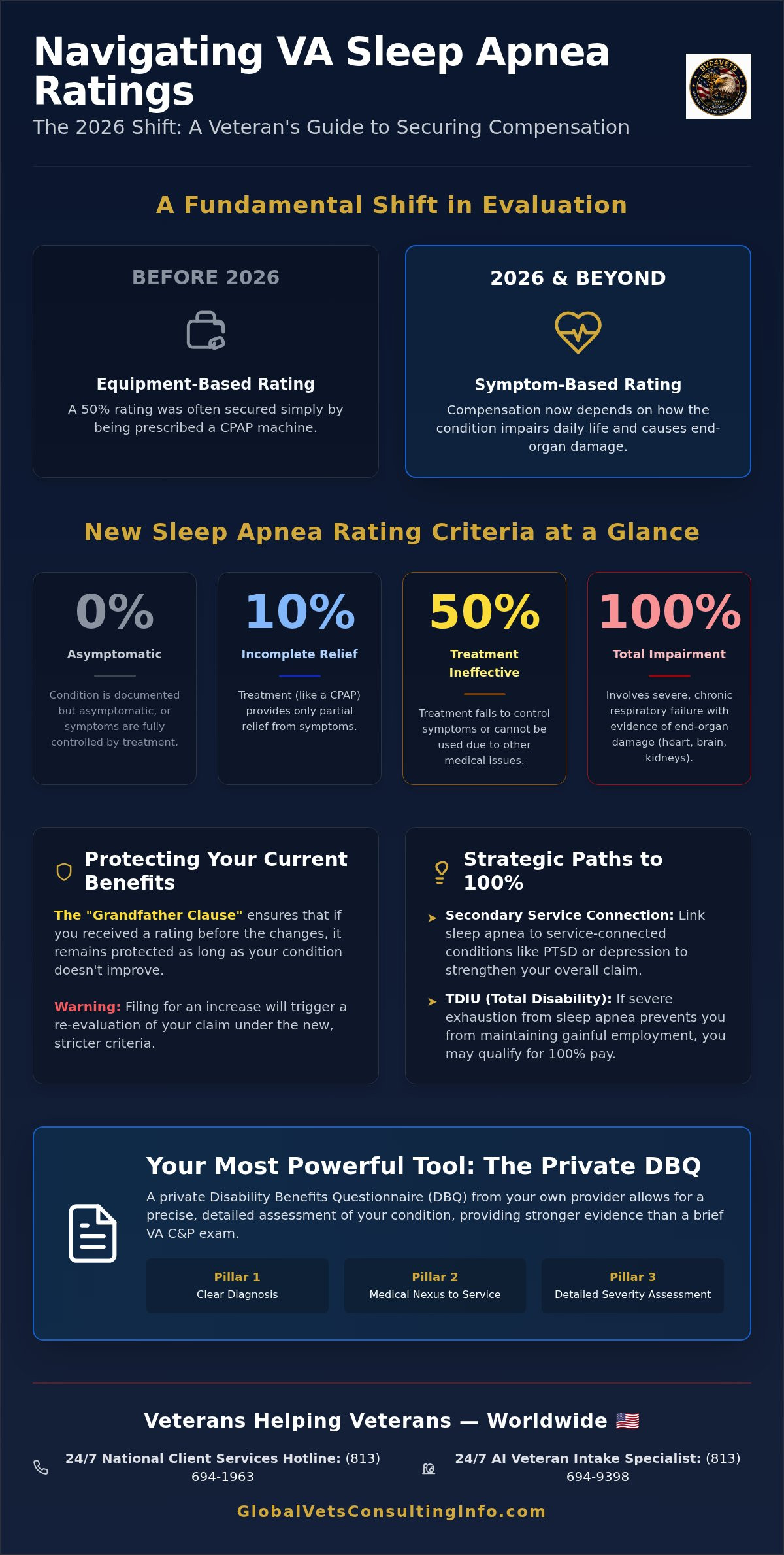
The year 2026 marks a significant turning point for how the VA evaluates respiratory conditions. For years, veterans could often secure a 50% rating simply by being prescribed a CPAP machine. Those days are over. The VA has transitioned from an equipment-based system to a symptom-based evaluation. This means your Sleep Apnea VA Compensation now depends on how the condition actually impairs your daily life, rather than the gear you use to manage it.
Before diving into the numbers, it helps to understand the basics of the condition. What is Sleep Apnea? It’s a serious disorder where breathing repeatedly stops and starts during sleep, leading to exhaustion and long-term health risks. Under the new rules, a diagnosis alone won’t guarantee a high rating. The VA now looks for evidence of chronic functional impairment or end-organ damage, such as heart or lung complications. 🌐
The 2026 Rating Schedule Explained
The new tiers prioritize medical outcomes over treatment methods. If your sleep apnea is fully controlled or you don’t show symptoms, the VA will likely assign a 0% rating. A 10% rating applies when treatment provides only incomplete relief. To reach the 50% or 100% levels, you must prove that treatment is ineffective or that the condition has caused severe secondary health issues. Documentation of “end-organ damage” is now the primary path to the highest compensation tiers.
Grandfathering and Protecting Your Benefits
Many veterans worry about losing their current benefits. If you received a rating before these changes took effect, you are generally protected by the “Grandfather Clause.” Your existing Sleep Apnea VA Compensation stays the same as long as your condition doesn’t improve. However, if you file for a VA rating increase in 2026, the VA will evaluate your entire claim under the new, stricter criteria. It’s vital to have meticulous medical evidence before reopening your file.
Sleep Apnea Rating Criteria: 0% to 100% Comparison
Understanding the specific tiers of Sleep Apnea VA Compensation is the first step in managing your expectations and your claim. Under the 2026 criteria, the VA assigns a 0% rating if your condition is documented but asymptomatic or fully controlled by treatment. If you experience incomplete relief despite using a CPAP or other device, you’ll likely qualify for a 10% rating. This is a major shift from previous years when any CPAP use often triggered a higher percentage. 🇺🇸
For higher ratings, the burden of proof increases. A 50% rating now requires evidence that your treatment is ineffective or that you cannot use it without risking organ damage. The 100% rating is reserved for total impairment involving end-organ damage to the heart, brain, or kidneys. You can find official information from the NIH regarding the severe long-term cardiovascular risks associated with untreated or poorly managed sleep disorders. If your symptoms persist, learning about Sleep Apnea Claims Education can help you document these failures effectively. 🌐
The ‘CPAP Rule’ Change
The “automatic” 50% rating for CPAP machines is a thing of the past. In 2026, simply owning the machine may only net you 10%. To reach the 50% level, you must document treatment failure or “compliance issues” caused by other service-connected conditions. If you can’t tolerate the mask due to physical or mental health limitations, that evidence must be clearly stated in your medical records.
Sleep Apnea and TDIU
Chronic daytime sleepiness can be debilitating. If your sleep apnea is so severe that you cannot maintain “gainful employment,” you might qualify for Total Disability Individual Unemployability (TDIU). This allows you to receive 100% pay even if your scheduled rating is lower. Proving that your exhaustion prevents you from working is a powerful strategic path to the benefits you’ve earned.
Proving Your Claim: The Power of a Private DBQ 🌐
Relying solely on a VA Compensation and Pension (C&P) exam is often a gamble. These appointments can be brief, and the examiner might not spend enough time reviewing your full medical history. A private Disability Benefits Questionnaire (DBQ) levels the playing field by allowing a provider to document the full scope of your condition with precision. To secure Sleep Apnea VA Compensation, your claim must stand on three pillars: a clear diagnosis, a medical nexus linking it to your service, and a detailed assessment of severity. You can learn more about this process in our guide, What is a DBQ? A Veteran’s Guide to Disability Benefits Questionnaires in 2026. 🇺🇸
Accurate documentation starts with identifying the right clinical indicators. Reviewing resources like the Mayo Clinic on sleep apnea symptoms can help you better articulate the exhaustion and gasping episodes you face daily. Proactive evidence prevents the “lack of evidence” denials that frequently frustrate veterans. By submitting a private DBQ, you ensure the VA sees a complete picture of your health before they even schedule a C&P exam.
Gathering Bulletproof Medical Evidence
Strong claims rely on recent, objective data. It’s vital to have a sleep study completed within the last 12 to 24 months to show your current status. Additionally, “Buddy Letters” from a spouse or roommate are invaluable. These statements provide eyewitness accounts of snoring and breathing cessations that a clinical setting might miss, adding a human element to your Sleep Apnea VA Compensation file.
Why Professional DBQ Support Matters
Every checkbox on a VA form must align with clinical findings to be considered valid by a rater. Global Vets Consulting focuses on education and resources to ensure your documentation is meticulous and accurate. We help you understand the administrative requirements so your evidence is organized and impactful. If you want to ensure your documentation accurately reflects your limitations, contact us for DBQ preparation education. 🌐
Secondary Service Connection: The Strategic Path to 100% 🇺🇸
Securing Sleep Apnea VA Compensation through a direct service connection is often a steep climb, particularly for those diagnosed years after leaving active duty. Most successful claims today utilize a secondary service connection strategy. This approach links your sleep apnea to an existing service-connected disability that either caused the condition or made it worse. By focusing on how your health issues interact, you can build a more comprehensive and persuasive case for the rater. 🌐
Mental health conditions are among the most common triggers for secondary claims. PTSD, depression, and anxiety can lead to sleep apnea through physiological changes or the side effects of necessary medications. If you’re already rated for a mental health disorder, exploring this link is a vital step. Our resource on DBQ for Mental Health Conditions: A Veteran’s Guide to VA Evidence in 2026 🇺🇸 provides specific insights into documenting these complex connections.
Common Secondary Connections for Sleep Apnea
- Rhinitis and Sinusitis: Under the PACT Act, many veterans now have service connection for chronic respiratory issues. These conditions often cause physical airway obstructions that lead directly to obstructive sleep apnea.
- Obesity as an Intermediate Step: While the VA doesn’t rate obesity as a standalone disability, it can serve as a “bridge.” For example, if a service-connected knee injury prevents exercise and leads to weight gain, which then causes sleep apnea, the connection is valid.
The Importance of a Medical Nexus Letter
The “Nexus” is the glue that holds a secondary claim together. A qualified medical professional must state that your sleep apnea is “at least as likely as not” caused or aggravated by your primary service-connected disability. This statement must be backed by clinical evidence and sound medical reasoning. Global Vets Consulting offers Secondary VA Claims Education to help you understand how to gather this critical evidence and present a clear, logical path to the benefits you’ve earned. 🇺🇸
Secure Your Earned Benefits Today 🇺🇸
The 2026 shift in rating criteria means you can’t rely on outdated strategies. You’ve learned that Sleep Apnea VA Compensation now depends on documenting functional impairment and end-organ damage rather than just showing a CPAP machine. By utilizing private medical evidence like a DBQ and exploring secondary service connections, you can effectively counter unfavorable C&P exams and bridge the gap to a higher rating.
Global Vets Consulting is here to support you in this journey. We’re a Veteran-Owned and Operated 🇺🇸 organization dedicated to your success. Whether you need a 24/7 AI Veteran Intake Specialist or Specialized Sleep Apnea Claims Education, our team provides the tools you need to build a bulletproof claim. You’ve served your country with honor; now let us help you secure the peace of mind you deserve.
Get Started with Your Sleep Apnea DBQ at Global Vets Consulting. You don’t have to face this complex system alone. 🌐
Frequently Asked Questions
Is sleep apnea a presumptive condition under the PACT Act in 2026?
No, sleep apnea isn’t currently a presumptive condition under the PACT Act. Veterans must still provide medical evidence to establish a service connection, often through a secondary claim or direct connection. Using professional Sleep Apnea Claims Education can help you understand how to document your symptoms correctly. Our team focuses on providing the resources you need to build a strong case for your Sleep Apnea VA Compensation.
Can I still get a 50% rating for sleep apnea if I use a CPAP machine?
Yes, under the current rating schedule, a veteran can receive a 50% rating if a CPAP machine is medically required for treatment. This rating depends on documented medical evidence showing the necessity of the device. If the VA updates its criteria in the future, having a thorough Disability Benefits Questionnaire (DBQ) becomes even more critical. We provide education on gathering the right evidence to support your Sleep Apnea VA Compensation 🇺🇸.
What happens to my current sleep apnea rating if the VA changes the rules?
If you already have a service-connected rating for sleep apnea, you’re generally protected by grandfathering rules. This means the VA typically won’t reduce your existing rating just because the evaluation criteria changed for new applicants. However, it’s vital to maintain updated medical documentation. We offer Veteran Benefits Education to help you navigate these transitions and ensure your records accurately reflect your current health status and limitations 🌐.
How do I link sleep apnea to my service-connected PTSD?
You can link sleep apnea to PTSD by filing a secondary VA claim supported by a medical nexus. This requires evidence showing that your mental health condition aggravates or causes your sleep disorder. Our Secondary VA Claims Education focuses on helping you understand the relationship between these conditions. Providing a detailed DBQ is a strategic way to present this connection clearly to the medical examiners during your review process.
What should I do if my sleep apnea claim was denied for lack of evidence?
If your claim was denied, you should review your denial letter to identify the specific evidence gaps. Often, the VA requires more detailed documentation or a clearer medical nexus. You can resolve this by obtaining independent medical evidence or a more comprehensive DBQ. Our team specializes in Sleep Apnea Claims Education to help you strengthen your file and prepare for a potential VA rating increase or appeal 📞.

Article by
Willie Daniel
Willie Daniel is the Founder and Chief Executive Officer (CEO) of Global Vets Consulting (GVC4Vets) – National Veterans Disability Services, a veteran-led educational and medical evidence support organization dedicated to helping veterans better understand VA disability rating increases, DBQ medical evidence, secondary claims education, and C&P examination preparation.
He is a retired U.S. Army Medical Service Corps Officer with more than 27 years of honorable military service, a decorated Iraq combat veteran, and a retired federal official with the U.S. Department of Veterans Affairs. Throughout his military and federal career, Willie Daniel served in leadership, healthcare administration, operational, and veteran-support roles focused on improving services and support systems for servicemembers, veterans, and their families.
Drawing from decades of military leadership, healthcare administration, veteran advocacy, and federal government experience, Willie Daniel brings a practical, veteran-centered perspective to Global Vets Consulting’s educational articles, AI-powered veteran resources, video education initiatives, and outreach programs. His experience navigating military systems, medical documentation processes, and veteran-related administrative operations provides valuable insight into many of the challenges veterans face when seeking to better understand VA disability rating criteria, medical evidence, documentation strategies, and secondary condition education.
Through GVC’s “Veterans Helping Veterans” mission, his focus is on delivering clear, educational, and easy-to-understand information designed to empower veterans with knowledge, resources, and educational tools that may help them make more informed decisions regarding their individual VA disability journeys.
The information provided through GVC is intended for educational and informational purposes only and should not be considered legal or medical advice.
Disclaimer
Disclaimer: Global Vets Consulting, LLC (“GVC”) is a veteran-led educational and medical evidence support organization. GVC is not a law firm, is not a Veterans Service Organization (VSO), and is not affiliated with the U.S. Department of Veterans Affairs (VA) or any government agency.
Global Vets Consulting does not provide legal advice, medical advice, medical treatment, or healthcare services. GVC does not prepare, file, or submit VA disability claims on behalf of veterans. All information provided through this website, blog articles, videos, educational materials, AI tools, dashboards, templates, and communications is intended solely for general educational and informational purposes.
Veterans are encouraged to consult with accredited representatives, licensed attorneys, qualified medical providers, or Veterans Service Organizations regarding their specific legal, medical, or VA-related matters. VA disability decisions, ratings, and outcomes are determined solely by the U.S. Department of Veterans Affairs based on applicable laws, regulations, medical evidence, and individual circumstances. Past results do not guarantee future outcomes.

