
A disorganized claim isn’t just a headache for you; it’s a direct invitation for a VA rater to deny your service connection. Even with the VA’s average processing time dropping to 81 days in 2026, speed doesn’t guarantee accuracy if your medical evidence is a scattered mess. You’ve likely spent years collecting records, only to feel overwhelmed by the volume of paperwork and the fear that a critical piece of your service connection will be overlooked. 🇺🇸
We understand that the VA’s “Duty to Assist” often feels like a hollow promise when you’re staring at a mountain of documentation alone. This guide will teach you exactly how to organize your va claim evidence to build a professional package that raters can easily navigate. We’ll show you how to use Disability Benefits Questionnaires (DBQs) as your strategic executive summary and how to structure your statements to create a clear, undeniable path to your earned rating. You’ll learn the methodical steps to ensure faster processing times and a successful VA rating increase on your first attempt. 🌐
Key Takeaways
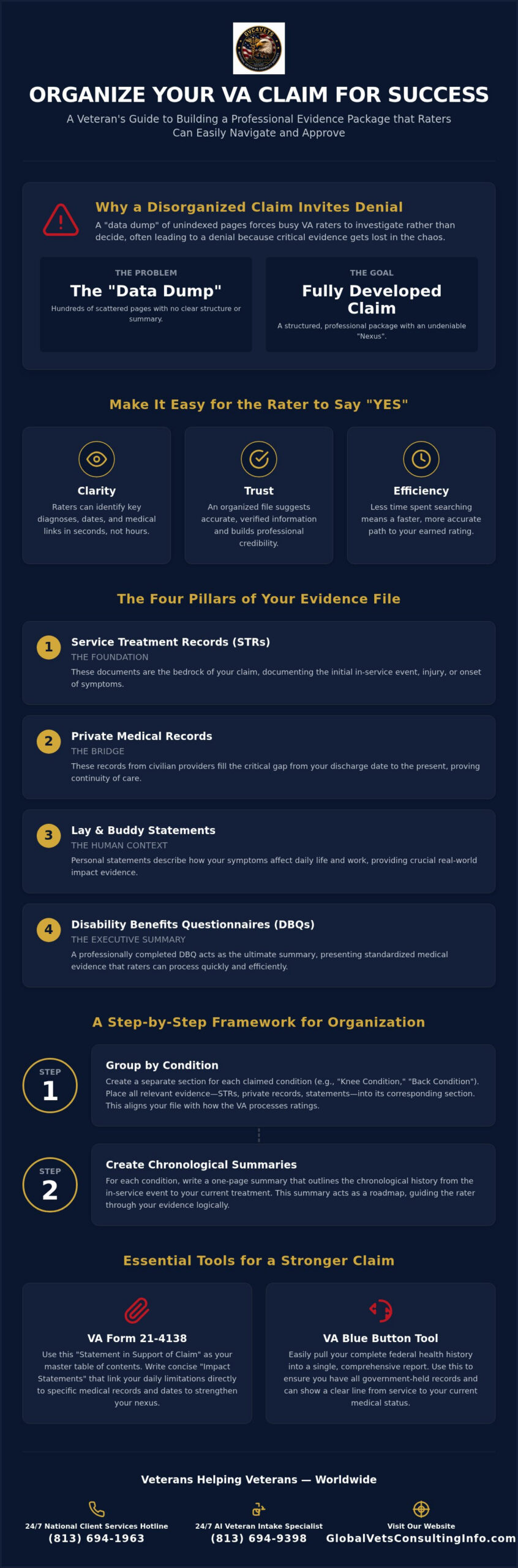
- Learn why a strategic layout prevents the “data dump” trap and ensures busy VA raters don’t overlook your most critical medical evidence.
- Master how to organize your va claim evidence by grouping records by specific condition to create a clear, undeniable path to service connection.
- Discover the framework for using chronological summaries to bridge the gap between your service records and current private treatment.
- Understand how a professional Disability Benefits Questionnaire (DBQ) acts as the ultimate executive summary to finalize your evidence package. 🇺🇸
Why Your VA Evidence Layout Matters to the Rater
VA raters are currently managing an unprecedented volume of work. By June 2026, the VA had already processed over 2 million claims, a record-breaking pace that leaves individual raters with very little time to hunt through your files. When you submit a disorganized “data dump” of hundreds of unindexed pages, you force the rater to act as an investigator rather than a decision-maker. This often leads to a VA claim denied for lack of evidence simply because the rater couldn’t find the specific medical link they needed in the chaos.
Mastering how to organize your va claim evidence is the most effective way to protect your interests. A structured file allows you to submit your case as a Fully Developed Claim (FDC), which signals to the VA that you’ve provided all necessary documentation upfront. This strategy reduces the need for the VA to search for external records, potentially leading to faster decision times. Your objective is to make the “Nexus,” or the medical connection between your service and your current diagnosis, undeniable at first glance. 🇺🇸
The Psychology of a Successful Claim File
A well-ordered evidence package reduces the cognitive load on the rater, making it easier for them to say “yes.” When you use clear headings and summaries, you build professional credibility. It shows you’re a serious claimant who understands the requirements of the system. This methodical approach transforms your file from a stack of paper into a persuasive roadmap. Consider these psychological benefits:
- Clarity: Raters can identify key diagnoses and dates in seconds.
- Trust: Organized files suggest accurate, verified information.
- Efficiency: Less time spent searching means a faster path to your rating.
By presenting your medical history logically, you lead the rater directly to the conclusion that your condition is service-connected. This partnership approach ensures your claim is seen with the respect it deserves. 🌐
Categorizing the Core Components of Your Claim File
Before you dive into the specifics of your history, you must categorize your documents into four primary buckets. Learning how to organize your va claim evidence effectively starts with understanding these categories. Service Treatment Records (STRs) serve as your foundation, as they document the initial in-service event or injury. Private medical records then fill the critical gap between your discharge date and the present day. Lay statements and buddy letters provide the human context, describing how your symptoms affect your daily life and work. Finally, professional medical evidence, specifically understanding what is a dbq, allows you to present a standardized summary that raters can process quickly. 🇺🇸
Separating Federal vs. Private Evidence
You’ll need to distinguish between records held by the government and those from civilian providers. Use the VA Blue Button tool 🌐 to pull your federal health history into a single report. Simultaneously, gather outside records from civilian specialists to prove you’ve maintained a continuity of care. Interleaving these records ensures the rater sees a straight line from your time in uniform to your current medical status. If you need help identifying which records are most relevant, our veteran benefits education resources can help you substantiate your claim with high-quality documentation.
The Power of the Statement in Support of Claim
Think of VA Form 21-4138 as the table of contents for your evidence package. Instead of just listing symptoms, you should write concise “Impact Statements.” These should link your daily limitations directly to specific medical records or dates. For example, mention a specific treatment date in your STRs and explain how that injury still limits your mobility today. This level of detail makes the rater’s job easier and strengthens your nexus. When you master how to organize your va claim evidence in this way, you’re building a professional file that commands respect and demands a fair rating. 🇺🇸
A Step-by-Step Framework for Organizing Your Evidence
Building a successful claim requires more than just gathering records; it requires a logical hierarchy. When you learn how to organize your va claim evidence, you should prioritize a condition-based structure. This method aligns your file with how the VA actually processes ratings. Follow these four steps to build your package:
- Step 1: Group by Condition. Place all evidence related to a specific issue, like your knees or back, into its own section.
- Step 2: Create Chronological Summaries. For each condition, write a brief timeline showing the progression from the initial in-service injury to your current diagnosis.
- Step 3: Highlight Key Phrases. Use a highlighter tool on digital PDFs to call out critical language such as “at least as likely as not” or specific diagnostic codes.
- Step 4: Audit for Negative Evidence. Review your files for contradictory statements or gaps in treatment that might suggest your condition has improved or isn’t service-connected.
Condition-Based vs. Chronological Structure
While many veterans simply list everything by date, a “Condition-First” approach is far more effective. Raters use the VA Schedule for Rating Disabilities (VASRD), which is organized by body systems. By grouping your evidence this way, you help the rater fill out the rating schedule faster. You should only use a chronological “Master Timeline” as a secondary index for complex claims involving multiple overlapping systems. 🇺🇸
Digital Organization Tips for 2026
The VA’s digital systems in 2026 require clean, searchable files. Use clear naming conventions for your PDF uploads, such as “2026_Knee_MRI_Results.pdf,” so the rater knows exactly what they’re clicking. Ensure all documents are non-encrypted and saved as searchable text PDFs rather than just flat images. If you’re feeling overwhelmed by the technical requirements, our team at Global Vets Consulting provides the education you need to prepare a professional evidence package. 🌐
Finalizing Your Evidence Package for a Successful Rating
The final stage of preparation requires a rigorous audit of your file against the VA Schedule for Rating Disabilities (VASRD). You must verify that your package clearly demonstrates three essential elements: a current medical diagnosis, evidence of an in-service event, and the medical nexus connecting them. This checklist ensures that your hard work in learning how to organize your va claim evidence results in a rating that reflects your actual functional loss. 🇺🇸
A professional Disability Benefits Questionnaire (DBQ) serves as the “Executive Summary” of your entire file. It anchors your private records and statements to the specific legal criteria the VA rater uses. This is especially critical when filing a dbq for va disability rating increase, where the organization must be meticulous to prove your condition has worsened over time. 🌐
Integrating Professional DBQs
Standardized medical documentation is the most effective way to provide a rater with exactly what they need without unnecessary fluff. By using a professional DBQ, you translate your medical history into the specific language of the VA rating schedule. Global Vets Consulting specializes in this high-quality documentation, streamlining your evidence-gathering process to ensure your claim stands on a foundation of professional authority. 🇺🇸
Submitting Your Fully Developed Claim (FDC)
Before you hit the final submit button on VA.gov, perform one last review to confirm no further evidence is needed. Submitting as a Fully Developed Claim tells the VA you’ve provided everything required for a decision, which is vital given the record volume of over 2 million claims processed so far in 2026. If you feel stuck or anxious about missing a critical piece of service connection, our 24/7 National Client Services Hotline 📞 is available to support you through the final steps of how to organize your va claim evidence. 🌐
Secure Your Earned Rating with Strategic Evidence Organization
Mastering how to organize your va claim evidence is the critical difference between a frustrating denial and a successful rating increase on your first attempt. By grouping your records by condition and using professional DBQs as your executive summary, you provide the VA rater with a clear, undeniable roadmap to your service connection. This methodical approach ensures your file is treated with the professional respect it deserves while reducing the risk of human error during the review process. 🇺🇸
As a veteran-owned and operated consulting service, we specialize in complex DBQ preparation and education to help you navigate the bureaucratic system. Our 24/7 AI Veteran Intake Specialist and national client services team are ready to assist you in substantiating your claim with high-quality medical documentation that commands attention. 🌐
Get the Professional DBQ Documentation You Need for Your Claim 🇺🇸
You’ve done the hard work of serving your country; now let’s work together to finish the mission and secure the benefits you’ve earned.
Frequently Asked Questions
How do I arrange medical records for a VA claim for the best results?
To achieve the best results, you should arrange your medical records by specific condition rather than just by date. Mastering how to organize your va claim evidence in this way allows the VA rater to quickly verify the severity of each disability. It’s best to use a professional Disability Benefits Questionnaire (DBQ) as an executive summary for each section. This provides a clear roadmap for the rater to identify service connection.
Is it better to submit medical evidence chronologically or by condition?
Submitting your medical evidence by condition is significantly more effective than a purely chronological approach. While a timeline helps show progression, raters must evaluate each disability separately. When you prioritize condition-based organization, you align your file with the VA’s internal processing workflow. This makes it easier for the rater to find the medical nexus and current diagnosis required to award your earned VA rating increase without unnecessary delays.
Should I highlight my medical records before sending them to the VA?
Yes, you should use digital highlighting on searchable PDF documents to call attention to critical medical findings. Focus on highlighting key phrases like “at least as likely as not” or specific diagnostic results. This technique guides the rater’s eyes to the most important parts of your evidence. Don’t over-highlight, as too much color can make the document difficult to read and reduce its overall professional appearance.
How many pages of evidence is too much for a VA disability claim?
There’s no official page limit for evidence, but submitting hundreds of unorganized pages often leads to delays. Even as processing speeds improve in 2026, the goal of learning how to organize your va claim evidence is to prioritize quality over quantity. Use a chronological summary to highlight the most relevant visits. This prevents the rater from becoming overwhelmed by redundant information while ensuring they see critical proof.
What is the most important piece of evidence for a service-connected claim?
The most important piece of evidence is the medical nexus, which is the formal link between your current diagnosis and an in-service event. Without a clear nexus statement from a medical professional, even a well-documented injury might not be granted service connection. A professional DBQ often acts as this critical bridge. This single document provides the standardized documentation the VA requires to secure your disability compensation.

Article by
Willie Daniel
Willie Daniel is the Founder and Chief Executive Officer (CEO) of Global Vets Consulting (GVC4Vets) – National Veterans Disability Services, a veteran-led educational and medical evidence support organization dedicated to helping veterans better understand VA disability rating increases, DBQ medical evidence, secondary claims education, and C&P examination preparation.
He is a retired U.S. Army Medical Service Corps Officer with more than 27 years of honorable military service, a decorated Iraq combat veteran, and a retired federal official with the U.S. Department of Veterans Affairs. Throughout his military and federal career, Willie Daniel served in leadership, healthcare administration, operational, and veteran-support roles focused on improving services and support systems for servicemembers, veterans, and their families.
Drawing from decades of military leadership, healthcare administration, veteran advocacy, and federal government experience, Willie Daniel brings a practical, veteran-centered perspective to Global Vets Consulting’s educational articles, AI-powered veteran resources, video education initiatives, and outreach programs. His experience navigating military systems, medical documentation processes, and veteran-related administrative operations provides valuable insight into many of the challenges veterans face when seeking to better understand VA disability rating criteria, medical evidence, documentation strategies, and secondary condition education.
Through GVC’s “Veterans Helping Veterans” mission, his focus is on delivering clear, educational, and easy-to-understand information designed to empower veterans with knowledge, resources, and educational tools that may help them make more informed decisions regarding their individual VA disability journeys.
The information provided through GVC is intended for educational and informational purposes only and should not be considered legal or medical advice.
Disclaimer
Disclaimer: Global Vets Consulting, LLC (“GVC”) is a veteran-led educational and medical evidence support organization. GVC is not a law firm, is not a Veterans Service Organization (VSO), and is not affiliated with the U.S. Department of Veterans Affairs (VA) or any government agency.
Global Vets Consulting does not provide legal advice, medical advice, medical treatment, or healthcare services. GVC does not prepare, file, or submit VA disability claims on behalf of veterans. All information provided through this website, blog articles, videos, educational materials, AI tools, dashboards, templates, and communications is intended solely for general educational and informational purposes.
Veterans are encouraged to consult with accredited representatives, licensed attorneys, qualified medical providers, or Veterans Service Organizations regarding their specific legal, medical, or VA-related matters. VA disability decisions, ratings, and outcomes are determined solely by the U.S. Department of Veterans Affairs based on applicable laws, regulations, medical evidence, and individual circumstances. Past results do not guarantee future outcomes.