
The VA doesn’t deny claims because you aren’t hurting; they deny them because your medical evidence doesn’t speak their technical language. We understand the confusion of “VA math” and the constant fear of an unfair denial letter. You’ve done your duty, and now it’s time to ensure the system works for you. This guide provides the exact va disability claim evidence checklist you need to secure your rating increase or initial claim approval in 2026. We’ve simplified the complex requirements into actionable steps.
You will learn how to:
- Identify the “Big Three” essential documents required for every submission.
- Use specialized DBQs as the missing link to prove condition severity.
- Leverage Fully Developed Claims (FDC) for faster processing times.
- Secure clear medical nexus documentation to bridge the service gap.
Our goal is to replace administrative confusion with steady confidence. Stop guessing what the rater needs and start submitting “VA-Ready” evidence that gets results 🇺🇸.
Key Takeaways
- Identify the essential “Big Three” documents every veteran needs to bypass the VA’s lengthy record-gathering process and speed up your decision.
- Use our comprehensive va disability claim evidence checklist to ensure your medical records include the specific severity data and formal diagnoses required for a rating increase.
- Understand how private Disability Benefits Questionnaires (DBQs) act as the missing link between your symptoms and the VA’s 2026 rating criteria.
- Learn the strategic advantages of online submission through the Fully Developed Claims (FDC) program to reduce the risk of lost documents and expedite your processing time.
The Foundation: Required Evidence for Every VA Disability Claim
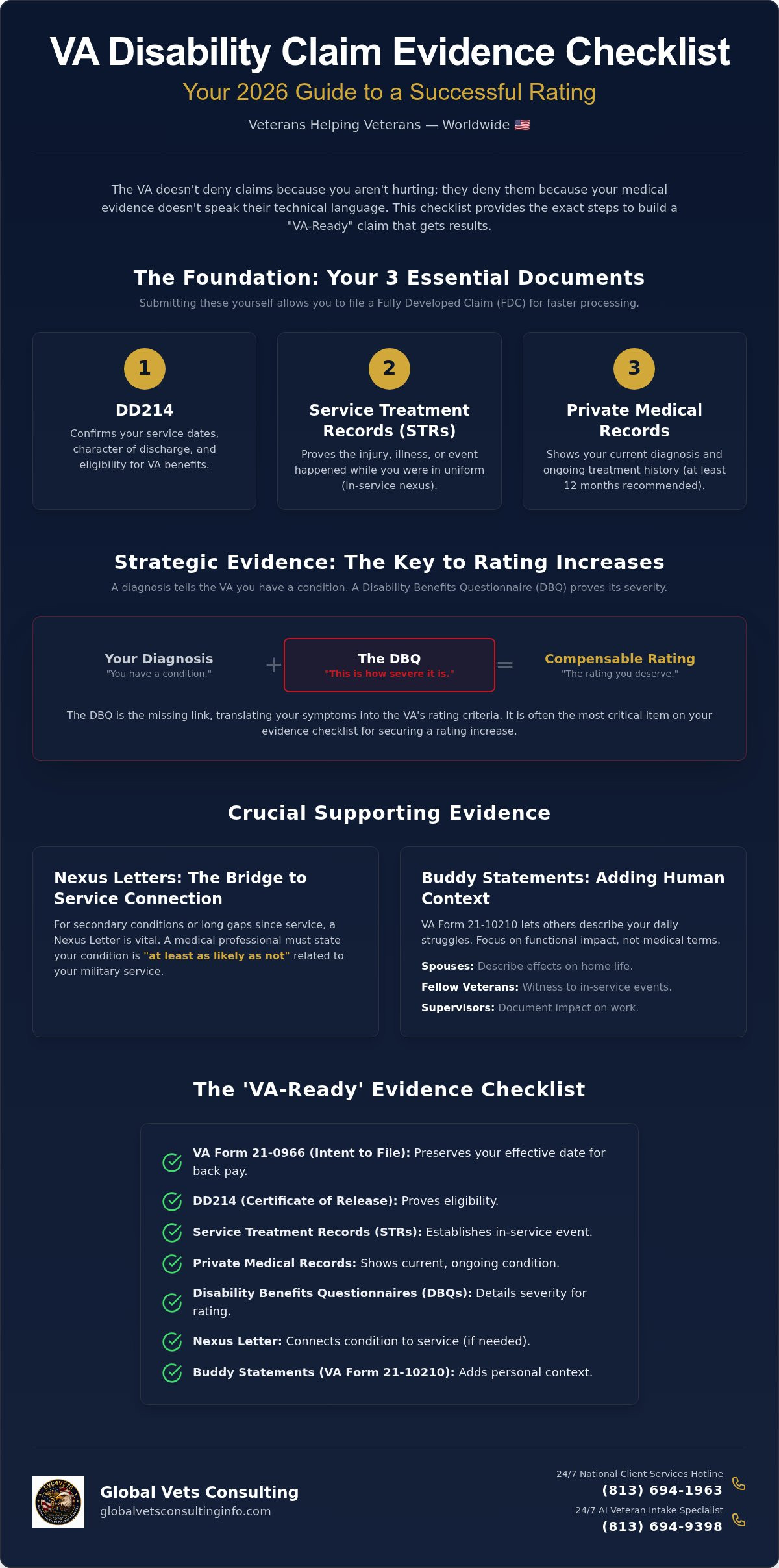
Your journey to a successful rating begins with VA Form 21-0966, the Intent to File. This document is your most powerful tool for preserving your effective date. It secures your potential back pay for one year while you compile your va disability claim evidence checklist. Don’t wait until you have every record to start the clock 🇺🇸.
To win your claim, you must provide the “Big Three” documents:
- DD214: This confirms your service dates and character of discharge.
- Service Treatment Records (STRs): These prove the injury or event happened while you were in uniform.
- Private Medical Records: These show your current diagnosis and ongoing treatment history.
The Veterans Benefits Administration (VBA) is legally required to help you gather records. However, this “Duty to Assist” is often the biggest bottleneck in the system. With 2026 processing times averaging between 68 and 80 days, taking the lead is essential. Submitting these records yourself allows you to file a Fully Developed Claim (FDC), which eliminates the need for the VA to wait on third-party requests.
Service Treatment Records (STRs) vs. Private Records
Your STRs are the primary evidence for establishing an in-service nexus. If your military records were lost or are incomplete, private clinical data must bridge that gap. We recommend gathering at least 12 months of recent private treatment history. This ensures the rater sees a consistent pattern of medical issues, making it a vital part of your va disability claim evidence checklist.
Buddy Statements: Adding Context to Clinical Data
Clinical records show your diagnosis, but they don’t always show your daily struggle. VA Form 21-10210 allows those closest to you to provide “lay evidence” to support your case:
- Spouses: Can describe how your condition affects home life and sleep patterns.
- Fellow Veterans: Can testify to the specific in-service event or injury they witnessed.
- Supervisors: Can document how your disability impacts your productivity and attendance.
Focus these statements on functional impact rather than medical terms. Raters need to know exactly how your symptoms prevent you from living a normal life or maintaining employment.
Strategic Evidence: Why DBQs are the Key to Rating Increases
While gathering your initial records is vital, the Disability Benefits Questionnaire (DBQ) is what actually determines your financial compensation. A diagnosis simply tells the VA you have a condition; the DBQ describes the severity of your symptoms. In the 2026 rating process, raters use these standardized forms to map your limitations directly to the VA Schedule for Rating Disabilities. This is why a private DBQ for va claim is often the most critical item on your va disability claim evidence checklist. It ensures the rater sees the full picture of your functional impairment rather than a brief clinical note.
Using DBQs is also the most effective way to establish secondary service connections. For example, if your service-connected tinnitus has led to chronic anxiety, a specific DBQ can document how the two conditions interact. When you learn how to file a VA disability claim, you’ll see that the VA requires clear evidence of this link. Providing high-quality medical evidence through professional education can help you secure a compensable rating rather than a 0% non-compensable decision.
How to Get a DBQ Filled Out Correctly
You might find that many VA healthcare providers refuse to complete these forms due to internal policies or time constraints. This creates a significant hurdle for veterans seeking an increase. Professional consulting for a dbq for mental health conditions or other complex issues ensures your symptoms are recorded accurately. If you’re struggling to get the right documentation, Global Vets Consulting can provide the educational resources needed to move forward.
Nexus Letters: The Bridge to Service Connection
For secondary claims or conditions with a long gap since service, a DBQ alone may not be enough. You often need a Nexus Letter. This formal statement from a medical professional must use the specific “at least as likely as not” language required by the VA. Including a Nexus Letter in your va disability claim evidence checklist can prevent a denial based on a lack of service connection, providing the medical justification the rater needs to grant your claim.
Submitting Your Claim: Online vs. Mail Comparison
Once you’ve compiled your va disability claim evidence checklist, the method you use to submit it can dictate your timeline. In 2026, the VA has streamlined digital portals to prioritize speed. Submitting online via VA.gov provides an immediate digital receipt, which is your proof that the clock has started. This method is the preferred route for the Fully Developed Claims (FDC) program because it allows you to certify that no further evidence is needed. Digital files are also searchable, helping raters find key medical data faster, which is a major factor in reducing the average 80 day wait time currently reported by the VA.
Understanding the VA claim process after you file helps manage expectations. Once submitted, your claim enters a multi-step review where digital evidence is much harder to lose than paper stacks. Raters can access your files instantly, making your case “decision ready” from the moment of upload.
Online Submission via VA.gov
To ensure success when uploading dbq to va.gov, you should convert all medical records into searchable PDF formats. Raters often handle dozens of cases daily. If they can use a “find” command to locate your diagnosis within your va disability claim evidence checklist, your claim moves faster. Avoid blurry photos or non-standard file types that can trigger a request for more information, stalling your progress.
When to Consider Filing by Mail
While digital is faster, some veterans with thousands of pages of records still prefer traditional mail. If you choose this route, you must use Certified Mail with Return Receipt. This is the only way to protect your effective date if the VA claims they never received your packet. It’s a slower process, but it provides a physical paper trail for massive record sets that might exceed online upload limits.
If you’re unsure which submission strategy fits your specific case, connect with our veteran-led intake specialists for clear guidance on finalizing your evidence package.
The ‘VA-Ready’ Evidence Checklist for 2026
Before hitting submit, you must ensure your package is bulletproof. Every va disability claim evidence checklist requires four non-negotiable elements to win. You need a current, formal diagnosis from a qualified medical provider. Next, you must provide evidence of an in-service event, injury, or illness. The third element is the “Nexus,” which is the medical bridge linking your diagnosis to your service. Finally, you must document functional loss. This describes exactly how your condition limits your daily life and work performance. Without these four pillars, your claim is incomplete and likely to face a 0% rating or a full denial.
Pre-Submission Quality Check
A simple clerical error can reset your timeline by months. Review your va disability claims process to verify that every document has the required signatures and dates. In 2026, the VA is using more robust fraud-detection systems, making accuracy more important than ever. You must confirm that your DBQ matches the current VA version for 2026. Using an outdated form often triggers an immediate request for a new C&P exam. This delay can cost you months of back pay while you wait for a new appointment.
What to Do If Your Claim Is Denied
If you receive a denial letter, look specifically for the “Reasons for Decision” section. Most denials occur because the rater couldn’t find a clear link or sufficient severity data. You can recover from a va claim denied for lack of evidence by filing a Supplemental Claim. This allows you to submit new and relevant evidence, such as a specialized DBQ or a more detailed Nexus Letter. Our 24/7 AI Veteran Intake Specialist is available to help you identify these gaps so you can secure the benefits you’ve earned 🇺🇸.
Take Command of Your 2026 VA Claim Success
Securing the rating you earned isn’t about the quantity of your records; it’s about the precision of your medical evidence. By following this va disability claim evidence checklist, you’ve learned how to translate your symptoms into the specific language VA raters require. You’re now equipped to bypass the common delays that trap many veterans in the system for years. Accuracy in your documentation is the foundation of a faster decision. 🌐 Worldwide
Global Vets Consulting is a Veteran-Owned & Operated team that understands your mission. We specialize in strategic medical documentation and education to ensure your claim is “Decision Ready” from day one. We offer round-the-clock support to ensure you never have to navigate this process alone:
- 📞 24/7 National Client Services Hotline
- 🤖 24/7 AI Veteran Intake Specialist
- 🇺🇸 Veteran-Owned & Operated
Get Your VA-Ready DBQ from Global Vets Consulting
Your service matters, and your health documentation should reflect that. Take the next step toward the benefits you’ve rightfully earned with a partner who speaks your language. GlobalVetsConsultingInfo.com 🇺🇸
Frequently Asked Questions
What is the most important piece of evidence for a VA claim?
The most important evidence is a current, formal medical diagnosis from a licensed provider. Without a documented condition, the VA cannot grant service connection, regardless of your past injuries. This diagnosis acts as the anchor for your entire va disability claim evidence checklist. It must clearly state the name of the condition and its current severity to help the rater determine a compensable percentage rather than a 0% non-compensable rating.
Can I submit new evidence after I’ve already filed my VA claim?
Yes, you can submit new evidence while your claim is pending, but it may remove your case from the Fully Developed Claim (FDC) program. If you find critical records after filing, upload them immediately through the VA.gov portal to ensure the rater sees them before the final decision. If a decision has already been reached, you’ll need to file a Supplemental Claim to introduce new and relevant evidence into your file.
How do I know if my medical evidence is ‘VA-Ready’?
Evidence is “VA-Ready” when it includes a clear diagnosis, a service link, and specific symptom severity documented on a current 2026 DBQ. You should also ensure your files are in a searchable PDF format. This allows raters to use digital “find” tools to locate key medical terms quickly. High-quality documentation that uses VA-specific language regarding functional limitations ensures your va disability claim evidence checklist is complete and easy for the rater to approve.
Do I need a Nexus Letter if I already have a DBQ?
A Nexus Letter is often necessary for secondary claims or conditions diagnosed years after discharge. While a DBQ documents the severity of your symptoms, it doesn’t always explain the cause. If your condition isn’t an obvious result of an in-service injury, a Nexus Letter provides the medical rationale linking the two. This bridge is vital for claims like sleep apnea secondary to PTSD where the service connection isn’t automatically assumed by the VA.
What happens if the VA says they can’t find my service records?
If the VA cannot locate your official records, you can use lay evidence and “buddy statements” to substantiate your claim. Statements from fellow veterans who witnessed the event or family members who observed the onset of symptoms are powerful tools. You can also provide civilian medical records from the time of discharge or social security records. These alternative documents help fill the gaps when official military treatment records are missing or destroyed.
Article by
Willie Daniel
Willie Daniel is the Founder and Chief Executive Officer (CEO) of Global Vets Consulting (GVC4Vets) – National Veterans Disability Services, a veteran-led educational and medical evidence support organization dedicated to helping veterans better understand VA disability rating increases, DBQ medical evidence, secondary claims education, and C&P examination preparation.
He is a retired U.S. Army Medical Service Corps Officer with more than 27 years of honorable military service, a decorated Iraq combat veteran, and a retired federal official with the U.S. Department of Veterans Affairs. Throughout his military and federal career, Willie Daniel served in leadership, healthcare administration, operational, and veteran-support roles focused on improving services and support systems for servicemembers, veterans, and their families.
Drawing from decades of military leadership, healthcare administration, veteran advocacy, and federal government experience, Willie Daniel brings a practical, veteran-centered perspective to Global Vets Consulting’s educational articles, AI-powered veteran resources, video education initiatives, and outreach programs. His experience navigating military systems, medical documentation processes, and veteran-related administrative operations provides valuable insight into many of the challenges veterans face when seeking to better understand VA disability rating criteria, medical evidence, documentation strategies, and secondary condition education.
Through GVC’s “Veterans Helping Veterans” mission, his focus is on delivering clear, educational, and easy-to-understand information designed to empower veterans with knowledge, resources, and educational tools that may help them make more informed decisions regarding their individual VA disability journeys.
The information provided through GVC is intended for educational and informational purposes only and should not be considered legal or medical advice.
Disclaimer
Disclaimer: Global Vets Consulting, LLC (“GVC”) is a veteran-led educational and medical evidence support organization. GVC is not a law firm, is not a Veterans Service Organization (VSO), and is not affiliated with the U.S. Department of Veterans Affairs (VA) or any government agency.
Global Vets Consulting does not provide legal advice, medical advice, medical treatment, or healthcare services. GVC does not prepare, file, or submit VA disability claims on behalf of veterans. All information provided through this website, blog articles, videos, educational materials, AI tools, dashboards, templates, and communications is intended solely for general educational and informational purposes.
Veterans are encouraged to consult with accredited representatives, licensed attorneys, qualified medical providers, or Veterans Service Organizations regarding their specific legal, medical, or VA-related matters. VA disability decisions, ratings, and outcomes are determined solely by the U.S. Department of Veterans Affairs based on applicable laws, regulations, medical evidence, and individual circumstances. Past results do not guarantee future outcomes.