
What if your restless nights and morning exhaustion aren’t just a separate health issue, but a direct result of the trauma you carried home from service? Many veterans struggle with the debilitating cycle of Sleep Apnea and PTSD, yet they find themselves hitting a brick wall when trying to explain this connection to the VA. It’s frustrating to feel like your symptoms are being ignored because you lack the technical language to link them together. You know that your mental health and your physical ability to breathe at night are deeply intertwined, but the bureaucracy often makes you feel isolated in your struggle.
You deserve a disability rating that accurately reflects the reality of your health. Establishing a secondary service connection is the most effective path to securing the benefits you earned through your service. In this article, we’ll walk you through the secondary claim process, the specific medical evidence required, and how a professional DBQ serves as the key to unlocking a successful evaluation. By the end, you’ll have a clear roadmap to navigate the system with confidence and peace of mind.
Key Takeaways
- Learn how to establish a secondary service connection for Sleep Apnea and PTSD to ensure your VA disability rating reflects your true health status.
- Discover the physiological link between the mental health “fight or flight” response and respiratory issues to better understand your symptoms.
- Identify the essential medical evidence and service treatment records needed to build a robust case for a secondary claim.
- Understand how a professional DBQ serves as the key piece of medical evidence to help the VA rater accurately evaluate the severity of your condition.
Understanding the Connection Between Sleep Apnea and PTSD
Obstructive Sleep Apnea (OSA) is more than just loud snoring. It’s a serious respiratory condition where your airway physically collapses during sleep, causing you to stop breathing repeatedly throughout the night. For many veterans, these episodes lead to chronic exhaustion, morning headaches, and irritability. The VA frequently sees Sleep Apnea and PTSD appearing together because the physiological toll of trauma often manifests in physical health complications.
Why Sleep Apnea is Often Secondary to PTSD
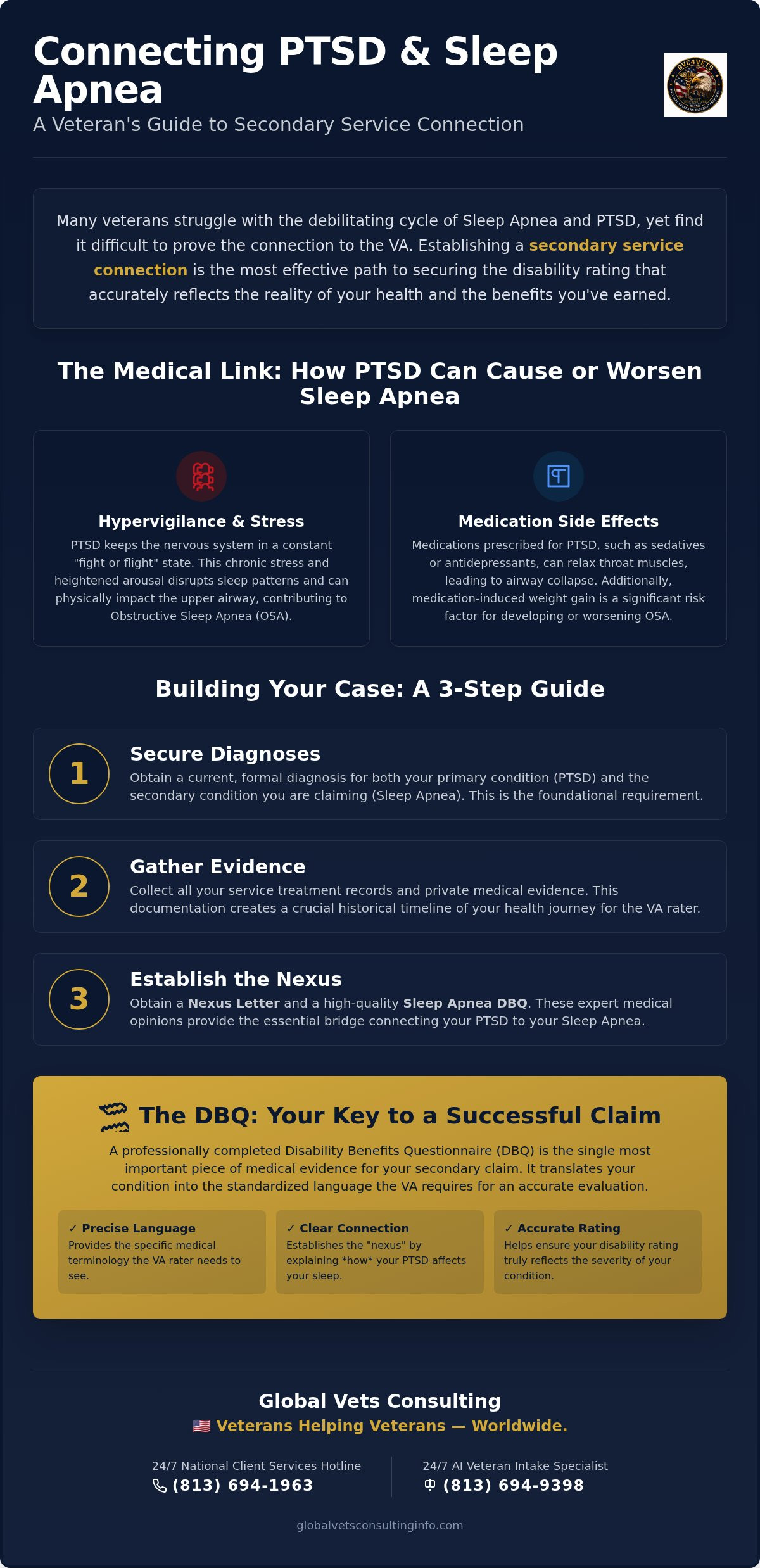
Living with Post-traumatic stress disorder (PTSD) means your nervous system is often stuck in a state of hypervigilance. This constant “fight or flight” response interferes with your body’s ability to maintain normal sleep architecture. Additionally, many veterans experience weight gain as a side effect of mental health medications, which significantly increases the risk of developing OSA. A secondary service connection is a condition caused or aggravated by an already rated disability. By identifying these links, you can demonstrate to the VA how your service-connected mental health is the root cause of your sleep struggles.
The Importance of Accurate Documentation
Securing a rating for Sleep Apnea and PTSD requires more than just a diagnosis. The VA requires clear medical evidence that establishes a “nexus” between the two conditions. A simple diagnosis doesn’t explain the “how” or “why” to a rater. You need documentation that shows how your mental health specifically aggravates your respiratory system. Using standardized tools like a DBQ helps bridge this gap by providing the precise medical language the VA needs to see to approve your claim.
The Medical Link: How PTSD Aggravates or Causes Sleep Apnea
The biological connection between your mental health and your breathing is significant. When you live with chronic stress, your body remains in a heightened state of arousal. This constant “fight or flight” response doesn’t just keep you on edge; it physically impacts your upper airway. Research, such as this Medical Study on Veterans with PTSD and OSA, highlights how the prevalence of disordered breathing is remarkably high among those with service-connected trauma. It’s not a coincidence. It’s a physiological interaction where one condition actively worsens the other.
PTSD Medications and Sleep Apnea
Many veterans take prescribed sedatives or antidepressants to manage their trauma symptoms. While helpful for mental health, these medications often relax the muscles in the throat. This relaxation can lead to airway collapse during the night. Additionally, medication-induced weight gain is a common side effect that contributes directly to obstructive sleep apnea. This creates a clear “aggravation” theory for your claim, showing that your treatment for one disability is causing or worsening another.
Hypervigilance and Sleep Fragmentation
Hypervigilance leads to a cycle of night terrors and frequent waking. This fragmentation ruins your sleep architecture and makes Sleep Apnea and PTSD symptoms significantly harder to manage. If you’re struggling to document these connections, reviewing a DBQ for Mental Health Conditions can help you understand how to present your evidence properly. Understanding these links is the first step toward a successful rating. For more guidance on substantiating your claim, you can explore educational resources specifically designed for veterans.
Filing Sleep Apnea Secondary to PTSD: A Step-by-Step Guide
When you’re ready to link Sleep Apnea and PTSD, a methodical approach is your best tool. You aren’t just filling out forms; you’re building a clinical narrative for the VA rater. This process demands precision to ensure your physical symptoms are clearly tied to your service-connected mental health. Taking the time to prepare properly now can save you months of frustration later. Follow these steps to organize your claim effectively:
- Step 1: Secure a current diagnosis for both conditions. You cannot have a secondary claim without a solid primary rating and a confirmed secondary diagnosis.
- Step 2: Gather your service treatment records and private medical evidence. This creates a historical trail of your health journey.
- Step 3: Obtain a high-quality Sleep Apnea DBQ and a Nexus Letter. These documents provide the professional medical opinion needed to bridge the two conditions.
- Step 4: Submit your claim using the VA disability claims process.
The Role of the Sleep Study
A formal sleep study is a non-negotiable piece of evidence. The VA won’t grant a rating for OSA based on symptoms alone; they need objective data from a polysomnogram. Ensure your results are interpreted by a professional who understands the specific criteria the VA uses for rating severity. This data proves that your condition is a chronic medical reality rather than an occasional sleep disturbance.
Proving the ‘Nexus’ Connection
The “nexus” is the medical bridge between your conditions. For a successful claim, your evidence must show that your sleep apnea is “at least as likely as not” caused or aggravated by your PTSD. This standard of proof is essential. Many veterans who struggle with Sleep Apnea and PTSD fail because their records don’t explicitly state this link. If you’re ready to substantiate your evidence, you can access professional DBQ education to help you navigate the requirements with confidence.
Strengthening Your Evidence with a Sleep Apnea DBQ
A Disability Benefits Questionnaire (DBQ) is a standardized tool that captures the specific medical data the VA requires to evaluate your condition. It covers everything from your initial diagnosis to the clinical necessity of a CPAP machine. Standardized forms are vital because they speak the VA’s language. They ensure the rater understands the full severity of your symptoms without having to hunt through hundreds of pages of disorganized records. Using private medical evidence often provides a more comprehensive view of your health than a standard C&P exam alone.
Global Vets Consulting specializes in streamlining the evidence gathering process. We provide the educational resources needed to help you substantiate your claims with accurate documentation. By focusing on meticulousness and integrity, we help you present a clear, undeniable case that reflects the true impact of your service connected conditions.
Why Professional DBQ Preparation Matters
Many veterans face a VA claim denied for lack of evidence because their paperwork was incomplete or vague. When you’re linking Sleep Apnea and PTSD, you can’t afford to leave anything to chance. Every symptom and functional limitation must be documented with precision. Professional education helps you avoid these common pitfalls by ensuring your medical evidence is bulletproof from the start. We act as your knowledgeable guide, helping you turn a confusing bureaucratic task into a predictable path forward.
Your Next Steps Toward a Rating Increase
If you’re ready to secure a DBQ for a VA disability rating increase, taking action today is the best way to protect your future. Our team focuses on Sleep Apnea and PTSD documentation to ensure your claim is substantiated correctly. We believe in veterans helping veterans, and we’re here to provide the steady guidance you deserve.
🇺🇸 Veteran-owned and operated since 2021
📞 24/7 National Client Services Hotline
🌐 Visit GlobalVetsConsultingInfo.com to start your intake today.
Take Control of Your VA Rating Today
You now understand how mental health impacts respiratory function and the specific steps needed to bridge these conditions. Linking Sleep Apnea and PTSD requires more than just knowing they coexist; it demands a clinical narrative that proves aggravation or causation. By following the step-by-step guide and focusing on high-quality medical evidence, you’re taking control of your VA disability claim. Every detail in your documentation serves as a building block toward a successful outcome.
Don’t let a lack of documentation stand between you and the rating you deserve. Get the medical evidence you need for your VA claim at Global Vets Consulting. We focus on meticulousness and integrity to help you substantiate your claim with confidence. Our team is ready to provide the professional education you need to navigate this complex system.
🇺🇸 Veteran-owned and operated since 2021
📞 24/7 National Client Services Hotline
Meticulous DBQ preparation focused on accuracy
You’ve served your country with honor, and now it’s time to ensure the system works for you. Stay persistent, stay informed, and keep moving forward toward the benefits you’ve earned.
Frequently Asked Questions
Can I get a 50% rating for Sleep Apnea secondary to PTSD?
Yes, if you require a CPAP machine or other breathing assistance device. The VA rating schedule for sleep apnea assigns 50% for conditions requiring a breathing assistance device. When filing as secondary to PTSD, the rating depends on the severity of the symptoms as documented in your medical evidence and DBQ. High-quality documentation is essential to prove the level of impairment and secure the rating you have earned.
What is a ‘nexus letter’ and do I need one for Sleep Apnea?
A nexus letter is a formal document from a medical professional that establishes a link between your service-connected disability and your secondary condition. While not strictly required, it is highly recommended for claims involving Sleep Apnea and PTSD. It provides the clinical reasoning needed to show your sleep disorder is at least as likely as not caused or aggravated by your mental health condition, strengthening your overall claim.
Does the VA consider Sleep Apnea a presumptive condition for PTSD?
No, the VA does not currently list sleep apnea as a presumptive condition for veterans with PTSD. This means the burden of proof is on you to provide medical evidence linking the two. You must actively demonstrate a secondary service connection through diagnostic testing, service treatment records, and educational resources like a DBQ. Without this direct evidence, the VA is unlikely to grant a service connection automatically.
What happens if my Sleep Apnea claim is denied?
If your claim is denied, you have several options including filing a Supplemental Claim with new evidence or requesting a Higher-Level Review. Many denials occur because of a lack of clear medical evidence or a missing nexus. Reviewing your denial letter will clarify what the rater found insufficient. You can then use professional DBQ education to address those specific gaps and resubmit your claim for a more accurate evaluation.
Can weight gain from PTSD medication be a bridge to a Sleep Apnea claim?
Yes, weight gain caused by medications used to treat Sleep Apnea and PTSD can serve as an intermediary link. If your service-connected mental health condition requires treatment that leads to obesity, and that obesity causes your sleep apnea, it creates a valid path for a secondary service connection. Precise documentation of your medication history and its physical effects is vital to support this theory and secure the benefits you deserve.

Article by
Willie Daniel
Willie Daniel is the Founder and Chief Executive Officer (CEO) of Global Vets Consulting (GVC4Vets) – National Veterans Disability Services, a veteran-led educational and medical evidence support organization dedicated to helping veterans better understand VA disability rating increases, DBQ medical evidence, secondary claims education, and C&P examination preparation.
He is a retired U.S. Army Medical Service Corps Officer with more than 27 years of honorable military service, a decorated Iraq combat veteran, and a retired federal official with the U.S. Department of Veterans Affairs. Throughout his military and federal career, Willie Daniel served in leadership, healthcare administration, operational, and veteran-support roles focused on improving services and support systems for servicemembers, veterans, and their families.
Drawing from decades of military leadership, healthcare administration, veteran advocacy, and federal government experience, Willie Daniel brings a practical, veteran-centered perspective to Global Vets Consulting’s educational articles, AI-powered veteran resources, video education initiatives, and outreach programs. His experience navigating military systems, medical documentation processes, and veteran-related administrative operations provides valuable insight into many of the challenges veterans face when seeking to better understand VA disability rating criteria, medical evidence, documentation strategies, and secondary condition education.
Through GVC’s “Veterans Helping Veterans” mission, his focus is on delivering clear, educational, and easy-to-understand information designed to empower veterans with knowledge, resources, and educational tools that may help them make more informed decisions regarding their individual VA disability journeys.
The information provided through GVC is intended for educational and informational purposes only and should not be considered legal or medical advice.
Disclaimer
Disclaimer: Global Vets Consulting, LLC (“GVC”) is a veteran-led educational and medical evidence support organization. GVC is not a law firm, is not a Veterans Service Organization (VSO), and is not affiliated with the U.S. Department of Veterans Affairs (VA) or any government agency.
Global Vets Consulting does not provide legal advice, medical advice, medical treatment, or healthcare services. GVC does not prepare, file, or submit VA disability claims on behalf of veterans. All information provided through this website, blog articles, videos, educational materials, AI tools, dashboards, templates, and communications is intended solely for general educational and informational purposes.
Veterans are encouraged to consult with accredited representatives, licensed attorneys, qualified medical providers, or Veterans Service Organizations regarding their specific legal, medical, or VA-related matters. VA disability decisions, ratings, and outcomes are determined solely by the U.S. Department of Veterans Affairs based on applicable laws, regulations, medical evidence, and individual circumstances. Past results do not guarantee future outcomes.