

What if the most important part of your C&P exam happens before you even walk through the clinic doors? For many veterans, the exam room feels like a place where their service-connected disabilities are questioned rather than confirmed. It’s completely normal to feel anxious about being “lowballed” or failing to explain your symptoms clearly under pressure. You’ve earned your benefits, and it’s exhausting to feel like you’re fighting a second battle just to get an accurate rating. We understand that confusion over complex medical terminology and fear of missing a service connection can make the process feel overwhelming.
This guide will help you master the C&P exam by providing expert strategies on medical evidence and DBQs that protect your VA disability rating. You’ll learn how to present your case with steady confidence and ensure your medical documentation speaks louder than a brief exam. We’ll explore the critical steps for preparation, from understanding the examiner’s role to organizing your evidence so you can secure the fair and accurate rating you deserve. By the end of this article, you’ll have a clear, predictable path forward to handle your next evaluation with total peace of mind.
Key Takeaways
- Understand that a C&P Exam is a forensic evaluation designed to gather evidence for your claim, rather than a typical medical treatment session.
- Learn why stopping at the point of pain during physical range-of-motion tests is vital for documenting the true severity of your condition.
- Discover how to articulate the specific social and occupational impacts of your symptoms during mental health interviews to ensure an accurate rating.
- Explore how leveraging private Disability Benefits Questionnaires (DBQs) can provide the high-quality medical evidence needed to support your claim.
- Master the post-exam steps of documenting your experience and requesting official reports to protect your rights throughout the VA claims process.
What is a C&P Exam? Understanding the VA Claim Evaluation 🇺🇸
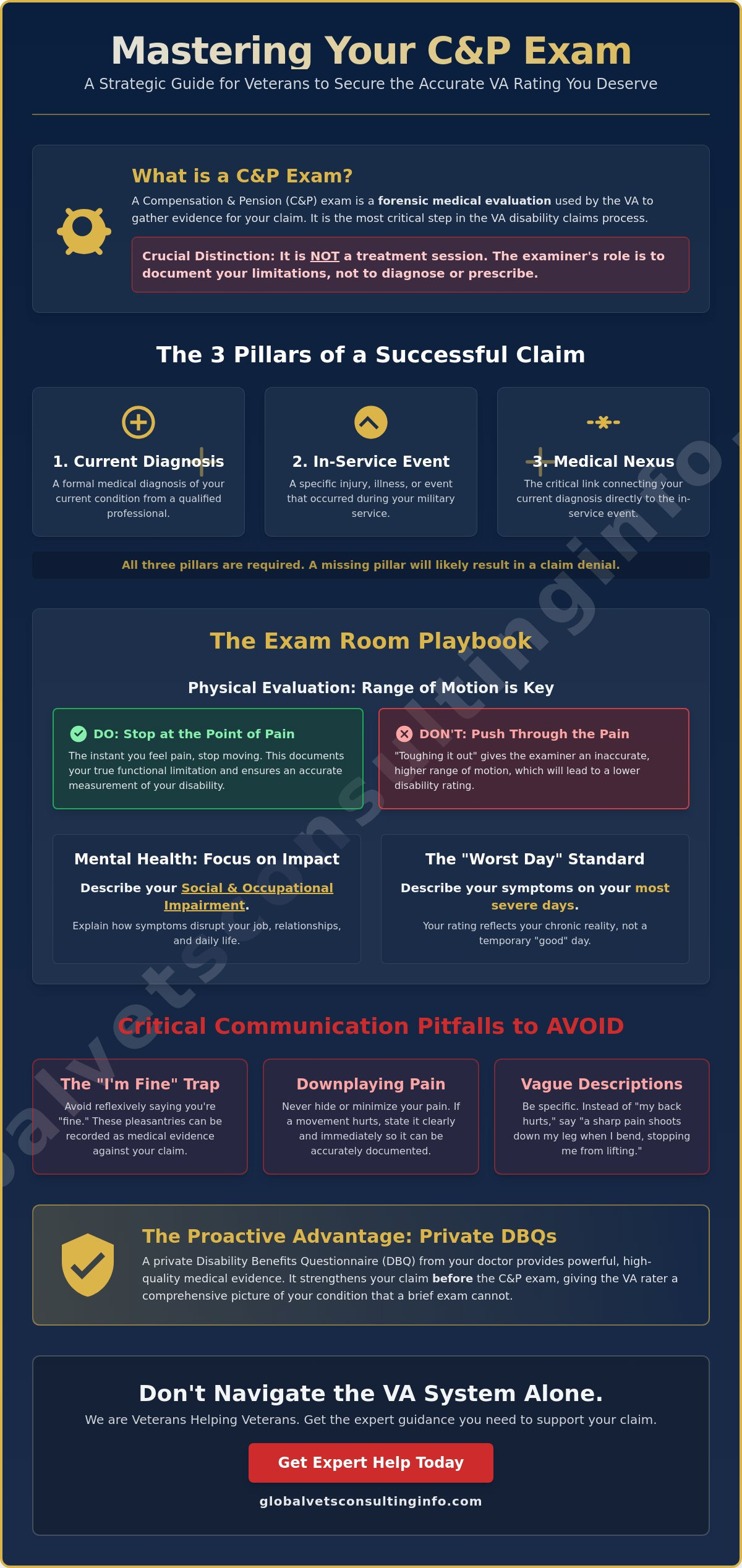
A Compensation and Pension (C&P) exam is a forensic medical evaluation used by the VA to determine service connection and disability percentages. This evaluation is the most critical step in the VA disability claims process step by step. It provides the medical evidence necessary for the VA to decide if your condition is related to your service and how much it affects your daily life.
You should understand that the examiner’s role is highly specific. They are there to gather facts for the Veterans Benefits Administration (VBA). They don’t provide medical treatment, and they won’t give you prescriptions or new diagnoses. While most exams are in person, the VA sometimes uses an “Acceptable Clinical Evidence” (ACE) review instead. This allows an examiner to complete the evaluation by simply reviewing your existing medical records without an appointment.
The Three Pillars of a Successful C&P Exam
To secure a rating, your claim must stand on three specific legs of evidence. First, you need a current, formal medical diagnosis. Second, you must show an in-service event or injury that occurred during your military career. Finally, you need a medical nexus. This is the logical link that connects your current diagnosis directly to your time in service. Without all three, the VA will likely deny the claim.
Common Conditions Requiring C&P Evaluations in 2026
Many veterans undergo a C&P Exam for musculoskeletal issues like back, shoulder, or knee pain. These evaluations often focus on range of motion testing. Mental health conditions, such as PTSD, anxiety, or depression, are also very frequent and require a detailed interview. Since the passage of the PACT Act, many veterans now receive exams for presumptive conditions related to toxic exposure, which has simplified the service connection process for thousands of claimants by removing the need for a specific nexus letter.
What to Expect During Your Appointment: A Step-by-Step Breakdown 🇺🇸
Walking into your VA Claim Exam (C&P Exam) requires a strategic mindset. You aren’t there for medical treatment; you’re there to document functional limitations for the rater. Here is what you can expect during the appointment:
- The Physical Evaluation: Examiners use a tool called a goniometer to measure your range of motion. It is vital that you stop moving the second you feel pain. Pushing through the pain results in a higher, inaccurate range of motion reading that doesn’t reflect your true disability.
- The Mental Health Interview: The focus is on social and occupational impairment. Using a dbq for mental health conditions helps you articulate how symptoms like flashbacks or anxiety disrupt your ability to work and maintain relationships.
- The “Worst Day” Standard: Always describe your symptoms based on your most severe days. If you describe a “good” day, the VA will rate you based on that temporary window of health rather than your chronic reality.
- C-File Review: The examiner has access to your military and VA medical records. Be prepared to discuss your history consistently with what is already documented in your file to maintain credibility.
The Examiner’s Checklist: What They Are Looking For 📞
- Flare-ups: They track the frequency, severity, and duration of your worst episodes to see how your condition changes over time.
- Objective Evidence: They look for observable signs like swelling, muscle atrophy, or distress that verify your subjective reports of pain.
- Functional Loss: The examiner is looking for evidence of functional loss that prevents you from working or performing daily tasks.
Communication Pitfalls to Avoid 🌐
- The “I’m Fine” Trap: Avoid reflexively saying you’re okay when the examiner greets you. Habits of politeness can be recorded as medical evidence of wellness, which can hurt your rating.
- Toughing It Out: Never hide your pain. If a movement hurts, say it hurts immediately so the examiner can record the functional limit accurately.
- Vague Descriptions: Be precise about how your condition stops you from doing specific tasks. If you need help articulating these details, Global Vets Consulting provides education on preparing your narrative for the best possible outcome.
Proactive Preparation: Using DBQs to Support Your Claim 📞
A Disability Benefits Questionnaire (DBQ) is a standardized medical form that allows private doctors to provide the exact evidence the VA requires. These forms are highly effective because they mirror the 38 CFR Book C rating schedule used by VA raters to determine disability percentages. When a private physician completes a DBQ accurately, it can sometimes bypass the need for a C&P Exam entirely. This is a powerful advantage for veterans who want to ensure their medical record is complete before the VA even reviews their file. You can find more official VA claim exam information to see how different types of evidence impact your case.
If you’ve already received an unfavorable opinion from a VA examiner, don’t lose hope. A private DBQ serves as vital “rebuttal evidence” to challenge an inaccurate or rushed report. It provides a detailed, clinical counter-argument that the VA must consider during the decision-making process. This proactive approach ensures your file contains a thorough record of your limitations rather than a generic summary that might lead to a lower rating.
How Global Vets Consulting Streamlines Your Evidence
We provide expert education on how to use a dbq for a va disability rating increase. Our mission is to help you ensure every symptom and functional limitation is documented with technical accuracy. We assist veterans in gathering standardized medical documentation to support complex secondary claims that are often difficult to prove without specific clinical language. If you’re ready to strengthen your claim with high-quality evidence, explore our educational preparation resources to get started.
Private DBQ vs. C&P Exam: A Strategic Comparison
- Time and Depth: VA exams are often rushed, sometimes lasting only 15-20 minutes, while private evaluations allow for a thorough review of your entire medical history.
- Specialized Expertise: Private evaluations give you access to specialists who understand the specific nexus requirements needed to link your condition to your military service.
- Faster Decisions: A private DBQ allows you to submit a ‘Fully Developed Claim,’ which often results in faster decisions from the VA.
After the Exam: Next Steps and Recovery Strategies 🌐
Your responsibility to your claim continues the moment you leave the clinic. Once the C&P Exam is over, your focus must shift to verifying that the examiner’s report is technically accurate and reflects the full severity of your condition. If the report contains errors, you must be prepared to challenge the findings before the VA issues a final decision.
- Step 1: Immediate Documentation. Sit in your vehicle and write down everything that happened during the appointment. Note the total time the examiner spent with you, the specific questions they asked, and whether they used proper tools like a goniometer for physical tests.
- Step 2: Secure the Report. You cannot fix what you cannot see. Request a copy of the examiner’s findings through a Freedom of Information Act (FOIA) request or your VSO as soon as the report is uploaded to your file.
- Step 3: Audit for Inaccuracies. Review the report against your medical history. Look for symptoms you mentioned that were omitted or range-of-motion measurements that seem incorrect based on the pain levels you experienced.
- Step 4: Recovery Planning. If your va claim is denied for lack of evidence, don’t give up. Prepare a supplemental claim using a private DBQ to provide the clinical depth the VA examiner may have missed.
What to Do if You Had a Bad Exam Experience 📞
If you felt the examiner was biased, dismissive, or failed to perform a thorough evaluation, you have the right to protest the results. File a Memorandum for Record (MFR) to document these issues in your official C-file immediately. You should also contact the VA facility director or the specific contractor, such as QTC, VES, or Optum, to report the sub-standard experience. Documenting these failures early is the most effective way to justify a request for a new, fair examination.
Final Checklist for Success 🇺🇸
- Compare your final exam report against the 38 CFR rating criteria to see if the examiner checked the correct boxes for your specific symptoms.
- Verify that your witness or support person has their own notes to back up your Memorandum for Record if an appeal becomes necessary.
- 📞 Reach out to our 24/7 National Client Services Hotline for expert education on preparing a high-quality medical evidence package that protects your earned benefits.
Take Control of Your VA Disability Rating 🇺🇸
You’ve served your country with honor, and now it’s time to ensure the system serves you correctly. Successfully navigating your C&P Exam requires more than just showing up; it demands a proactive approach to your medical documentation. By understanding the forensic nature of the evaluation and utilizing standardized evidence like Disability Benefits Questionnaires, you can protect your VA rating increase from being undermined by a rushed or incomplete report. You have the power to influence the outcome by being precise, thorough, and prepared before the appointment begins.
As a veteran-owned and operated consulting service, we understand the intricacies of the bureaucratic system. We specialize in providing the education you need regarding DBQs and medical evidence to help you present a clear, undeniable case. Our 24/7 AI Veteran Intake Specialist is available right now to help you start your journey toward a fair evaluation. 🇺🇸 Get the Medical Evidence You Need—Contact Global Vets Consulting Today
You don’t have to navigate this complex process alone. We’re here to serve as your steady guide and knowledgeable advocate as you secure the earned benefits you and your family deserve.
Frequently Asked Questions 📞
Can I bring someone with me to my C&P exam?
Yes, you generally have the right to bring a spouse, family member, or friend to your appointment as a witness or support person. While the examiner may occasionally ask them to wait outside during certain clinical portions, having a witness is helpful for documenting the interaction and ensuring you don’t forget to mention critical symptoms. This peer support can significantly reduce the anxiety often associated with the C&P Exam process.
What happens if I miss my scheduled C&P exam?
Missing your appointment without a valid reason usually results in the VA denying your claim for “failure to report.” If an emergency arises, you must contact the VA or the contract examiner (like VES or QTC) immediately to reschedule. Proactive communication is the only way to protect your claim. The VA views a missed C&P Exam as a sign that you are no longer seeking service connection for your condition.
How long does it take to get a decision after a C&P exam in 2026?
Most veterans receive a rating decision within 120 to 150 days after their evaluation is completed. This timeline can vary based on the complexity of your medical evidence and the current volume of PACT Act claims being processed. Once the examiner submits their report, it moves to a VA rater who will weigh it against your existing records to determine your final disability percentage.
Can I use a private doctor instead of going to a VA C&P exam?
You can submit a private Disability Benefits Questionnaire (DBQ) to support your claim, but you must still attend a VA-ordered exam if one is scheduled. Submitting high-quality private evidence is a strategic move that can lead to a “Fully Developed Claim,” sometimes allowing the VA to skip the exam. However, if the VA determines they need more information, skipping their scheduled appointment will likely lead to a claim denial.
Will the VA pay for my travel to the claim exam?
Yes, the VA provides mileage reimbursement for travel to authorized claim evaluations. As of April 2026, the mileage reimbursement rate is 41.5 cents ($0.415) per mile. While most healthcare appointments involve a small deductible, this fee is waived for veterans traveling specifically for a C&P evaluation. You can submit your travel claim through the Beneficiary Travel Self-Service System (BTSSS) to receive your payment directly.

Article by
Willie Daniel
Willie Daniel is the Founder and Chief Executive Officer (CEO) of Global Vets Consulting (GVC) – National Veterans Disability Services, a veteran-led educational and medical evidence support organization dedicated to helping veterans better understand VA disability rating increases, DBQ medical evidence, secondary claims education, and C&P examination preparation.
He is a retired U.S. Army Medical Service Corps Officer with more than 27 years of honorable military service, a decorated Iraq combat veteran, and a retired federal official with the U.S. Department of Veterans Affairs. Throughout his military and federal career, Willie Daniel served in leadership, healthcare administration, operational, and veteran-support roles focused on improving services and support systems for servicemembers, veterans, and their families.
Drawing from decades of military leadership, healthcare administration, veteran advocacy, and federal government experience, Willie Daniel brings a practical, veteran-centered perspective to Global Vets Consulting’s educational articles, AI-powered veteran resources, video education initiatives, and outreach programs. His experience navigating military systems, medical documentation processes, and veteran-related administrative operations provides valuable insight into many of the challenges veterans face when seeking to better understand VA disability rating criteria, medical evidence, documentation strategies, and secondary condition education.
Through GVC’s “Veterans Helping Veterans” mission, his focus is on delivering clear, educational, and easy-to-understand information designed to empower veterans with knowledge, resources, and educational tools that may help them make more informed decisions regarding their individual VA disability journeys.
The information provided through GVC is intended for educational and informational purposes only and should not be considered legal or medical advice.
Disclaimer
Disclaimer: Global Vets Consulting, LLC (“GVC”) is a veteran-led educational and medical evidence support organization. GVC is not a law firm, is not a Veterans Service Organization (VSO), and is not affiliated with the U.S. Department of Veterans Affairs (VA) or any government agency.
Global Vets Consulting does not provide legal advice, medical advice, medical treatment, or healthcare services. GVC does not prepare, file, or submit VA disability claims on behalf of veterans. All information provided through this website, blog articles, videos, educational materials, AI tools, dashboards, templates, and communications is intended solely for general educational and informational purposes.
Veterans are encouraged to consult with accredited representatives, licensed attorneys, qualified medical providers, or Veterans Service Organizations regarding their specific legal, medical, or VA-related matters. VA disability decisions, ratings, and outcomes are determined solely by the U.S. Department of Veterans Affairs based on applicable laws, regulations, medical evidence, and individual circumstances. Past results do not guarantee future outcomes.

