
The VA often assumes that if you had a minor injury or a chronic condition before you put on the uniform, any current pain is simply the result of getting older. This assumption is not only frustrating; it’s often legally incorrect under the “Presumption of Soundness.” Winning a va claim for aggravation of pre-service condition isn’t about proving you were perfectly healthy on day one. Instead, it’s about documenting the “delta” between your pre-service baseline and your current level of functional impairment. 🇺🇸
You probably feel like the system is designed to overlook the toll that years of rucking, training, and deployment took on your body. We agree that proving the military worsened an old injury is difficult, especially when you lack old medical records. This guide will show you exactly how to prove your service aggravated a pre-existing condition so you can secure the disability rating you earned. We’ll break down the May 2026 M21-1 manual updates, explain the new “but-for” causation standard, and provide a clear checklist of the medical evidence you need to succeed.
Key Takeaways
- Understand how the “Presumption of Soundness” places the burden of proof on the VA if your condition wasn’t noted on your entry physical.
- Learn how to navigate the 2026 “but-for” standard to successfully file a va claim for aggravation of pre-service condition.
- Discover why establishing a medical baseline through pre-service records is the foundation of a winning evidence package.
- Identify how a targeted Disability Benefits Questionnaire (DBQ) can document the specific ways your service worsened a pre-existing injury.
- Get actionable tips for defending your aggravation theory during a C&P Exam to ensure your rating reflects your actual level of impairment.
What is a VA Claim for Aggravation of a Pre-Service Condition? 🇺🇸
A va claim for aggravation of pre-service condition is a specific legal path for veterans who entered the military with a known injury or illness. If your active duty service caused that condition to worsen beyond what would be expected in normal daily life, you are entitled to a VA disability claim rating. Many veterans mistakenly believe that a pre-existing condition automatically disqualifies them from benefits. In reality, the law recognizes that military service often places extreme stress on the body, turning manageable issues into life-altering disabilities.
The most common obstacle you’ll face is the “natural progression” trap. This is when the VA acknowledges your condition is worse but argues it would have happened anyway due to age or the typical course of the illness. To fight this, you must follow the va disability claims process step by step to gather medical evidence that identifies the specific military events that accelerated your decline. Success depends on showing a clear “delta” between your health when you enlisted and your health today.
The Presumption of Soundness Explained
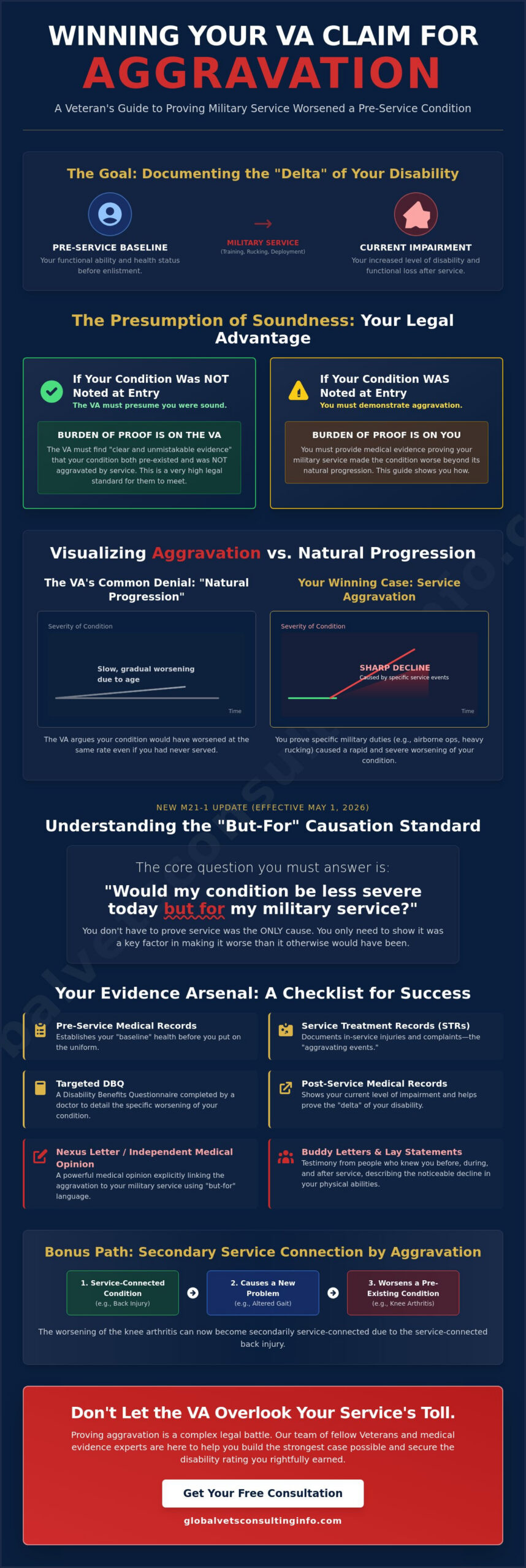
Your entry MEPS physical is the most important document in your file. Under 38 U.S.C. § 1111, the VA must presume you were in “sound condition” when you enlisted unless a disability was clearly noted on that exam. If your condition was not documented at MEPS, the burden of proof shifts entirely to the VA. They must provide “clear and unmistakable evidence” that the condition both existed before service and was not aggravated by it. This is a very high bar for the government to clear, making it your strongest tool in a va claim for aggravation of pre-service condition.
If the condition was noted at entry, the burden shifts to you to prove aggravation. Following the May 1, 2026, M21-1 update, the VA now uses a “but-for” standard for these cases. You don’t have to prove permanent worsening anymore, but you must show that your condition would be less severe today “but for” your military service. This often requires a detailed nexus letter or a specific DBQ to bridge the gap between your pre-service baseline and your current functional impairment.
Aggravation vs. Natural Progression: Proving Your Case
Under 38 CFR 3.306, aggravation is an increase in disability that is not due to the natural progress of the disease. This legal definition is the cornerstone of your va claim for aggravation of pre-service condition. The VA frequently uses “natural progression” as a reason for denial, arguing that your condition would have worsened at the same rate even if you had never served. To overcome this, you must pinpoint specific service events, such as the repetitive impact of airborne operations or the physical toll of a specific MOS, that accelerated your decline.
The landscape of these claims shifted significantly on May 1, 2026, with the VA’s adoption of the “but-for” standard following the Spicer v. McDonough court case. This means the central question is now whether your condition would be less severe today “but for” your military service. You don’t have to prove that the military was the sole cause of your pain. You only need to show that the rigors of active duty pushed your pre-existing injury past the point of its expected natural development.
Countering the ‘Natural Progression’ Denial
To fight a “natural progression” denial, you need to compare your pre-service activity level to your current limitations. If you were an athlete before enlisting but now require medication or assistive devices, that change is critical evidence. We often see success when veterans use medical literature to show that the specific physical requirements of their service, like heavy rucking or prolonged standing, are known to accelerate certain conditions. Establishing this link is a key part of Independent Medical Evidence Education, as it helps you speak the VA’s language during an appeal.
Secondary Service Connection by Aggravation
Aggravation isn’t limited to what happened during your initial enlistment. It also applies when a service-connected disability makes a pre-existing, non-service-connected condition worse. For example, if you have a service-connected back injury that forces you to walk with an altered gait, that change can aggravate pre-existing arthritis in your knees. This creates a secondary path to a VA rating increase by showing that your service-connected disability is the “but-for” cause of the worsening knee pain.
How to Build Your Evidence Package for an Aggravation Claim
Winning a va claim for aggravation of pre-service condition requires a methodical collection of medical and lay evidence. You must provide the VA with a clear map that starts at your pre-service baseline and ends at your current level of functional impairment. This process begins with Step 1: obtaining your pre-service medical records. These documents establish “Point A.” If those records are unavailable, you can use civilian treatment records from that era or your MEPS entrance exam to show the initial severity of the condition.
Step 2 involves securing a Disability Benefits Questionnaire (DBQ) that specifically addresses the aggravation. While a Nexus Letter (Step 3) is important for connecting the dots, the DBQ provides the clinical depth the VA needs to assign a rating. Finally, Step 4 requires Buddy Letters and Personal Statements (VA Form 21-4138). These statements provide the “boots on the ground” perspective of how your condition worsened during your time in service, such as being unable to complete a PT test you previously passed with ease. If you need help understanding which documents are most critical for your situation, explore our Independent Medical Evidence Education resources today.
Using a DBQ to Document Worsening
The DBQ is often the deciding factor in a va claim for aggravation of pre-service condition. You must ensure your medical provider checks the specific box indicating the condition was “aggravated” by service. General statements about pain aren’t enough. The VA looks for objective measurements in the “Clinical Findings” section of your DBQ for VA claims, such as a specific decrease in Range of Motion (ROM) or an increased frequency of flare-ups. Under the February 17, 2026, rule change, your rating will also consider the effects of medication. If your symptoms are only managed because of heavy medication, your DBQ should clearly document the underlying functional impairment that remains.
Submitting Your Claim and Navigating the VA Decision 🇺🇸
Once you’ve gathered your medical evidence, the most efficient way to file is as a Fully Developed Claim (FDC). This process allows the VA to move straight to the decision phase because you’ve already provided all the necessary records, including your DBQs and nexus letters. In the 2026 claims environment, filing an FDC is the best strategy to minimize wait times and reduce the back-and-forth that often leads to delays. You should also ensure your evidence clearly distinguishes between a temporary flare-up and a lasting increase in severity. While the May 1, 2026, M21-1 update clarifies that “permanent worsening” isn’t strictly required to establish service connection, showing a sustained change in your functional baseline makes your va claim for aggravation of pre-service condition much harder to deny.
The Compensation and Pension (C&P) exam is often where these claims are won or lost. You must stand your ground on the aggravation theory. If an examiner suggests your condition is just a result of aging, remind them of the specific service events that caused your symptoms to spike. If you find your va claim denied for lack of evidence, don’t lose hope. Denials are often just a sign that the “delta” between your pre-service health and current status wasn’t clearly articulated in the initial paperwork.
The Role of Independent Medical Opinions
A private doctor’s Independent Medical Opinion (IMO) can carry significant weight, especially when a C&P examiner’s report is brief or dismissive. Your medical evidence needs to meet the “at least as likely as not” standard of proof. This means a qualified professional must state there is at least a 50% chance that your military service aggravated your condition. A well-drafted IMO that uses the 2026 “but-for” standard provides the legal and medical bridge the VA needs to rule in your favor.
Next Steps for Your Rating Increase
Many veterans start with a 0% non-compensable rating for pre-existing conditions. Moving from 0% to a paid percentage requires showing that the aggravation has resulted in measurable functional loss. Whether you’re dealing with musculoskeletal issues or neurological conditions, documenting your worsening symptoms is the only path to the compensation you’ve earned. Contact Global Vets Consulting today for expert DBQ education and support to ensure your evidence package is mission-ready.
Take Command of Your Disability Rating 🇺🇸
Successfully navigating a va claim for aggravation of pre-service condition requires more than just showing you have an injury. You must use the Presumption of Soundness as your shield and the 2026 “but-for” causation standard as your primary strategy. By establishing a clear medical baseline and documenting the specific ways military service accelerated your functional impairment, you can bridge the gap between a denial and the rating you deserve. Clinical depth in your documentation is what finally stops the VA from using the “natural progression” excuse to deny your benefits.
You don’t have to navigate this complex system alone. Global Vets Consulting is veteran-owned and operated, specializing in the DBQ documentation support you need to prove your case. We provide the medical evidence education required to secure a VA rating increase with steady confidence and professional authority. Ready to secure the evidence you need? Contact Global Vets Consulting for DBQ Education today! Our 24/7 National Client Services Hotline 📞 is available to help you move forward. You earned these benefits through your service; it’s time to secure them.
Frequently Asked Questions 🇺🇸
What is the Presumption of Soundness in a VA claim?
The Presumption of Soundness is a legal protection that assumes you were in good health when you entered the military unless a specific disability was noted on your entrance physical. Under 38 U.S.C. § 1111, if your MEPS exam didn’t document a condition, the VA must provide clear and unmistakable evidence that the condition both existed before service and wasn’t worsened by your duties. This shifts the burden of proof from you to the government.
Can I get VA disability if I had the injury before I joined?
Yes, you can receive compensation through a va claim for aggravation of pre-service condition if your time in the military worsened your health beyond its natural progression. The VA acknowledges that the physical and mental demands of active duty can accelerate pre-existing issues. As long as you can show that your service made the condition more severe than it would’ve been otherwise, you are entitled to a disability rating.
How do I prove my military service made my pre-existing condition worse?
You prove aggravation by establishing a medical baseline of your health before service and comparing it to your current functional impairment. Following the May 2026 M21-1 updates, you must satisfy the “but-for” standard; showing that your condition would be less severe today if you hadn’t served. Using a Disability Benefits Questionnaire (DBQ) to document specific changes in range of motion or symptom frequency is the most effective way to provide this proof.
What is the difference between direct service connection and aggravation?
Direct service connection applies to new injuries or illnesses that began during active duty. In contrast, an aggravation claim applies to conditions you already had before enlisting that were made worse by your service. While the evidence requirements differ, both paths lead to the same result: a service-connected disability rating and monthly compensation based on your level of impairment. Both require medical evidence to link your current health to your time in uniform.
What happens if my entry physical didn’t list my pre-existing condition?
If your entry physical didn’t list your pre-existing condition, the VA must legally treat you as if you were perfectly healthy on day one. This triggers the Presumption of Soundness, meaning the VA has to prove your condition pre-existed service and wasn’t aggravated by it. This often makes your va claim for aggravation of pre-service condition much stronger because the government faces a very high evidentiary bar to deny your benefits.
Do I need a Nexus Letter for an aggravation claim?
A Nexus Letter is highly recommended because it provides the medical rationale linking your service to the worsening of your condition. In an aggravation claim, a doctor’s opinion must state that your service-connected duties were “at least as likely as not” the cause of your increased disability. This letter, combined with a detailed DBQ, helps overcome the common “natural progression” denial often issued by VA raters when they claim your injury just aged poorly.

Article by
Willie Daniel
Willie Daniel is the Founder and Chief Executive Officer (CEO) of Global Vets Consulting (GVC) – National Veterans Disability Services, a veteran-led educational and medical evidence support organization dedicated to helping veterans better understand VA disability rating increases, DBQ medical evidence, secondary claims education, and C&P examination preparation.
He is a retired U.S. Army Medical Service Corps Officer with more than 27 years of honorable military service, a decorated Iraq combat veteran, and a retired federal official with the U.S. Department of Veterans Affairs. Throughout his military and federal career, Willie Daniel served in leadership, healthcare administration, operational, and veteran-support roles focused on improving services and support systems for servicemembers, veterans, and their families.
Drawing from decades of military leadership, healthcare administration, veteran advocacy, and federal government experience, Willie Daniel brings a practical, veteran-centered perspective to Global Vets Consulting’s educational articles, AI-powered veteran resources, video education initiatives, and outreach programs. His experience navigating military systems, medical documentation processes, and veteran-related administrative operations provides valuable insight into many of the challenges veterans face when seeking to better understand VA disability rating criteria, medical evidence, documentation strategies, and secondary condition education.
Through GVC’s “Veterans Helping Veterans” mission, his focus is on delivering clear, educational, and easy-to-understand information designed to empower veterans with knowledge, resources, and educational tools that may help them make more informed decisions regarding their individual VA disability journeys.
The information provided through GVC is intended for educational and informational purposes only and should not be considered legal or medical advice.
Disclaimer
Disclaimer: Global Vets Consulting, LLC (“GVC”) is a veteran-led educational and medical evidence support organization. GVC is not a law firm, is not a Veterans Service Organization (VSO), and is not affiliated with the U.S. Department of Veterans Affairs (VA) or any government agency.
Global Vets Consulting does not provide legal advice, medical advice, medical treatment, or healthcare services. GVC does not prepare, file, or submit VA disability claims on behalf of veterans. All information provided through this website, blog articles, videos, educational materials, AI tools, dashboards, templates, and communications is intended solely for general educational and informational purposes.
Veterans are encouraged to consult with accredited representatives, licensed attorneys, qualified medical providers, or Veterans Service Organizations regarding their specific legal, medical, or VA-related matters. VA disability decisions, ratings, and outcomes are determined solely by the U.S. Department of Veterans Affairs based on applicable laws, regulations, medical evidence, and individual circumstances. Past results do not guarantee future outcomes.