
If the VA denied your claim because your injury existed before you put on the uniform, they’re essentially ignoring the physical toll your service took on your body. It is a common hurdle, but an “Existed Prior to Service” (EPTS) note in your records isn’t the end of the road. You likely feel frustrated by medical terminology that seems designed to confuse you, especially when you’re just trying to access the support you were promised. We know that proving a pre-existing condition was worsened by service feels like an uphill battle against a massive bureaucracy, but the law is actually on your side if you have the right strategy. 🇺🇸
In this guide, you’ll learn the exact evidence and legal standards required to prove service-connected aggravation and secure the VA disability benefits you earned. We’ll explore the “aggravation” legal standard and how the Presumption of Soundness under 38 U.S.C. § 1111 protects you from unfair denials. You’ll also discover what specific medical evidence can overcome an EPTS ruling, helping you link your current disability to your time in uniform with confidence. With over 2 million claims processed so far in fiscal year 2026, it’s more important than ever to submit a clear, evidence-backed package that stands out to raters.
Key Takeaways
- Understand how the Presumption of Soundness protects you if your condition wasn’t documented when you entered the service.
- Learn the legal difference between a temporary flare-up and the permanent worsening required for a successful aggravation claim.
- Identify the specific clinical evidence required for proving a pre-existing condition was worsened by service to overcome an EPTS denial.
- Discover how a Medical Nexus Letter and standardized DBQs work together to establish a clear service connection.
- See how professional medical evidence education can help you submit a thorough claim that accurately reflects your current limitations.
Understanding EPTS and the Presumption of Soundness
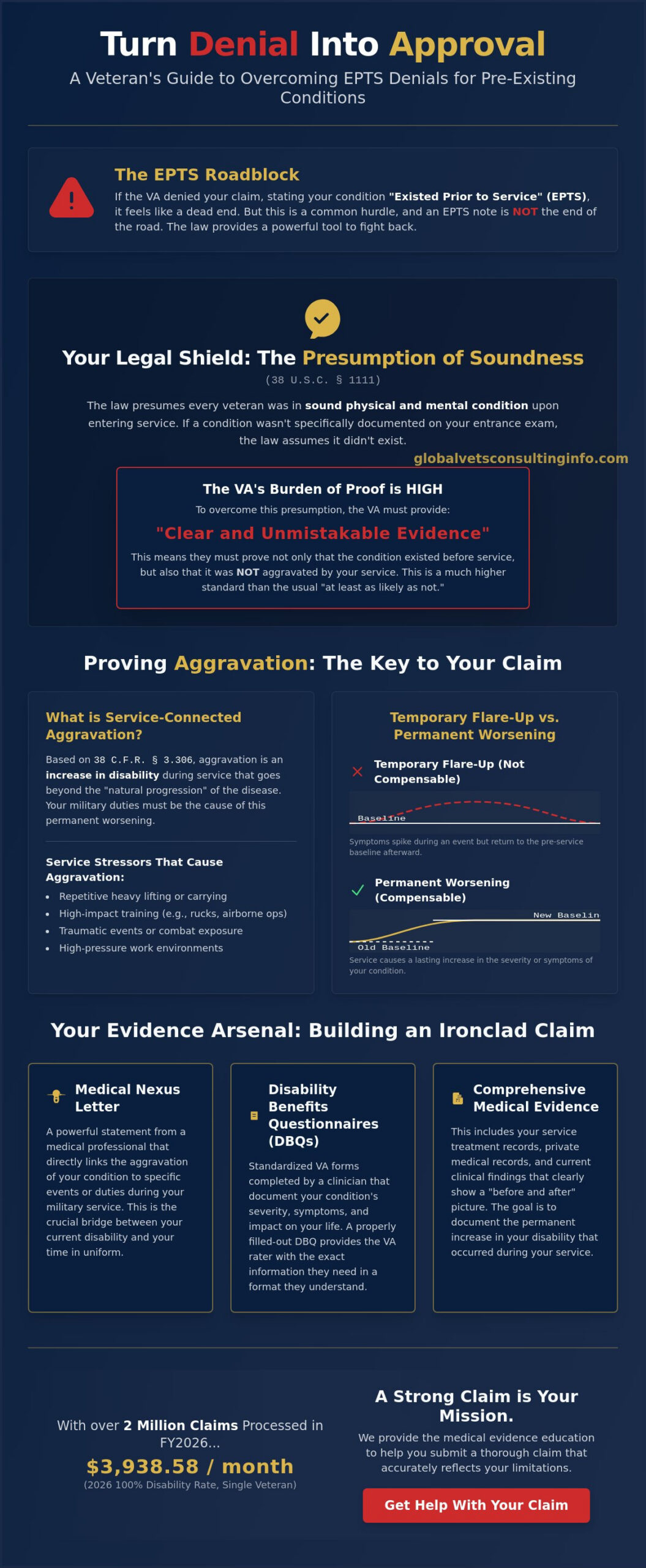
When you receive a denial letter stating your condition “Existed Prior to Service” (EPTS), it can feel like a door has been slammed shut. The VA uses this designation as a primary trigger for denials, suggesting that your injury or illness is a holdover from your civilian life. However, federal law provides a vital safeguard called the Presumption of Soundness. Under 38 U.S.C. § 1111, every veteran is legally presumed to have been in sound physical and mental condition upon entering the service. If a condition wasn’t specifically documented on your entrance physical exam, the law assumes it didn’t exist.
To overcome this presumption, the VA faces a very high legal hurdle. They must provide “clear and unmistakable evidence” that your condition was not only present before your enlistment but also that it was not aggravated by military service. This standard is significantly more demanding than the usual “at least as likely as not” threshold. It requires the VA to present undeniable medical proof that your service played no role in the condition’s development. There’s also a critical distinction between a condition being “noted” on your records and one that merely “manifested” later. If it wasn’t noted at entry, the burden of proof rests entirely on the VA, not on you.
What Happens if Your Condition Was Noted at Entry?
If your entrance exam did list a specific injury, you aren’t disqualified from receiving a VA disability claim. Instead, that notation serves as your medical baseline. The VA is legally responsible for any increase in the severity of that condition that occurred during your time in uniform, provided it exceeds the natural progression of the illness. Successfully proving a pre-existing condition was worsened by service requires showing that your duties or environment caused a permanent increase in disability. You’ve earned these benefits; establishing this link is simply about documenting the reality of your service through thorough medical evidence.
The Aggravation Standard: Proving Your Condition Worsened
The legal foundation for your claim rests on 38 C.F.R. § 3.306. This regulation explains that a pre-existing condition is considered aggravated when there’s an increase in disability during service, unless that increase is the result of the natural progress of the disease. Successfully proving a pre-existing condition was worsened by service requires more than just showing you have more pain now than you did at MEPS. You must demonstrate a permanent change in your clinical baseline that was specifically caused by your military duties. 🇺🇸
It’s vital to distinguish between a temporary flare-up and permanent worsening. The VA generally won’t compensate you for symptoms that spiked during a field exercise but returned to normal afterward. They’re looking for a lasting shift in severity. This often involves combatting the VA’s argument that your condition simply followed its “natural progress.” If you had minor scoliosis at 18, the VA might claim it would naturally be worse at 38. You must counter this by highlighting service-related stressors like repetitive heavy lifting, high-impact training, or traumatic events that accelerated that decline. With the 2026 100% disability rate at $3,938.58 per month for a single veteran, the stakes for getting this evidence right are high. Our medical evidence education can help you identify which stressors to highlight in your documentation.
Mental Health vs. Physical Aggravation
Aggravation isn’t limited to physical injuries. For example, a veteran might enter service with mild, manageable anxiety. The high-pressure environment of a combat zone or the isolation of certain overseas assignments can cause that condition to become a major disability. In these cases, utilizing a dbq for mental health conditions is essential to document how your current symptoms far exceed your pre-service baseline. Physical aggravation is equally common. A pre-existing knee issue might have been stable in civilian life, but years of airborne operations or 12-mile rucks can cause structural damage that wouldn’t have occurred in a typical office job. You need to show that the military environment was the specific catalyst for your current level of impairment.
Gathering Clinical Evidence: The Role of Nexus Letters and DBQs
Winning your claim requires a strategic assembly of medical documentation that speaks the VA’s language. The most critical piece of this puzzle is a Medical Nexus Letter. This document must explicitly state that it is “at least as likely as not,” which means a 50 percent or greater probability, that your condition was aggravated by your military service. Under the standards of 38 CFR § 3.306, your doctor must explain the clinical “how” and “why” behind the worsening of your health. Without this specific medical opinion, the VA often defaults to their “natural progression” argument to deny your benefits.
To build a bulletproof case for proving a pre-existing condition was worsened by service, you should follow these four essential steps:
- Obtain a Nexus Letter: Secure a professional medical opinion that links your service stressors to the permanent worsening of your health.
- Utilize DBQs: Use Disability Benefits Questionnaires to provide a standardized snapshot of your current functional limitations and symptom severity.
- Gather Buddy Statements: Collect lay evidence from fellow service members or family who witnessed your physical decline during or after your service period.
- Show Treatment Continuity: Ensure your private medical records reflect a consistent history of seeking care, which prevents the VA from claiming the condition is unrelated to your time in uniform.
Why a Private DBQ is the Key to Your Aggravation Claim
A private DBQ often provides a much more comprehensive assessment than a standard C&P exam. While a C&P examiner might only spend a few minutes reviewing your history, a private provider can take the time to document every specific flare-up and functional loss. This detail is vital for aggravation claims because the DBQ highlights the “increase in severity” since your enlistment. If you are unsure how these forms work, read our guide on what is a dbq to understand their impact on your rating. Ready to strengthen your claim? Explore our Disability Benefits Questionnaires (DBQ) education to ensure your medical evidence accurately reflects your service-connected aggravation. 🇺🇸
How Global Vets Consulting Supports Your Aggravation Claim 🇺🇸
Global Vets Consulting operates on a “Veterans Helping Veterans” ethos, serving as a dedicated partner for those navigating the complexities of the VA system. We are a veteran-owned consulting service that understands the physical and mental toll of service. Our primary mission is to provide the standardized DBQ documentation you need to accurately reflect your medical status and functional limitations. We specialize in Independent Medical Evidence Education, which empowers you to understand exactly what the VA requires to establish service-connected aggravation.
Many veterans find themselves confused by “VA Math” when dealing with aggravated conditions. In these cases, the VA often subtracts the pre-existing “baseline” level of disability from your current severity to determine your compensable rating. This makes proving a pre-existing condition was worsened by service a matter of clinical precision. We focus on ensuring your medical evidence is thorough, accurate, and ready for VA submission, so the rater sees the clear impact your service had on your health. Our goal is to replace your anxiety with a predictable, evidence-based path toward the benefits you earned. 🌎
Avoiding Denials Through Meticulous Documentation
A frequent cause for a va claim denied for lack of evidence is the failure to document a permanent increase in severity versus a temporary flare-up. We help you avoid this pitfall by prioritizing compliance and accuracy in your medical evidence. Our team is committed to supporting veteran disability evaluations with meticulous attention to detail, ensuring that no symptom or limitation is overlooked. We provide the education necessary to help you link your current disability to your service period successfully.
If you’re ready to secure the support you deserve, we are here to help 24/7. Connect with us today to learn more about our education services and resource awareness.
💻 GlobalVetsConsultingInfo.com
📞 24/7 National Client Services Hotline
🤖 24/7 AI Veteran Intake Specialist
Take the Next Step Toward Your Earned Benefits
Securing a VA rating for a pre-existing condition doesn’t have to be a source of anxiety. By understanding the Presumption of Soundness and focusing on the legal standard of permanent aggravation, you can overcome an initial EPTS denial. The key is moving beyond temporary flare-ups to document a lasting change in your health through high-quality medical evidence. Successfully proving a pre-existing condition was worsened by service is about providing the VA with a clear, clinical baseline compared to your current functional limitations.
As a veteran-owned and operated team, we specialize in the DBQ documentation and medical evidence education required to strengthen your claim. We understand the mission because we’ve lived it. Don’t let a lack of evidence stand between you and the compensation you’ve earned through your service. 🇺🇸
Get the Medical Documentation You Need for Your Aggravation Claim – Global Vets Consulting
📞 24/7 National Client Services Hotline: 1-800-484-0557
🤖 24/7 AI Veteran Intake Specialist
You’ve served your country with honor. Now, it’s time to ensure the VA recognizes the full extent of your sacrifices with the steady confidence and professional support you deserve.
Frequently Asked Questions
What is the VA “aggravation” rule for pre-existing conditions?
The VA aggravation rule establishes that a condition is compensable if military service caused it to worsen beyond its natural progression. This legal standard is defined under 38 C.F.R. § 3.306. When proving a pre-existing condition was worsened by service, you must demonstrate that the increase in disability is permanent rather than a temporary flare-up of symptoms. The VA assumes any worsening is service-connected unless they can prove otherwise.
Can I get VA disability for an injury I had before joining the military?
Yes, you can receive VA disability benefits for a pre-existing injury if your service made it worse. The VA doesn’t disqualify you simply because a condition started in civilian life. You must show that your military duties, such as heavy lifting or high-impact training, caused a permanent increase in the severity of the injury. This allows you to receive a rating for the “aggravated” portion of the disability.
How do I prove my service aggravated my pre-existing condition?
You prove aggravation by providing a Medical Nexus Letter and Disability Benefits Questionnaires (DBQs) that establish a clear medical baseline versus your current severity. Proving a pre-existing condition was worsened by service involves showing that specific service stressors caused a permanent decline in your health. Clinical evidence must state it’s “at least as likely as not” that the military environment accelerated your condition beyond its natural course.
What if my pre-existing condition was not noted on my entry physical?
If the condition wasn’t noted on your entrance exam, the Presumption of Soundness applies under 38 U.S.C. § 1111. This means the law assumes you were in sound condition when you entered the military. To deny your claim, the VA must provide clear and unmistakable evidence that the condition existed before service and wasn’t worsened by it. This is a very high burden of proof for the VA to meet.
How much does the VA pay for aggravated conditions?
The VA pays the same monthly compensation rates for aggravated conditions as they do for any other service-connected disability. As of the 2026 COLA adjustment, a 10% disability rating pays $180.42 per month. A 100% rating for a single veteran is $3,938.58 per month. The VA determines your final payment by calculating the current severity of the condition and subtracting the pre-service baseline level of disability.

Article by
Willie Daniel
Willie Daniel is the Founder and Chief Executive Officer (CEO) of Global Vets Consulting (GVC) – National Veterans Disability Services, a veteran-led educational and medical evidence support organization dedicated to helping veterans better understand VA disability rating increases, DBQ medical evidence, secondary claims education, and C&P examination preparation.
He is a retired U.S. Army Medical Service Corps Officer with more than 27 years of honorable military service, a decorated Iraq combat veteran, and a retired federal official with the U.S. Department of Veterans Affairs. Throughout his military and federal career, Willie Daniel served in leadership, healthcare administration, operational, and veteran-support roles focused on improving services and support systems for servicemembers, veterans, and their families.
Drawing from decades of military leadership, healthcare administration, veteran advocacy, and federal government experience, Willie Daniel brings a practical, veteran-centered perspective to Global Vets Consulting’s educational articles, AI-powered veteran resources, video education initiatives, and outreach programs. His experience navigating military systems, medical documentation processes, and veteran-related administrative operations provides valuable insight into many of the challenges veterans face when seeking to better understand VA disability rating criteria, medical evidence, documentation strategies, and secondary condition education.
Through GVC’s “Veterans Helping Veterans” mission, his focus is on delivering clear, educational, and easy-to-understand information designed to empower veterans with knowledge, resources, and educational tools that may help them make more informed decisions regarding their individual VA disability journeys.
The information provided through GVC is intended for educational and informational purposes only and should not be considered legal or medical advice.
Disclaimer
Disclaimer: Global Vets Consulting, LLC (“GVC”) is a veteran-led educational and medical evidence support organization. GVC is not a law firm, is not a Veterans Service Organization (VSO), and is not affiliated with the U.S. Department of Veterans Affairs (VA) or any government agency.
Global Vets Consulting does not provide legal advice, medical advice, medical treatment, or healthcare services. GVC does not prepare, file, or submit VA disability claims on behalf of veterans. All information provided through this website, blog articles, videos, educational materials, AI tools, dashboards, templates, and communications is intended solely for general educational and informational purposes.
Veterans are encouraged to consult with accredited representatives, licensed attorneys, qualified medical providers, or Veterans Service Organizations regarding their specific legal, medical, or VA-related matters. VA disability decisions, ratings, and outcomes are determined solely by the U.S. Department of Veterans Affairs based on applicable laws, regulations, medical evidence, and individual circumstances. Past results do not guarantee future outcomes.