
Your current VA rating is a snapshot of your health from years ago, but your body doesn’t live in the past. If you’re feeling more pain or facing new functional limitations today, simply telling a rater “it’s worse” isn’t enough to trigger a change. Learning how to prove va disability has worsened in 2026 is actually a clinical mapping exercise. You must translate your daily physical or mental struggles into the specific medical language and standardized benchmarks the VA uses to assign percentages. 🇺🇸
It’s incredibly frustrating when your symptoms progress but your monthly compensation stays stuck, especially as living costs rise. You shouldn’t have to feel anxious about a C&P exam or confused by complex rating schedules. We’re going to show you how to use professional medical documentation and Disability Benefits Questionnaires to bridge the gap between your current health and the rating you deserve. This guide provides a clear path to understanding the 2.8% COLA adjustments for 2026 and gathering the evidence needed to secure an accurate, streamlined increase in your benefits.
Key Takeaways
- Identify the specific clinical red flags, such as increased medication use or frequency of flare-ups, that indicate your service-connected condition requires a formal re-evaluation.
- Master how to prove va disability has worsened by using professional Disability Benefits Questionnaires (DBQs) to provide the VA with a clear, evidence-backed picture of your current health.
- Learn to navigate the 38 CFR Book C to map your specific symptoms to the correct diagnostic codes and higher percentage thresholds.
- Understand how the Fully Developed Claim (FDC) process can speed up your 2026 rating increase by submitting all medical evidence upfront.
- Prepare for your Compensation and Pension (C&P) exam by using your DBQ as a guide to ensure your testimony accurately reflects your documented functional limitations.
Understanding the Increased Claim: When Your Health Outpaces Your Rating 🇺🇸
An “Increased Claim” is a formal request to the VA to re-evaluate a service-connected condition that has deteriorated since your last rating decision. While Understanding VA Benefits can feel like learning a new language, the core concept is simple; your rating should always match your current physical or mental reality. If your symptoms have progressed, your compensation needs to catch up.
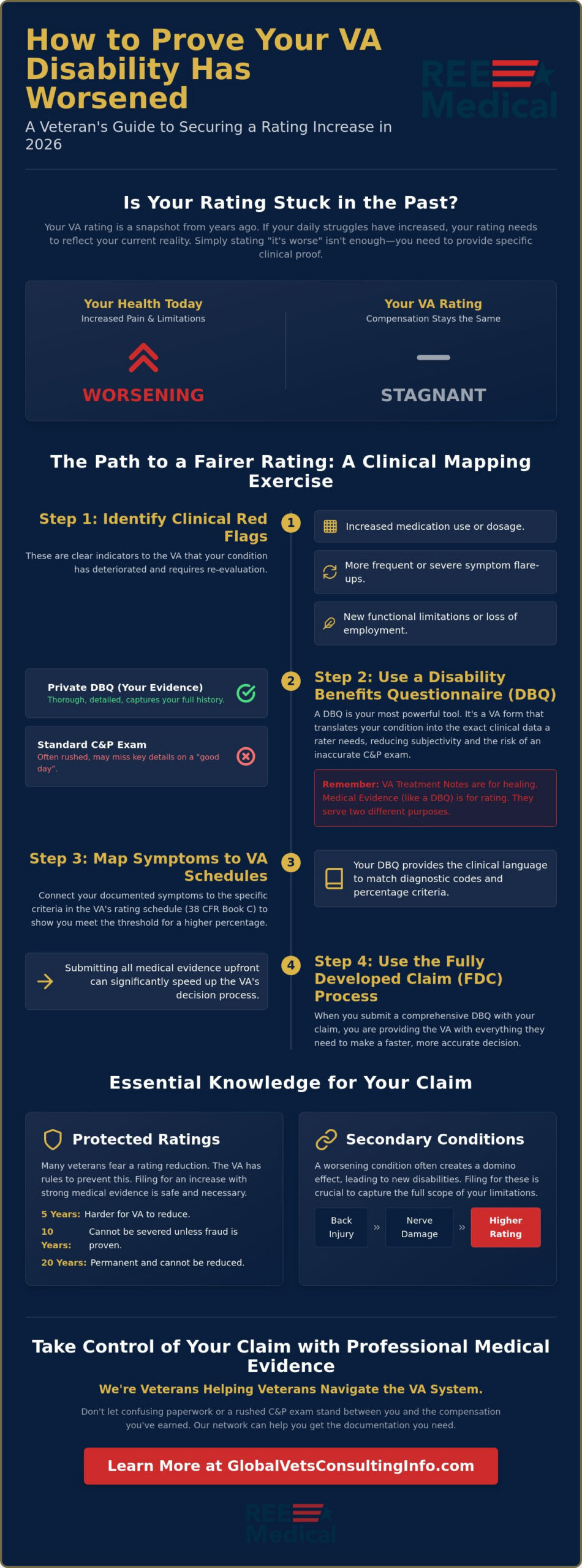
Knowing how to prove va disability has worsened starts with identifying specific clinical red flags. You should consider filing if you notice an increased frequency of flare-ups, new medication requirements, or if your condition has led to a loss of gainful employment. These changes are clear indicators that your previous rating no longer reflects your functional limitations.
The VA disability claims process step by step remains the same for an increase, but your burden of proof shifts. You don’t need to re-establish service connection. Instead, you must provide “new and material evidence” showing that you meet the criteria for a higher percentage. A critical factor in this evidence is VA functional loss, which is defined as the inability of a body part to perform its normal working movements with normal speed, strength, and coordination.
The Risk of Rating Reductions: Myth vs. Reality
Many veterans hesitate to file for an increase because they fear the VA will decrease their current benefits. In reality, the VA follows “Protected Ratings” rules to prevent arbitrary reductions. If you’ve held a rating for 5, 10, or 20 years, specific legal safeguards protect your status. For instance, a rating held for 20 years is permanent and cannot be reduced unless the original grant was fraudulent.
New Symptoms and Secondary Service Connection
Worsening of one condition often creates a domino effect, leading to new, secondary disabilities. For example, a service-connected back injury might eventually cause nerve damage in your legs. Filing for a secondary condition is often a more effective strategy than only seeking an increase for the primary ailment, as it accurately captures the full scope of your disability and its impact on your life.
The Power of Professional Medical Evidence: Why DBQs are Vital
A Disability Benefits Questionnaire (DBQ) is the most powerful tool in your arsenal. These forms are designed by the VA to collect the exact clinical data needed to assign a disability percentage. While the VA often relies on contracted C&P exams, these sessions can be rushed and sometimes fail to capture the full extent of your functional loss. Understanding how to prove va disability has worsened requires a level of accuracy and thoroughness that a brief, high-pressure exam simply cannot provide.
Standardized medical documentation is essential because it reduces rater subjectivity. When you provide a private DBQ, you’re presenting the VA with evidence that is already formatted in the language they use to make decisions. This is especially critical for a DBQ for mental health conditions. PTSD and anxiety symptoms often fluctuate; a single 15-minute C&P exam might catch you on a “good day” and result in an inaccurate rating. A private DBQ ensures that the nuances of your social and occupational impairment are fully documented over time.
Independent Medical Evidence vs. VA Treatment Notes
It is a common mistake to assume that regular VA treatment notes are sufficient to win an increase. Doctors write treatment notes to help you heal, but raters need evidence to determine your level of disability. These are two very different goals. Claim evidence must focus specifically on your limitations and clinical benchmarks. Professional preparation ensures that every “checked box” on your medical forms aligns with your actual clinical reality. Educating yourself on medical evidence requirements is the best way to ensure your claim is fully developed before it hits a rater’s desk.
The Role of the Nexus in Proving Worsening
Even though your service connection is already established, you must still demonstrate that your current decline is a direct progression of that original injury. The link, or nexus, must remain clear so the VA does not attribute your worsening to unrelated factors or natural aging. Private medical opinions can bridge gaps in your history, providing a continuous record of your condition’s decline. You can find more details on the formal requirements through the VA’s guide on How to File a Claim for Increased Compensation. Using this authoritative framework ensures your evidence meets the VA’s high standards for 2026.
How to Map Your Symptoms to the VA Rating Schedule 📞
Mapping your clinical symptoms to the legal criteria used by the VA is the most effective way to understand how to prove va disability has worsened. This process allows you to “self-audit” your claim before you ever submit VA Form 21-526EZ. By comparing your daily reality to the VA Schedule for Rating Disabilities, you can identify exactly which clinical benchmarks you need to document to trigger an increase.
- Step 1: Access the 38 CFR Book C to find the specific “Diagnostic Code” (DC) for your condition. This code dictates the exact symptoms the VA looks for.
- Step 2: Compare your current clinical symptoms, such as a reduced range of motion or an increased frequency of seizures, to the higher percentage thresholds listed in that DC.
- Step 3: Document your “worst days” rather than your average days. The VA rates you based on your level of impairment during flare-ups, not when you’re feeling your best.
- Step 4: Utilize a DBQ for a VA disability rating increase to formalize these findings into the standardized language a rater expects to see.
Understanding “VA Math” and Combined Ratings
You must also account for “VA Math” when seeking an increase. Because the VA uses a combined rating table, an increase in one condition doesn’t always change your overall monthly payment. For example, in 2026, a single veteran at a 70% rating receives $1,808.45 per month. Moving to an 80% rating increases that compensation to $2,102.15. While the jump to 90% provides even more financial security, the “math” requires your combined disabilities to reach the next ten-percent bracket through a specific calculation of remaining efficiency.
Common Pitfalls in Symptom Reporting
A major pitfall is “toughing it out” during your medical evaluations. If a rater asks you to move your arm, stop the moment it starts to hurt; pushing through pain gives an inaccurate representation of your disability. You should also use “Lay Statements” from family or friends to support your medical evidence. These statements provide a 24/7 view of your worsening condition that a short exam can’t capture. If you want to ensure your evidence is as strong as possible, connect with our veteran intake specialists for a thorough review of your documentation needs.
Filing Your Claim and Navigating the 2026 C&P Exam 🌐
Choosing the right filing path is just as important as the evidence itself. The “Fully Developed Claim” (FDC) lane is your best option for a faster decision in 2026. By submitting your private DBQs and medical records upfront, you signal to the VA that your claim is ready for immediate rating. This proactive approach is a core part of how to prove va disability has worsened, as it removes the guesswork for the rater and can significantly reduce the standard 120 to 160 day processing window.
Preparation is your best defense against the anxiety of a Compensation and Pension (C&P) exam. You should use your private DBQ as a “study guide” before your appointment. Review the specific functional limitations your doctor documented, such as range of motion degrees or the frequency of your symptoms. During the exam, your testimony must remain consistent with this clinical evidence. If the VA claim is denied for lack of evidence, don’t lose hope. The Supplemental Claim option allows you to submit new and relevant documentation to address the rater’s concerns while preserving your original effective date.
Your health is dynamic, and your benefits should be too. Don’t settle for an outdated rating that doesn’t cover your current needs or reflects a version of you that no longer exists. 🇺🇸
24/7 Support for Your Documentation Needs 📞
Global Vets Consulting is committed to providing standardized forms that accurately reflect your current health. We understand the intricacies of the bureaucratic system and work to simplify it for you. Our 24/7 National Client Services Hotline and 24/7 AI Veteran Intake Specialist are always available to help you start the process of gathering meticulous evidence. Taking immediate action ensures you have the necessary paperwork for an accurate evaluation by the VA.
The Legacy of Your Service: Securing Your Future 🌐
A rating increase is more than just a monthly check; it’s a matter of long-term security for you and your dependents. As living costs rise in 2026, securing the compensation you’ve earned is vital for your peace of mind. We invite you to reach out for a professional consultation to review your current documentation and identify any gaps in your evidence. Visit Global Vets Consulting today to take the first step toward a rating that truly reflects your service and your sacrifice.
Secure the Rating You’ve Earned Today 🇺🇸
You’ve served your country with honor, and your disability rating should reflect the physical and mental reality you live with every day. Successfully mastering how to prove va disability has worsened is about shifting from a passive approach to an evidence-driven strategy. By mapping your current symptoms to the VA Schedule for Rating Disabilities and utilizing professional Disability Benefits Questionnaires (DBQ), you can bridge the gap between your previous assessment and your current functional limitations.
Securing an increase in 2026 requires meticulous documentation that standard medical notes often lack. Since 2021, Global Vets Consulting has been veteran-owned and operated, providing specialized education on medical evidence to help our peers navigate these complex administrative hurdles. We provide a predictable path forward through our 24/7 National Client Services Hotline, ensuring you never have to face the VA system alone. Don’t wait for your condition to improve on its own or for the VA to notice the change; take the next step toward the financial security you deserve.
Your health is too important to leave to chance. It’s time to take control of your claim and secure the future you and your family have earned.
Frequently Asked Questions
Will the VA automatically increase my rating as I get older?
The VA does not automatically increase ratings simply because you are getting older. Disability percentages are strictly tied to the severity of your symptoms and how they impact your ability to work or perform daily tasks as defined in the rating schedule. If you believe your age is exacerbating a service-connected injury, you must still provide clinical evidence of increased functional loss to secure a higher rating. Relying on age alone will not trigger a re-evaluation of your benefits.
Can I use a private doctor to fill out my DBQ for a rating increase?
You absolutely can use a private doctor to complete a Disability Benefits Questionnaire (DBQ). In fact, private medical documentation is a central strategy in how to prove va disability has worsened. Private physicians often have a deeper understanding of your medical history compared to a VA-contracted examiner who might only see you for fifteen minutes. Ensure your doctor uses the most current VA forms to maintain compliance and provides detailed clinical findings.
What happens if my C&P exam contradicts my private medical evidence?
When a C&P examiner’s report contradicts your private medical evidence, the VA rater is required to weigh both opinions. If your private evidence is more thorough and clinically sound, it can serve as a powerful rebuttal during the decision process. If the rater still denies the increase based on a flawed C&P exam, you have the right to file a Supplemental Claim or a Higher-Level Review to challenge the decision and present your evidence again.
How long does it take for the VA to process a claim for an increase in 2026?
Processing times for a VA rating increase in 2026 typically range between 90 and 160 days. Claims that require a new C&P exam often lean toward the longer end of that spectrum, usually falling between 120 and 160 days. Utilizing the Fully Developed Claim (FDC) path by submitting all your evidence upfront is the most effective way to keep your claim on the faster side of this timeline and avoid unnecessary administrative delays.
Is a 100% P&T rating possible through an increased claim?
A 100% Permanent and Total (P&T) rating is definitely possible through an increased claim if your symptoms have reached the highest scheduler threshold. To achieve this, your medical evidence must demonstrate that your condition is not expected to improve for the rest of your life. This status provides the highest level of long-term security and additional benefits for your dependents, such as CHAMPVA healthcare and Chapter 35 education assistance for your children.

Article by
Willie Daniel
Willie Daniel is the Founder and Chief Executive Officer (CEO) of Global Vets Consulting (GVC) – National Veterans Disability Services, a veteran-led educational and medical evidence support organization dedicated to helping veterans better understand VA disability rating increases, DBQ medical evidence, secondary claims education, and C&P examination preparation.
He is a retired U.S. Army Medical Service Corps Officer with more than 27 years of honorable military service, a decorated Iraq combat veteran, and a retired federal official with the U.S. Department of Veterans Affairs. Throughout his military and federal career, Willie Daniel served in leadership, healthcare administration, operational, and veteran-support roles focused on improving services and support systems for servicemembers, veterans, and their families.
Drawing from decades of military leadership, healthcare administration, veteran advocacy, and federal government experience, Willie Daniel brings a practical, veteran-centered perspective to Global Vets Consulting’s educational articles, AI-powered veteran resources, video education initiatives, and outreach programs. His experience navigating military systems, medical documentation processes, and veteran-related administrative operations provides valuable insight into many of the challenges veterans face when seeking to better understand VA disability rating criteria, medical evidence, documentation strategies, and secondary condition education.
Through GVC’s “Veterans Helping Veterans” mission, his focus is on delivering clear, educational, and easy-to-understand information designed to empower veterans with knowledge, resources, and educational tools that may help them make more informed decisions regarding their individual VA disability journeys.
The information provided through GVC is intended for educational and informational purposes only and should not be considered legal or medical advice.
Disclaimer
Disclaimer: Global Vets Consulting, LLC (“GVC”) is a veteran-led educational and medical evidence support organization. GVC is not a law firm, is not a Veterans Service Organization (VSO), and is not affiliated with the U.S. Department of Veterans Affairs (VA) or any government agency.
Global Vets Consulting does not provide legal advice, medical advice, medical treatment, or healthcare services. GVC does not prepare, file, or submit VA disability claims on behalf of veterans. All information provided through this website, blog articles, videos, educational materials, AI tools, dashboards, templates, and communications is intended solely for general educational and informational purposes.
Veterans are encouraged to consult with accredited representatives, licensed attorneys, qualified medical providers, or Veterans Service Organizations regarding their specific legal, medical, or VA-related matters. VA disability decisions, ratings, and outcomes are determined solely by the U.S. Department of Veterans Affairs based on applicable laws, regulations, medical evidence, and individual circumstances. Past results do not guarantee future outcomes.