
Your current disability rating is not a permanent label; it is merely a snapshot of your health from a time that may no longer reflect your daily reality. If you find that your symptoms are increasingly interfering with your career and family life, you are likely feeling the frustration of a system that does not seem to listen. It’s common to feel ignored by VA doctors or anxious that a new PTSD Increase Claim might actually result in a rating decrease. You deserve a monthly compensation level that acknowledges the true challenges you face, especially as the 2026 cost of living adjustments highlight how vital accurate support is for your stability.
You can take back control of this administrative process by shifting the focus from simple symptom lists to clear, documented functional impairment. This article teaches you exactly how to document your worsening condition and utilize a private Disability Benefits Questionnaire (DBQ) to secure the rating you have earned. We will guide you through the current 38 CFR § 4.130 criteria and provide a step-by-step path to streamline your claim for a successful, predictable outcome.
Key Takeaways
- Understand how the VA applies the General Rating Formula for Mental Disorders to measure your current level of occupational and social impairment.
- Discover how to leverage the “Big Three” of evidence—medical records, personal statements, and buddy letters—to build a robust case for your PTSD Increase Claim.
- Learn why a private Disability Benefits Questionnaire (DBQ) is often the gold standard for proving functional impairment compared to a brief C&P exam.
- Master the step-by-step process of filing an Intent to File (ITF) to protect your effective date and maximize your potential backpay.
- Gain the education needed to transition from feeling ignored by the system to submitting a meticulous, evidence-based claim that accurately reflects your disability.
Evaluating Your Current PTSD Rating vs. 2026 VA Criteria 🇺🇸
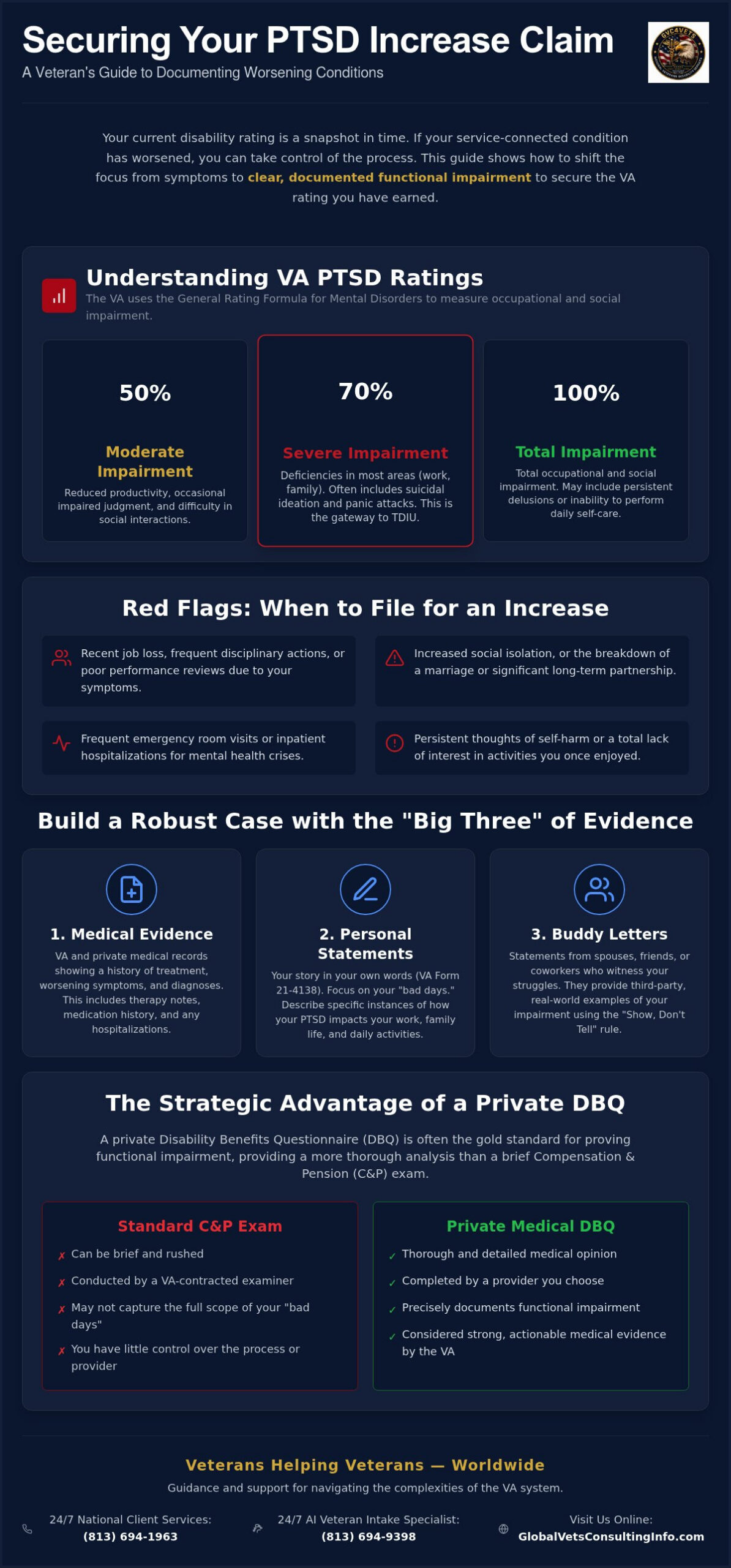
Understanding how the VA evaluates your mental health is the first step in a successful PTSD Increase Claim. The VA relies on the General Rating Formula for Mental Disorders to assign a percentage to your condition. This formula focuses on “Occupational and Social Impairment,” which means the VA isn’t just looking for a diagnosis. They’re looking at how your symptoms prevent you from functioning in a workplace or maintaining a stable home life.
Under the 2026 VA Criteria, the difference between a 50% and 70% rating often comes down to the frequency and severity of your bad days. While a 50% rating reflects reduced productivity and occasional impaired judgment, a 70% rating indicates deficiencies in most areas of your life. For those seeking a 100% rating, the VA requires evidence of “total occupational and social impairment.” This level of disability often includes persistent delusions, hallucinations, or an inability to perform basic activities of daily living like hygiene or self-care.
The 70% PTSD Rating: The Gateway to TDIU
A 70% rating is a critical threshold for many veterans because it acknowledges severe impairment. At this level, symptoms typically include suicidal ideation, near-continuous panic attacks, and a significant inability to maintain healthy relationships with family or coworkers. This rating is frequently called the gateway to Total Disability Individual Unemployability (TDIU). If your PTSD makes it impossible to maintain gainful employment, a 70% rating provides the legal pathway to receive 100% monthly compensation rates even if your scheduler rating is lower.
When to File for a PTSD Increase
You should consider filing when your symptoms begin to spiral beyond your current rating’s description. Watch for these red flags:
- Recent job loss or frequent disciplinary actions at work due to temper or memory issues.
- Increased social isolation or the complete breakdown of a marriage or long-term partnership.
- Frequent emergency room visits or inpatient hospitalizations for mental health crises.
- Persistent thoughts of self-harm or a total lack of interest in daily activities.
The effective date for an increase is usually the date you filed your Intent to File or the date your medical records first show your symptoms reached the higher criteria level.
Gathering the Evidence Needed for a Successful PTSD Increase
Winning a PTSD Increase Claim requires more than just telling the VA your symptoms have worsened. You must provide undeniable proof through what we call the “Big Three” of evidence: medical records, personal statements, and buddy letters. This combination creates a complete picture of your daily life that a single doctor’s visit cannot capture. For a clear roadmap on how these pieces fit together, you can follow the VA Disability Claims Process Step by Step guide.
Your personal statement on VA Form 21-4138 is your opportunity to speak directly to the rater. Many veterans make the mistake of describing their average day. Instead, you should focus your statement on your “bad days.” Detail the specific times you couldn’t leave the house, the nights you didn’t sleep, or the moments you felt completely overwhelmed. This document should also mention secondary conditions like sleep apnea or migraines, as these often worsen alongside your mental health and provide additional proof of your overall level of impairment. When you are ready to begin, review the official guidance on How to File Your PTSD Increase Claim Step-by-Step to ensure your timing is correct.
The Power of Buddy Statements
Buddy statements from spouses, former coworkers, or fellow service members are vital because they see what you might try to hide. These witnesses should follow the “Show, Don’t Tell” rule. Instead of saying you are “angry,” they should describe a specific incident where you lost your temper over a minor issue. These specific examples provide the rater with concrete evidence of how your PTSD manifests in the real world. If you need help organizing this documentation, our team provides expert benefits education to help you stay on track.
Documenting Occupational Impairment
Your work history is often the most objective evidence of a worsening condition. If you have received poor performance reviews, disciplinary actions, or termination letters, include them in your claim. These documents link your service-connected symptoms directly to your inability to maintain employment. Tracking the frequency of your “call-outs” or workplace conflicts helps prove that your disability has reached a higher tier of impairment. This paper trail is difficult for the VA to ignore when it comes from an employer’s perspective.
The Strategic Advantage of a Private DBQ for PTSD
A Disability Benefits Questionnaire (DBQ) is the precise tool VA raters use to decide your compensation level. It’s often called the “gold standard” of evidence because it translates your mental health struggles into the exact language the VA requires for a PTSD Increase Claim. While the VA will schedule a Compensation and Pension (C&P) exam, these appointments can be as short as 15 minutes. This brief window is rarely enough time to capture the complex reality of your symptoms.
By contrast, a private medical evaluation is much more thorough. It allows you to spend significant time with a professional who can document the full scope of your occupational and social impairment. This level of detail is essential for Gathering the Evidence Needed to prove your condition has worsened. When you submit a completed, private DBQ with your application, you can file through the “Fully Developed Claim” (FDC) path. This tells the VA you’ve provided all necessary evidence up front, which often leads to a faster decision.
Global Vets Consulting specializes in educating you on how to use a DBQ for a VA disability rating increase. If you want to ensure your evidence is meticulous and accurate, get started with our expert education today.
Countering a Bad C&P Exam
It’s a common fear among veterans that a VA examiner might downplay their symptoms. If you receive a medical opinion that doesn’t reflect your reality, a private DBQ acts as a powerful rebuttal. It provides a competing medical record that the VA must consider. Having this evidence already in your file before your C&P exam even happens creates a stronger foundation for your claim and reduces the anxiety of relying on a single, rushed appointment.
Ensuring Your DBQ is “VA-Ready”
A DBQ is only effective if it meets the VA’s strict standards. It must include objective clinical observations and results from diagnostic testing, such as the PCL-5. Most importantly, the medical professional must state they’ve reviewed your entire C-File. This ensures their opinion is based on your complete history, making it much harder for the VA to dismiss the findings as incomplete or anecdotal.
How to File Your PTSD Increase Claim Step-by-Step 🌎
Preserving your effective date is the first priority in this process. You should file an Intent to File (ITF) immediately. This simple action locks in your potential backpay while you gather the necessary medical evidence for your PTSD Increase Claim. Once the ITF is active, you have exactly one year to submit your completed package without losing that earlier start date.
After your ITF is filed, you must secure your private medical evidence. This includes obtaining a completed PTSD DBQ that accurately reflects your current level of impairment. When your documentation is ready, submit your application as a “Fully Developed Claim” (FDC). This specific filing path signals to the VA that no further evidence is needed, which typically results in faster processing times. Finally, you should prepare for a potential C&P exam by thoroughly reviewing your submitted statements and medical records. Consistency between your written evidence and your verbal testimony is vital for a successful outcome.
Common Pitfalls to Avoid
The “Good Day” Trap is the most frequent mistake veterans make during evaluations. You might feel the urge to put on a brave face and tell the examiner you’re “doing fine.” You must resist this impulse. If you describe your best days, the rater will assume your condition is stable or improving. Always focus on your worst days to ensure the VA understands the full severity of your disability. Additionally, pay close attention to your decision letter. If the VA denies your increase, you have a one-year window to appeal while maintaining your original effective date. Missing this deadline can cost you thousands in backpay.
What to Expect After Submitting
Once your claim is submitted, it enters the “Evidence Gathering, Review, and Decision” phase. In 2026, the VA continues to face a high volume of claims, but the FDC path remains the most efficient route. You can monitor your progress through the VA portal to see when your claim moves into the final stages. If you find the process confusing or feel like your claim has stalled, you can reach out to our 24/7 National Client Services Hotline for support. Staying informed and proactive is the best way to ensure you receive the recognition and compensation you have earned through your service.
Take the Next Step Toward Your Earned Benefits 🇺🇸
You’ve served your country with honor; now it’s time to ensure the system honors your current reality. A successful PTSD Increase Claim isn’t just about listing your symptoms. It requires a strategic approach that combines an immediate Intent to File with meticulous medical evidence. By leveraging a private Disability Benefits Questionnaire (DBQ), you can bypass the limitations of a rushed C&P exam and present a clear picture of your functional impairment to the VA.
Global Vets Consulting is a veteran-owned and operated team dedicated to providing worldwide support through specialized DBQ education. We understand the intricacies of the 2026 rating criteria and are ready to help you navigate this bureaucratic path with steady confidence. You don’t have to face this complex system alone.
Ready to secure the rating you earned? Contact our 24/7 Veteran Intake Specialist today.
Your health and stability are worth the effort of a well-documented claim. We’re here to help you move forward.
Frequently Asked Questions
Can the VA decrease my PTSD rating if I file for an increase?
Yes, the VA has the authority to decrease your rating if your medical evidence shows sustained improvement. When you file a PTSD Increase Claim, you effectively reopen your entire file for review. This is why submitting meticulous documentation is vital. You must ensure your medical records and private DBQ clearly demonstrate that your symptoms have worsened or remained severe rather than improved over time.
How long does a PTSD increase claim take in 2026?
Most veterans see a decision on their increase claim within 120 to 150 days. This timeline depends heavily on the type of claim you file and the complexity of your evidence. Filing a Fully Developed Claim (FDC) with all your medical evidence attached at the start is the most efficient way to reduce wait times. It allows the VA to bypass the lengthy evidence gathering phase and move straight to the review process.
What is the difference between 70% and 100% PTSD ratings?
The primary difference lies in the level of “total” versus “most” impairment. A 70% rating reflects severe deficiencies in most areas of life, such as work, family, and judgment. A 100% rating requires evidence of total occupational and social impairment. This often involves symptoms like persistent delusions, an inability to maintain minimal personal hygiene, or a constant danger of hurting yourself or others.
Do I need a new nexus letter for a PTSD increase claim?
You typically don’t need a new nexus letter if your PTSD is already service-connected. The VA has already acknowledged that your condition is related to your military service. Your goal for an increase is to prove that your symptoms have become more debilitating. Focus your efforts on securing a high-quality “Review PTSD DBQ” and gathering medical records that document your increased functional impairment in your daily life.
What happens if my PTSD increase claim is denied?
You have the right to appeal the decision through a Supplemental Claim, a Higher-Level Review, or a Board Appeal. It’s important to review your decision letter to see exactly where the VA found your evidence lacking. You must file your appeal within one year of the denial date to protect your original effective date and any potential backpay you’ve earned.
Can I get a 100% PTSD rating and still work?
You can work with a 100% scheduler rating for PTSD without any income restrictions. The VA does not limit your earnings if your 100% rating is based on the severity of your symptoms. However, if your 100% compensation comes through Total Disability Individual Unemployability (TDIU), you are generally prohibited from maintaining “substantial gainful employment.” Always verify your specific rating type before returning to the workforce.

Article by
Willie Daniel
Willie Daniel is the Founder and Chief Executive Officer (CEO) of Global Vets Consulting (GVC4Vets) – National Veterans Disability Services, a veteran-led educational and medical evidence support organization dedicated to helping veterans better understand VA disability rating increases, DBQ medical evidence, secondary claims education, and C&P examination preparation.
He is a retired U.S. Army Medical Service Corps Officer with more than 27 years of honorable military service, a decorated Iraq combat veteran, and a retired federal official with the U.S. Department of Veterans Affairs. Throughout his military and federal career, Willie Daniel served in leadership, healthcare administration, operational, and veteran-support roles focused on improving services and support systems for servicemembers, veterans, and their families.
Drawing from decades of military leadership, healthcare administration, veteran advocacy, and federal government experience, Willie Daniel brings a practical, veteran-centered perspective to Global Vets Consulting’s educational articles, AI-powered veteran resources, video education initiatives, and outreach programs. His experience navigating military systems, medical documentation processes, and veteran-related administrative operations provides valuable insight into many of the challenges veterans face when seeking to better understand VA disability rating criteria, medical evidence, documentation strategies, and secondary condition education.
Through GVC’s “Veterans Helping Veterans” mission, his focus is on delivering clear, educational, and easy-to-understand information designed to empower veterans with knowledge, resources, and educational tools that may help them make more informed decisions regarding their individual VA disability journeys.
The information provided through GVC is intended for educational and informational purposes only and should not be considered legal or medical advice.
Disclaimer
Disclaimer: Global Vets Consulting, LLC (“GVC”) is a veteran-led educational and medical evidence support organization. GVC is not a law firm, is not a Veterans Service Organization (VSO), and is not affiliated with the U.S. Department of Veterans Affairs (VA) or any government agency.
Global Vets Consulting does not provide legal advice, medical advice, medical treatment, or healthcare services. GVC does not prepare, file, or submit VA disability claims on behalf of veterans. All information provided through this website, blog articles, videos, educational materials, AI tools, dashboards, templates, and communications is intended solely for general educational and informational purposes.
Veterans are encouraged to consult with accredited representatives, licensed attorneys, qualified medical providers, or Veterans Service Organizations regarding their specific legal, medical, or VA-related matters. VA disability decisions, ratings, and outcomes are determined solely by the U.S. Department of Veterans Affairs based on applicable laws, regulations, medical evidence, and individual circumstances. Past results do not guarantee future outcomes.