
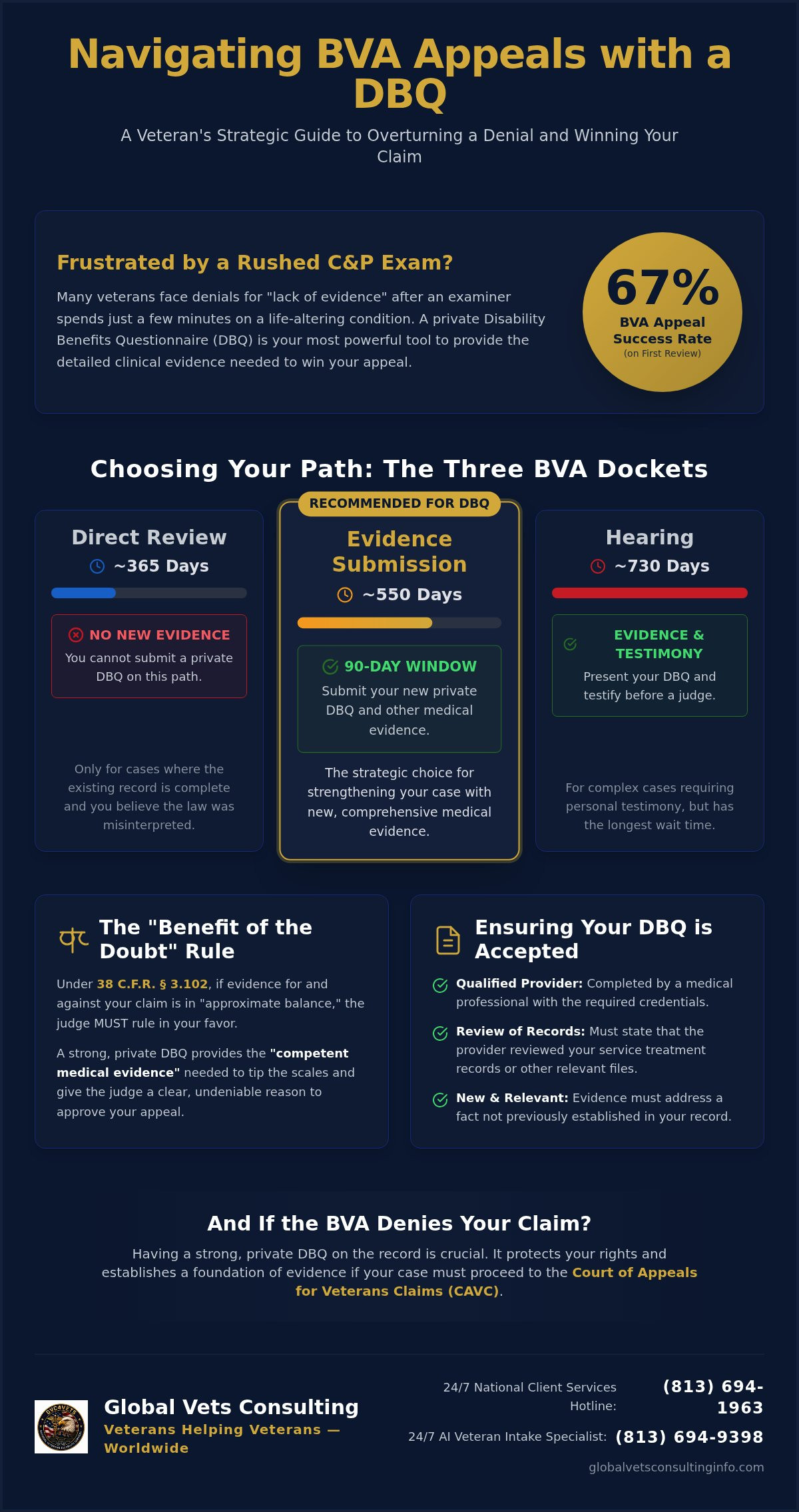
Did you know that in 2026, 67% of appeals to the Board of Veterans’ Appeals (BVA) are successful on the first review? It is deeply frustrating when a C&P examiner spends only five minutes evaluating a condition that affects your life every single day. Many veterans live with the constant fear that their appeal will be denied again for a “lack of evidence,” especially after a rushed or incomplete exam. We understand that feeling of being neglected by a complex system that should be supporting your transition to civilian life.
In this article, you will learn how using a dbq in a bva appeal can serve as your primary tool to challenge the VA’s findings and provide the clinical detail necessary to overturn a denial or low rating. We will guide you through the strategic choice between the Evidence Submission docket, which currently averages 550 days, and the faster Direct Review docket. You will also discover how to introduce new medical evidence effectively and what to expect if your journey moves toward the Court of Appeals for Veterans Claims (CAVC). Our goal is to provide the clarity and peace of mind you need to navigate this process with steady confidence.
Key Takeaways
- Understand how a private DBQ acts as a clinical snapshot to challenge the VA’s previous findings under the Appeals Modernization Act.
- Learn why selecting the Evidence Submission or Hearing docket is mandatory when using a dbq in a bva appeal, as the Direct Review docket prohibits new evidence.
- Discover the specific medical provider credentials and “Review of Records” statements the Board requires to ensure your private evidence is deemed sufficient for rating.
- Secure your medical evidence on the record now to protect your rights if your case eventually proceeds to the Court of Appeals for Veterans Claims.
The Role of a DBQ in the Board of Veterans’ Appeals (BVA) Process
The Board of Veterans’ Appeals represents the second tier of the VA’s Appeals Modernization Act (AMA) system. When you move beyond a Higher-Level Review or a Supplemental Claim, you’re asking a Veterans Law Judge to take a fresh look at your case. In this high-stakes environment, a Disability Benefits Questionnaire (DBQ) serves as the “clinical snapshot” the Board uses to determine your rating percentage. It’s the primary document that translates your physical or mental symptoms into the specific legal language the VA requires for an accurate evaluation.
Judges frequently remand cases back to the regional office because the initial medical evidence was “inadequate for rating purposes.” This often happens when a C&P examiner fails to document the full severity of your condition. Using a dbq in a bva appeal allows you to provide a comprehensive rebuttal to a negative or rushed C&P exam. Instead of relying on a five-minute government assessment, you can present a thorough medical record that accurately reflects your daily struggles.
Why Medical Evidence is the Foundation of a BVA Win
Success at the Board often hinges on the “Benefit of the Doubt” rule. Under 38 C.F.R. § 3.102, if the evidence for and against your claim is roughly equal, the judge must rule in your favor. A strong, private DBQ provides the “competent medical evidence” needed to tip those scales. While your personal “lay evidence” is vital for describing how a condition feels, the Board requires the clinical expertise found in a DBQ to establish service connection or justify a rating increase. It’s about giving the judge a clear, undeniable reason to say “yes.”
Common Reasons for BVA Denials Related to Evidence
It’s a painful reality that many veterans find their va claim denied for lack of evidence during the initial stages of the process. At the BVA level, denials usually stem from a missing nexus or an incomplete list of symptoms that doesn’t meet the next highest rating criteria. If your previous records didn’t clearly link your condition to your service, a private DBQ can bridge that gap. It ensures that every symptom is documented according to the VA’s specific schedule for rating disabilities.
Choosing the Right BVA Docket for Submitting Your DBQ
Selecting your path at the Board is a critical tactical decision. When you file your Notice of Disagreement, you must choose one of three dockets. Choosing the Right BVA Docket depends entirely on whether you have new evidence to present. If you’re using a dbq in a bva appeal to fix a flawed C&P exam, you can’t select the Direct Review docket. This docket is designed for cases where the record is already complete; it’s the fastest option at approximately 365 days, but it strictly prohibits adding new medical documentation.
For most veterans seeking to strengthen their case, the Evidence Submission docket or the Hearing docket are the only viable choices. The Hearing docket allows you to testify before a Veterans Law Judge (VLJ) and provides a window to submit a DBQ after your testimony. This path currently faces the longest wait time, averaging about 730 days. If you’re looking for a middle ground, the Evidence Submission docket offers a 550 day average timeline and a specific window for your new evidence.
The Evidence Submission Docket: A Strategic Deep Dive
This docket gives you a 90 day window to submit your private medical evidence. This period begins the moment your appeal is received by the Board. Under the Appeals Modernization Act (AMA) rules, your DBQ must be “new and relevant.” This means it should address a fact that wasn’t previously established in your record. We recommend submitting your documentation as early as possible within that 90 day window to ensure it’s properly associated with your file before the judge begins their review. If you need help understanding which evidence fits your specific condition, you can explore our resources at globalvetsconsultinginfo.com.
When to Use a DBQ for a Rating Increase at the BVA
Wait times at the Board can be lengthy, and your physical or mental health might change while you wait. You can learn more about how to use a dbq for a va disability rating increase in 2026 to capture these changes. If your symptoms have worsened during the 365 to 730 days your appeal has been pending, a new DBQ provides the judge with an updated clinical picture. This ensures your final rating reflects your current level of impairment rather than how you felt years ago.
How to Ensure Your Private DBQ is Accepted by the Board
To win at the Board, your evidence must be bulletproof. A Veterans Law Judge (VLJ) reviews your file with a legal eye, looking for specific clinical markers that justify a higher rating. Using a dbq in a bva appeal requires more than just a signature; it requires a document that stands up to judicial scrutiny. The foundation of this acceptance is rooted in The Role of a DBQ as defined by federal law, which mandates that medical evidence must be sufficient for rating purposes. If you need help securing the right medical documentation, visit globalvetsconsultinginfo.com to explore our educational resources.
The Board places significant weight on the specialty of the doctor signing your form. For instance, a DBQ for a neurological condition carries much more authority when signed by a neurologist rather than a general practitioner. Additionally, the signing physician must explicitly state they reviewed your entire VA Claims File (C-File). Without this “Review of Records” statement, the Board often dismisses private evidence, claiming the doctor lacked a complete understanding of your medical history. Your doctor must also provide a clear clinical rationale. Judges frequently ignore “conclusory” statements where a doctor simply checks a box without explaining the “why” behind the diagnosis. They want to see the clinical work that leads to the result.
Addressing Mental Health specifically at the BVA
Mental health claims are under intense scrutiny in 2026. If you are submitting a dbq for mental health conditions, the VLJ will look specifically for the occupational and social impairment section. The Board requires precise markings that align with the 30%, 50%, 70%, or 100% rating criteria. A vague description of “anxiety” isn’t enough; the DBQ must detail how your symptoms interfere with your ability to work and maintain relationships.
The Importance of the Medical Nexus in Appeals
A Medical Nexus is the bridge between service and current diagnosis. While a DBQ details the severity of your symptoms, a nexus statement provides the expert opinion that your condition was “at least as likely as not” caused or aggravated by your military service. Combining a detailed DBQ with a strong nexus statement is the gold standard for winning a BVA appeal. This combination provides the judge with both the “what” and the “how,” making it much harder for the VA to justify a denial.
Appealing to the CAVC: What Happens if the BVA Denies You?
If the Board issues a denial, you have 120 days from the date the decision is mailed to appeal to the Court of Appeals for Veterans Claims (CAVC). It’s vital to understand that the CAVC is a federal court focused on judicial review, not a new evidence stage. This means using a dbq in a bva appeal before that final Board decision is rendered is absolutely critical for your long-term success. The Court doesn’t hold new medical exams or accept fresh documents; it only reviews the Record Before the Agency (RBA).
Your private DBQ acts as a vital insurance policy during this phase. If you’ve already placed a high-quality, clinical snapshot into your file, it remains part of the record the Court must examine. If the Board denied your claim by ignoring or misinterpreting that DBQ, your attorney can argue that a legal error occurred. This often results in a “remand,” where the Court orders the Board to re-evaluate your case correctly because they failed to consider the competent medical evidence you provided.
The ‘Record Before the Agency’ (RBA) Explained
The RBA is the complete collection of all evidence the VA possessed at the time of the Board’s decision. Because you cannot submit a new DBQ directly to the CAVC, your evidence must be “locked in” during the BVA stage. A well-prepared DBQ that follows all clinical requirements makes it much harder for a judge to dismiss your symptoms. If the BVA fails to address the specific findings in your private medical evidence, they’ve likely committed a reversible error that allows your appeal to survive at the Court level.
Next Steps: Partnering with Global Vets Consulting 🇺🇸
We understand the frustration of facing a complex bureaucratic system alone. Professional DBQ preparation is a proactive way to prevent the “lack of evidence” trap that stalls thousands of claims every year. Our team is dedicated to providing the medical documentation and education you need to substantiate your disability. We’re ready to help you build a stronger file today.
- 🌎 Worldwide Support
- 📞 24/7 National Client Services Hotline: Contact us for immediate intake assistance.
- 🌐 Foundational Knowledge: Read our guide on what is a dbq to learn more about these essential forms.
Visit us at GlobalVetsConsultingInfo.com to take the next step in your appeal journey. We’re here to provide the steady guidance you’ve earned through your service.
Secure Your Veteran Benefits with Precise Medical Evidence
Winning your appeal at the Board requires a shift from frustration to strategic action. You now understand that selecting the correct docket and ensuring a thorough clinical record review are the keys to overcoming a previously denied claim. By strategically using a dbq in a bva appeal, you take control of the medical narrative and provide the Board with the precise proof required to grant your request. This meticulous approach helps your current case while also securing your rights if your journey continues to the CAVC.
Ready to strengthen your BVA appeal? Get your professional DBQ from Global Vets Consulting today. Our veteran-owned and operated team provides standardized medical documentation for all major VA systems, ensuring your symptoms are recorded accurately. With our 24/7 AI Veteran Intake Specialist available to assist you, you can start substantiating your claim at any time. You served with honor, and you deserve a system that recognizes your sacrifices. We’re here to stand as your steady partner until you achieve the result you’ve earned.
Frequently Asked Questions
Can I submit a private DBQ after my BVA hearing?
Yes, you can submit a private DBQ within 90 days following your scheduled hearing with a Veterans Law Judge. This window allows you to address specific clinical gaps or concerns raised during your testimony. It is a strategic opportunity to provide the clinical snapshot the judge needs to clarify the severity of your condition before they make a final decision on your appeal.
What is the difference between the BVA Evidence Docket and Direct Review?
The primary difference lies in your ability to introduce new medical documentation. The Direct Review docket is for veterans who believe the current record is sufficient, offering a faster timeline of about 365 days. However, using a dbq in a bva appeal is only possible through the Evidence Submission docket, which allows for new evidence but currently takes an average of 550 days to process.
Does a private DBQ guarantee a BVA win?
No, a private DBQ does not guarantee a victory, but it significantly strengthens your evidence by challenging inadequate C&P exams. The Board must consider all competent medical evidence when making its determination. A well-prepared DBQ that includes a clear clinical rationale and a Review of Records statement provides the judge with a legal basis to apply the Benefit of the Doubt rule in your favor.
How long does the BVA take to review new DBQ evidence in 2026?
In 2026, the wait time depends on the specific docket you choose for your appeal. Veterans on the Evidence Submission docket can expect a decision in approximately 550 days. If you choose the Hearing docket to present your DBQ alongside personal testimony, the average timeline extends to about 730 days. These timelines are faster than in previous years due to increased staffing and digitization.
What happens if the BVA ignores my private medical evidence?
If the Board fails to address your private medical evidence, it may constitute a legal error that you can challenge at the CAVC. The judge is required by law to provide reasons and bases for their decision. If they ignore a valid DBQ that was properly submitted on the record, your case may be remanded by the Court of Appeals for Veterans Claims for a proper review.
Article by
Willie Daniel
Willie Daniel is the Founder and Chief Executive Officer (CEO) of Global Vets Consulting (GVC4Vets) – National Veterans Disability Services, a veteran-led educational and medical evidence support organization dedicated to helping veterans better understand VA disability rating increases, DBQ medical evidence, secondary claims education, and C&P examination preparation.
He is a retired U.S. Army Medical Service Corps Officer with more than 27 years of honorable military service, a decorated Iraq combat veteran, and a retired federal official with the U.S. Department of Veterans Affairs. Throughout his military and federal career, Willie Daniel served in leadership, healthcare administration, operational, and veteran-support roles focused on improving services and support systems for servicemembers, veterans, and their families.
Drawing from decades of military leadership, healthcare administration, veteran advocacy, and federal government experience, Willie Daniel brings a practical, veteran-centered perspective to Global Vets Consulting’s educational articles, AI-powered veteran resources, video education initiatives, and outreach programs. His experience navigating military systems, medical documentation processes, and veteran-related administrative operations provides valuable insight into many of the challenges veterans face when seeking to better understand VA disability rating criteria, medical evidence, documentation strategies, and secondary condition education.
Through GVC’s “Veterans Helping Veterans” mission, his focus is on delivering clear, educational, and easy-to-understand information designed to empower veterans with knowledge, resources, and educational tools that may help them make more informed decisions regarding their individual VA disability journeys.
The information provided through GVC is intended for educational and informational purposes only and should not be considered legal or medical advice.
Disclaimer
Disclaimer: Global Vets Consulting, LLC (“GVC”) is a veteran-led educational and medical evidence support organization. GVC is not a law firm, is not a Veterans Service Organization (VSO), and is not affiliated with the U.S. Department of Veterans Affairs (VA) or any government agency.
Global Vets Consulting does not provide legal advice, medical advice, medical treatment, or healthcare services. GVC does not prepare, file, or submit VA disability claims on behalf of veterans. All information provided through this website, blog articles, videos, educational materials, AI tools, dashboards, templates, and communications is intended solely for general educational and informational purposes.
Veterans are encouraged to consult with accredited representatives, licensed attorneys, qualified medical providers, or Veterans Service Organizations regarding their specific legal, medical, or VA-related matters. VA disability decisions, ratings, and outcomes are determined solely by the U.S. Department of Veterans Affairs based on applicable laws, regulations, medical evidence, and individual circumstances. Past results do not guarantee future outcomes.