
What if the reason your rating doesn’t match your daily struggle isn’t a lack of symptoms, but a lack of the right technical evidence? Many veterans feel like they’re shouting into a void when filing Mental Health VA Claims, only to receive a decision that ignores the severity of their condition. It’s frustrating to face a system that seems more interested in checkboxes than your actual well-being. 🇺🇸
We understand that sharing your personal trauma with a stranger during a C&P exam is a heavy burden. You shouldn’t have to worry about a “bad” exam or a confusing rating formula standing between you and the benefits you’ve earned. This guide will show you exactly how the VA rates mental health conditions and how to secure the medical documentation needed to prove your service connection. We’ll break down the 2026 rating schedule, explain how to use private Disability Benefits Questionnaires (DBQs) to your advantage, and provide a clear path toward a successful rating increase that validates your service. Our goal is to help you build a claim that reflects the reality of your daily life.
Key Takeaways
- Learn why the VA prioritizes “Occupational and Social Impairment” over your specific diagnosis when determining your benefit level.
- Understand the specific criteria for 10%, 30%, and 50% ratings, including how the VA measures reduced reliability and productivity.
- Discover the essential two-step process for strengthening Mental Health VA Claims through formal diagnoses and accurate medical evidence.
- Explore how standardized DBQs act as a bridge between your personal medical history and the VA’s technical requirements.
- Find out how to properly document the functional impact of your symptoms to ensure your rating reflects your daily struggle.
Understanding Mental Health VA Claims: The Functional Impairment Framework
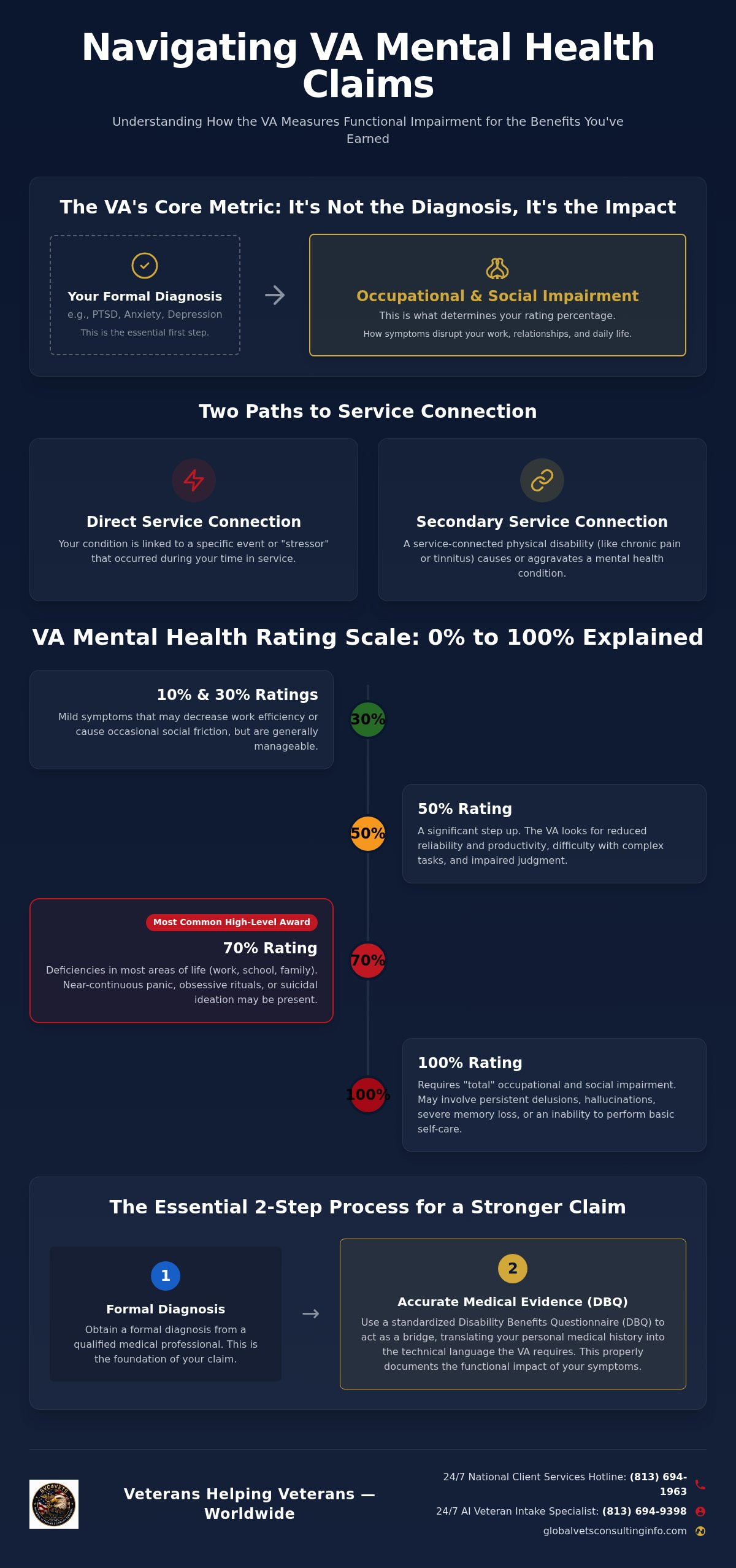
When you file for Mental Health VA Claims, the specific name of your condition is often less important than how that condition disrupts your life. The VA doesn’t grant ratings based on a medical label alone. Instead, they look at the functional impact your symptoms have on your daily existence. You might have a diagnosis of PTSD, but if you’re still able to work a high-stress job without issues, your rating will reflect that reality regardless of the diagnosis.
Occupational and Social Impairment is the core metric the VA uses to determine how your mental health symptoms limit your ability to maintain a job and healthy interpersonal relationships.
Common claimable conditions include PTSD, generalized anxiety, major depressive disorder, and somatic symptom disorder. While getting a formal diagnosis from a qualified professional is essential, it’s only the first step. Securing the right evidence for Mental Health VA Claims requires a deep dive into how your symptoms manifest in the real world, from your sleep patterns to your ability to follow instructions at work.
Direct vs. Secondary Service Connection
Establishing a direct service connection involves linking your condition to a specific event or “stressor” that happened during your time in uniform. However, many veterans find success through a secondary service connection, which is a path often overlooked by many. This occurs when a service-connected physical disability, such as chronic back pain or tinnitus, causes or aggravates a mental health issue. Understanding the VA disability claims process step by step can help you identify which path fits your specific situation best.
The Importance of 38 C.F.R. § 4.130
All VA raters use the General Rating Formula for Mental Disorders found in 38 C.F.R. § 4.130. This regulation ensures that regardless of whether you have depression or VA disability benefits for PTSD, you’re evaluated on a standardized scale. The VA also follows a “pyramiding” rule, which means you can’t receive separate ratings for multiple psychiatric conditions if they share the same symptoms. They’ll grant one combined rating that reflects your overall level of impairment, ensuring the process remains consistent across the board.
The VA Mental Health Rating Schedule: 0% to 100% Explained
The VA evaluates the severity of your Mental Health VA Claims using a standardized sliding scale. This isn’t a subjective guess. Every rater follows the General Rating Formula for Mental Disorders to determine your monthly compensation level.
- 10% and 30% Ratings: These are typically assigned for mild symptoms. You may experience an occasional reduction in work efficiency, but you’re generally able to function in social settings.
- 50% Rating: This level indicates a significant step up in impairment. The VA looks for reduced reliability and productivity. You might have trouble following complex instructions or find it difficult to maintain focus during a standard shift.
Specific symptoms like suicidal ideation, frequent panic attacks, or impaired judgment are often the catalysts for moving into the higher brackets. These indicators show the VA that your condition has progressed beyond mild social discomfort into something that fundamentally alters your ability to function. 🇺🇸
The 70% Rating: The Most Common High-Level Award
Many veterans find that a 70% rating is the most accurate reflection of their daily struggle. This award is given when there are deficiencies in most areas of life, including work, school, and family relations. You might experience near-continuous panic or engage in obsessive rituals that interfere with your daily routine. At this level, the impact on your social circle and your ability to maintain steady employment is undeniable. It’s often the point where your symptoms make it impossible to hide your struggle from those around you.
When is a 100% Mental Health Rating Appropriate?
Securing a 100% rating is a high bar that requires “total” occupational and social impairment. This often involves persistent delusions, hallucinations, or a complete inability to care for your own basic needs. It’s about a total disconnect from normal functioning and severe memory loss. Understanding the specific medical evidence needed is vital. Reviewing a DBQ for Mental Health Conditions can help you see how the VA structures these evaluations. If you’re feeling overwhelmed by the technical requirements, seeking Independent Medical Evidence Education can provide the clarity you need to move forward with confidence.
Winning Your Claim: The Role of DBQs and Medical Evidence
Securing the benefits you deserve for Mental Health VA Claims requires more than just a conversation about your past. It’s about building a bulletproof medical file that the VA cannot ignore. This process follows a logical, three-step progression designed to establish the legitimacy of your struggle.
- Step 1: Obtain a formal diagnosis. You must have a clear diagnosis from a qualified mental health professional. Without this, your claim lacks a medical foundation.
- Step 2: Secure an accurate DBQ. A Disability Benefits Questionnaire (DBQ) is the standardized tool the VA uses to evaluate your symptoms. It must reflect your worst days, not just how you feel in the moment.
- Step 3: Establish the Nexus. You need a clear link, or “nexus,” between your current diagnosis and your military service. This is the bridge that connects your symptoms to your time in uniform.
While medical facts are the priority, “buddy letters” and personal statements provide essential context. These pieces of lay evidence describe how your symptoms manifest in your daily life, offering a peer-to-peer perspective that medical codes sometimes miss. They help rater’s understand the human side of your documentation. 🇺🇸
Private DBQs vs. C&P Examinations
Relying solely on a VA-contracted C&P exam can be risky. Many veterans report “rushed” examinations where a contractor spends only 15 minutes reviewing a lifetime of trauma. This brief window often fails to capture the full scope of your functional limitations. In contrast, a private DBQ allows for a comprehensive, expert-led evaluation. It ensures that every symptom is documented with the meticulousness required for a successful outcome, giving you more control over the evidence submitted for your Mental Health VA Claims.
Avoiding the “Lack of Evidence” Denial
The stakes are high when it comes to your paperwork. Industry data suggests that approximately 31% of claims are denied primarily due to insufficient medical documentation. This is a preventable hurdle. If you find your VA claim denied for lack of evidence, the path forward involves strengthening your file with standardized, professional documentation. Utilizing Independent Medical Evidence Education can help you identify the gaps in your current file before you submit, reducing the risk of a technical denial.
How Global Vets Consulting Supports Your Mental Health Claim
Global Vets Consulting acts as the bridge between your personal history and the VA’s technical requirements. We specialize in educating you on the specific documentation needed for successful Mental Health VA Claims. Our approach is built on a “Veterans Helping Veterans” ethos. We’ve walked this path ourselves, and we understand the weight of sharing your story with a bureaucratic system. We don’t just offer advice; we provide a clear and predictable path forward to reduce your anxiety.
Our mission is to empower you through expert-led education and standardized resources. We provide the following support to ensure your claim is handled with the respect it deserves:
- Expert-led education on Disability Benefits Questionnaires (DBQ) and medical evidence.
- Standardized medical documentation designed to meet strict VA technical requirements.
- A peer-to-peer support model from a veteran-owned and operated team.
- 24/7 access to our National Client Services Hotline and AI Veteran Intake Specialist.
Streamlining the Evidence Process
Navigating the administrative side of a claim is often the most overwhelming part for veterans. We help streamline this by using standardized forms that capture your mental health symptoms using the precise language VA raters are trained to look for. By translating your daily struggles into the clinical terms required by the General Rating Formula, we help ensure your evidence is clear and undeniable. This meticulousness helps ensure your evidence is accurate from the start, reducing the administrative burden on you and ensuring that no symptom is overlooked during the evaluation of your Mental Health VA Claims. We focus on the details so you can focus on your well-being.
Get Started with Global Vets Today 🇺🇸
You don’t have to navigate this complex system alone or settle for a rating that doesn’t reflect your reality. Our 24/7 National Client Services Hotline is available for immediate assistance, and our team is ready to help you get started at any hour. Visit our website to learn more about our mission-driven consulting and how we can support your journey toward a successful rating increase. We’re here to serve as your steady guide and reliable ally.
Ready to document your claim? Contact Global Vets Consulting now
Take the Next Step Toward Your Earned Benefits
Securing a rating that reflects your daily struggle requires more than just showing up to an exam. It’s about presenting a complete picture of your functional impairment through meticulous medical evidence. You now understand that the VA focuses on how your symptoms disrupt your work and social life, and that a professional DBQ is the most effective tool to bridge the gap between your history and their technical requirements. Standardizing your paperwork is the best way to prevent the common “lack of evidence” denial that stalls so many Mental Health VA Claims. 🇺🇸
Global Vets Consulting is a veteran-owned and mission-driven partner dedicated to your success. We specialize in providing the specialized, VA-compliant medical documentation you need to move forward with confidence. Our team is available round-the-clock to ensure you never have to navigate this complex system alone. 🌎
📞 24/7 National Client Services Hotline: 800-484-0551
Don’t let a confusing process stand in the way of your well-being. Secure Your Professional DBQ Documentation with Global Vets Consulting today. You’ve served your country with honor; now it’s time to ensure you receive the validation and support you’ve earned. We’re ready to stand with you.
Frequently Asked Questions
Can I have separate VA ratings for PTSD and Depression?
No, you cannot receive separate ratings for PTSD and depression because the VA prohibits “pyramiding,” which is the practice of compensating for the same symptoms twice. All mental health conditions are evaluated together under a single rating using the General Rating Formula. The VA will assign one combined percentage that reflects your overall level of occupational and social impairment, regardless of how many psychiatric diagnoses you have.
What symptoms do I need for a 70% mental health rating?
A 70% rating requires evidence of social and occupational impairment with deficiencies in most areas, such as work, school, or family relations. Raters look for specific symptoms like suicidal ideation, near-continuous panic, or chronic sleep impairment. You might also struggle with obsessive rituals that interfere with daily routine or demonstrate impaired judgment that makes it difficult to maintain steady employment or healthy interpersonal relationships.
Is a private DBQ better than a VA C&P exam for mental health?
A private DBQ often provides a more comprehensive and expert-led view of your functional limitations than a standard C&P examination. While the VA provides free exams, they can sometimes feel rushed or fail to capture the full scope of your daily struggle. Submitting a private DBQ for your Mental Health VA Claims ensures that your symptoms are documented with the technical precision required for an accurate rating decision.
Can I file for anxiety as a secondary condition to tinnitus?
Yes, you can file for anxiety as a secondary condition to tinnitus if the persistent ringing in your ears causes or aggravates your mental health symptoms. This path requires medical evidence establishing a “nexus” between the two conditions. You’ll need to show how the physical distress of tinnitus leads to increased anxiety, irritability, or sleep disturbances that impair your ability to function normally.
How long does a mental health VA claim take in 2026?
VA processing times for Mental Health VA Claims currently average between 125 and 155 days in 2026, though individual timelines vary based on claim complexity. Providing a fully developed claim with a professional DBQ can often help avoid lengthy delays caused by requests for additional evidence. Ensuring your file is accurate and complete from the start is the most effective way to reach a decision as quickly as possible.

Article by
Willie Daniel
Willie Daniel is the Founder and Chief Executive Officer (CEO) of Global Vets Consulting (GVC4Vets) – National Veterans Disability Services, a veteran-led educational and medical evidence support organization dedicated to helping veterans better understand VA disability rating increases, DBQ medical evidence, secondary claims education, and C&P examination preparation.
He is a retired U.S. Army Medical Service Corps Officer with more than 27 years of honorable military service, a decorated Iraq combat veteran, and a retired federal official with the U.S. Department of Veterans Affairs. Throughout his military and federal career, Willie Daniel served in leadership, healthcare administration, operational, and veteran-support roles focused on improving services and support systems for servicemembers, veterans, and their families.
Drawing from decades of military leadership, healthcare administration, veteran advocacy, and federal government experience, Willie Daniel brings a practical, veteran-centered perspective to Global Vets Consulting’s educational articles, AI-powered veteran resources, video education initiatives, and outreach programs. His experience navigating military systems, medical documentation processes, and veteran-related administrative operations provides valuable insight into many of the challenges veterans face when seeking to better understand VA disability rating criteria, medical evidence, documentation strategies, and secondary condition education.
Through GVC’s “Veterans Helping Veterans” mission, his focus is on delivering clear, educational, and easy-to-understand information designed to empower veterans with knowledge, resources, and educational tools that may help them make more informed decisions regarding their individual VA disability journeys.
The information provided through GVC is intended for educational and informational purposes only and should not be considered legal or medical advice.
Disclaimer
Disclaimer: Global Vets Consulting, LLC (“GVC”) is a veteran-led educational and medical evidence support organization. GVC is not a law firm, is not a Veterans Service Organization (VSO), and is not affiliated with the U.S. Department of Veterans Affairs (VA) or any government agency.
Global Vets Consulting does not provide legal advice, medical advice, medical treatment, or healthcare services. GVC does not prepare, file, or submit VA disability claims on behalf of veterans. All information provided through this website, blog articles, videos, educational materials, AI tools, dashboards, templates, and communications is intended solely for general educational and informational purposes.
Veterans are encouraged to consult with accredited representatives, licensed attorneys, qualified medical providers, or Veterans Service Organizations regarding their specific legal, medical, or VA-related matters. VA disability decisions, ratings, and outcomes are determined solely by the U.S. Department of Veterans Affairs based on applicable laws, regulations, medical evidence, and individual circumstances. Past results do not guarantee future outcomes.