
What if the very condition the VA used to deny your claim is actually the strongest evidence for your rating? Receiving notice that your va claim denied due to pre-existing condition feels like a door slamming in your face after years of service. You know your time in uniform made your health worse, yet the system seems to be using your medical history against you. It’s a common struggle, but a denial isn’t the end of the road; it’s a signal to change your strategy.
We understand the frustration of feeling like the military broke you without taking responsibility. You deserve a clear path forward that doesn’t involve deciphering complex legal jargon alone. This guide will show you how to leverage the Presumption of Soundness and address the “but-for” causation standards updated in May 2026. You’ll learn how to document medical aggravation effectively using professional DBQs. This approach provides a clear method to challenge a flawed C&P exam and secure the benefits you’ve earned.
Key Takeaways
- Leverage the Presumption of Soundness to challenge denials, ensuring the VA proves a condition was pre-existing with “clear and unmistakable” evidence.
- Master the legal concept of “Aggravation” to distinguish between the natural progression of a disease and the worsening caused by your military service.
- Overcome the frustration of a va claim denied due to pre-existing condition by documenting how your service is the direct “but-for” cause of your current symptoms.
- Use professional Disability Benefits Questionnaires (DBQs) as a powerful rebuttal to brief C&P exams that fail to capture the full severity of your condition.
- Follow a structured path to file a Supplemental Claim by identifying the specific reasons for denial in your decision letter and gathering new medical evidence.
Understanding Your VA Denial and the Presumption of Soundness
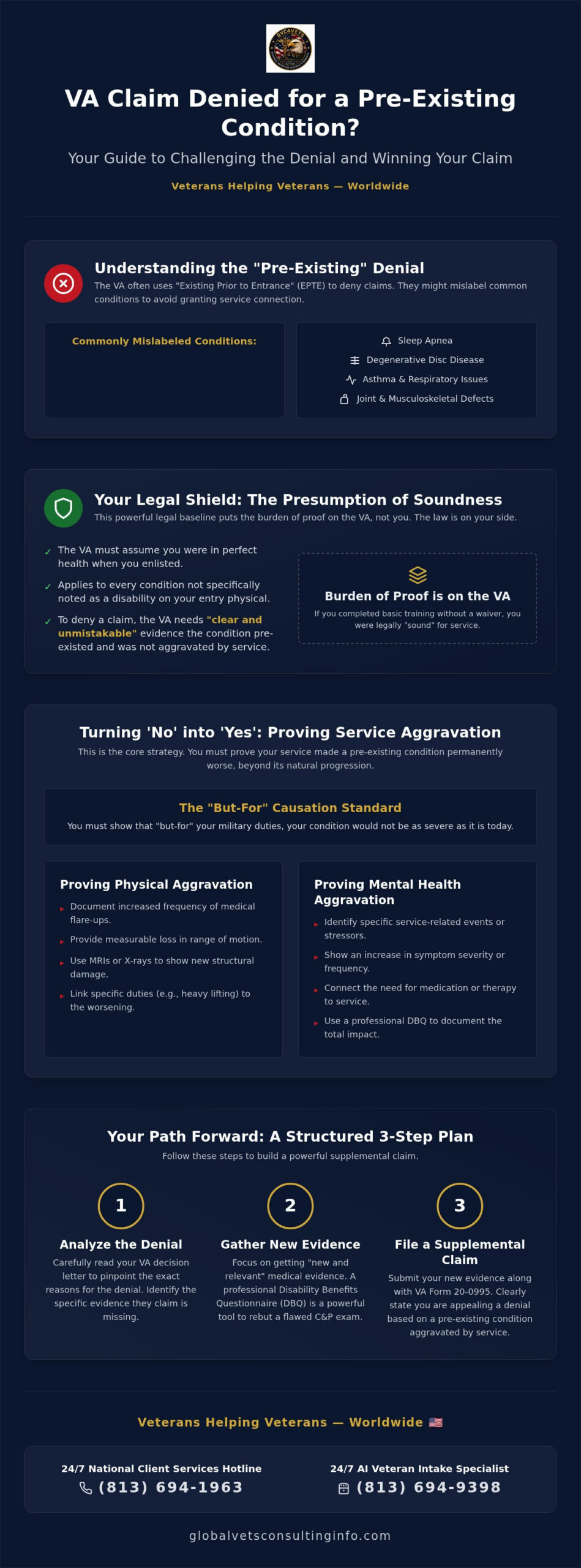
A va claim denied due to pre-existing condition often feels like the system is working against you. However, the law provides a powerful shield for veterans known as the Presumption of Soundness. 🇺🇸 This legal baseline establishes your health status at the moment you entered service.
- The VA must assume you were in perfect health when you enlisted.
- This applies to every condition unless it was specifically noted on your entry physical.
- To deny your claim, the VA must provide “clear and unmistakable” evidence that the condition existed beforehand.
- The burden of proof is on the VA, not the veteran.
Raters frequently use the “Existing Prior to Entrance” (EPTE) designation to avoid granting service connection. They often mislabel common conditions to save costs. These typically include:
- Sleep Apnea
- Degenerative Disc Disease
- Asthma and other respiratory issues
- Joint and musculoskeletal defects
When the VA Claims You Weren’t ‘Sound’ at Enlistment
Winning your case requires a meticulous review of your Military Entrance Processing Station (MEPS) records. It’s vital to understand the difference between a noted minor issue and a truly disabling condition.
- Review your entrance exam for any medical codes or handwritten notations.
- Identify if a noted condition actually limited your ability to perform duties.
- If you completed basic training without a waiver, you were legally “sound” for service.
- A notation of a “predisposition” is not the same as a pre-existing disability.
Common Errors in VA Pre-Existing Condition Denials
The Presumption of Soundness means the VA must prove your condition wasn’t aggravated by service. Many denials happen because the VA ignores this requirement. Common mistakes include:
- Nexus Gaps: Examiners often ignore how service-related stress accelerated a minor underlying issue.
- Natural Progression: The VA wrongly claims your condition would have worsened regardless of your service.
- Evidence Oversight: Raters frequently overlook records showing a lack of symptoms prior to enlistment.
Service Connection by Aggravation: Turning a ‘No’ into a ‘Yes’
Service connection by aggravation is the primary strategy used when the VA admits you have a medical condition but claims it isn’t their responsibility. If you’ve had a va claim denied due to pre-existing condition, you must prove that your time in uniform made that condition worse than it would have naturally become. 🇺🇸
- Aggravation defined: Medical proof that military service increased the severity of a pre-existing injury or illness.
- Natural Progression: The VA’s common defense, claiming your health would have declined regardless of your service.
- The 2026 Standard: You must now meet a “but-for” causation standard, showing your condition wouldn’t be this severe “but-for” your military duties.
- Strategic Placement: Understanding where aggravation fits into the VA disability claims process step by step is vital for a successful appeal.
The VA often denies these claims because of a lack of baseline medical data from your enlistment. You can overcome this by providing evidence that clearly separates your pre-service health from your current disability. If you’re unsure how to document this decline, exploring independent medical evidence education can provide the clarity you need. 🌐
Proving Aggravation for Physical Injuries
To win a physical aggravation claim, you must move beyond general complaints of pain. You need objective data that shows a measurable decline in your physical health during your service years.
- Document an increased frequency of flare-ups that require medical intervention.
- Provide evidence of a measurable loss in your range of motion compared to your entry baseline.
- Use imaging like MRIs or X-rays to show structural changes or damage that developed while you were on active duty.
- Link specific physical duties, such as heavy lifting or repetitive movements, to the worsening of your condition.
Mental Health and Pre-Existing Vulnerabilities
Military service is uniquely demanding and can easily trigger or worsen underlying mental health vulnerabilities. Even if you had minor symptoms before enlisting, the VA is responsible for the additional impact caused by service-connected stressors.
- Identify specific service-related events that exacerbated your psychiatric symptoms.
- Use a standardized DBQ for mental health conditions to record the current severity of your symptoms.
- Ensure your medical provider explains how military stress acted as the catalyst for your increased functional impairment.
- Focus on how your current social and occupational impairment is directly linked to your time in the military.
Strengthening Your Evidence with Independent DBQs and Medical Opinions
A standard C&P exam often lasts less than 15 minutes, which is rarely enough time to review a complex medical history. When you are facing a va claim denied due to pre-existing condition, you need evidence that goes deeper than a rushed government checkup. 🇺🇸
- Standard C&P Exams: These often overlook the specific military stressors that accelerated your condition.
- Independent Medical Opinions (IMOs): These provide a comprehensive clinical rebuttal to the VA’s “natural progression” argument.
- Standardized Documentation: Using a private DBQ for VA claims ensures your symptoms are recorded using the VA’s own criteria.
- Clinical Nexus: A private doctor can spend the time necessary to link your current functional loss to your service record.
The Role of the DBQ in Rebutting a Denial
The Disability Benefits Questionnaire (DBQ) is the most effective tool for documenting medical severity. It forces the medical provider to address the “Aggravation” question with specific data points. 🌐
- Addressing Aggravation: A properly filled DBQ identifies the exact delta between your pre-service health and your current disability.
- Standard of Proof: Your provider can confirm your condition is “at least as likely as not” worsened by service.
- Functional Impact: DBQs capture day-to-day limitations that a 15-minute C&P exam typically misses.
Why Professional DBQ Preparation Matters
The VA is incredibly strict regarding how medical evidence is formatted and submitted. Even minor errors in your paperwork can lead to a VA claim denied for lack of evidence. 📞
- Accuracy: Professional preparation ensures all checkboxes and medical codes align with 2026 VA rating schedules.
- Completeness: We help you identify missing service treatment records that could support your aggravation claim.
- Efficiency: Streamlining your evidence reduces the likelihood of the VA requesting repetitive exams.
Don’t leave your rating to chance with an incomplete file. Explore our professional DBQ preparation education to ensure your medical evidence is mission-ready. 🇺🇸
Steps to Take After a Denial for a Pre-Existing Condition
Your path to a successful rating begins with the Rating Decision Letter. This document is the roadmap the VA provides to explain exactly why your claim fell short. If you find your va claim denied due to pre-existing condition, you must look for the specific “Reason for Denial” section. It might state a lack of service connection or claim the condition is purely “congenital.” Identifying this reason allows you to target your response with surgical precision rather than guessing what the rater wants to see.
Once you’ve identified the gap, you need to choose the right lane for your appeal. Under the Appeals Modernization Act (AMA), you have exactly one year from the date on your letter to file. Missing this deadline means losing your effective date and potential back pay. You aren’t just stuck with a “no”; you have options to provide the evidence they missed or point out where they ignored the law.
Filing a Supplemental Claim vs. Higher-Level Review
Choosing between these two paths depends on what is missing from your file. You should file a Supplemental Claim if you have “New and Relevant” evidence to add, such as a fresh DBQ or a Nexus letter that addresses the “but-for” causation standard. If you believe the evidence was already there but the rater made a legal error, a Higher-Level Review (HLR) is the better choice. In an HLR, a more experienced rater reviews the existing file without considering new evidence. This is often the best route if the VA ignored the Presumption of Soundness despite a clean entrance physical.
Engage Expert Support for Your Appeal
Navigating these choices while managing a disability is a heavy lift. Global Vets Consulting operates on a “Veterans Helping Veterans” philosophy, ensuring you don’t have to face the bureaucracy alone. 🇺🇸 We specialize in helping you submit a “Fully Developed” claim that leaves no room for VA guesswork. You can connect with our 24/7 AI Veteran Intake Specialist right now for immediate guidance on your next steps. Our team is ready to help you document the aggravation of your condition with the meticulousness your service deserves. Visit Global Vets Consulting today to start your path toward a fair rating.
Take Control of Your Disability Rating Today
You’ve seen how the Presumption of Soundness and the principle of medical aggravation can turn a denial into a path forward. Proving that your service made a health issue worse is the most effective way to secure your earned benefits. By focusing on objective data and high-quality medical opinions, you can successfully navigate the stricter 2026 “but-for” causation standards. Getting a va claim denied due to pre-existing condition is often just the beginning of a stronger, more evidence-based appeal.
Global Vets Consulting is a veteran-owned and operated service dedicated to helping you bridge the gap between service and disability. We specialize in professional DBQ preparation and medical evidence education to ensure your claim speaks the VA’s language. Our team is ready to stand with you as a reliable partner in this process. Get the medical evidence you need—Contact Global Vets Consulting today for DBQ support!
24/7 National Client Services Hotline: 📞 866-201-1370
You’ve served your country with honor, and you deserve a rating that reflects the true impact of that service. Stay focused, stay documented, and keep pushing forward.
Frequently Asked Questions
Can the VA deny my claim if the condition was already in my medical records before I joined?
Yes, the VA can deny a claim for a condition that existed prior to service, but they must prove that military life didn’t make it worse. If your va claim denied due to pre-existing condition, the rater is likely claiming the worsening was just “natural progression.” You can counter this by showing your symptoms increased in severity or frequency because of your service duties. The law requires the VA to compensate you for the degree of disability that exceeds your pre-service baseline.
What is the ‘Presumption of Soundness’ in VA disability law?
The Presumption of Soundness is a legal protection stating that every veteran is presumed to have been in sound condition when they entered the military. This applies unless a specific defect was noted on your entrance physical exam. If no condition was documented at MEPS, the burden of proof shifts to the VA. They must show “clear and unmistakable evidence” that the condition existed beforehand and wasn’t aggravated by your time in uniform.
How do I prove that military service aggravated my pre-existing condition?
Proving aggravation requires medical evidence showing your condition worsened beyond its natural course due to your military service. Under the 2026 “but-for” causation standard, you must demonstrate that your current level of disability wouldn’t exist if not for your service-connected activities. This is best achieved through a Nexus letter or a professional DBQ that compares your pre-service baseline to your current functional limitations. Detailed medical opinions are essential to bridge this gap.
Is it worth appealing a VA denial for a pre-existing condition?
Appealing is absolutely worth the effort because many initial denials are based on incomplete medical records or a rushed C&P exam. A va claim denied due to pre-existing condition can often be overturned by submitting a Supplemental Claim with new medical evidence. Securing a service connection for an aggravated condition grants you access to monthly tax-free compensation and VA healthcare. Don’t let a “no” stop you from receiving the benefits you’ve earned through your service.
What kind of medical evidence do I need to win an aggravation claim?
You need specific medical documentation that establishes a clear link between your service and the worsening of your condition. This includes Disability Benefits Questionnaires (DBQs) that detail your range of motion or symptom frequency, and Independent Medical Opinions (IMOs) that rebut the VA examiner’s findings. Objective evidence like X-rays, MRIs, or service treatment records showing an increase in medical visits for the condition are also vital for a successful appeal.

Article by
Willie Daniel
Willie Daniel is the Founder and Chief Executive Officer (CEO) of Global Vets Consulting (GVC4Vets) – National Veterans Disability Services, a veteran-led educational and medical evidence support organization dedicated to helping veterans better understand VA disability rating increases, DBQ medical evidence, secondary claims education, and C&P examination preparation.
He is a retired U.S. Army Medical Service Corps Officer with more than 27 years of honorable military service, a decorated Iraq combat veteran, and a retired federal official with the U.S. Department of Veterans Affairs. Throughout his military and federal career, Willie Daniel served in leadership, healthcare administration, operational, and veteran-support roles focused on improving services and support systems for servicemembers, veterans, and their families.
Drawing from decades of military leadership, healthcare administration, veteran advocacy, and federal government experience, Willie Daniel brings a practical, veteran-centered perspective to Global Vets Consulting’s educational articles, AI-powered veteran resources, video education initiatives, and outreach programs. His experience navigating military systems, medical documentation processes, and veteran-related administrative operations provides valuable insight into many of the challenges veterans face when seeking to better understand VA disability rating criteria, medical evidence, documentation strategies, and secondary condition education.
Through GVC’s “Veterans Helping Veterans” mission, his focus is on delivering clear, educational, and easy-to-understand information designed to empower veterans with knowledge, resources, and educational tools that may help them make more informed decisions regarding their individual VA disability journeys.
The information provided through GVC is intended for educational and informational purposes only and should not be considered legal or medical advice.
Disclaimer
Disclaimer: Global Vets Consulting, LLC (“GVC”) is a veteran-led educational and medical evidence support organization. GVC is not a law firm, is not a Veterans Service Organization (VSO), and is not affiliated with the U.S. Department of Veterans Affairs (VA) or any government agency.
Global Vets Consulting does not provide legal advice, medical advice, medical treatment, or healthcare services. GVC does not prepare, file, or submit VA disability claims on behalf of veterans. All information provided through this website, blog articles, videos, educational materials, AI tools, dashboards, templates, and communications is intended solely for general educational and informational purposes.
Veterans are encouraged to consult with accredited representatives, licensed attorneys, qualified medical providers, or Veterans Service Organizations regarding their specific legal, medical, or VA-related matters. VA disability decisions, ratings, and outcomes are determined solely by the U.S. Department of Veterans Affairs based on applicable laws, regulations, medical evidence, and individual circumstances. Past results do not guarantee future outcomes.