What if the reason your claim was denied isn’t because you aren’t disabled, but because your medical evidence didn’t speak the VA’s specific language? It’s a question thousands of veterans ask when they open a Rating Decision letter that feels like a punch in the gut. You might be wondering, is a private dbq worth it for a denied claim, especially with the VA’s increased scrutiny on private medical submissions in 2026. 🇺🇸 It’s natural to feel ignored by the system you served, but a denial isn’t the end of the road; it’s often just a request for more precise documentation.
We understand the anxiety that comes with the cost of private opinions and the fear of new fraud-detection tools mentioned in recent news. However, a private DBQ is a powerful clinical bridge that can address the exact deficiencies identified in your denial. In this guide, you’ll learn how to use professional medical evidence education to turn a “no” into a successful service-connected rating. We will walk through the steps to ensure your evidence is “actionable and sufficient” so the rater has everything they need to grant the benefits you’ve earned.
Key Takeaways
- Identify the specific deficiencies in your VA Rating Decision letter to understand exactly which pillar of evidence, diagnosis, event, or nexus, was missing from your initial filing.
- Discover why determining if is a private dbq worth it for a denied claim depends on its ability to provide the accuracy and clinical thoroughness often missing from standard C&P exams.
- Learn how to map your symptoms directly to the 38 CFR Schedule for Ratings to ensure your private medical documentation is actionable and sufficient for a VA rater.
- Understand the strategic process of submitting a private DBQ as “New and Relevant Evidence” to successfully reopen your case through a Supplemental Claim appeal.
- Gain insight into how standardized medical documentation and a “Veterans Helping Veterans” approach can help you bypass administrative hurdles and secure the rating you earned.
Understanding Why Your VA Claim Was Denied: The Starting Point
Opening a denial letter from the Veterans Benefits Administration (VBA) can feel like a dead end, but it’s actually the first step in your counter-offensive. To move forward, you must look past the first page and locate the “Reasons for Decision” section. This is where the VA rater explains exactly why your claim didn’t meet the legal requirements for a service-connected rating. When you’re asking, is a private dbq worth it for a denied claim, the answer depends entirely on which of the three pillars of a successful claim is missing from your file.
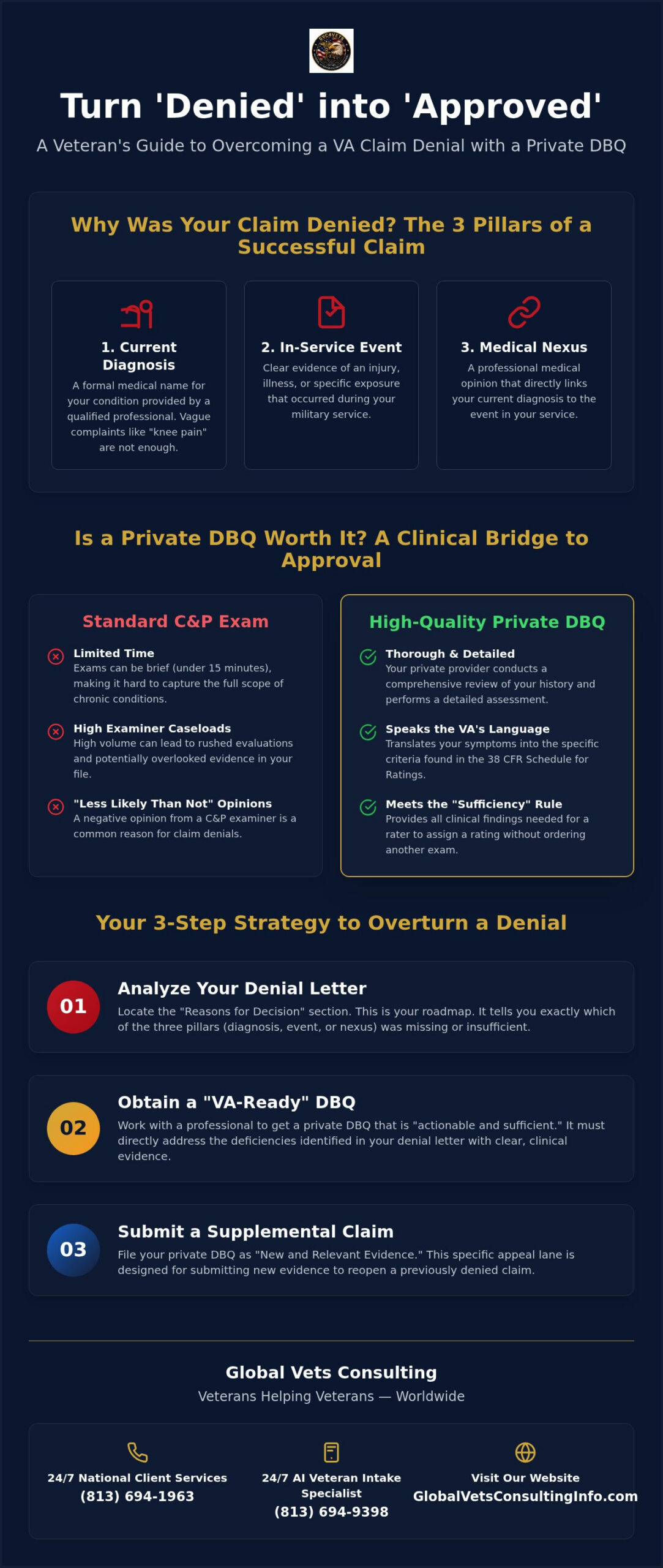
A successful claim requires three specific elements, often called the Caluza Triangle:
- A Current Diagnosis: A formal medical name for your condition.
- An In-Service Event: Evidence of an injury, illness, or exposure during your military service.
- A Medical Nexus: A professional opinion linking your current diagnosis to your service.
The VA weighs your submitted medical evidence against the specific diagnostic codes and functional loss criteria found in Title 38 of the Code of Federal Regulations (CFR) to justify a denial. It’s vital to distinguish between a denial for “lack of service connection,” which means the VA doesn’t believe the military caused the issue, and “insufficient severity,” which means they acknowledge the connection but don’t believe your symptoms warrant a compensable rating. 🇺🇸
Common Denial Reasons in 2026
In 2026, the VA has increased its scrutiny of medical submissions. Here are the most frequent hurdles veterans face:
- Lack of a formal diagnosis: Reporting “knee pain” isn’t enough; you need a qualified professional to diagnose a specific condition like degenerative arthritis or a meniscus tear.
- The “Less Likely Than Not” Opinion: If a C&P examiner states your condition is “less likely than not” related to service, the rater will almost always deny the claim unless you provide stronger evidence.
- Insufficient or irrelevant evidence: Your records might show you have a condition, but if they don’t document the specific symptoms required by the 38 CFR Schedule for Ratings, the evidence is deemed “not relevant” for rating purposes.
By identifying these gaps early, you can use a private DBQ to provide the precise medical evidence the VA is looking for. 🇺🇸
Is a Private DBQ Worth It? Evaluating Your ROI
Deciding whether to pay for medical documentation is a serious financial decision for your household. Many veterans find themselves at a crossroads, asking, is a private dbq worth it for a denied claim, especially when the VA offers “free” C&P exams. If your denial letter cited “insufficient severity” or “lack of evidence,” a private DBQ acts as a clinical bridge. It translates your daily pain and functional loss into the specific language used in the 38 CFR Schedule for Ratings. 🇺🇸
Private DBQ vs. C&P Exam: The Evidence Gap
C&P examiners are often tasked with high volumes of evaluations, which can lead to sessions that last less than 15 minutes. In such a short window, it’s nearly impossible for a provider to capture the full scope of your chronic symptoms or how a condition like degenerative arthritis limits your ability to work. A private provider has the flexibility to conduct a more thorough review of your medical history and perform a detailed physical assessment.
The VA allows the use of Public Disability Benefits Questionnaires to ensure external evidence is standardized. For your private evidence to be successful, it must meet the “sufficiency” rule. This means the DBQ must be legally adequate for a rater, containing all the clinical findings, range-of-motion measurements, and diagnostic test results required to assign a rating without needing another exam. If you’re unsure if your documentation hits the mark, seeking independent medical evidence education can provide the clarity you need to move forward confidently.
In 2026, the VA’s new fraud detection tools have made professional accuracy a requirement rather than an option. The system is designed to flag inconsistent or “template-based” submissions. A high-quality, individualized DBQ is essential to bypassing these administrative hurdles. While there’s an upfront cost, the return on investment is clear. A rating increase from 10% to 50% or 100% can result in hundreds or thousands of dollars in additional tax-free monthly compensation, often paying for the cost of professional documentation in just one or two months. 🇺🇸
How to Overcome a Previous VA Denial Using a Private DBQ
Overcoming a previous denial is about precision, not just persistence. If you’ve been asking yourself is a private dbq worth it for a denied claim, the answer lies in how you execute the follow-up. You must first map your private DBQ results directly to the symptoms listed in the 38 CFR Schedule for Ratings. This ensures that the medical evidence you provide speaks the exact language the VA rater uses to assign a percentage. 🇺🇸
Next, ensure your DBQ qualifies as “New and Relevant Evidence.” For a Supplemental Claim, “new” means the VA hasn’t seen it before, and “relevant” means it addresses the specific reason for your previous denial. When you submit your documentation, include VA Form 21-4138, the Statement in Support of Claim. This is your chance to explain in plain language how your symptoms impact your daily life. You can then track your progress through our 24/7 AI Veteran Intake Specialist to stay updated on your claim status without the stress of constant manual checking.
Choosing the Right Appeal Lane
The Supplemental Claim lane is generally the best path when introducing a new private DBQ as evidence. Unlike a Higher-Level Review (HLR), which is a closed-record review where no new evidence can be added, the Supplemental lane allows you to fix the clinical gaps in your file. If you are facing a complex legal dispute, you might eventually look toward the Board of Veterans’ Appeals, but most veterans find success much faster through the Supplemental route. For more details on this, see our guide on VA Claim Denied for Lack of Evidence: How to Recover in 2026 🇺🇸.
Documenting Severity for Rating Increases
A private DBQ is also an essential tool when your condition has worsened since your last evaluation. By documenting increased frequency or severity of symptoms, you provide the rater with the clinical proof needed for a rating increase. Learn more about how to use a DBQ for a VA disability rating increase in 2026 to maximize your compensation. If you’re ready to take the next step, our team can provide the DBQ preparation education you need to succeed. 🇺🇸
The Global Vets Standard: Ensuring Your DBQ is ‘VA-Ready’
Navigating the VA’s administrative hurdles requires more than just filling out forms; it requires a strategy rooted in meticulousness. Many veterans still question if is a private dbq worth it for a denied claim when faced with the VA’s new fiscal year 2026 fraud-detection system. This system is designed to flag submissions that lack clinical depth or appear generic. Our ‘Veterans Helping Veterans’ approach ensures that your medical evidence isn’t just another piece of paper, but a professional document that withstands this increased scrutiny. 🇺🇸
Global Vets Consulting focuses on professional authority in DBQ preparation. We understand that a single error in range-of-motion measurements or a missed diagnostic test result can lead to another years-long appeal. The 2025 Elizabeth Dole Act now mandates that contractors provide DBQs in PDF form through standardized sharing systems, which has increased the VA’s expectation for high-quality, electronic-ready evidence. When you consider the long-term benefits of a successful appeal, determining if is a private dbq worth it for a denied claim often comes down to the quality of the documentation you submit.
A Predictable Path Forward
Reducing the anxiety surrounding your claim starts with having a clear, predictable path forward. Our educational resources empower you to take control of your medical file, ensuring you aren’t just a bystander in your own case. For those just starting to explore their options, understanding the basics is the first step. You can read more in our detailed guide, What is a DBQ? A Veteran’s Guide to Disability Benefits Questionnaires in 2026. By providing standardized documentation and specialized education on secondary VA claims, we help you build a case that is both actionable and sufficient for any VA rater. 🇺🇸
Secure the Rating You’ve Earned Today
A VA denial letter is a roadmap for your next move, not the end of your journey. You’ve learned that identifying the specific evidence gaps in your Rating Decision is the first step toward a successful appeal. By using high-quality medical documentation that aligns with the 38 CFR, you provide the rater with the clinical clarity they need to grant your claim. When you look at the potential for life-changing monthly compensation, it becomes obvious that is a private dbq worth it for a denied claim when accuracy is the priority. 🇺🇸
Global Vets Consulting is a veteran-owned and operated firm committed to your success through expert independent medical evidence education. We offer a predictable path forward with support available through our 24/7 National Client Services Hotline. Don’t let a previous denial stand in the way of the benefits you earned through your service. Take the next step with confidence and precision.
Frequently Asked Questions
Can the VA reject a private DBQ from a non-VA doctor?
The VA cannot legally reject a private DBQ simply because it originated from a non-VA provider, but they can deem it “insufficient” if it lacks required clinical data. To be considered “actionable and sufficient,” the form must contain all the findings, range-of-motion measurements, and diagnostic results needed for a rater to make a decision. This is why ensuring your documentation is thorough and follows the 38 CFR criteria is essential to bypass administrative hurdles.
What makes evidence ‘new and relevant’ for a Supplemental Claim?
Evidence is considered “new” if the VA has never reviewed it in a previous decision, and “relevant” if it addresses the specific reason your claim was originally denied. When you are deciding if is a private dbq worth it for a denied claim, the document must provide new clinical findings that prove service connection or a higher level of severity than what was previously recorded in your file.
What happens if my private DBQ contradicts the C&P examiner’s report?
When medical opinions conflict, the VA rater must determine which report has more “probative value” based on thoroughness and clinical support. A private DBQ that cites specific medical history and uses standardized testing often carries significant weight. If the evidence from both reports is equally balanced, the VA is required to apply the “benefit of the doubt” rule and decide in favor of the veteran.

Article by
Willie Daniel
Willie Daniel is the Founder and Chief Executive Officer (CEO) of Global Vets Consulting (GVC4Vets) – National Veterans Disability Services, a veteran-led educational and medical evidence support organization dedicated to helping veterans better understand VA disability rating increases, DBQ medical evidence, secondary claims education, and C&P examination preparation.
He is a retired U.S. Army Medical Service Corps Officer with more than 27 years of honorable military service, a decorated Iraq combat veteran, and a retired federal official with the U.S. Department of Veterans Affairs. Throughout his military and federal career, Willie Daniel served in leadership, healthcare administration, operational, and veteran-support roles focused on improving services and support systems for servicemembers, veterans, and their families.
Drawing from decades of military leadership, healthcare administration, veteran advocacy, and federal government experience, Willie Daniel brings a practical, veteran-centered perspective to Global Vets Consulting’s educational articles, AI-powered veteran resources, video education initiatives, and outreach programs. His experience navigating military systems, medical documentation processes, and veteran-related administrative operations provides valuable insight into many of the challenges veterans face when seeking to better understand VA disability rating criteria, medical evidence, documentation strategies, and secondary condition education.
Through GVC’s “Veterans Helping Veterans” mission, his focus is on delivering clear, educational, and easy-to-understand information designed to empower veterans with knowledge, resources, and educational tools that may help them make more informed decisions regarding their individual VA disability journeys.
The information provided through GVC is intended for educational and informational purposes only and should not be considered legal or medical advice.
Disclaimer
Disclaimer: Global Vets Consulting, LLC (“GVC”) is a veteran-led educational and medical evidence support organization. GVC is not a law firm, is not a Veterans Service Organization (VSO), and is not affiliated with the U.S. Department of Veterans Affairs (VA) or any government agency.
Global Vets Consulting does not provide legal advice, medical advice, medical treatment, or healthcare services. GVC does not prepare, file, or submit VA disability claims on behalf of veterans. All information provided through this website, blog articles, videos, educational materials, AI tools, dashboards, templates, and communications is intended solely for general educational and informational purposes.
Veterans are encouraged to consult with accredited representatives, licensed attorneys, qualified medical providers, or Veterans Service Organizations regarding their specific legal, medical, or VA-related matters. VA disability decisions, ratings, and outcomes are determined solely by the U.S. Department of Veterans Affairs based on applicable laws, regulations, medical evidence, and individual circumstances. Past results do not guarantee future outcomes.