

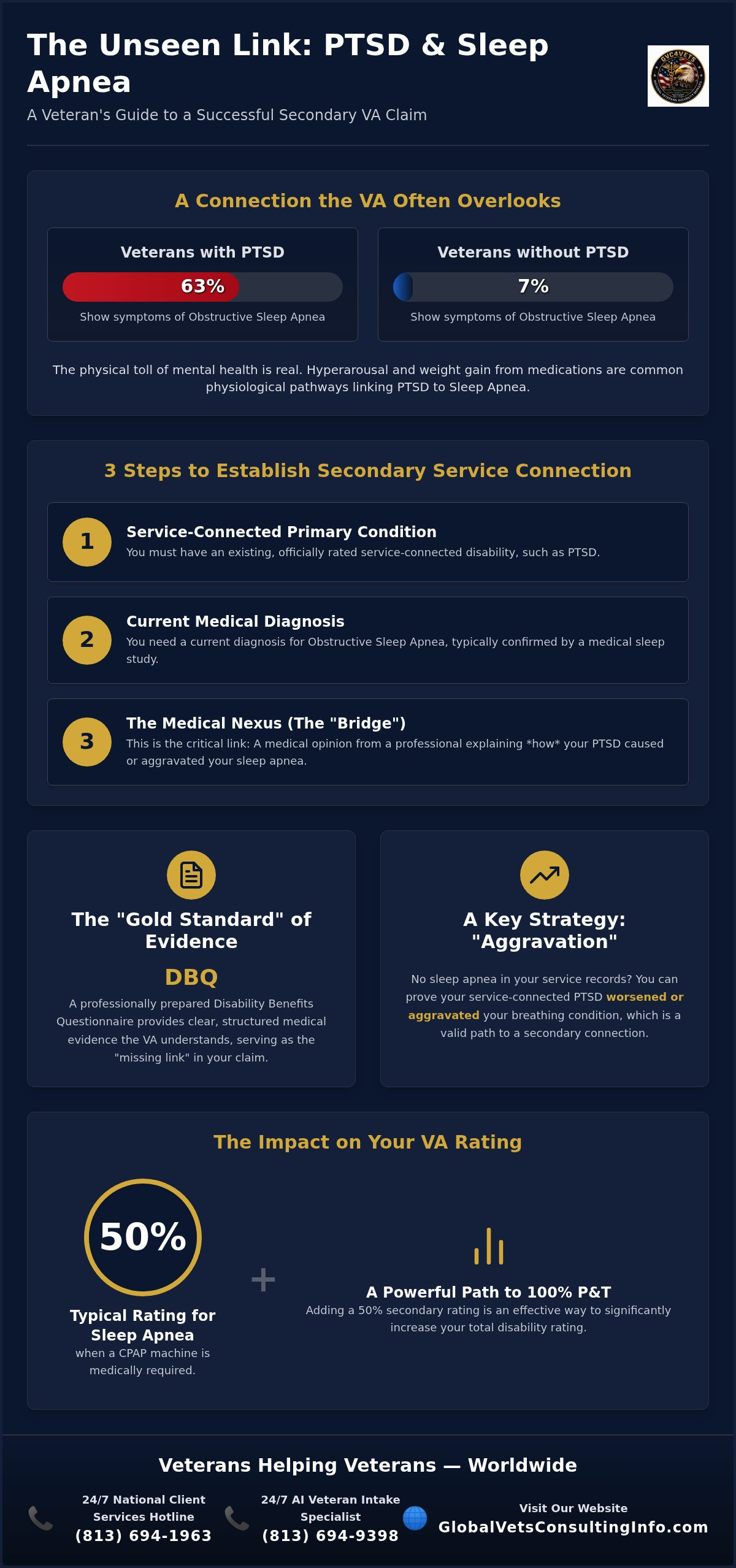
Did you know that 63% of veterans living with PTSD also show symptoms of obstructive sleep apnea, compared to just 7% of veterans without it? This statistic highlights a reality many of you face every night, yet the VA often fails to acknowledge the clear link between your mental health and your breathing. It’s exhausting to feel like you’re fighting a system that ignores the physical toll of your service while you struggle with the complexities of PTSD and Sleep Apnea. We understand the anxiety that comes with C&P exams and the confusion of “VA Math,” but you don’t have to navigate this process alone. 🇺🇸
In this guide, you’ll learn exactly how to bridge the gap between these conditions to secure a secondary service connection. We’ll show you how to use professional medical documentation and Disability Benefits Questionnaires (DBQs) to build a claim the VA cannot ignore. By following a clear, methodical path, you can move toward higher monthly compensation and the peace of mind that comes with an accurate rating. 🌎
Our team of fellow veterans is here to help you understand the current 2026 regulations, including how a 50% rating is typically assigned when a CPAP machine is medically required. We provide the education and resources you need to turn your health struggles into a successful claim. If you’re ready for a partner who respects your history and your health, let’s get started. 📞
Key Takeaways
- Understand the physiological connection between PTSD and Sleep Apnea and why the VA often overlooks this critical secondary relationship.
- Learn the three essential elements required to establish a secondary service connection, including the “Aggravation” standard that can secure your claim.
- Discover why a professionally prepared Disability Benefits Questionnaire (DBQ) serves as the “missing link” and the gold standard for your medical evidence.
- Identify the specific steps to file your secondary claim in 2026 to maximize your VA rating increase and monthly compensation.
- Gain the confidence to face your C&P examination with professional preparation that ensures your physical and mental health are treated as one.
The Proven Link Between PTSD and Sleep Apnea 📞
Obstructive Sleep Apnea (OSA) occurs when the muscles in your throat relax too much during sleep, causing your airway to collapse and stop your breathing. For many veterans, the intersection of PTSD and Sleep Apnea isn’t just a coincidence; it’s a direct consequence of their service. Clinical research, including studies published via ScienceDirect, has identified a staggering 75.7% comorbidity rate between Post-traumatic stress disorder and sleep apnea in the veteran population. This data suggests that if you’re living with one, there’s a high probability you’re dealing with the other.
The symptoms of PTSD, such as hyperarousal and chronic nightmares, don’t just stay in your mind. They physically alter your sleep architecture. When your body is constantly in a “fight or flight” mode, your respiratory system and sleep cycles never truly rest. This physiological stress creates a clear path for a secondary service connection. This VA mechanism allows you to receive compensation for a condition that was either caused or made worse by an existing service-connected disability.
Why Sleep Apnea is Often Secondary to PTSD
The connection between PTSD and Sleep Apnea often manifests through secondary physical changes. Many veterans are prescribed medications to manage their mental health symptoms, and a common side effect of these drugs is significant weight gain. Increased neck circumference and body mass directly contribute to airway obstruction during the night. Additionally, chronic stress hormones can lead to upper airway instability, making it harder for your body to maintain a clear breathing passage while you sleep.
To successfully link these conditions, you must first ensure your primary rating is accurately documented. Utilizing a professional dbq for mental health conditions is a vital step in establishing the foundation of your claim. Once your PTSD is service-connected at the appropriate level, you can more effectively demonstrate how it has aggravated or led to your sleep-disordered breathing. We focus on providing the medical evidence education needed to bridge this gap between your mental and physical health. 🇺🇸
How to Establish Secondary Service Connection for Sleep Apnea 🇺🇸
Establishing a claim for PTSD and Sleep Apnea requires a specific administrative approach that goes beyond just showing you have both conditions. A secondary service connection allows veterans to link a new diagnosis to an existing service-connected disability like PTSD. To succeed, you must satisfy three specific criteria: a current medical diagnosis of sleep apnea (usually confirmed by a sleep study), an existing service-connected primary condition, and a medical nexus that bridges the two.
A common hurdle veterans face is the lack of “sleep apnea” mentions in their original service treatment records. This is where the “Aggravation” standard becomes vital. Even if your breathing issues didn’t start in the barracks, you can argue that your service-connected PTSD has aggravated or worsened your sleep apnea. The VA recognizes that Sleep Problems in Veterans with PTSD are pervasive and often interconnected. If your mental health symptoms make your physical airway obstruction more severe or harder to treat, you have a valid path forward.
The Role of the Medical Nexus
The medical nexus is the most critical piece of evidence in your file. It’s a formal medical opinion where a healthcare provider explains the “how” and “why” behind the connection. For PTSD and Sleep Apnea, this might involve detailing how chronic hyperarousal or weight gain from psychiatric medications directly impacts your respiratory health. Without this clear medical reasoning, the VA is likely to view the two conditions as unrelated coincidences.
Securing this connection is often the difference between a stalled claim and a significant rating increase. Under current 2026 regulations, a sleep apnea rating requiring a CPAP machine typically yields a 50% evaluation. Because of how “VA Math” works, adding a 50% secondary rating to an existing PTSD rating is one of the most effective ways to reach 100% Permanent and Total (P&T) status. If you’re feeling overwhelmed by the paperwork, you can explore our educational resources to simplify the process. We focus on providing the clarity you need to ensure your documentation is meticulous and your service is respected. 🌎
Essential Evidence: The DBQ and Independent Medical Evidence 🌐
The medical evidence you submit determines the success of your VA disability claim. While the VA uses Compensation and Pension (C&P) exams to evaluate veterans, these appointments are often brief and may overlook the nuanced relationship between PTSD and Sleep Apnea. This is why the Disability Benefits Questionnaire (DBQ) has become the gold standard for evidence. A private DBQ allows for a more comprehensive review of your medical history compared to a standard VA exam, ensuring that your symptoms are documented with the precision required for a rating increase. 🇺🇸
To build a case the VA cannot ignore, you’ll need a specific set of documents that prove the severity and connection of your condition. You should gather the following items before filing:
- A formal sleep study (polysomnography) confirming your diagnosis.
- Proof of a medically required CPAP machine or similar breathing device.
- A professional DBQ that establishes the medical nexus to your mental health.
Peer-reviewed research in The Proven Link Between PTSD and Sleep Apnea confirms that these conditions frequently coexist, but your evidence must prove it in your specific case. Understanding how to use a dbq for a va disability rating increase in 2026 is the first step toward securing the compensation you’ve earned. 📞
Why Professional DBQ Preparation Matters
Incomplete evidence is one of the leading causes of automatic denials. If your documentation doesn’t explicitly mention how you gasp for air at night or struggle with debilitating daytime sleepiness, the VA might assign a lower rating or deny the connection entirely. We focus on ensuring every symptom is meticulously recorded so your file is complete before it reaches the rater’s desk. This reduces the stress of the claims process and provides a clear, predictable path forward.
Global Vets Consulting streamlines this evidence-gathering process by providing the education you need to present a strong case. We treat your claim with the sense of duty it deserves, acting as a knowledgeable advocate in a complex system. If you’re ready to stop feeling ignored by the system, connect with our expert team today. Our goal is to provide the “missing link” in your claim through professional medical documentation that respects your history and your health. 🌎
Steps to File Your Secondary Claim in 2026 📞
Filing a secondary claim for PTSD and Sleep Apnea requires a methodical approach to ensure your evidence is viewed correctly by the rater. It’s a process of connecting the dots between your mental health and your physical respiratory struggles. You shouldn’t wait for your symptoms to become unmanageable or for your sleep quality to hit rock bottom before seeking the rating you’ve earned. Taking action now protects your health and your financial future. Global Vets Consulting provides 24/7 support to help you navigate these administrative hurdles with confidence. For a more comprehensive look at the overall timeline, you can explore the va disability claims process step by step. 🇺🇸
Your 2026 Filing Checklist
To ensure your claim is fully developed before submission, follow these three essential steps:
- Step 1: Secure a formal sleep apnea diagnosis. This must be confirmed through a clinical sleep study (polysomnography) that identifies the severity of your condition.
- Step 2: Obtain a professional DBQ and Medical Nexus Letter. These documents provide the medical reasoning that explicitly links your sleep apnea to your service-connected PTSD.
- Step 3: Submit your claim via VA.gov. Ensure you select “Secondary Condition” and upload all your medical evidence, including your CPAP prescription, to avoid unnecessary delays.
Winning the Rating You Earned
The path to a successful claim is built on meticulous documentation and professional education. You served your country; now let your evidence serve you. By presenting a complete file, you reduce the chances of an “incomplete” denial and move closer to the monthly compensation that reflects your true level of disability. Our 24/7 AI Veteran Intake Specialist and dedicated team are ready to assist you at any hour. 🌎
If you’re ready to secure a secondary service connection and navigate the system with an expert ally by your side, contact the Global Vets Consulting 24/7 National Client Services Hotline today. We are committed to your success and dedicated to the well-being of the veteran community. 📞
Secure the Rating Your Service Earned 🇺🇸
You’ve seen how the physiological link between PTSD and Sleep Apnea is supported by clinical data, yet the VA often requires meticulous documentation to grant a secondary service connection. By utilizing a professional DBQ and establishing a clear medical nexus, you can overcome the common hurdles of “VA Math” and secure the 50% rating typically assigned for CPAP use. Our team of specialists is dedicated to mental health and respiratory evidence, ensuring your file is complete before it reaches a rater’s desk. As a veteran-owned and operated consulting service, we understand the weight of your service and the importance of your health. 🌎
If you’re ready to bridge the gap between your physical and mental health claims, Contact our 24/7 AI Veteran Intake Specialist for DBQ Support. We operate a 24/7 National Client Services Hotline to ensure you never have to navigate this complex system alone. Whether you need assistance with a rating increase or educational resources for your secondary claim, we are here to guide you every step of the way. 📞
You served with honor and dedication. Now, let us help you secure the benefits and peace of mind you’ve rightfully earned. 🇺🇸
Frequently Asked Questions
Can I claim sleep apnea secondary to PTSD if I wasn’t diagnosed in the military?
Yes, you can claim sleep apnea even if your diagnosis occurred years after you left active duty. The VA allows for secondary service connection when a new condition is caused or aggravated by an existing service-connected disability. The key is proving that your current respiratory issues are a physiological result of your mental health condition, rather than showing the symptoms started while you were in uniform.
What is the VA rating for sleep apnea secondary to PTSD in 2026?
In 2026, the VA typically assigns ratings of 0%, 30%, or 50% for sleep apnea depending on the severity of your symptoms. These percentages are combined with your existing mental health rating to determine your total monthly compensation. Successfully linking PTSD and Sleep Apnea can lead to a significant increase in your overall disability percentage, especially with the 2.8% COLA adjustment that took effect earlier this year.
Do I need a CPAP machine to get a 50% rating for sleep apnea?
Yes, under the current 2026 regulations, the VA assigns a 50% rating when a breathing assistance device like a CPAP machine is medically required. While there have been discussions about changing these criteria, the current rules still focus on the necessity of the device for treatment. It’s vital that your medical records and DBQ explicitly state that a CPAP is required to manage your condition effectively.
How does a Nexus Letter help my secondary sleep apnea claim?
A nexus letter provides the professional medical reasoning that bridges the gap between your two conditions. It explains the “how” and “why” to the VA rater, detailing how PTSD symptoms or medications have directly impacted your airway stability. Without this clear medical link, the VA often views sleep apnea as a standalone issue, which frequently leads to a denial of secondary service connection.
What happens if my VA claim is denied for lack of evidence?
If your claim is denied, you can submit a Supplemental Claim or request a Higher-Level Review to address the rater’s concerns. Denials often occur because the veteran provided a diagnosis but failed to include a professional DBQ or a strong medical nexus. We focus on educating veterans on how to gather the “missing link” of evidence so they can present a complete file that the VA cannot ignore.

Article by
Willie Daniel
Willie Daniel is the Founder and Chief Executive Officer (CEO) of Global Vets Consulting (GVC4Vets) – National Veterans Disability Services, a veteran-led educational and medical evidence support organization dedicated to helping veterans better understand VA disability rating increases, DBQ medical evidence, secondary claims education, and C&P examination preparation.
He is a retired U.S. Army Medical Service Corps Officer with more than 27 years of honorable military service, a decorated Iraq combat veteran, and a retired federal official with the U.S. Department of Veterans Affairs. Throughout his military and federal career, Willie Daniel served in leadership, healthcare administration, operational, and veteran-support roles focused on improving services and support systems for servicemembers, veterans, and their families.
Drawing from decades of military leadership, healthcare administration, veteran advocacy, and federal government experience, Willie Daniel brings a practical, veteran-centered perspective to Global Vets Consulting’s educational articles, AI-powered veteran resources, video education initiatives, and outreach programs. His experience navigating military systems, medical documentation processes, and veteran-related administrative operations provides valuable insight into many of the challenges veterans face when seeking to better understand VA disability rating criteria, medical evidence, documentation strategies, and secondary condition education.
Through GVC’s “Veterans Helping Veterans” mission, his focus is on delivering clear, educational, and easy-to-understand information designed to empower veterans with knowledge, resources, and educational tools that may help them make more informed decisions regarding their individual VA disability journeys.
The information provided through GVC is intended for educational and informational purposes only and should not be considered legal or medical advice.
Disclaimer
Disclaimer: Global Vets Consulting, LLC (“GVC”) is a veteran-led educational and medical evidence support organization. GVC is not a law firm, is not a Veterans Service Organization (VSO), and is not affiliated with the U.S. Department of Veterans Affairs (VA) or any government agency.
Global Vets Consulting does not provide legal advice, medical advice, medical treatment, or healthcare services. GVC does not prepare, file, or submit VA disability claims on behalf of veterans. All information provided through this website, blog articles, videos, educational materials, AI tools, dashboards, templates, and communications is intended solely for general educational and informational purposes.
Veterans are encouraged to consult with accredited representatives, licensed attorneys, qualified medical providers, or Veterans Service Organizations regarding their specific legal, medical, or VA-related matters. VA disability decisions, ratings, and outcomes are determined solely by the U.S. Department of Veterans Affairs based on applicable laws, regulations, medical evidence, and individual circumstances. Past results do not guarantee future outcomes.

