A low C&P exam rating isn’t a final verdict; it’s often just a sign that the VA didn’t have the full picture of your disability. You’ve likely felt the frustration of a brief medical exam that failed to capture the true impact of your service-connected conditions. With the VA implementing more aggressive AI-driven fraud detection in 2026, simply sending in more paperwork isn’t enough. You need a specific strategy for resubmitting a claim with a private dbq that forces the VA to acknowledge your private medical evidence as new and relevant.
We understand how exhausting it is to fight for the benefits you were promised. This guide provides the exact steps to leverage a high-quality, private Disability Benefits Questionnaire to secure the rating you earned. You’ll learn how to navigate the supplemental claim process, choose the correct forms like VA Form 20-0995, and present your evidence so it meets 38 CFR § 3.326 standards. We’re going to show you how to bypass administrative delays and move toward the 2026 COLA-adjusted compensation your family deserves.
Key Takeaways
- Understand why private medical evidence provides a more detailed snapshot of your condition than a rushed C&P exam.
- Identify the specific lane for your appeal, focusing on why VA Form 20-0995 is essential for introducing new evidence.
- Learn the precise steps for resubmitting a claim with a private dbq to ensure your documentation is categorized as “new and relevant.”
- Discover how to safeguard your submission against 2026 AI fraud detection tools by avoiding generic, non-specific DBQ templates.
- Gain the knowledge needed to present your evidence so the VA is required to consider it for a de novo review of your rating.
Why Resubmitting a Claim with a Private DBQ is a Strategic Move in 2026
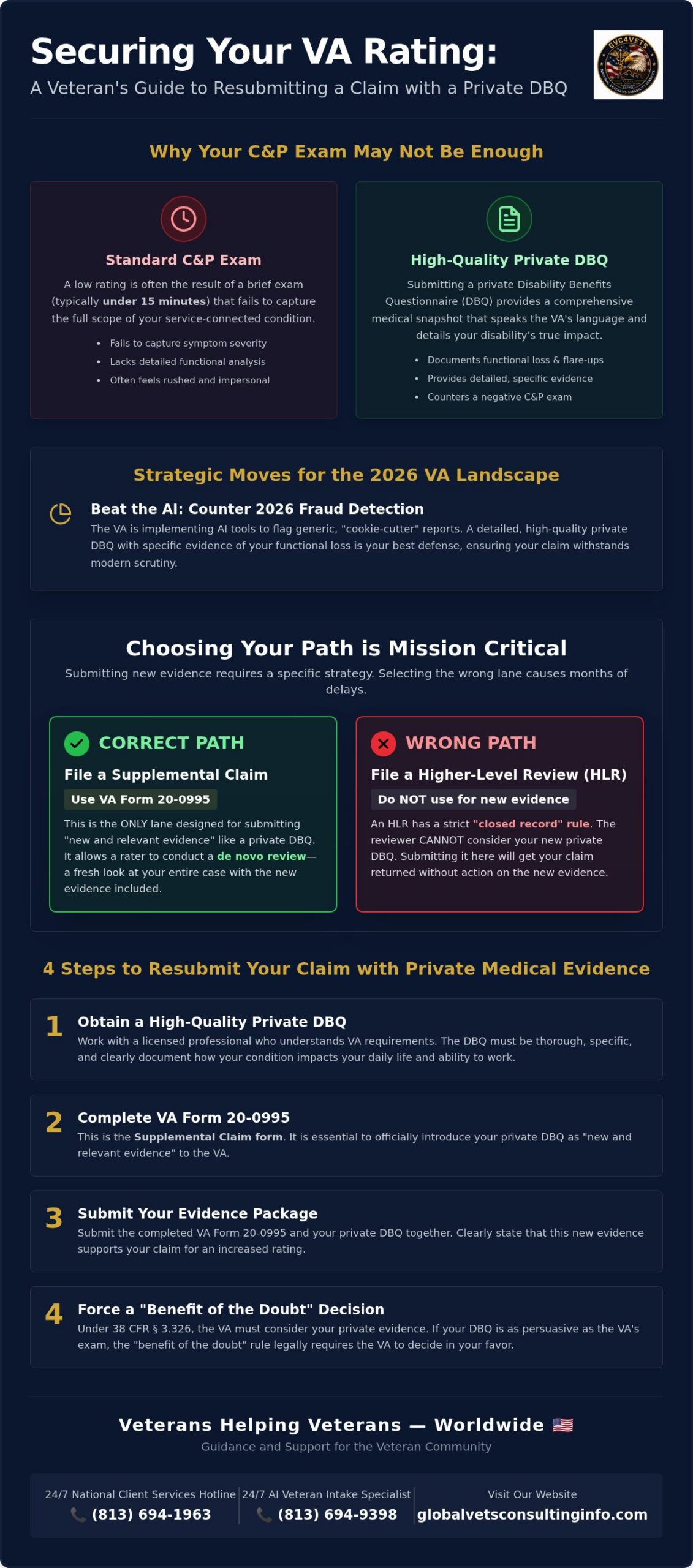
Choosing to take control of your medical evidence is a tactical decision that can change the outcome of your appeal. Many veterans find that a standard C&P exam, which often lasts less than 15 minutes, fails to capture the full severity of their symptoms. By resubmitting a claim with a private dbq, you provide the VA rater with a comprehensive medical snapshot that accurately reflects your level of disability. This documentation bridges the critical gap between your physical or mental limitations and the technical requirements of the VA rating schedule. Under 38 CFR § 3.326, every veteran has the legal right to submit independent medical evidence from a private, licensed professional to support their rating increase.
The Power of Independent Medical Evidence
A private clinician typically offers a much more detailed functional loss analysis than a contracted examiner. They have the time to document how your condition affects your ability to work and perform daily tasks, especially during flare-ups. This level of detail is vital when you need to counter a negative C&P exam. Because Disability Benefit Questionnaires (DBQs) are standardized, a well-prepared private report speaks the VA’s language, making it much harder for a rater to ignore your symptoms. If your private evidence is as persuasive as the VA’s exam, the “benefit of the doubt” rule requires the VA to lean in your favor.
Navigating the 2026 VA Landscape
The 2026 environment is increasingly technical, with the VA using new AI-driven tools to detect “cookie-cutter” medical reports. Quality and specificity are your best defenses against these fraud detection systems. Fortunately, the Elizabeth Dole Act of 2025 has streamlined the process by requiring the VA to accept private evidence through machine-readable portals. This means your private documentation is now more accessible to raters than ever before. When resubmitting a claim with a private dbq, focusing on meticulous, evidence-based documentation ensures your claim stands up to this modern scrutiny. It’s about presenting a professional file that the system cannot easily dismiss.
Choosing the Right Path: Supplemental Claim vs. Higher-Level Review
Deciding how to challenge a VA decision is a critical step in your journey toward a fair rating. You generally have two primary options: the Supplemental Claim or the Higher-Level Review. Choosing the wrong lane can result in months of lost time and continued financial strain. If you’ve been VA claim denied for lack of evidence, understanding the difference between these paths is the first step toward recovery. Each lane has specific rules about what the VA can and cannot look at during the review process.
When to File a Supplemental Claim
The Supplemental Claim lane is specifically designed for veterans who have new information to share with the VA. When resubmitting a claim with a private dbq, you must use VA Form 20-0995 because the VA considers a private DBQ to be “new and relevant evidence.” This means the evidence was not part of your file when the previous decision was made and it directly relates to the issue you’re claiming. This path allows a rater to perform a de novo review, essentially looking at your case with fresh eyes in light of the VA evidence requirements. If you’re unsure which medical evidence will best support your case, our team can help you understand your veteran benefits education options.
Why HLR is the Wrong Choice for New DBQs
A Higher-Level Review (HLR) is often tempting because it involves a more experienced rater, but it comes with a strict “closed record” rule. In an HLR, the rater can only look at the evidence that was already in your file at the time of the denial. They cannot consider your new private DBQ, no matter how detailed or accurate it is. If you submit new medical evidence in this lane, the VA will likely return the claim without reviewing the new data. While the Elizabeth Dole Act of 2025 has improved how the VA receives digital files, it hasn’t changed these fundamental lane rules. If your goal is resubmitting a claim with a private dbq to fix a low rating, the Supplemental Claim is your only viable option.
Step-by-Step: How to Resubmit Your Claim Using Private Medical Evidence
Resubmitting a claim with a private dbq requires a methodical approach to ensure the VA rater has everything they need to make a favorable decision. As of July 2026, many veterans receive decisions on their disability compensation claims in approximately 75 to 90 days. To stay within this window, you must correctly prepare VA Form 20-0995. This document is the gateway to your Supplemental Claim. It signals to the VA that you’re providing new and relevant evidence that wasn’t previously considered. Following the VA disability claims process step by step ensures you don’t miss administrative details that cause avoidable denials.
Reviewing Your Private DBQ for Submission
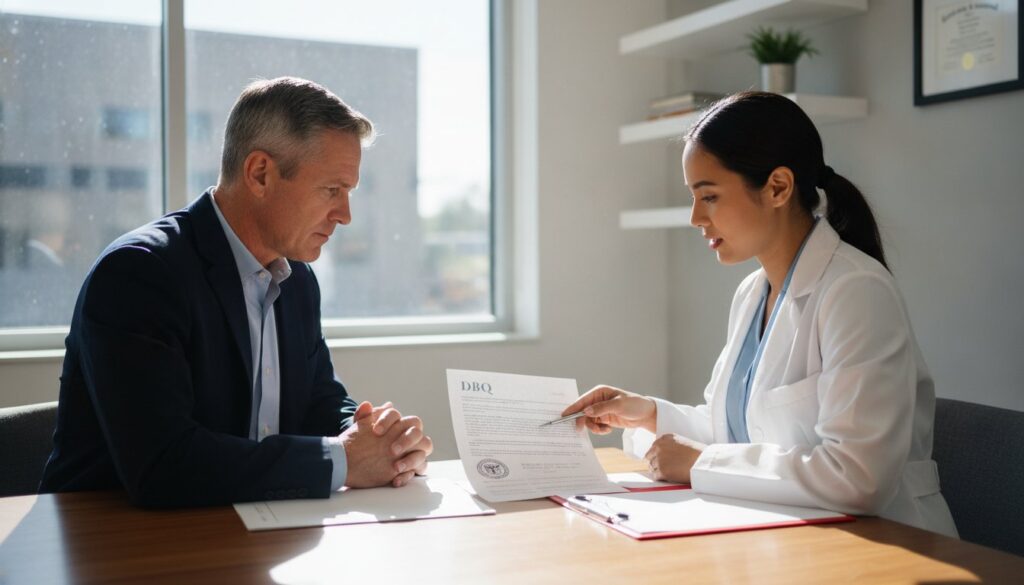
Before you hit upload, verify that your medical provider has completed every section of the questionnaire. A missing signature or an unclear date is the fastest way to have your evidence dismissed. Ensure the clinician’s credentials, NPI number, and contact information are legible. Most importantly, the “Medical Opinion” section must contain a clear Nexus statement. It should explicitly link your current symptoms to your military service using the phrase “at least as likely as not.” Without this specific language, the VA may find the evidence insufficient to change your rating.
The Online Submission Process
The fastest way to get your evidence in front of a rater is through the VA.gov Direct Upload portal. This digital path is more reliable than mail and provides an immediate confirmation of receipt. When resubmitting a claim with a private dbq, it’s helpful to include a VA Form 21-4138, Statement in Support of Claim. Use this statement to briefly highlight the specific findings in your private DBQ that address the previous reasons for denial. This roadmap helps the rater identify the “new and relevant” facts quickly. If you want to ensure your documentation is VA-ready, you can explore our DBQ preparation education resources today.
Avoiding Common Pitfalls: Ensuring Your Private DBQ Meets VA Standards
In the 2026 VA environment, the quality of your documentation is more important than the quantity. With new AI-driven fraud detection systems in place, the VA is actively looking for “cookie-cutter” DBQs that use identical language for different veterans. If your form looks like a generic template, it’s likely to be flagged for additional scrutiny. To avoid this, your private clinician must provide specific details in the “Remarks” section. This area should explain your unique functional limitations, such as how a musculoskeletal condition prevents you from standing for more than 15 minutes or how migraines force you to seek a dark room twice a week. If you’re still asking what is a DBQ exactly, it’s a tool designed to capture these specific medical facts for the rater.
The Importance of Medical Record Review
A common reason for dismissing private evidence is the lack of a comprehensive record review. When resubmitting a claim with a private dbq, your doctor must explicitly state that they have reviewed your entire C-file and military medical records. VA raters often discount private opinions if they believe the doctor didn’t have access to your full service history. This review ensures the clinician can provide a credible Nexus, showing that your current disability is a direct result of your time in service. Without this verification, the VA may favor a lower-quality C&P exam simply because the examiner had access to your official records. Meticulous documentation is the only way to ensure your private evidence carries the weight it deserves.
Global Vets: Your Partner in Accurate Documentation
We believe that an educated veteran is a successful veteran. Our mission is to help you present a file that is meticulous, compliant, and ready for the 2026 digital submission portals. We provide the resources you need to understand your medical evidence and the nuances of the secondary claim process. By focusing on high-quality documentation, we help you avoid the pitfalls that lead to delays and denials. If you’re ready to take the next step toward your earned rating increase, get started with Global Vets today and let’s work together to secure your future.
🇺🇸 Global Vets Consulting — Worldwide
📞 24/7 National Client Services Hotline
🤖 24/7 AI Veteran Intake Specialist
Take Control of Your VA Rating Today
You’ve served with honor and you deserve a disability rating that reflects the true impact of your service. Navigating the 2026 VA landscape requires a strategic approach to medical evidence. By choosing the Supplemental Claim path and ensuring your documentation is meticulous, you can overcome the limitations of a brief C&P exam. Quality and specificity are your best tools to avoid administrative delays and fraud detection triggers. Each piece of evidence must be precise to ensure the system works for you, not against you.
Successfully resubmitting a claim with a private dbq is about bridging the gap between your daily struggles and the VA’s technical requirements. This process allows for a fresh review of your case based on new and relevant evidence that accurately captures your functional loss. You don’t have to navigate this complex system alone. 🇺🇸 Ready to strengthen your claim? Contact Global Vets Consulting for expert DBQ education today! We are veteran-owned and operated, offering specialized expertise in 2026 VA documentation standards. Our 24/7 National Client Services Hotline is available whenever you need support. You’ve earned these benefits; let’s work together to secure the rating you deserve.
Frequently Asked Questions
Can I resubmit a denied VA claim with a private DBQ?
Yes, you can resubmit a denied claim by filing a Supplemental Claim using VA Form 20-0995. Under 38 CFR § 3.326, the VA is required to accept reports from private medical providers as long as they are adequate and complete. By resubmitting a claim with a private dbq, you are providing the “new and relevant” evidence necessary to reopen your case and trigger a fresh review of your disability rating.
Will the VA order a C&P exam if I submit a private DBQ?
The VA often schedules a C&P exam even when you provide your own medical evidence. While a private DBQ can be the sole basis for a rating if it meets all technical requirements, raters frequently use contract exams to verify or clarify clinical findings. You must attend these appointments. If you fail to show up for a VA-scheduled exam, the rater can deny your claim regardless of the quality of your private evidence.
What is the best appeal path for resubmitting a claim with new evidence?
The Supplemental Claim lane is the correct path when you have new medical documentation to present. A Higher-Level Review (HLR) does not allow you to add new evidence to your file; it only permits a review of what was present during the initial denial. For veterans resubmitting a claim with a private dbq, the Supplemental lane allows the rater to consider the detailed functional loss and Nexus statements provided by your private clinician.
How long does it take for the VA to process a Supplemental Claim with a private DBQ?
As of July 2026, the VA is typically reaching decisions on Supplemental Claims within 75 to 90 days. Providing a fully completed private DBQ can sometimes help your claim qualify for the Fully Developed Claim (FDC) program, which may result in a faster turnaround. However, these timelines can fluctuate based on the volume of claims at your specific Regional Office and the complexity of your service-connected conditions.
Does a private DBQ guarantee a higher VA disability rating?
A private DBQ is a piece of evidence, not a guaranteed outcome. The rater evaluates your private medical report alongside your service records and any C&P exam results. If the evidence is “in equipoise,” meaning your private DBQ and the VA’s exam are both equally persuasive, the “benefit of the doubt” rule applies. This legal standard requires the VA to resolve the conflict in your favor and grant the higher rating.
What happens if the VA rejects my private DBQ as insufficient?
If the VA finds your private DBQ insufficient, they will usually schedule a new C&P exam to gather the missing information. Rejections often occur if the clinician didn’t review your entire C-file or if the documentation appears too generic. In the 2026 environment of AI-driven fraud detection, it’s vital that your doctor includes specific functional limitations and detailed remarks to ensure the VA accepts the report as credible evidence.
Article by
Willie Daniel
Willie Daniel is the Founder and Chief Executive Officer (CEO) of Global Vets Consulting (GVC4Vets) – National Veterans Disability Services, a veteran-led educational and medical evidence support organization dedicated to helping veterans better understand VA disability rating increases, DBQ medical evidence, secondary claims education, and C&P examination preparation.
He is a retired U.S. Army Medical Service Corps Officer with more than 27 years of honorable military service, a decorated Iraq combat veteran, and a retired federal official with the U.S. Department of Veterans Affairs. Throughout his military and federal career, Willie Daniel served in leadership, healthcare administration, operational, and veteran-support roles focused on improving services and support systems for servicemembers, veterans, and their families.
Drawing from decades of military leadership, healthcare administration, veteran advocacy, and federal government experience, Willie Daniel brings a practical, veteran-centered perspective to Global Vets Consulting’s educational articles, AI-powered veteran resources, video education initiatives, and outreach programs. His experience navigating military systems, medical documentation processes, and veteran-related administrative operations provides valuable insight into many of the challenges veterans face when seeking to better understand VA disability rating criteria, medical evidence, documentation strategies, and secondary condition education.
Through GVC’s “Veterans Helping Veterans” mission, his focus is on delivering clear, educational, and easy-to-understand information designed to empower veterans with knowledge, resources, and educational tools that may help them make more informed decisions regarding their individual VA disability journeys.
The information provided through GVC is intended for educational and informational purposes only and should not be considered legal or medical advice.
Disclaimer
Disclaimer: Global Vets Consulting, LLC (“GVC”) is a veteran-led educational and medical evidence support organization. GVC is not a law firm, is not a Veterans Service Organization (VSO), and is not affiliated with the U.S. Department of Veterans Affairs (VA) or any government agency.
Global Vets Consulting does not provide legal advice, medical advice, medical treatment, or healthcare services. GVC does not prepare, file, or submit VA disability claims on behalf of veterans. All information provided through this website, blog articles, videos, educational materials, AI tools, dashboards, templates, and communications is intended solely for general educational and informational purposes.
Veterans are encouraged to consult with accredited representatives, licensed attorneys, qualified medical providers, or Veterans Service Organizations regarding their specific legal, medical, or VA-related matters. VA disability decisions, ratings, and outcomes are determined solely by the U.S. Department of Veterans Affairs based on applicable laws, regulations, medical evidence, and individual circumstances. Past results do not guarantee future outcomes.