

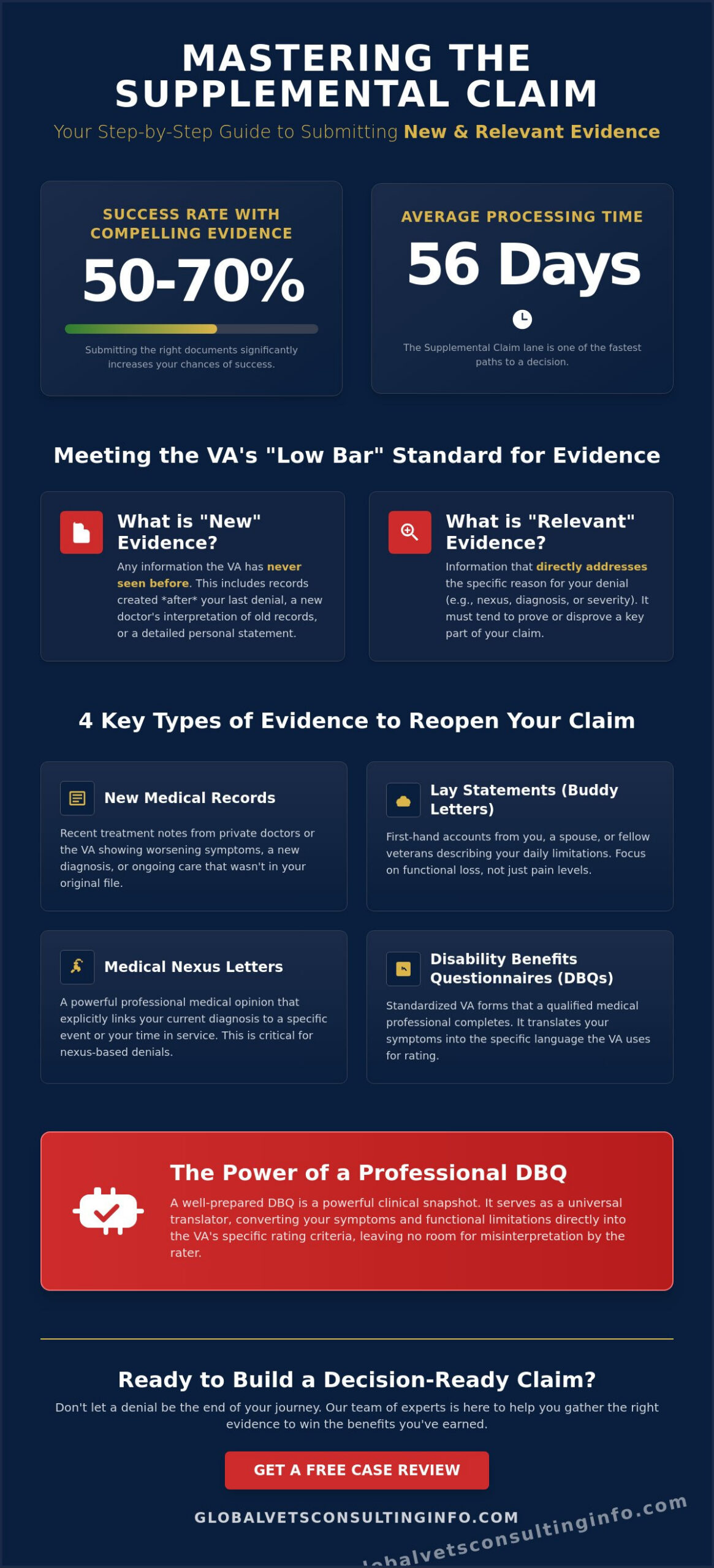
Did you know that supplemental claims have an estimated success rate of 50 to 70 percent when you submit compelling documentation? It’s incredibly frustrating to open a VA decision letter only to see a denial, especially when you know your military service caused your current health struggles. You’ve likely felt ignored by the system or overwhelmed by confusing legal terms and “VA math” that never seems to add up in your favor. Many veterans stop their journey here because they don’t understand how to provide new and relevant evidence for supplemental claim filings, but the “new and relevant” standard is actually a manageable bar designed to help you succeed. 🇺🇸
We understand the anxiety that comes with reopening a case or facing another C&P exam. This guide will show you exactly how to meet the VA’s criteria so you can successfully reopen your denied claim and finally secure the rating you earned. We’ll break down the latest 2026 evidence standards, provide a clear checklist of what to gather, and explain how professional medical evidence can bridge the gap between your symptoms and the law. By following a methodical, step-by-step approach, you can move forward with the steady confidence that your claim is decision-ready.
Key Takeaways
- Understand the legal distinction between “new” and “relevant” to ensure your submission meets the 2026 VA standards for reopening a claim.
- Learn how to identify the “missing link” in your Rating Decision Letter, whether it is a nexus, diagnosis, or severity issue, to target your evidence gathering.
- Discover why submitting new and relevant evidence for supplemental claim filings, such as private medical records or buddy letters, is the key to overcoming a prior denial.
- Explore how a professional Disability Benefits Questionnaire (DBQ) acts as a powerful clinical snapshot that translates your symptoms into the VA’s specific rating language.
- Master the step-by-step process of requesting specific documentation that directly addresses the reason for your initial denial and supports a VA rating increase.
What is New and Relevant Evidence for a Supplemental Claim?
Under the Appeals Modernization Act (AMA), the Veterans Benefits Administration (VBA) has streamlined how you can challenge a denial. The supplemental claim lane is often the fastest path to a win. As of May 2026, the average processing time for these claims is just 56 days. To use this lane, you must provide new and relevant evidence for supplemental claim consideration. This requirement is a “low bar” by design. It’s meant to give you a fair shot at proving your case without the long wait times of a Board Appeal. 🇺🇸
The VA is legally required to accept and review your claim if your evidence meets two simple criteria:
- New Evidence: Information the VA has never seen or considered in your prior decision.
- Relevant Evidence: Information that tends to prove or disprove an issue in your claim.
The ‘New’ Requirement Explained 📝
If you simply resubmit the same medical records you used the first time, the VA will send you a “not readjudicated” notice. They need something they haven’t reviewed yet. To be sure you’re providing something fresh, check your C-File to confirm exactly what the VA already has on record. Any evidence generated after your last denial date is automatically considered “new” because it didn’t exist when the previous rater made their decision. This includes updated treatment notes or a fresh clinical snapshot from a private provider.
The ‘Relevant’ Requirement Explained 🔍
Relevant evidence must address the specific reason your claim was denied. If the VA denied you because they didn’t see a “nexus” (connection to service), a general medical report showing your symptoms are worse won’t help. You need evidence that specifically links the condition to your time in uniform. Relevant evidence is any data that shifts the probability of a claim’s validity. Sometimes this means using a “Theory of Entitlement” to show a secondary connection if your direct connection claim failed. Providing new and relevant evidence for supplemental claim filings ensures the rater has the specific facts needed to grant a VA rating increase.
What Counts? 4 Types of Evidence That Can Reopen Your Claim
Reopening a denied claim requires a strategic approach to documentation. You must provide specific items that bridge the gap in your file and address the VA’s previous concerns. According to official VA guidance on Supplemental Claims, the goal is to present facts that were not considered in the prior decision. Identifying the right new and relevant evidence for supplemental claim submissions is about quality, not just quantity. 🇺🇸
Four primary categories of evidence typically succeed in reopening a claim:
- New Medical Records: Recent treatment notes from private doctors or the VA that show worsening symptoms or a fresh diagnosis.
- Lay Statements (Buddy Letters): First-hand accounts from you, your spouse, or fellow veterans that describe your daily functional limitations.
- Medical Nexus Letters: Professional medical opinions that explicitly link your current diagnosis to your time in uniform.
- Disability Benefits Questionnaires (DBQs): Standardized forms that the VA uses to evaluate the severity of your condition and assign a rating percentage.
Using Lay Evidence to Fill the Gaps
If your VA claim denied for lack of evidence: How to recover strategy involves lay statements, focus on functional loss. Don’t just list your pain levels. Instead, describe how your condition prevents you from performing daily tasks, like standing for long periods or lifting heavy objects. Personal statements are legally “new” if they contain specific details about your limitations that the rater has not previously reviewed. This peer-to-peer evidence provides a human perspective that medical codes sometimes miss.
The Power of Private Medical Opinions
A private doctor’s review of your history can be a powerful tool. Even if a physician reviews your old service records, their new clinical interpretation of those facts is legally “new” evidence. There’s a major difference between a simple diagnostic record and an evaluative opinion that explains why your condition meets the criteria for a higher rating. If you’re feeling overwhelmed by the paperwork, exploring medical evidence education can help you organize your records for a stronger new and relevant evidence for supplemental claim submission.
How to Gather Evidence That Meets VA Requirements in 2026
Gathering the right documentation requires a methodical approach. You don’t want to flood the rater with irrelevant paperwork. Instead, follow these four steps to build a decision-ready packet. This guide to supplemental claims highlights that the quality of your submission often dictates the speed of the outcome. 🇺🇸
- Step 1: Analyze your Rating Decision Letter (RDL) to pinpoint the “missing link”. Is it a missing diagnosis, a lack of service connection (nexus), or insufficient evidence of severity?
- Step 2: Request specific documentation that speaks directly to that missing link.
- Step 3: Organize your files chronologically to demonstrate how your condition has progressed over time.
- Step 4: Use VA-recognized formats for all private medical evidence to ensure the rater can process it quickly.
Identifying the Reason for Denial 🚩
Look closely at the “favorable findings” section of your denial letter. If the VA already concedes you have a diagnosis and a nexus, don’t waste time proving those again. Focus your energy on providing new and relevant evidence for supplemental claim approval by addressing the specific severity issues they found lacking. Understanding the VA disability claims process step by step helps you avoid redundant work and speeds up your path to a rating increase.
Submitting Your Supplemental Claim Packet
In the 2026 claims environment, the VA prioritizes digital submissions. While you can still mail paper forms, digital uploads via VA.gov typically result in faster decision times. Ensure you use VA Form 20-0995 and always include a concise cover letter. This letter should clearly summarize the new and relevant evidence for supplemental claim consideration you’ve included. If you’re ready to take the next step, our team specializes in VA rating increase education to help you secure the benefits you’ve earned.
Strengthening Your Supplemental Claim with a Professional DBQ
A Disability Benefits Questionnaire (DBQ) is arguably the most powerful tool in your arsenal. It serves as the ultimate new and relevant evidence for supplemental claim filings because it bridges the gap between medical facts and legal ratings. While a standard medical record might mention your symptoms, a DBQ uses the exact terminology the VA rater requires to assign a percentage. It satisfies the “relevant” criteria by speaking the VA’s language and the “new” criteria by providing a fresh clinical snapshot that didn’t exist during your last denial.
Understanding what is a DBQ? The key to your VA claim is essential for any veteran facing a denial. At Global Vets Consulting, we emphasize a meticulous approach to documentation. We help ensure your evidence is accurate and ready for the rater’s desk, reducing the likelihood of a “not readjudicated” notice. Our goal is to provide you with the steady confidence that your claim is complete before you hit submit. 🇺🇸
Why DBQs Win Supplemental Claims 🏆
Most denials are rooted in a perceived lack of severity. A DBQ specifically addresses this by documenting range of motion, functional loss, and frequency of flare-ups. This standardized format makes it easy for a rater to see that you meet the requirements for a higher rating. You can learn more about how to use a DBQ for a VA rating increase to ensure your supplemental claim is as strong as possible. Having this level of detail provides the peace of mind that comes from knowing your case is built on solid ground.
Ready to Reopen Your Claim? 📞
Don’t let a denial be the end of your journey. We’re here to act as your steady guide through the complexities of the VA system. Whether you need education on medical evidence or help understanding which DBQ fits your condition, our team is available to support you. 🌎
- 24/7 National Client Services Hotline: Call us anytime for immediate guidance on your evidence needs.
- 24/7 AI Veteran Intake Specialist: Connect with our modern intake system to start your evidence-gathering process today.
- Global Vets Consulting Info: Explore our resources and get the professional DBQ you need at Global Vets Consulting to move your claim forward.
Secure the Benefits You’ve Earned
Turning a VA denial into an approval is a matter of precision and persistence. By identifying the “missing link” in your rating letter and providing new and relevant evidence for supplemental claim filings, you can successfully bridge the gap in your medical records. A professional DBQ acts as the ultimate bridge, translating your daily physical or mental struggles into the specific ratings and percentages the VA requires for a rating increase. 🇺🇸
At Global Vets Consulting, we’ve been veteran-owned and operated since 2021. We are dedicated specialists in professional DBQ documentation and medical evidence education. Whether you’re just starting to organize your files or you’re ready to submit, our 24/7 National Client Services Hotline is here to support you every step of the way. 📞
Start your supplemental claim journey with a professional DBQ today!
You’ve served your country with honor; now it’s time to ensure the system works for you. Stay focused, stay organized, and move forward with the steady confidence that your earned outcomes are finally within reach. 🇺🇸
Frequently Asked Questions
Can I submit a supplemental claim if my denial was years ago?
Yes, you can file a supplemental claim to reopen a previously denied issue regardless of how much time has passed. There is no expiration date for submitting new and relevant evidence for supplemental claim consideration. While you can reopen a claim from decades ago, keep in mind that filing more than one year after your denial usually means you won’t be eligible for back pay reaching back to your original filing date. Your new effective date will typically be the day you submit the supplemental request.
Does a new diagnosis count as new and relevant evidence?
A new diagnosis is almost always considered new and relevant evidence if it relates to the condition you originally claimed. It’s “new” because the VA hasn’t seen this specific clinical finding before, and it’s “relevant” because it provides a formal medical name for your symptoms. For instance, if you were previously denied for “joint pain” but now have a formal diagnosis of “osteoarthritis,” this update gives the rater the concrete medical data needed to move your claim forward toward a successful rating.
What happens if the VA says my evidence isn’t new and relevant?
If the VA determines your evidence doesn’t meet the required standard, they’ll issue a notice stating that the claim has not been readjudicated. This means the rater didn’t find enough fresh information to justify a new look at your case. If this happens, you don’t lose your right to benefits. You can gather more targeted evidence that specifically addresses the “missing link” in your file, or you can challenge the VA’s determination through a Higher-Level Review to have a senior rater re-examine the evidence you provided.
Do I need a lawyer to submit new and relevant evidence?
No, you aren’t required to hire a lawyer or use a Veterans Service Organization to submit new and relevant evidence for supplemental claim filings. Many veterans successfully reopen their claims by focusing on high-quality medical documentation like private Nexus letters or professional DBQs. While professional education can help you organize your records, the “new and relevant” standard is intentionally low to ensure veterans can have their claims reviewed without needing complex legal representation or expensive litigation.
How much new evidence do I need to submit for a supplemental claim?
The VA values the quality and precision of your evidence over the total number of pages you submit. You only need to provide enough documentation to address the specific reason for your previous denial, such as a missing service connection or a lack of a current diagnosis. Often, a single, well-documented Disability Benefits Questionnaire (DBQ) that clearly outlines your functional limitations is more effective than sending hundreds of pages of general treatment notes that don’t speak the VA’s specific rating language.

Article by
Willie Daniel
Willie Daniel is the Founder and Chief Executive Officer (CEO) of Global Vets Consulting (GVC) – National Veterans Disability Services, a veteran-led educational and medical evidence support organization dedicated to helping veterans better understand VA disability rating increases, DBQ medical evidence, secondary claims education, and C&P examination preparation.
He is a retired U.S. Army Medical Service Corps Officer with more than 27 years of honorable military service, a decorated Iraq combat veteran, and a retired federal official with the U.S. Department of Veterans Affairs. Throughout his military and federal career, Willie Daniel served in leadership, healthcare administration, operational, and veteran-support roles focused on improving services and support systems for servicemembers, veterans, and their families.
Drawing from decades of military leadership, healthcare administration, veteran advocacy, and federal government experience, Willie Daniel brings a practical, veteran-centered perspective to Global Vets Consulting’s educational articles, AI-powered veteran resources, video education initiatives, and outreach programs. His experience navigating military systems, medical documentation processes, and veteran-related administrative operations provides valuable insight into many of the challenges veterans face when seeking to better understand VA disability rating criteria, medical evidence, documentation strategies, and secondary condition education.
Through GVC’s “Veterans Helping Veterans” mission, his focus is on delivering clear, educational, and easy-to-understand information designed to empower veterans with knowledge, resources, and educational tools that may help them make more informed decisions regarding their individual VA disability journeys.
The information provided through GVC is intended for educational and informational purposes only and should not be considered legal or medical advice.
Disclaimer
Disclaimer: Global Vets Consulting, LLC (“GVC”) is a veteran-led educational and medical evidence support organization. GVC is not a law firm, is not a Veterans Service Organization (VSO), and is not affiliated with the U.S. Department of Veterans Affairs (VA) or any government agency.
Global Vets Consulting does not provide legal advice, medical advice, medical treatment, or healthcare services. GVC does not prepare, file, or submit VA disability claims on behalf of veterans. All information provided through this website, blog articles, videos, educational materials, AI tools, dashboards, templates, and communications is intended solely for general educational and informational purposes.
Veterans are encouraged to consult with accredited representatives, licensed attorneys, qualified medical providers, or Veterans Service Organizations regarding their specific legal, medical, or VA-related matters. VA disability decisions, ratings, and outcomes are determined solely by the U.S. Department of Veterans Affairs based on applicable laws, regulations, medical evidence, and individual circumstances. Past results do not guarantee future outcomes.

