
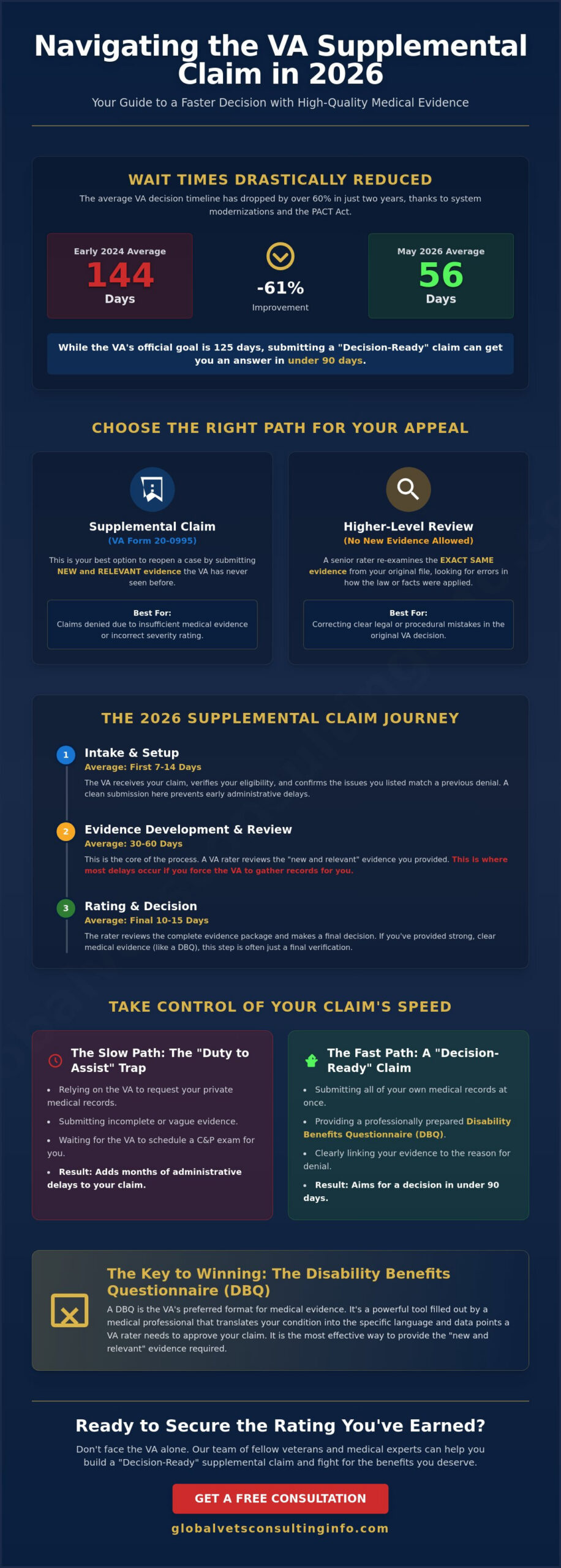
Did you know that the average wait for a VA decision has dropped by more than 60 percent in just two years? As of May 2026, the average supplemental claim timeline 2026 is sitting at just 56 days, which is a massive improvement from the 144 day slog veterans faced in early 2024. While the VA officially sets a goal of 125 days for these decisions, many of our fellow veterans are seeing results much faster by submitting high quality evidence right out of the gate.
We understand the financial strain and anxiety that comes with a second attempt at a claim, especially when terms like “new and relevant evidence” feel like confusing bureaucratic hurdles. You’ve earned these benefits through your service, and waiting months only to face another denial is a stress you don’t need. This guide will show you exactly how to navigate the current processing stages to aim for a decision in under 90 days. We’ll explore the latest 2.8 percent COLA rates and explain how specific medical evidence, such as a Disability Benefits Questionnaire (DBQ), can help you finally secure the service connection or rating increase you deserve.
Key Takeaways
- Learn why the current supplemental claim timeline 2026 is averaging 60-90 days and how the intake phase sets the pace for your decision.
- Understand the critical differences between a Supplemental Claim and a Higher-Level Review so you can choose the fastest path for submitting new evidence.
- Discover how providing your own medical records prevents the “Duty to Assist” trap from adding months of administrative delays to your claim.
- See how professionally prepared Disability Benefits Questionnaires (DBQs) provide the “new and relevant” medical evidence needed to support a rating increase.
Understanding the VA Supplemental Claim Timeline in 2026
A supplemental claim is your primary tool for reopening a case after receiving a denial letter. By filing VA Form 20-0995, you’re asking the Veterans Benefits Administration (VBA) to take a second look based on information they didn’t have the first time. Unlike a Higher-Level Review (HLR), where a senior rater looks at the exact same file, the supplemental lane allows you to inject fresh medical data into the record. This makes it the most flexible and effective path for veterans who were denied due to a lack of evidence or an incorrect severity rating.
The supplemental claim timeline 2026 has evolved significantly due to the VA’s push for digital automation and the massive staffing surge following the PACT Act. While the VA disability claims process step by step usually involves several months of waiting, the supplemental lane is currently one of the fastest routes to a decision. The system is now better equipped to handle these reviews because the framework for the claim is already established; the rater just needs to evaluate the specific new evidence you’ve provided to fill the gaps.
The “New and Relevant” Evidence Standard
To win a supplemental claim, you must meet a specific legal threshold: your evidence must be both new and relevant. “New” simply means the VA has never seen this specific document or medical record before. “Relevant” means the information directly addresses the specific reason the VA gave for your initial denial. Relevant evidence is any documentation that proves a missing link in service connection or establishes the current severity of your condition.
Many veterans find that a professionally prepared Disability Benefits Questionnaire (DBQ) is the key to meeting this standard. Because a DBQ is designed to capture the exact medical data points a rater needs, it often serves as the “relevant” piece that was missing from your original file. Providing this level of precision helps the VA make a faster, more accurate decision without having to hunt for information themselves. It’s about giving them exactly what they need to say “yes” the second time around.
2026 Timeline Breakdown: From Filing to Decision
The supplemental claim timeline 2026 reached a peak efficiency of 56 days as of May 2026. While most veterans should still plan for a 60 to 90 day window, the trend is clearly moving toward faster resolutions. This process follows a structured path that starts the moment your VA Form 20-0995 is uploaded into the system. Understanding these phases helps reduce the anxiety of the “black hole” period where it feels like nothing is happening with your file.
During the first 14 days, the VA focuses on intake. They verify your eligibility and confirm that the issues listed match previous denials. Following official VA guidance on Supplemental Claims ensures your paperwork is processed without administrative kickbacks. This is the stage where the VA determines if your claim is actually “supplemental” or if it belongs in a different review lane.
The Evidence Development phase is the core of the wait, typically lasting 30 to 60 days. This is when the VA reviews your new evidence or attempts to gather records. If your file is missing clear medical data, this phase can stretch longer as the VA schedules exams or waits for third-party records. Finally, the Rating and Decision phase occurs. A rater reviews the complete evidence package and issues a notice of action. If you’ve provided a strong medical foundation, this step is often a straightforward verification of the facts.
The Impact of the PACT Act on 2026 Wait Times
In 2026, the VA continues to prioritize claims related to toxic exposure and presumptive conditions under the PACT Act. Veterans filing for respiratory issues or other toxic exposure illnesses often see faster results because the VA has streamlined these specific workflows. Using a precise Disability Benefits Questionnaire (DBQ) for these conditions can help bypass common development delays and get your decision faster. These documents provide the exact medical evidence the rater needs to confirm a presumptive service connection without extra legwork.
Factors That Influence Your Supplemental Claim Speed
While the supplemental claim timeline 2026 is faster on average, your individual speed depends largely on how much work you leave for the VA rater. In the modernized 2026 system, the VA prioritizes “Decision-Ready” files. These are claims where every piece of evidence is already in the folder, allowing the rater to make a determination without reaching out to external doctors or archives. If your file is complete, it moves; if it’s missing data, it sits.
A major bottleneck is the “Duty to Assist” trap. While the VA is legally required to help you gather records, this process is notoriously slow. Relying on the VA to track down your private medical history or military personnel records can add three to six months to your wait. You can avoid having your VA claim denied for lack of evidence by taking control of the documentation yourself. Providing a complete evidence package on day one is the most effective way to keep your file moving through the VA Supplemental Claim Information portal.
Another common delay involves the Compensation and Pension (C&P) exam. Scheduling these exams with third-party contractors often creates a backlog that stalls your claim for weeks. When the VA has to order an exam to clarify the severity of your condition, your timeline effectively pauses while you wait for an appointment and the subsequent medical report to be uploaded.
The Speed Advantage of Private Medical Evidence
Submitting a private Disability Benefits Questionnaire (DBQ) offers a distinct advantage over waiting for a VA-ordered exam. A private DBQ acts as a “fast-pass” by providing the rater with all necessary medical data on day one. When a rater sees a fully completed DBQ that is actionable and sufficient, they can often skip the evidence-gathering phase entirely. This can shave months off your total wait time compared to a veteran who relies solely on the VA’s internal exam process. Ready to take control of your evidence? See how our educational resources can help you prepare a Decision-Ready file today.
How Professional DBQs Streamline Your Supplemental Claim
Global Vets Consulting serves as your dedicated partner in generating the “Relevant Evidence” the VA requires to overturn a prior denial. While legal arguments have their place, VA raters primarily rely on medical documentation to make their determinations. Our Disability Benefits Questionnaires (DBQ) are meticulously designed to survive the highest levels of scrutiny by speaking the language of the rater. By providing clear, actionable data on day one, we help ensure your file moves through the supplemental claim timeline 2026 with minimal friction and fewer administrative delays.
Our “Veterans Helping Veterans” approach ensures that no symptom is overlooked or minimized during the documentation process. We understand that documenting the reality of your daily life is the only way to bridge the gap between a denial and an approval. This peer-driven focus means your medical evidence isn’t just a form; it’s a comprehensive, technical reflection of your service-connected conditions that meets the VA’s strict evidentiary standards.
Why Quality Documentation Prevents Future Appeals
Winning your supplemental claim isn’t just about speed; it’s about accuracy. If you secure a service connection but receive an underrated percentage, you’re forced back into the waiting cycle for another increase. A thorough, educational DBQ can often lead to a VA disability rating increase on the first attempt, saving you years of future appeals. Our goal is to help you secure the correct rating the first time so you can focus on your health and family rather than bureaucracy.
Ready to stop waiting and start winning? Our team provides the resources and education you need to submit a decision-ready file. Connect with us today to take the next step in your journey.
- 🇺🇸 Global Vets Consulting Worldwide
- 🌐 GlobalVetsConsultingInfo.com
- 📞 24/7 National Client Services Hotline
- 🤖 24/7 AI Veteran Intake Specialist
Take Control of Your VA Supplemental Claim Today
The supplemental claim timeline 2026 offers a clear path to the benefits you’ve earned, provided you approach the process with precision. Success in this review lane depends on bypassing the “Duty to Assist” trap by submitting a decision-ready file on day one. When you provide the VA with thorough, technically accurate medical evidence, you eliminate the need for them to schedule extra exams or hunt for missing records. This proactive strategy speeds up the rater’s decision and significantly reduces the anxiety of the waiting period.
Our team is veteran-owned and operated, driven by a “Veterans Helping Veterans” mission to ensure no symptom goes undocumented. We offer specialized expertise in complex musculoskeletal and mental health DBQs, providing the clinical clarity raters need to approve your claim or rating increase. If you’re ready to stop waiting on the system and start advocating for your future, our 24/7 AI Veteran Intake Specialist is available to help you begin immediately.
Get Started with a Private DBQ Today 🇺🇸
You’ve served your country with honor, and now it’s time to secure the rating you deserve. Stay focused, stay informed, and keep moving forward toward the decision you’ve earned.
Frequently Asked Questions
How long does a VA supplemental claim take in 2026?
The average processing time for a VA supplemental claim was 56 days as of May 2026. While the VA sets an official goal of 125 days, the current trend shows that most veterans receive a decision within two to three months. Your individual supplemental claim timeline 2026 depends on the quality of your evidence and whether the rater needs to order additional exams to clarify your diagnosis.
Can I submit a supplemental claim online?
Yes, you can submit your supplemental claim digitally through the official VA.gov website or the Direct Upload tool. Filing online is the most efficient method because it eliminates the transit and scanning delays associated with paper mail. When you upload VA Form 20-0995 and your medical evidence electronically, your file becomes visible to the Veterans Benefits Administration almost immediately, which helps keep your timeline on track.
What is considered new and relevant evidence for a supplemental claim?
New evidence is any documentation the VA hasn’t seen before, and relevant evidence is information that directly addresses the reason for your denial. This might include a private Disability Benefits Questionnaire (DBQ) that provides missing clinical data or updated treatment records showing an increase in symptom severity. To be effective, this evidence must prove a specific point that was previously missing or misunderstood by the rater.
Will I get back pay for a supplemental claim?
You’ll receive back pay if you file your supplemental claim within one year of the date on your VA decision letter. This preserves your original effective date, ensuring you’re compensated for the entire time your claim was in the system. If you wait longer than 365 days to file, you’ll likely lose that original effective date, and your back pay will only go back to the date you reopened the claim.
Is a supplemental claim faster than a Higher-Level Review?
A supplemental claim is generally faster than a Higher-Level Review because it allows you to fix mistakes by adding new medical evidence immediately. While the supplemental claim timeline 2026 is currently averaging under 60 days, a Higher-Level Review is restricted to the existing evidence, which often leads to a “Duty to Assist” error that restarts the development process. Providing a decision-ready file in the supplemental lane is usually the most direct path to a result.

Article by
Willie Daniel
Willie Daniel is the Founder and Chief Executive Officer (CEO) of Global Vets Consulting (GVC) – National Veterans Disability Services, a veteran-led educational and medical evidence support organization dedicated to helping veterans better understand VA disability rating increases, DBQ medical evidence, secondary claims education, and C&P examination preparation.
He is a retired U.S. Army Medical Service Corps Officer with more than 27 years of honorable military service, a decorated Iraq combat veteran, and a retired federal official with the U.S. Department of Veterans Affairs. Throughout his military and federal career, Willie Daniel served in leadership, healthcare administration, operational, and veteran-support roles focused on improving services and support systems for servicemembers, veterans, and their families.
Drawing from decades of military leadership, healthcare administration, veteran advocacy, and federal government experience, Willie Daniel brings a practical, veteran-centered perspective to Global Vets Consulting’s educational articles, AI-powered veteran resources, video education initiatives, and outreach programs. His experience navigating military systems, medical documentation processes, and veteran-related administrative operations provides valuable insight into many of the challenges veterans face when seeking to better understand VA disability rating criteria, medical evidence, documentation strategies, and secondary condition education.
Through GVC’s “Veterans Helping Veterans” mission, his focus is on delivering clear, educational, and easy-to-understand information designed to empower veterans with knowledge, resources, and educational tools that may help them make more informed decisions regarding their individual VA disability journeys.
The information provided through GVC is intended for educational and informational purposes only and should not be considered legal or medical advice.
Disclaimer
Disclaimer: Global Vets Consulting, LLC (“GVC”) is a veteran-led educational and medical evidence support organization. GVC is not a law firm, is not a Veterans Service Organization (VSO), and is not affiliated with the U.S. Department of Veterans Affairs (VA) or any government agency.
Global Vets Consulting does not provide legal advice, medical advice, medical treatment, or healthcare services. GVC does not prepare, file, or submit VA disability claims on behalf of veterans. All information provided through this website, blog articles, videos, educational materials, AI tools, dashboards, templates, and communications is intended solely for general educational and informational purposes.
Veterans are encouraged to consult with accredited representatives, licensed attorneys, qualified medical providers, or Veterans Service Organizations regarding their specific legal, medical, or VA-related matters. VA disability decisions, ratings, and outcomes are determined solely by the U.S. Department of Veterans Affairs based on applicable laws, regulations, medical evidence, and individual circumstances. Past results do not guarantee future outcomes.