

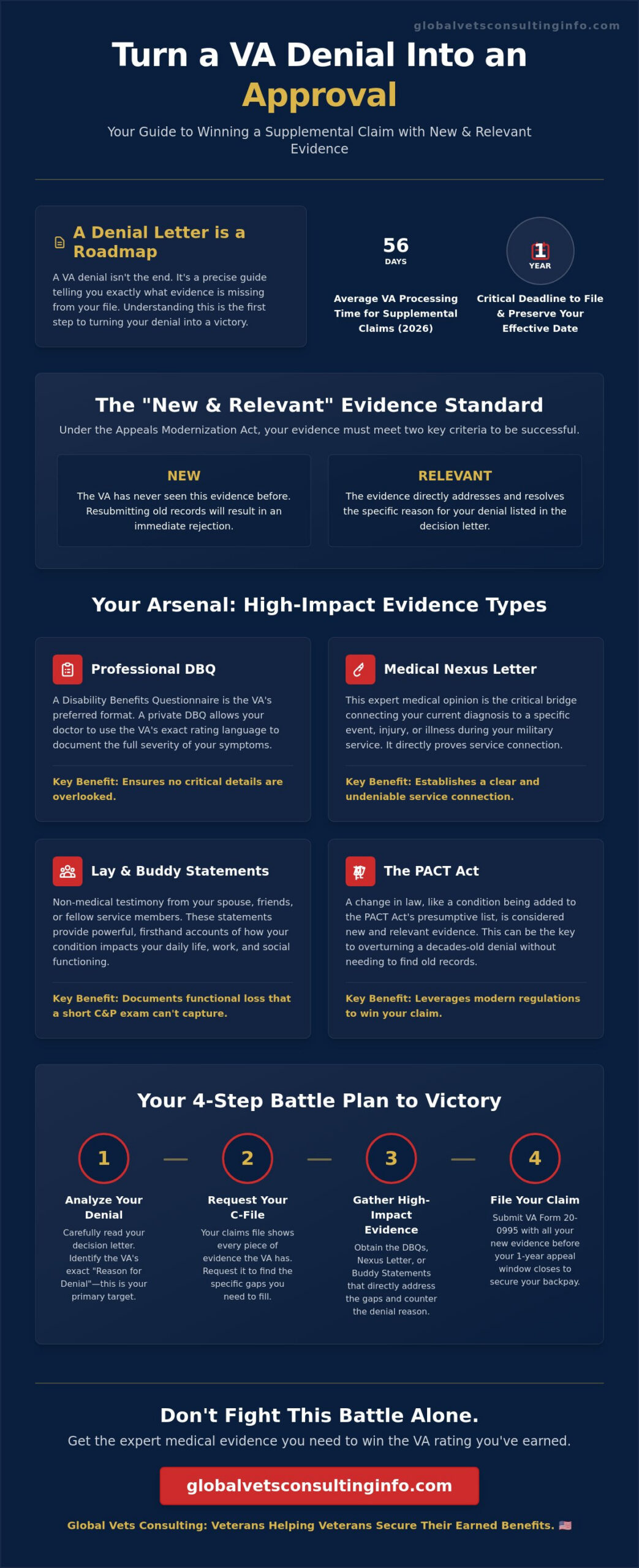
A VA denial letter isn’t the end of your journey; it’s a roadmap that tells you exactly what is missing from your file. Most veterans feel a sense of dread when they see that “denied” status, especially when faced with a 1-year deadline and confusing medical jargon. It’s frustrating to feel like the system is working against you, but with the average supplemental claim processing time dropping to just 56 days in 2026, there has never been a better time to push back. Winning your appeal starts with submitting the right new evidence for va supplemental claim, which must be both new to the VA and relevant to your specific condition.
We understand the stress of trying to decode a generic denial. You’ll learn exactly what counts as “new and relevant” evidence under the Appeals Modernization Act and how to use professional Disability Benefits Questionnaires (DBQs) to overturn a previous decision. This guide provides a clear strategy to obtain the high-quality medical documentation you need to secure your earned rating increase. We’ll walk through the current 2026 standards and the specific steps required to turn a “no” into a “yes” before your appeal window closes. 🇺🇸
Key Takeaways
- Master the “New and Relevant” evidence standard by identifying exactly what information the VA lacked during your initial claim review.
- Learn how to strategically submit new evidence for va supplemental claim that directly addresses the specific “Reason for Denial” listed in your decision letter.
- Discover why professional Disability Benefits Questionnaires (DBQs) are essential for documenting the full severity of your symptoms using the VA’s required terminology.
- Understand the critical role of Nexus Letters and Lay Statements in establishing a clear service connection and documenting daily functional loss.
- Follow a logical, step-by-step process to request your C-File and uncover the specific gaps in your previous medical evidence.
Understanding the “New and Relevant” Evidence Standard for Supplemental Claims
Filing a supplemental claim is the most effective way to reopen a denied case, but success depends entirely on meeting the “new and relevant” evidence standard. Under the Appeals Modernization Act (AMA), the Veterans Benefits Administration requires that any additional documentation submitted was not previously considered. If you simply resubmit the same medical records that led to your initial denial, the VA will likely issue an immediate rejection without a full review. To move your claim forward, you must provide information that is both “new,” meaning it’s the first time the VA is seeing it, and “relevant,” meaning it directly addresses the specific legal or medical deficiency in your previous decision.
Timing is critical when preparing your new evidence for va supplemental claim. You have a one year window from the date on your decision letter to file this appeal. Meeting this deadline ensures you preserve your original effective date, which protects your potential backpay. In 2026, the VA has significantly improved its efficiency, with supplemental claims now averaging just 56 days for completion. This faster pace makes it even more vital to have your evidence organized and ready before you hit the submit button.
Why Your Previous Evidence Was Not Enough
Most denials happen because the evidence lacked “probative value.” This means the records didn’t actually prove the specific medical facts required for a grant. Common issues include a missing medical nexus or evidence that doesn’t show your symptoms meet a specific rating percentage. If you’ve found yourself in this position, it’s helpful to review our guide on VA claim denied for lack of evidence: how to recover in 2026 🇺🇸. To win, your new documentation must bridge the gap between your current health status and your military service with clear, clinical facts.
The PACT Act and Presumptive Conditions in 2026
In some cases, the “new and relevant” evidence isn’t a medical record, but a change in the law itself. As we move through 2026, the list of presumptive conditions under the PACT Act continues to provide a pathway for previously denied veterans. If a condition you were denied for in the past is now considered presumptive, that legal change qualifies as new and relevant information. Staying updated on these expansions allows you to leverage modern regulations to overturn old denials without needing to prove a direct service connection through events that happened decades ago.
High-Impact Evidence Types: DBQs, Nexus Letters, and Lay Statements
Understanding the “new and relevant” standard is the first step, but knowing which documents carry the most weight is how you actually win. High-impact evidence fills the clinical gaps that led to your initial denial. A Medical Nexus Letter is often the most critical piece of new evidence for va supplemental claim submissions. It acts as a professional bridge, connecting your current diagnosis to specific events during your time in service. As highlighted on the official VA page for Supplemental Claims, this documentation must be relevant to the issues identified in your previous decision letter.
Lay Statements, commonly known as “Buddy Letters,” provide non-medical testimony that documents your daily functional loss. While a C&P examiner might only see you for fifteen minutes, a spouse or fellow service member can describe how your condition affects your ability to work or perform daily tasks. Private medical records and Independent Medical Opinions (IMOs) also carry significant weight. These records often provide a more comprehensive history of your treatment than standard VA notes, offering a fresh clinical perspective that can challenge a previous examiner’s findings.
The Power of a Professional DBQ
A Disability Benefits Questionnaire (DBQ) is the VA’s preferred format for capturing medical data. Private DBQs are particularly effective because they allow your doctor to document every symptom using the exact language the VA uses for its rating schedule. This ensures that no detail is overlooked during the review process. For a detailed breakdown of how these forms work, read our guide on What is a DBQ for VA Claims? A Veteran’s Guide in 2026 🇺🇸. Using a professional DBQ can help you present a clearer picture of your disability’s severity.
Secondary Service Connection Evidence
Many veterans find success by linking a new condition to an already service-connected disability. For example, you might claim migraines secondary to a service-connected neck injury. To prove this link, your doctor should provide a checklist of evidence including:
- A clear diagnosis of the secondary condition.
- A clinical rationale explaining how the primary condition caused or aggravated the secondary one.
- Citations of medical literature that support the link between the two conditions.
Educating yourself on medical evidence strategies can help you build a stronger case for these complex secondary connections. 🇺🇸
Step-by-Step Guide: How to Gather and Submit Your Supplemental Claim Evidence
Winning an appeal requires a methodical approach that transforms your frustration into a structured medical argument. Your first objective is to treat your Rating Decision Letter as a diagnostic tool rather than just a rejection. By identifying the exact technicality the VA used to deny you, you can provide new evidence for va supplemental claim that acts as a direct solution to their objection. For a broader perspective on your options, the VA Decision Review Toolkit provides excellent context on choosing the right appeal lane based on your specific situation.
Once you’ve identified the gap, request your C-File immediately. This file contains the DBQ from your last C&P exam, allowing you to see exactly where the VA examiner might have downplayed your symptoms or ignored your medical history. With this information in hand, you can secure a private DBQ that specifically addresses those missing clinical details. Finally, draft a Statement in Support of Claim using VA Form 21-4138. This narrative ties your new medical evidence to your service history, ensuring the rater sees the full picture of your disability.
Decoding Your VA Denial Letter
Look for specific phrases in your decision letter. If it says “no medical nexus,” your new evidence must be a Nexus Letter. If it says “symptoms do not meet the criteria for a higher rating,” your evidence must be a DBQ documenting increased severity. Your goal is to provide the clinical “antidote” to the VA’s specific language. This level of precision prevents the rater from issuing another generic denial.
Filing Form 20-0995 in 2026
When you’re ready to submit, you’ll use VA Form 20-0995. In 2026, the VA prioritizes “Fully Developed” submissions to manage the current backlog and maintain the improved 56-day average processing time. You can find more details in our VA disability claims process step by step: a 2026 guide. Submitting all your evidence at once prevents the VA from having to hunt for records, which speeds up your decision. If you’re ready to take the next step, you can get professional DBQ education and support to ensure your claim is bulletproof. 🇺🇸
Why a Professional DBQ is the Ultimate Evidence for a Denied Condition
A professional Disability Benefits Questionnaire (DBQ) serves as the most potent form of new evidence for va supplemental claim submissions because it eliminates ambiguity. While standard medical notes often focus on treatment, a DBQ focuses on the specific rating criteria the VA uses to determine your compensation. Global Vets Consulting specializes in medical documentation education that bridges the gap between your actual health struggles and the rigid requirements of the VA system. We utilize a “Veterans Helping Veterans” approach, meaning we understand the frustration of the process because we’ve navigated it ourselves.
A private DBQ provides the “probative value” that a Higher-Level Review or a previously denied claim often lacks. It ensures that every symptom, from frequency to severity, is documented in the exact clinical language required by the rating schedule. This precision prevents the VA from relying solely on a brief C&P exam where your symptoms might have been having a “good day.” Providing this detailed clinical roadmap makes it significantly harder for the VA to justify a denial or an underrated decision.
Accuracy Leads to Higher Ratings
Precision in your documentation is often the difference between a low rating and the compensation you actually deserve. For instance, a detailed DBQ can move a veteran from a 30% rating to a 70% rating simply by accurately documenting the frequency of prostrating attacks or the severity of social impairment. In 2026, with the 2.8% COLA increase now in effect, these rating jumps result in significant differences in your monthly payments. You can read more about this strategy in our guide on How to Use a DBQ for a VA Disability Rating Increase in 2026. 🇺🇸
Take the Next Step with Global Vets Consulting
Don’t let the 1-year appeal deadline pass you by. Securing the right new evidence for va supplemental claim requires immediate action to preserve your backpay and original effective date. We are ready to assist you with the education and resources needed to challenge your denial with confidence. Our team is dedicated to providing a clear, predictable path forward for those who feel neglected by complex systems.
- ☎️ 24/7 National Client Services Hotline
- 🤖 24/7 AI Veteran Intake Specialist
- 🌐 Visit Global Vets Consulting to get started
Take Action to Secure Your Earned VA Rating
Winning an appeal is a matter of medical precision and tactical persistence. By identifying the exact technicality in your denial letter and gathering new evidence for va supplemental claim that addresses that specific gap, you shift the odds in your favor. Remember that clinical accuracy through professional DBQs is your most powerful tool to ensure no symptom is overlooked by a rater during the review process.
Global Vets Consulting is a veteran-owned and operated organization that understands the weight of your service. We specialize in medical documentation education designed to bridge the gap between your health and the VA’s complex requirements. With our 24/7 AI Veteran Intake Specialist and National Client Services Hotline, you have constant access to the support you need to meet your one year appeal deadline with confidence.
📞 Contact our 24/7 National Client Services Hotline to secure your professional DBQ education today.
You’ve earned these benefits through your service and sacrifice. Don’t let a generic denial letter be the final word on your claim. We are here to stand with you as you fight for the rating you deserve. 🇺🇸
Frequently Asked Questions
What is considered “new and relevant” evidence for a VA supplemental claim?
New evidence is information the VA has not previously reviewed, while relevant evidence is information that tends to prove or disprove an aspect of your claim. Under the Appeals Modernization Act, your submission must address the specific reason for denial listed in your decision letter. This could include a new medical diagnosis, a nexus letter linking your condition to service, or a DBQ that documents increased symptom severity.
How long do I have to file a supplemental claim after a denial?
You have exactly one year from the date on your VA decision letter to file a supplemental claim. Meeting this deadline is critical because it preserves your original effective date and protects your potential backpay. If you miss this one year window, you can still file a supplemental claim at any time, but you will likely lose the earlier effective date for your benefits.
Can I submit a supplemental claim if my condition has worsened?
Yes, you can file a supplemental claim if your condition has worsened, as new medical records showing increased severity qualify as new and relevant evidence. This strategy is often used to challenge a rating that no longer reflects your daily functional loss. By submitting updated medical documentation, you provide the VA with the clinical facts necessary to justify a rating increase while potentially maintaining your original effective date.
Is a private DBQ better than a VA C&P exam for a supplemental claim?
A private DBQ is often more effective because it allows a doctor who understands your history to document your symptoms using the VA’s specific language. Standard C&P exams are often brief and may overlook the full frequency of your symptoms. Submitting a private DBQ provides new evidence for va supplemental claim that can directly counter a contractor’s findings with more detailed and accurate clinical data.
Can I file a supplemental claim online at VA.gov?
Veterans can file VA Form 20-0995 electronically through the VA.gov portal or by mailing the physical form to the Evidence Intake Center. Filing online is generally the fastest way to get your evidence into the system. As of early 2026, the average processing time for a supplemental claim has improved to approximately 56 days, making digital submission the most efficient choice for a timely decision.
What happens if my supplemental claim is denied again?
If your claim is denied again, you can submit another supplemental claim with different new evidence for va supplemental claim, request a Higher-Level Review, or appeal to the Board of Veterans’ Appeals. The supplemental lane is unique because you can keep the claim active indefinitely by providing new information within one year of each denial. This continuous cycle allows you to maintain your original effective date until you achieve a successful outcome.

Article by
Willie Daniel
Willie Daniel is the Founder and Chief Executive Officer (CEO) of Global Vets Consulting (GVC) – National Veterans Disability Services, a veteran-led educational and medical evidence support organization dedicated to helping veterans better understand VA disability rating increases, DBQ medical evidence, secondary claims education, and C&P examination preparation.
He is a retired U.S. Army Medical Service Corps Officer with more than 27 years of honorable military service, a decorated Iraq combat veteran, and a retired federal official with the U.S. Department of Veterans Affairs. Throughout his military and federal career, Willie Daniel served in leadership, healthcare administration, operational, and veteran-support roles focused on improving services and support systems for servicemembers, veterans, and their families.
Drawing from decades of military leadership, healthcare administration, veteran advocacy, and federal government experience, Willie Daniel brings a practical, veteran-centered perspective to Global Vets Consulting’s educational articles, AI-powered veteran resources, video education initiatives, and outreach programs. His experience navigating military systems, medical documentation processes, and veteran-related administrative operations provides valuable insight into many of the challenges veterans face when seeking to better understand VA disability rating criteria, medical evidence, documentation strategies, and secondary condition education.
Through GVC’s “Veterans Helping Veterans” mission, his focus is on delivering clear, educational, and easy-to-understand information designed to empower veterans with knowledge, resources, and educational tools that may help them make more informed decisions regarding their individual VA disability journeys.
The information provided through GVC is intended for educational and informational purposes only and should not be considered legal or medical advice.
Disclaimer
Disclaimer: Global Vets Consulting, LLC (“GVC”) is a veteran-led educational and medical evidence support organization. GVC is not a law firm, is not a Veterans Service Organization (VSO), and is not affiliated with the U.S. Department of Veterans Affairs (VA) or any government agency.
Global Vets Consulting does not provide legal advice, medical advice, medical treatment, or healthcare services. GVC does not prepare, file, or submit VA disability claims on behalf of veterans. All information provided through this website, blog articles, videos, educational materials, AI tools, dashboards, templates, and communications is intended solely for general educational and informational purposes.
Veterans are encouraged to consult with accredited representatives, licensed attorneys, qualified medical providers, or Veterans Service Organizations regarding their specific legal, medical, or VA-related matters. VA disability decisions, ratings, and outcomes are determined solely by the U.S. Department of Veterans Affairs based on applicable laws, regulations, medical evidence, and individual circumstances. Past results do not guarantee future outcomes.

