
A 70% PTSD rating pays over $15,000 more per year than a 30% rating in 2026, yet the difference often comes down to how well you document your symptoms. You’ve likely felt the frustration of trying to explain how your service connected trauma makes a standard workday feel impossible. It’s exhausting to feel misunderstood by a system that seems to prioritize checkboxes over your lived experience. We understand that struggling to maintain employment isn’t just a financial burden; it’s a constant source of anxiety. This guide will help you bridge the gap between your daily challenges and the VA’s specific criteria for PTSD Occupational Impairment.
You’ll gain a clear understanding of the 0 to 100 percent rating scale and learn how the VA measures social and industrial impairment. We’ll also show you how to use the Mental Health DBQ as a powerful tool to provide the objective medical evidence required for an accurate rating. By the end of this article, you’ll have the knowledge and confidence needed to document your symptoms correctly and file for the rating increase you deserve.
Key Takeaways
- Learn how the VA uses PTSD Occupational Impairment as the primary yardstick for your disability rating rather than just a medical diagnosis.
- Understand the specific criteria for 0% to 50% ratings, including how intermittent symptoms and medication impact your monthly compensation.
- Identify real-world signs of workplace impairment, from difficulty following supervisor instructions to frequent “episodes” that disrupt your productivity.
- Discover how a Mental Health DBQ serves as critical medical evidence to map your symptoms directly to the VA’s legal requirements for a rating increase.
- Gain the confidence to move past “lack of evidence” denials by learning how to document your functional limitations with precision.
What is PTSD Occupational Impairment in the VA System? 🇺🇸
When the VA evaluates your claim, they aren’t just looking for a doctor’s signature on a diagnosis. They are measuring your PTSD Occupational Impairment. This term refers to the specific ways your symptoms interfere with your ability to earn a living and maintain professional relationships. A diagnosis of Post-traumatic Stress Disorder serves as the baseline; however, your rating depends on the functional impact the condition has on your daily life. The VA doesn’t grant a rating based on how you feel in a vacuum, but on how those feelings stop you from functioning in a work environment.
This distinction matters because two veterans might have the same diagnosis but receive vastly different ratings. One might manage their symptoms well enough to work a steady job, while another might struggle to leave the house. The VA uses what is a dbq (Disability Benefits Questionnaire) to map these struggles into a language the rater understands. Your personal life often mirrors these workplace challenges. If you find it impossible to trust a supervisor, you likely face similar hurdles with friends and family. The VA views these social and occupational struggles as two sides of the same coin, assessing how they collectively diminish your quality of life.
The Difference Between Symptoms and Impairment
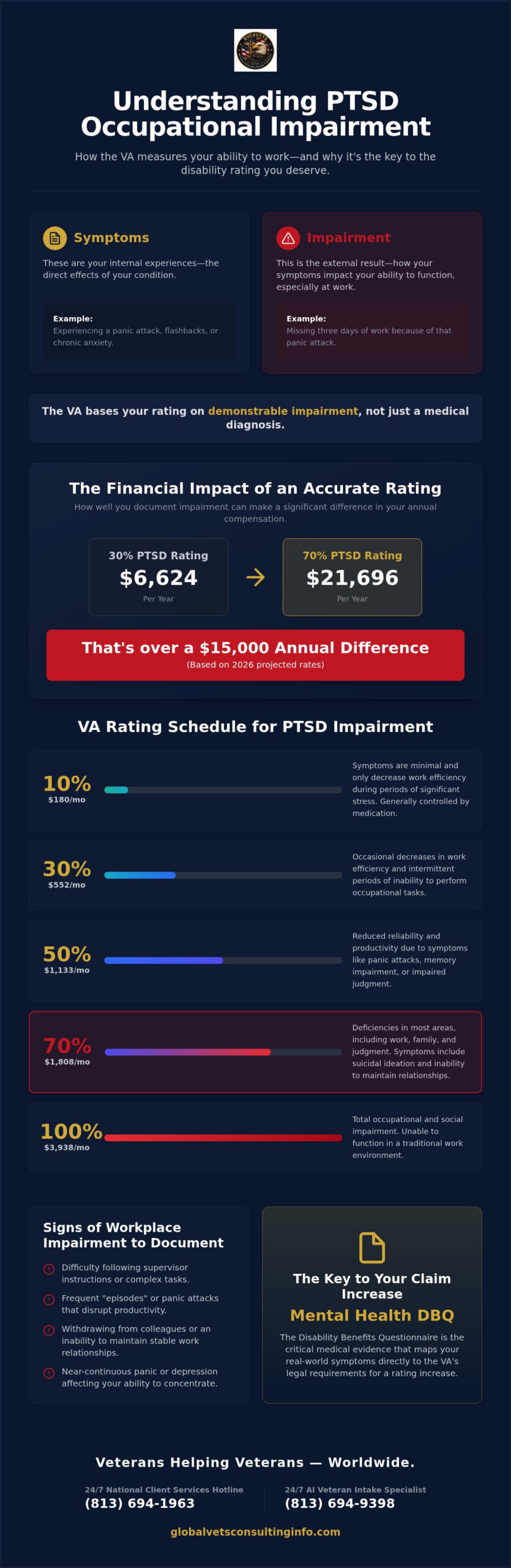
It’s easy to confuse symptoms with impairment. Symptoms are the internal experiences you face, such as panic attacks, flashbacks, or chronic anxiety. Impairment is the external result of those symptoms. For example, a panic attack is a symptom; missing three days of work because of that panic attack is the impairment. The VA looks for this “total” picture of your life to determine how much your earning capacity is reduced by your service connected condition.
Direct vs. Secondary Occupational Impairment
PTSD can impact your work in multiple ways. Direct impairment occurs when your PTSD symptoms alone make it difficult to perform tasks, follow instructions, or stay employed. Secondary impairment happens when your PTSD Occupational Impairment aggravates other service connected conditions. For instance, the high stress and cortisol levels from chronic PTSD might worsen a heart condition or gastrointestinal issues, creating a combined effect that further limits your ability to function in a professional environment.
The VA Rating Schedule for PTSD Impairment Levels
The VA assigns a percentage to your condition based on a specific formula found in the VA Schedule of Ratings for Mental Disorders. This isn’t a random guess; it’s a structured assessment of your PTSD Occupational Impairment. Your monthly compensation depends entirely on where you fall on this scale. As of 2026, a veteran with a 10% rating receives $180 per month, while a 100% rating provides $3,938.58. Understanding these levels helps you identify if your current rating truly reflects your daily struggle.
- 0% to 10% Rating: You have a formal diagnosis, but symptoms are minimal. At 10%, symptoms might decrease work efficiency during periods of significant stress but are generally controlled by medication.
- 30% to 50% Rating: This is where most veterans start. At 30% ($552/month), you might experience occasional decreases in work efficiency. By 50% ($1,133/month), your reliability and productivity slip due to symptoms like panic attacks or impaired judgment.
- 70% Rating: This level pays $1,808 per month and indicates deficiencies in most areas, such as work, family, and mood. You likely struggle with complex tasks and find yourself withdrawing from colleagues.
- 100% Rating: This represents total occupational and social impairment. You’re unable to function in a traditional work environment and may require constant supervision or support.
Breaking Down the 70% PTSD Rating Criteria
Many veterans find themselves “stuck” at a 50% rating despite being unable to maintain a steady job. To move to 70%, the medical evidence must show deeper PTSD Occupational Impairment. Key indicators include near-continuous panic attacks, suicidal ideation, or an inability to maintain stable relationships. If you’re struggling to keep a job because of these symptoms, you shouldn’t settle for a lower rating. Learning more about VA rating increases can help you secure the benefits you actually earned.
Total Disability Based on Individual Unemployability (TDIU)
Sometimes, your symptoms don’t perfectly match the 100% criteria, but you still can’t work. TDIU allows the VA to pay you at the 100% rate ($3,938.58/month) even if your PTSD is only rated at 70%. If your service connected conditions prevent you from maintaining “substantially gainful employment,” you may qualify. This bridges the financial gap when your impairment is total, even if your specific rating schedule doesn’t say so yet.
Recognizing Symptoms of Occupational Impairment in Your Daily Life
Understanding the rating schedule is one thing, but seeing how it applies to your 9 to 5 is another. The VA looks for specific behaviors that prove your PTSD Occupational Impairment is real and persistent. It’s not just about feeling stressed; it’s about the tangible ways your productivity drops. For many, this manifests as friction with authority. If you find yourself unable to accept feedback from a supervisor or if following simple instructions feels like a personal attack, you’re experiencing a core rating criterion. These aren’t just bad days. They are documented functional limitations.
Workplace attendance is another major indicator. Frequent absences or needing to leave your workstation during “episodes” directly impacts your value to an employer. You might also struggle with social withdrawal. Alienating coworkers or having angry outbursts isn’t a personality trait; it’s a symptom that the VA evaluates when determining your level of impairment. To see how these symptoms are officially tracked, you can review the Mental Health DBQ forms provided by the VA. Documenting these struggles is key.
Hypervigilance and Workplace Safety
In a standard office or warehouse, the need to constantly “watch your back” is exhausting. Hypervigilance keeps your nervous system in a state of high alert, leading to physical fatigue and a sharp decrease in productivity. Loud noises, slamming doors, or crowded breakrooms can trigger an immediate fight or flight response. This makes it nearly impossible to maintain the focus required for your duties, creating a clear case of PTSD Occupational Impairment. Your environment shouldn’t be your enemy.
Memory Loss and Cognitive Fog
Cognitive fog often makes project details or deadlines feel impossible to track. You might find yourself staring at a screen, unable to concentrate on complex tasks due to intrusive thoughts. The VA considers “impaired judgment” and memory loss as heavy hitters for higher ratings. If you can’t remember the specifics of a briefing or struggle to make sound decisions under pressure, your earning capacity is objectively reduced. If you need help documenting these specific workplace hurdles, we provide expert Mental Health Ratings education to ensure your medical evidence is thorough and accurate.
How to Document Impairment Using a Mental Health DBQ 🌐
The Mental Health DBQ is the bridge between your lived experience and the VA’s legal requirements. While a standard C&P exam is often brief, a private DBQ allows for a more comprehensive look at your PTSD Occupational Impairment. It maps your specific symptoms directly to the percentages we discussed earlier. You must ensure your documentation focuses on three critical pillars: frequency, severity, and duration. Without these details, the VA rater cannot accurately judge the functional impact of your condition. At Global Vets Consulting, we specialize in dbq for mental health conditions education to help you translate your daily struggles into the technical language the system requires.
Preparing for Your Evaluation
Success starts with preparation. You should write down your “worst days” before your appointment. It’s common to minimize symptoms when talking to a professional, but for an accurate rating, the provider needs to see the full scope of your impairment. Don’t just describe how you feel today; describe the days you couldn’t get out of bed or the times you had to walk away from your job. Your medical provider should also understand the va disability claims process step by step. This ensures the medical evidence is filed correctly from the start.
Overcoming a ‘Lack of Evidence’ Denial
Receiving a denial is frustrating, but it isn’t the end of the road. Most denials happen because the medical record lacks the specific functional data required to prove PTSD Occupational Impairment. You can use new, detailed medical documentation to recover from a va claim denied for lack of evidence. In the 2026 VA system, a fully developed claim backed by a private DBQ is a powerful tool. It provides the rater with a clear, undeniable picture of your service connected disability, making it much harder for them to justify a lower rating.
Secure the VA Rating You’ve Earned 🇺🇸
You now understand that the VA focuses on the functional impact of your condition rather than just a medical diagnosis. Securing a fair rating requires you to translate your daily workplace struggles into the specific language of PTSD Occupational Impairment. By utilizing a detailed Mental Health DBQ and documenting your “worst days,” you provide the objective medical evidence necessary to overcome denials and substantiate your claim. You don’t have to struggle through this bureaucratic maze alone; help is available right now.
Global Vets Consulting is veteran owned and operated, offering expert DBQ education for mental health ratings to ensure your symptoms are never minimized. We act as your knowledgeable advocate, providing a predictable path toward the benefits you deserve. If you’re ready to stop feeling misunderstood by the system, our team is standing by to support your mission.
24/7 National Client Services Hotline: 📞 Call Us Now
Global Vets Consulting 🌐 Worldwide
Get the Evidence You Earned—Contact Global Vets Consulting Today!
Your contributions to this nation were significant, and your compensation should reflect that reality. Stay focused, stay documented, and remember that you’ve earned every bit of the support you are seeking.
Frequently Asked Questions
What is the most common VA rating for PTSD?
The 70% rating is one of the most common for veterans with significant symptoms, though many remain underrated at 30% or 50% due to insufficient documentation. A 70% rating currently pays $1,808 per month and indicates that your symptoms cause deficiencies in most areas of your life. If your current rating doesn’t reflect your actual PTSD Occupational Impairment, you may need to submit a supplemental claim with more detailed medical evidence.
Can I get 100% for PTSD if I am still working?
You can technically receive a 100% PTSD rating while working, but it is exceptionally rare because the criteria require total impairment in professional and social settings. Most veterans who are unable to work but don’t meet the 100% criteria instead pursue Total Disability Individual Unemployability (TDIU). This allows you to be paid at the 100% rate, which is $3,938.58 per month in 2026, even if your specific PTSD rating is lower.
How does the VA define ‘total occupational impairment’?
The VA defines total occupational impairment as a complete inability to function in professional and social environments due to severe psychiatric symptoms. This is the criteria for a 100% rating and includes symptoms like persistent delusions, hallucinations, or a constant danger of hurting yourself or others. It represents a total loss of earning capacity where a traditional job is no longer a viable option without significant support or supervision.
What happens if my C&P examiner ignores my work-related symptoms?
If your C&P examiner ignores your symptoms, you must act quickly by submitting a formal statement to the VA detailing the examiner’s failure to capture your functional limitations. You can request a new examination or submit a supplemental claim with more robust medical evidence. It is vital to document these errors immediately so the rater doesn’t rely solely on an incomplete report that minimizes your daily challenges.
Is a private DBQ better than a C&P exam for proving impairment?
A private DBQ is often superior to a standard C&P exam for documenting PTSD Occupational Impairment because your own provider has more time to review your history. C&P exams are frequently rushed, sometimes lasting only 15 to 20 minutes, which isn’t enough time to capture the full scope of your workplace struggles. A private clinician can provide the meticulous medical evidence required to substantiate a higher rating and prevent a lack of evidence denial.

Article by
Willie Daniel
Willie Daniel is the Founder and Chief Executive Officer (CEO) of Global Vets Consulting (GVC4Vets) – National Veterans Disability Services, a veteran-led educational and medical evidence support organization dedicated to helping veterans better understand VA disability rating increases, DBQ medical evidence, secondary claims education, and C&P examination preparation.
He is a retired U.S. Army Medical Service Corps Officer with more than 27 years of honorable military service, a decorated Iraq combat veteran, and a retired federal official with the U.S. Department of Veterans Affairs. Throughout his military and federal career, Willie Daniel served in leadership, healthcare administration, operational, and veteran-support roles focused on improving services and support systems for servicemembers, veterans, and their families.
Drawing from decades of military leadership, healthcare administration, veteran advocacy, and federal government experience, Willie Daniel brings a practical, veteran-centered perspective to Global Vets Consulting’s educational articles, AI-powered veteran resources, video education initiatives, and outreach programs. His experience navigating military systems, medical documentation processes, and veteran-related administrative operations provides valuable insight into many of the challenges veterans face when seeking to better understand VA disability rating criteria, medical evidence, documentation strategies, and secondary condition education.
Through GVC’s “Veterans Helping Veterans” mission, his focus is on delivering clear, educational, and easy-to-understand information designed to empower veterans with knowledge, resources, and educational tools that may help them make more informed decisions regarding their individual VA disability journeys.
The information provided through GVC is intended for educational and informational purposes only and should not be considered legal or medical advice.
Disclaimer
Disclaimer: Global Vets Consulting, LLC (“GVC”) is a veteran-led educational and medical evidence support organization. GVC is not a law firm, is not a Veterans Service Organization (VSO), and is not affiliated with the U.S. Department of Veterans Affairs (VA) or any government agency.
Global Vets Consulting does not provide legal advice, medical advice, medical treatment, or healthcare services. GVC does not prepare, file, or submit VA disability claims on behalf of veterans. All information provided through this website, blog articles, videos, educational materials, AI tools, dashboards, templates, and communications is intended solely for general educational and informational purposes.
Veterans are encouraged to consult with accredited representatives, licensed attorneys, qualified medical providers, or Veterans Service Organizations regarding their specific legal, medical, or VA-related matters. VA disability decisions, ratings, and outcomes are determined solely by the U.S. Department of Veterans Affairs based on applicable laws, regulations, medical evidence, and individual circumstances. Past results do not guarantee future outcomes.