
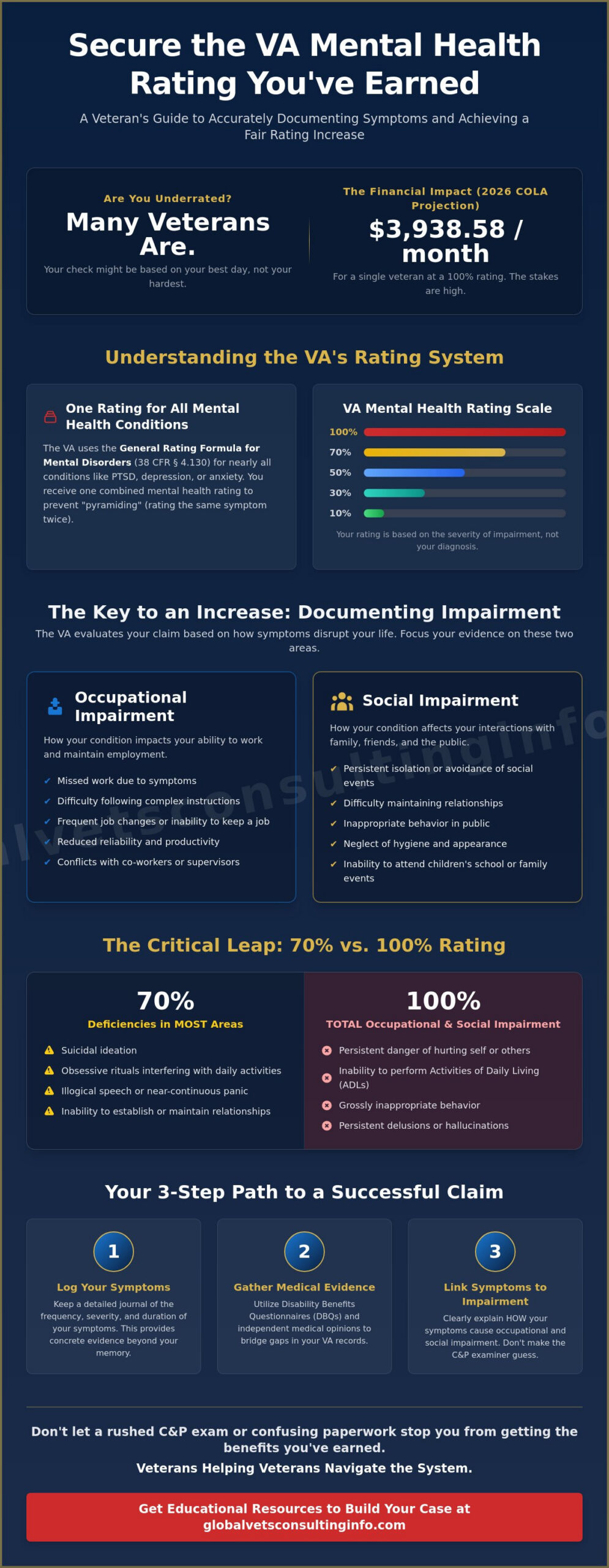
What if your current disability check is based on a snapshot of your best day rather than the reality of your hardest ones? For many, securing a Mental Health VA Rating Increase feels like an uphill battle against a system that doesn’t fully see them. You’ve likely felt the sting of being underrated or the frustration of a C&P examiner who barely listened to your concerns. With the 2026 COLA adjustment setting a 100% rating at $3,938.58 per month for a single veteran, the stakes for your financial stability have never been higher. We agree that you shouldn’t have to carry the weight of service-connected symptoms without the full support you were promised.
This guide will teach you how to accurately document your symptoms and navigate the VA system to secure the rating you’ve earned. You’ll learn the specific steps to move from a 50% rating to the 70% or 100% levels by focusing on functional impairment and medical evidence. We’re going to break down the process of using Disability Benefits Questionnaires and independent evidence to bridge the gap between your current rating and your actual needs. By following this methodical path, you can turn your frustration into a successful claim that finally reflects your true daily experience.
Key Takeaways
- 🇺🇸 Learn how the VA applies the General Rating Formula for Mental Disorders to determine your specific percentage under 38 CFR § 4.130.
- 📈 Identify the signs of occupational and social impairment that the VA looks for when considering a higher rating.
- 📝 Master the process of filing a Mental Health VA Rating Increase by leveraging medical evidence and Disability Benefits Questionnaires.
- 🗣️ Discover how to avoid the “Good Day Trap” during your C&P exam to ensure your symptoms are documented accurately.
- 🛡️ Gain a clear plan for responding to a denial so you can continue your pursuit of the benefits you earned.
Understanding the VA Mental Health Rating Schedule in 2026
The VA doesn’t assign a rating based on your specific diagnosis. Whether you live with PTSD, major depressive disorder, or chronic anxiety, the agency evaluates how your symptoms interfere with your daily life. This evaluation is governed by the VA’s General Rating Formula for Mental Disorders found in 38 CFR § 4.130. Because the VA uses a single set of criteria for almost all mental health conditions, you won’t receive separate ratings for multiple diagnoses. Instead, all your symptoms are bundled into one combined mental health percentage to prevent what the VA calls “pyramiding.”
Your rating will fall into one of six specific brackets: 0%, 10%, 30%, 50%, 70%, or 100%. A 0% rating acknowledges a service-connected condition that doesn’t currently require compensation, while a 100% rating reflects total impairment. If your condition has worsened since your last decision, you can apply for a Mental Health VA Rating Increase immediately. You don’t have to wait for a scheduled re-evaluation to seek the benefits that match your current reality.
The 70% vs. 100% Threshold: What Changes?
The transition from a 70% to a 100% rating is a high bar to clear. At 70%, the VA looks for “deficiencies in most areas,” such as suicidal ideation or an inability to maintain relationships. To reach 100%, you must demonstrate “total occupational and social impairment.” This means your symptoms, such as persistent delusions or a complete inability to perform activities of daily living, make it impossible to work or function in society. Documentation for a Mental Health VA Rating Increase must clearly show this shift from “most areas” to “total” dysfunction.
Why Your Current Rating Might Be Too Low
Many veterans find themselves “underrated” because of a rushed Compensation and Pension (C&P) exam. If you don’t clearly communicate the frequency and severity of your symptoms, the examiner might assume you’re doing better than you actually are. Additionally, “VA Math” can be confusing; while a mental health rating is often the largest single component of a veteran’s combined score, it’s frequently the area where evidence is the most subjective. Precise medical documentation is the only tool that can bridge the gap between an unfair rating and the one you’ve earned.
Identifying Occupational and Social Impairment for Your Increase
Securing a Mental Health VA Rating Increase requires moving beyond a simple diagnosis. The VA evaluates your claim based on how your symptoms disrupt your ability to work and interact with others. This specific criteria is detailed in the official VA Schedule of Ratings for Mental Disorders. To build a strong case, you must document the frequency, severity, and duration of your mental health episodes. We recommend keeping a symptom log. Record every instance of missed work, inability to follow instructions, or sudden job changes. These are clear markers of occupational impairment that demonstrate your condition’s real world impact.
Social impairment is equally vital for your claim. This includes persistent isolation, difficulty maintaining family relationships, or inappropriate behavior in public settings. The VA needs to see a pattern of behavior rather than isolated incidents. If you feel your current records don’t fully capture these struggles, exploring educational resources for mental health ratings can help you organize your evidence more effectively. By tracking these details, you provide the C&P examiner with a roadmap of your daily challenges.
Critical Symptoms the VA Looks For
Certain symptoms act as “red flags” that often trigger higher rating brackets. You should clearly document suicidal ideation, near-continuous panic attacks, or spatial disorientation. Examiners also look for a “flattened affect,” where your emotional responses are muted, or impaired impulse control that leads to reckless behavior. These symptoms are key indicators that your condition has progressed toward the 70% or 100% threshold.
Impact on Daily Life and Family Dynamics
Your documentation should link specific symptoms to life limitations. For example, don’t just state you have depression; explain that your lack of motivation results in neglecting basic hygiene or being unable to complete household chores. This “Veteran’s Perspective” provides the context the VA needs. A sentence like, “My chronic anxiety causes twice-weekly panic attacks that prevent me from attending my children’s school events,” creates a clear link between a medical symptom and a social limitation.
How to File for a VA Rating Increase Successfully
Filing for a Mental Health VA Rating Increase is a methodical process that requires more than just filling out a form. It’s about building a bulletproof case that leaves no room for interpretation by the VA. 🇺🇸 To give your claim the best chance of success, you’ll need to follow a structured approach that prioritizes high-quality evidence over simple assertions. We recommend following these specific steps to ensure your claim is complete:
- Step 1: Identify the Gap. Review your current medical records against the rating criteria to see exactly where your symptoms have outpaced your existing rating.
- Step 2: Secure Medical Evidence. Use Disability Benefits Questionnaires (DBQs) to translate your symptoms into the clinical language the VA requires for an increase.
- Step 3: Collect Lay Evidence. Gather Buddy Letters from those who see your daily struggles to provide a firsthand account of your social and occupational life.
- Step 4: File an FDC. Submit a Fully Developed Claim to inform the VA that you’ve provided all necessary evidence, which often leads to a faster decision.
The Power of a Private DBQ
A private DBQ is a powerful tool because it ensures all your symptoms are captured thoroughly. Many C&P exams are rushed; an examiner might only spend 15 minutes reviewing a condition that has impacted you for years. Global Vets Consulting specializes in providing these critical medical documentation forms to ensure your record is complete and accurate. This level of detail is often what makes the difference in a successful Mental Health VA Rating Increase. 📝
Using Lay Evidence to Support Your Claim
Your medical records tell part of the story, but your family sees the rest. A spouse or close friend can describe symptoms you might subconsciously downplay, such as night terrors or severe social withdrawal. A Buddy Letter is often the ‘missing link’ in mental health claims because it provides the VA with concrete examples of your daily struggles that medical records alone might miss. 🤝 If you’re ready to move forward, connect with us for expert rating increase education today.
Overcoming Common VA Rating Increase Challenges
Even with a well-documented case, the road to a Mental Health VA Rating Increase often involves bureaucratic hurdles. One of the most common pitfalls is the “Good Day Trap.” On the day of your Compensation and Pension (C&P) exam, you might feel a natural instinct to put on a brave face. However, this often leads to an underrated claim. You must describe your symptoms as they exist on your worst days. If the examiner only sees your “best” self, they cannot accurately document the level of impairment you face during a crisis. 🇺🇸
If your VA claim is denied for lack of evidence, don’t lose hope. You have several options to keep your claim alive. A Higher-Level Review (HLR) allows a senior rater to look for errors in the original decision without adding new evidence. Alternatively, a Supplemental Claim lets you submit new and relevant medical evidence, such as an updated private DBQ. At Global Vets Consulting, we act as your 24/7 partner to help you choose the right path forward through these complex administrative processes. 📞
C&P Exam Prep: What to Expect
Honesty and vulnerability are your best tools during an exam. It’s difficult to talk about your darkest moments, but the examiner needs that data to justify an increase. We recommend bringing a copy of your DBQ for mental health conditions to the appointment. Having your own copy ensures you can reference specific symptoms and frequencies you’ve already documented, keeping your story consistent and thorough. 📝
TDIU: An Alternative to a 100% Rating
Sometimes, a veteran’s symptoms meet the 70% criteria, but their impairment still prevents them from keeping a job. In these cases, Total Disability Based on Individual Unemployability (TDIU) is a vital alternative. TDIU pays you at the 100% rate even if your combined rating is lower. Global Vets Consulting provides the educational resources you need to understand how to qualify for these benefits. 🌐
Our team is available through our 24/7 National Client Services Hotline and our 24/7 AI Veteran Intake Specialist to ensure you never have to face the VA system alone. We’re dedicated to your mission of securing the benefits you’ve earned. 🇺🇸
Take the Next Step Toward Your Earned Benefits
You’ve learned that your rating is a reflection of your daily impairment, not just a diagnosis on a chart. By documenting your symptoms on your worst days and utilizing high-quality medical evidence, you’re better positioned for a successful outcome. Securely navigating the path to a Mental Health VA Rating Increase requires a methodical approach that leaves nothing to chance. We’re here to ensure your story is told accurately and professionally.
Global Vets Consulting is a veteran-owned and operated organization dedicated to supporting those who served. We specialize in mental health DBQ documentation and provide a steady hand through every bureaucratic hurdle. Whether you’re just starting your increase or responding to a denial, our 24/7 National Client Services Hotline is always available to assist you. 🇺🇸
Ready to secure the rating you deserve? Contact Global Vets Consulting 24/7 for expert DBQ assistance. You’ve fought for our country; now let us help you fight for the benefits you’ve earned. 📞 🌎
Frequently Asked Questions
Can the VA decrease my rating if I ask for an increase?
Yes, the VA can propose a rating decrease if your medical evidence suggests your condition has improved since your last decision. When you file for an increase, the VA re-evaluates the entire service-connected condition. This is why meticulous documentation is vital. Providing a clear record of worsening symptoms helps ensure the rater understands your current level of impairment and protects your existing benefits.
How long does a VA mental health rating increase take in 2026?
As of 2026, the average processing time for a disability claim is between four and five months. You can often shorten this window by submitting a Fully Developed Claim (FDC). By providing all your medical evidence and completed DBQs upfront, you reduce the time the VA spends gathering records. This organized approach is the most reliable way to secure a Mental Health VA Rating Increase without facing long administrative delays.
What is the difference between a 70% and 100% mental health rating?
The primary difference lies in the level of impairment documented in your records. A 70% rating is assigned for “deficiencies in most areas” of life, such as significant difficulty with work, school, and relationships. A 100% rating requires “total occupational and social impairment.” This means you’re unable to function in a work environment or maintain social connections due to severe symptoms like persistent delusions or a high risk of self-harm.
Do I need a new Nexus Letter for a rating increase?
No, you typically don’t need a new Nexus Letter if the VA has already granted service connection for your condition. The purpose of a rating increase is to demonstrate that your existing condition has worsened over time. Instead of proving service connection again, you should focus on gathering current medical evidence. Detailed DBQs that highlight your current occupational and social limitations are the most important documents for this Mental Health VA Rating Increase process.
Can I use a private doctor for my mental health rating increase?
Yes, you can and should use evidence from a private doctor to support your claim. Private medical professionals often provide more comprehensive evaluations than rushed C&P examiners. By having a private doctor complete a Disability Benefits Questionnaire (DBQ), you ensure that every specific symptom and life limitation is documented in the clinical language the VA requires. This high-quality evidence often carries significant weight during the rating process. If you work with a healthcare provider who needs help streamlining their administrative workload, check out HPC Healthcare Partners.

Article by
Willie Daniel
Willie Daniel is the Founder and Chief Executive Officer (CEO) of Global Vets Consulting (GVC) – National Veterans Disability Services, a veteran-led educational and medical evidence support organization dedicated to helping veterans better understand VA disability rating increases, DBQ medical evidence, secondary claims education, and C&P examination preparation.
He is a retired U.S. Army Medical Service Corps Officer with more than 27 years of honorable military service, a decorated Iraq combat veteran, and a retired federal official with the U.S. Department of Veterans Affairs. Throughout his military and federal career, Willie Daniel served in leadership, healthcare administration, operational, and veteran-support roles focused on improving services and support systems for servicemembers, veterans, and their families.
Drawing from decades of military leadership, healthcare administration, veteran advocacy, and federal government experience, Willie Daniel brings a practical, veteran-centered perspective to Global Vets Consulting’s educational articles, AI-powered veteran resources, video education initiatives, and outreach programs. His experience navigating military systems, medical documentation processes, and veteran-related administrative operations provides valuable insight into many of the challenges veterans face when seeking to better understand VA disability rating criteria, medical evidence, documentation strategies, and secondary condition education.
Through GVC’s “Veterans Helping Veterans” mission, his focus is on delivering clear, educational, and easy-to-understand information designed to empower veterans with knowledge, resources, and educational tools that may help them make more informed decisions regarding their individual VA disability journeys.
The information provided through GVC is intended for educational and informational purposes only and should not be considered legal or medical advice.
Disclaimer
Disclaimer: Global Vets Consulting, LLC (“GVC”) is a veteran-led educational and medical evidence support organization. GVC is not a law firm, is not a Veterans Service Organization (VSO), and is not affiliated with the U.S. Department of Veterans Affairs (VA) or any government agency.
Global Vets Consulting does not provide legal advice, medical advice, medical treatment, or healthcare services. GVC does not prepare, file, or submit VA disability claims on behalf of veterans. All information provided through this website, blog articles, videos, educational materials, AI tools, dashboards, templates, and communications is intended solely for general educational and informational purposes.
Veterans are encouraged to consult with accredited representatives, licensed attorneys, qualified medical providers, or Veterans Service Organizations regarding their specific legal, medical, or VA-related matters. VA disability decisions, ratings, and outcomes are determined solely by the U.S. Department of Veterans Affairs based on applicable laws, regulations, medical evidence, and individual circumstances. Past results do not guarantee future outcomes.