
Did you know that a single Pulmonary Function Test (PFT) result could be the difference between a 10% and a 60% Asthma VA Rating, even if you struggle to breathe every single day? 🇺🇸 It’s incredibly frustrating when complex medical jargon like FEV-1 and FVC doesn’t seem to capture the reality of your nightly wheezing or frequent emergency room visits. You’ve served your country with honor, and you shouldn’t feel like you’re fighting a losing battle against a bureaucratic system just to get the disability benefits you earned.
This 2026 guide will demystify the evaluation process and show you exactly how to use medical evidence to secure a rating that reflects your true condition. We’ll provide a clear roadmap to securing a 60% or 100% rating by documenting asthmatic attacks correctly and ensuring your Disability Benefits Questionnaire (DBQ) is precise. At Global Vets Consulting, we’re veterans helping veterans worldwide. Whether you need respiratory system claims education or C&P exam preparation, our 24/7 AI Veteran Intake Specialist and National Client Services Hotline at (727) 350-8387 are available. Visit https://www.GlobalVetsConsultingInfo.com today.
Key Takeaways
- Decode the 2026 VA Rating Schedule for respiratory conditions and understand how the PACT Act establishes presumptive service connection for eligible veterans. 🇺🇸
- Identify the specific FEV-1 scores and medication frequencies required to qualify for an Asthma VA Rating between 10% and 100%.
- Learn why a detailed Disability Benefits Questionnaire (DBQ) serves as the “gold standard” for medical evidence and can help prevent a low-ball rating.
- Master the two-step process for seeking a rating increase by documenting declines in respiratory function and changes in daily steroid use.
Understanding the VA Rating Schedule for Asthma in 2026
The VA evaluates asthma as a chronic respiratory condition using the criteria found in 38 CFR § 4.97, under Diagnostic Code 6602. This schedule determines your Asthma VA Rating based on how much the condition impairs your lung function or the intensity of the treatment required to manage it. While a medical diagnosis is the foundation, securing your benefits requires understanding the VA Disability Claims Process Step by Step to ensure your evidence matches these strict legal definitions. 🇺🇸
Direct vs. Presumptive Service Connection
The PACT Act has significantly changed the landscape for veterans exposed to burn pits or other environmental hazards. If you served in recognized locations during specific timeframes, asthma is now a presumptive condition. This means you don’t have to provide a “nexus” or direct proof that your service caused the illness; the VA presumes the connection exists, simplifying the path to a fair rating. For those without presumptive status, you’ll need to demonstrate a direct link between your service and your diagnosis through detailed medical documentation.
The ‘Highest Rating’ Rule Explained
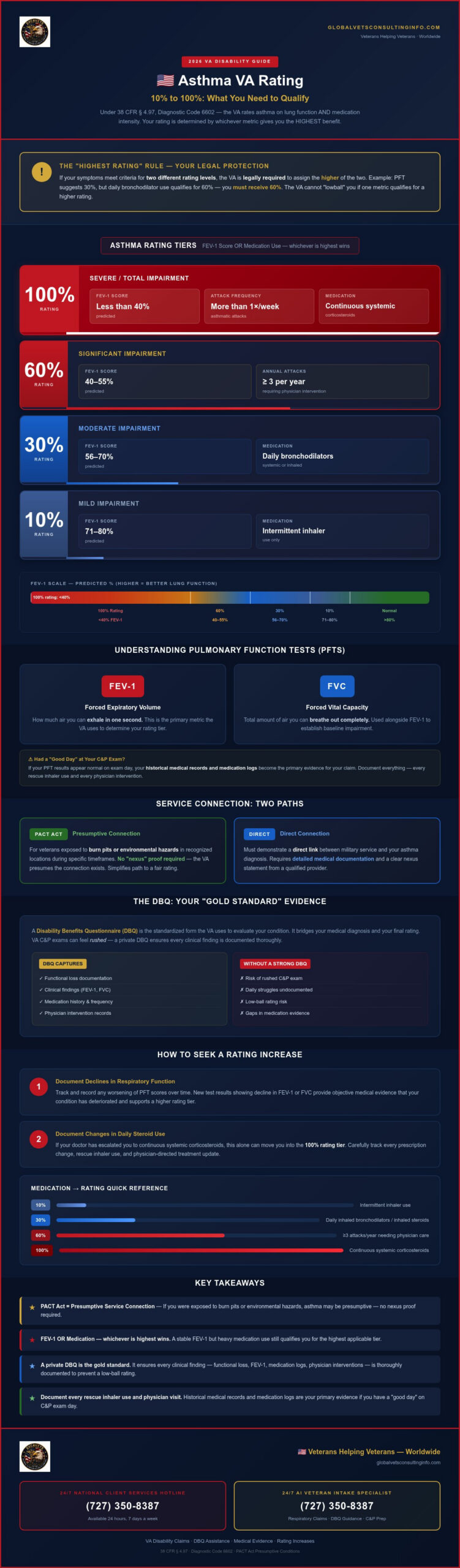
Under VA law, if your symptoms meet the criteria for two different rating levels, the VA is legally required to assign the higher of the two. For instance, if your Pulmonary Function Test (PFT) results suggest a 30% rating but your daily use of systemic or inhaled bronchodilators qualifies for a 60% rating, you must receive the 60% award. This ensures your Asthma VA Rating accurately reflects your most severe symptoms. The VA cannot ‘lowball’ you if one metric qualifies for a 60% rating.
Global Vets Consulting is a dedicated resource for the veteran community, operating with a mission-driven focus to help you get the rating you earned. We offer 24/7 access to our AI Veteran Intake Specialist and National Client Services Hotline at (727) 350-8387. For more information and resources, visit https://www.GlobalVetsConsultingInfo.com.
The 10% to 100% Asthma VA Rating Criteria
The VA assigns an Asthma VA Rating based on whichever metric yields the highest benefit. If your lung function is stable but your medication use is heavy, you still qualify for the higher tier. This ensures your monthly payments reflect your actual level of impairment according to current VA disability compensation rates. The criteria are structured as follows:
- 10% Rating: FEV-1 of 71-80% predicted, or intermittent inhaler use.
- 30% Rating: FEV-1 of 56-70% predicted, or daily use of systemic or inhaled bronchodilators.
- 60% Rating: FEV-1 of 40-55% predicted, or at least 3 asthmatic attacks requiring physician intervention annually.
- 100% Rating: FEV-1 less than 40% predicted, or more than one attack per week, or continuous systemic corticosteroids.
Deciphering Pulmonary Function Tests (PFT)
FEV-1 measures how much air you can exhale in one second. FVC is the total amount of air you can breathe out. The VA requires these tests to establish baseline impairment. If you have a “good day” during your C&P exam and your results appear normal, your historical medical records and medication logs become the primary evidence for your claim.
Medication Usage and Rating Tiers
Inhaled steroids often lead to a 30% rating. If your doctor prescribes continuous systemic corticosteroids, you may move into the 100% tier. It’s vital to document every rescue inhaler use and physician intervention. Tracking your prescriptions carefully is the most reliable way to substantiate an Asthma VA Rating increase. If you aren’t sure if your records are sufficient, you can seek respiratory system claims education to better prepare your evidence. 🇺🇸 For immediate assistance, our 24/7 AI Veteran Intake Specialist and National Client Services Hotline are available at (727) 350-8387.
The Role of the DBQ in Supporting Your Asthma Claim
A Disability Benefits Questionnaire (DBQ) is the standardized form the VA uses to evaluate your condition. It serves as the bridge between your medical diagnosis and your final Asthma VA Rating. While the VA often schedules a Compensation and Pension (C&P) exam, these appointments can feel rushed and may not capture the full scope of your daily breathing struggles. Securing a private DBQ ensures that every clinical finding is documented thoroughly. To learn more about how these forms function, read our guide on What is a DBQ for VA Claims?
The Asthma DBQ focuses on specific data points like functional loss and clinical findings. It requires precise information regarding asthma severity and pulmonary function testing. By providing Independent Medical Evidence through a well-prepared DBQ, you present a comprehensive view of your health that a single 20-minute exam might miss. 🇺🇸
Avoiding Common C&P Exam Pitfalls
Examiners sometimes overlook the frequency of your symptoms if you’re breathing well on the day of the test. A detailed DBQ acts as a safeguard. It ensures the examiner addresses key symptoms that you might forget to mention under the stress of the exam. This professional documentation ensures your claim remains grounded in reliability and accuracy. It’s about presenting a predictable path forward for the rater.
Documenting Asthmatic Attacks Correctly
The VA defines an “attack” as an episode requiring physician intervention, such as an ER visit or an urgent care encounter. Simply using a rescue inhaler at home doesn’t always meet this threshold for higher ratings. You should maintain a detailed symptom log to substantiate every DBQ entry. This log provides the meticulous evidence needed to prove how often your condition disrupts your life.
If you need help substantiating your claim with accurate documentation, you can access our DBQ preparation services. Our team is dedicated to the well-being of the veteran community. Contact our 24/7 National Client Services Hotline or our 24/7 AI Veteran Intake Specialist at (727) 350-8387. Visit https://www.GlobalVetsConsultingInfo.com for more resources.
How to Increase Your VA Rating for Asthma 🇺🇸
If your breathing has worsened since your last evaluation, you don’t have to wait for the VA to initiate a review. You can proactively request an increase. Securing a higher Asthma VA Rating requires a methodical approach to gathering new medical evidence that proves your condition has progressed. Follow these steps to build a stronger case for the rating you earned:
- Step 1: Obtain updated PFT results. If your lung function has declined, this clinical data is the essential foundation of your request.
- Step 2: Document medication changes. Moving from an as-needed inhaler to daily oral steroids often triggers a higher disability tier.
- Step 3: Secure a new DBQ. Using a specialized Disability Benefits Questionnaire ensures your symptoms are framed correctly for the rater. Learn how to use a DBQ for a VA disability rating increase to maximize your impact.
- Step 4: Submit VA Form 21-526EZ. Attach your new medical evidence and DBQ to this form to officially start the process.
Secondary Conditions Related to Asthma
Asthma often leads to or aggravates other health issues. You may be able to claim Sleep Apnea or GERD as secondary to your asthma if medical evidence shows a clear link. Under the VA’s Pyramiding Rule, you cannot receive separate ratings for two respiratory conditions, such as asthma and COPD. Instead, the VA assigns a single rating based on whichever condition is more severe. This makes accurate documentation of your primary Asthma VA Rating even more critical.
Get Expert Help with Your Documentation
Global Vets Consulting is a veteran-owned and operated firm dedicated to helping you substantiate your claims with accurate medical documentation. We specialize in Respiratory System Claims Education and DBQ preparation to help you avoid common pitfalls. Our team understands the mission because we’ve lived it. We provide a clear, predictable path forward for veterans worldwide. For immediate assistance, contact our 24/7 National Client Services Hotline or speak with our 24/7 AI Veteran Intake Specialist at (727) 350-8387. You can also find educational resources at https://www.GlobalVetsConsultingInfo.com.
Take Control of Your Respiratory Disability Claim 🇺🇸
Securing a fair Asthma VA Rating depends on your ability to bridge the gap between a medical diagnosis and the VA’s strict rating schedule. By prioritizing updated Pulmonary Function Tests and meticulous medication logs, you provide the clear evidence needed for a successful claim. A well-prepared DBQ serves as your strongest advocate during a C&P exam, ensuring every symptom is documented with precision and authority. Don’t let a rushed examination or confusing jargon stand in the way of the compensation you deserve.
Global Vets Consulting is veteran-owned and operated, providing specialized Respiratory System Claims Education to help you navigate this bureaucratic process with confidence. We offer constant accessibility through our 24/7 AI Veteran Intake Specialist and National Client Services Hotline at (727) 350-8387. Ready to secure the medical evidence you deserve? Contact Global Vets Consulting today at (727) 350-8387 or visit our website to get started! You’ve already done the hard work of serving our nation; now let’s work together to secure the future you earned.
Frequently Asked Questions
Can I get a 100% VA rating for asthma?
Yes, you can achieve a 100% rating if your FEV-1 is less than 40% predicted or if you experience more than one asthmatic attack per week requiring physician intervention. Continuous use of systemic corticosteroids also qualifies you for this tier. We recommend securing a detailed DBQ to ensure every clinical finding is captured accurately. Visit https://www.GlobalVetsConsultingInfo.com for professional respiratory system claims education.
What is the difference between asthma and COPD for VA ratings?
Asthma and COPD are distinct diagnoses, but the VA rates them using similar pulmonary function criteria. Because of the pyramiding rule, you can’t be rated for both conditions simultaneously. The VA will evaluate both issues and assign the single highest rating that reflects your overall respiratory impairment. Professional documentation is vital to ensure you receive the maximum benefit allowed under the law for your breathing struggles.
Does the VA consider inhaler use for an asthma rating?
Inhaler frequency is a critical component of your Asthma VA Rating. The VA assigns a 10% rating for intermittent inhaler use, while daily use of inhaled bronchodilators typically results in a 30% rating. If you require daily oral steroids, your rating may increase significantly. Keeping a detailed symptom log helps substantiate the frequency and necessity of your medication during the evaluation process.
How does the PACT Act affect my asthma claim in 2026?
Under the PACT Act, asthma is a presumptive condition for veterans exposed to burn pits or other environmental hazards in specific locations. This means you don’t have to provide a nexus letter to prove service connection. 🇺🇸 If you have a diagnosis, the focus shifts to documenting the severity of your symptoms to ensure your rating accurately reflects your daily challenges and health needs.
What happens if I fail my Pulmonary Function Test (PFT) at the C&P exam?
If your PFT results show decreased lung function, this data is used to support your claim for a higher Asthma VA Rating. The VA relies on these numbers to measure impairment accurately. If you’re concerned about your upcoming C&P exam, contact our 24/7 National Client Services Hotline at (727) 350-8387. Our veteran-owned team provides the education you need to navigate the system with steady confidence.

Article by
Willie Daniel
Willie Daniel is the Founder and Chief Executive Officer (CEO) of Global Vets Consulting (GVC4Vets) – National Veterans Disability Services, a veteran-led educational and medical evidence support organization dedicated to helping veterans better understand VA disability rating increases, DBQ medical evidence, secondary claims education, and C&P examination preparation.
He is a retired U.S. Army Medical Service Corps Officer with more than 27 years of honorable military service, a decorated Iraq combat veteran, and a retired federal official with the U.S. Department of Veterans Affairs. Throughout his military and federal career, Willie Daniel served in leadership, healthcare administration, operational, and veteran-support roles focused on improving services and support systems for servicemembers, veterans, and their families.
Drawing from decades of military leadership, healthcare administration, veteran advocacy, and federal government experience, Willie Daniel brings a practical, veteran-centered perspective to Global Vets Consulting’s educational articles, AI-powered veteran resources, video education initiatives, and outreach programs. His experience navigating military systems, medical documentation processes, and veteran-related administrative operations provides valuable insight into many of the challenges veterans face when seeking to better understand VA disability rating criteria, medical evidence, documentation strategies, and secondary condition education.
Through GVC’s “Veterans Helping Veterans” mission, his focus is on delivering clear, educational, and easy-to-understand information designed to empower veterans with knowledge, resources, and educational tools that may help them make more informed decisions regarding their individual VA disability journeys.
The information provided through GVC is intended for educational and informational purposes only and should not be considered legal or medical advice.
Disclaimer
Disclaimer: Global Vets Consulting, LLC (“GVC”) is a veteran-led educational and medical evidence support organization. GVC is not a law firm, is not a Veterans Service Organization (VSO), and is not affiliated with the U.S. Department of Veterans Affairs (VA) or any government agency.
Global Vets Consulting does not provide legal advice, medical advice, medical treatment, or healthcare services. GVC does not prepare, file, or submit VA disability claims on behalf of veterans. All information provided through this website, blog articles, videos, educational materials, AI tools, dashboards, templates, and communications is intended solely for general educational and informational purposes.
Veterans are encouraged to consult with accredited representatives, licensed attorneys, qualified medical providers, or Veterans Service Organizations regarding their specific legal, medical, or VA-related matters. VA disability decisions, ratings, and outcomes are determined solely by the U.S. Department of Veterans Affairs based on applicable laws, regulations, medical evidence, and individual circumstances. Past results do not guarantee future outcomes.