

What if the very system that makes VA math feel like a puzzle actually held a hidden “thank you” for the physical toll your service took on both sides of your body? Many veterans find themselves staring at a list of ratings, wondering why their va bilateral factor calculation doesn’t seem to reflect the reality of their daily pain. It’s a common frustration to feel like the system is working against you, especially when you’re managing mirrored conditions in your arms or legs. 🇺🇸
We understand that navigating these regulations can feel like an uphill battle, but you don’t have to do it alone. This article will help you master the complexities of the bilateral boost so you can ensure every service-connected disability is counted correctly. You’ll learn how this 10% addition functions under 38 CFR § 4.26 and how the 2.8% COLA adjustment for 2026 affects your potential monthly payment. We’ll provide a clear, step-by-step look at how to use Disability Benefits Questionnaires (DBQs) to document your conditions with the precision the VA requires for an accurate rating increase.
Key Takeaways
- Understand the “Rule of Pairs” and how the VA recognizes the additional functional loss of mirrored injuries to provide a 10% rating boost.
- Learn the specific order of operations for a va bilateral factor calculation to ensure your ratings are combined correctly for maximum compensation.
- Discover why documenting “Range of Motion” and secondary conditions like radiculopathy is critical for triggering the bilateral factor during your claim.
- Secure the medical evidence you need by using professional Disability Benefits Questionnaires (DBQs) that specifically address bilateral connections and physical limitations.
- Stay updated on the confirmed 2026 VA disability pay rates and see how the 2.8% COLA increase impacts your potential monthly award.
What is the VA Bilateral Factor? The 10% Boost Explained 🇺🇸
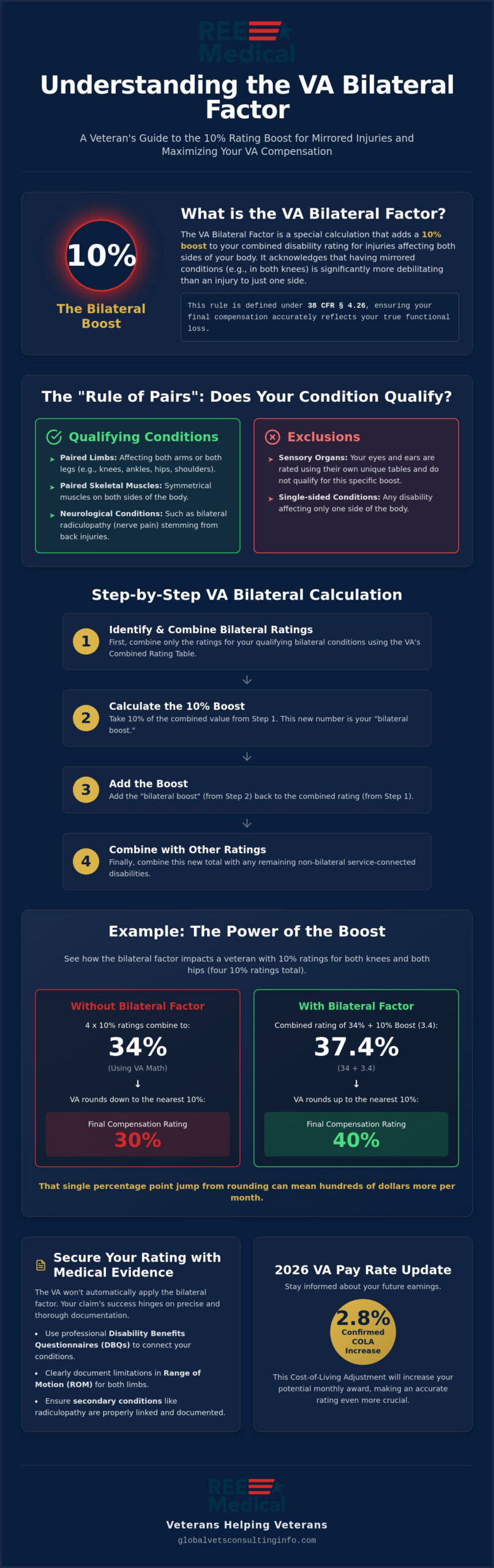
The VA bilateral factor is a specific mathematical adjustment designed to account for the increased functional loss of having mirrored conditions. Under 38 CFR § 4.26, when you have service-connected disabilities affecting both arms, both legs, or paired skeletal muscles, the VA applies a 10% boost to the combined rating for those specific disabilities. This isn’t just a random bonus; it’s a formal recognition that losing partial function in both knees is significantly more debilitating than losing function in just one. Understanding your VA disability claims process step by step is the foundation for ensuring this factor is applied correctly to your case.
The Veterans Benefits Administration uses this calculation to ensure your final compensation reflects your actual physical limitations. This small 10% increase is often the critical piece that pushes a veteran from a 70% rating to an 80% rating because of how VA rounding works. For instance, if your combined rating reaches 75% after the bilateral factor is added, it rounds up to 80%. Without it, a 74% rating would round down to 70%, resulting in hundreds of dollars less in monthly compensation. A precise va bilateral factor calculation ensures you don’t leave money on the table due to rounding errors.
Qualifying Conditions for Bilateral Ratings
To trigger the bilateral boost, your conditions must affect both sides of your body. Common qualifying musculoskeletal injuries include your knees, ankles, hips, and shoulders. We also see many veterans qualify through neurological conditions like bilateral radiculopathy, which often stems from service-connected back injuries. It’s important to know that sensory organs like your eyes and ears are excluded from this specific va bilateral factor calculation because they have their own unique rating tables.
The ‘Veterans Helping Veterans’ Perspective
As a veteran-owned team, we know that “VA Math” causes unnecessary anxiety. We advocate for thorough documentation because the system won’t automatically grant you the boost if your medical evidence is incomplete. We focus on transparency so you can see exactly how your ratings are calculated and why every documented limitation matters for your earned outcomes. Reducing the mystery of the claims process allows you to approach your exams with steady confidence rather than confusion.
Step-by-Step VA Bilateral Factor Calculation for 2026
Performing a va bilateral factor calculation correctly requires a specific order of operations. You can’t simply add all your ratings together; the VA uses a “whole person” concept that requires combining disabilities rather than adding them. To get this right, you must follow the legal framework established in 38 CFR § 4.26. This regulation ensures that your mirrored disabilities are given the weight they deserve before they’re combined with other service-connected issues.
- Step 1: List every service-connected disability that qualifies as bilateral, such as those affecting both arms, both legs, or paired skeletal muscles.
- Step 2: Combine these bilateral ratings first using the standard VA Combined Rating Table.
- Step 3: Take 10% of that combined bilateral value. This figure represents your “bilateral boost.”
- Step 4: Add that boost to the bilateral total, then combine that final figure with any remaining non-bilateral disabilities you may have.
Calculation Example: The Knee and Hip Scenario
Let’s look at a veteran with 10% ratings for both knees and both hips. Following standard VA math, combining four 10% ratings results in a 34% disability rating. Without the bilateral factor, this would round down to a 30% payment level. However, when we apply the va bilateral factor calculation, we take 10% of 34, which is 3.4, and add it back. This brings the total to 37.4%. Because the VA rounds to the nearest 10%, that 37.4% pushes the final rating up to 40% for compensation purposes.
Why Rounding Matters in Your Final Rating
The “nearest 10%” rule is where many veterans lose out on benefits they’ve earned. A 64% rating rounds down to 60%, but a 65% rating rounds up to 70%. That single percentage point can mean a difference of hundreds of dollars each month. If you’re unsure if your current ratings reflect these rules, it’s worth exploring how accurate medical evidence can clarify your bilateral connection. The bilateral factor is often the leverage needed to cross that next rounding threshold, ensuring your monthly check matches your physical reality.
Qualifying Your Conditions: The Role of the Musculoskeletal System
To secure the 10% boost, you must provide medical evidence that demonstrates functional loss in both limbs of a pair. This often comes down to documenting your “Range of Motion” (ROM) with meticulous detail. If your service-connected left knee leads to a secondary right knee condition due to compensation, you need to file for both to trigger the va bilateral factor calculation. Many veterans see a va claim denied for lack of evidence because they only focused on the primary injury while ignoring the mirrored pain on the opposite side.
Secondary conditions play a massive role in your final rating. For example, bilateral radiculopathy, which is nerve pain or numbness in both your legs or arms, can drastically improve your va bilateral factor calculation. You can find the full legal text on these requirements at Cornell Law School on the bilateral factor. Proving these connections requires an expert understanding of how mirrored injuries affect your overall mobility and daily life. We’ve seen that the VA often overlooks these connections unless they’re explicitly stated in your medical records.
Upper Extremities vs. Lower Extremities
The VA categorizes bilateral disabilities into two main groups. The “Upper” group includes your shoulders, elbows, wrists, and hands. The “Lower” group covers your hips, knees, ankles, and feet. You can certainly have bilateral conditions in both groups simultaneously. If you have service-connected issues in both wrists and both knees, the VA will apply the bilateral factor to each group separately before combining them into your final rating. Don’t let a simple oversight on one side of your body keep you from the compensation you’ve earned. If you need help substantiating these mirrored injuries, our musculoskeletal claims education resources can guide you through the process.
Maximizing Your Rating with Accurate DBQs 🌎
A professional Disability Benefits Questionnaire (DBQ) is the most effective tool to ensure a VA rater applies the va bilateral factor calculation correctly. While the VA uses internal forms, these often lack the specific commentary needed to link mirrored injuries. A meticulous DBQ provides a clear roadmap for the rater, showing exactly how your left and right side limitations interact. This level of detail is critical because the system won’t automatically assume a bilateral connection. Using high-quality medical evidence ensures the rater has no choice but to include the va bilateral factor calculation in your final award.
Relying solely on a C&P exam can be a dangerous gamble for your claim. Many examiners focus only on the specific limb listed on your paperwork, neglecting the mirrored condition that actually triggers the 10% boost. If the examiner fails to document the range of motion for both sides, the rater cannot legally apply the bilateral factor. We specialize in providing the medical evidence education required for va disability rating increases, ensuring your documentation leaves no room for interpretation or oversight.
Actionable Step: Take ten minutes today to review your most recent VA rating decision letter. Search the “Reasons for Decision” section for any mention of the bilateral factor. If you have service-connected disabilities in both knees, both shoulders, or both wrists but don’t see that 10% boost in the math, you have a missed opportunity for a rating increase.
Why Meticulousness Wins Claims
Accuracy in documenting your symptoms is the only way to prevent “VA Math” errors from reducing your monthly compensation. At Global Vets Consulting, we simplify the evidence-gathering process by focusing on the technical details that raters look for. Our peer-to-peer support model ensures you feel empowered throughout the process, moving from confusion to a clear, predictable path toward your earned outcomes.
Your Path Forward with Global Vets Consulting 🇺🇸
- 📞 24/7 National Client Services Hotline: Call 813-755-4144 for immediate support.
- 🤖 24/7 AI Veteran Intake Specialist: Visit our website to start your intake process today.
- 🌎 Global Expertise: Access professional DBQ resources from anywhere in the world at GlobalVetsConsultingInfo.com.
Don’t let complex calculations stand between you and the benefits you’ve earned through your service. Reach out today to secure the meticulous medical documentation you need to reflect your physical reality.
Take Control of Your Earned Benefits 🇺🇸
Mastering the va bilateral factor calculation is one of the most effective ways to ensure your disability rating truly reflects the physical toll of your service. By identifying mirrored conditions in your musculoskeletal or neurological systems and documenting them with precision, you can trigger the 10% boost that often pushes a combined rating into a higher compensation bracket. This process isn’t just about math; it’s about securing the resources you need to manage your health and support your family in 2026.
You don’t have to navigate these complex regulations alone. As a veteran-owned and operated team, we specialize in helping our peers obtain the meticulous medical evidence required for successful claims. Whether you need assistance with DBQ preparation or education on rating increases, our experts are ready to guide you. Our 24/7 National Client Services Hotline is always available at 813-755-4144 to answer your questions and provide the steady support you deserve.
Secure Your Accurate DBQ with Global Vets Consulting Today
Stay confident in your pursuit of a fair rating. You’ve earned these benefits through your dedication to our country, and we’re here to help you cross the finish line with peace of mind.
Frequently Asked Questions
What is the VA bilateral factor?
The VA bilateral factor is a 10% increase added to the combined rating of disabilities that affect both sides of your body, such as both arms, both legs, or paired skeletal muscles. This boost is applied after combining the percentages of your bilateral conditions but before they are combined with any other non-bilateral disabilities. It’s a formal recognition that mirrored injuries create a greater impact on your daily life and mobility than a single injury would.
Does the bilateral factor apply to ears or eyes?
No, the bilateral factor does not apply to sensory organs like your eyes or ears. These conditions are rated using their own specific sets of criteria and tables within the VA Schedule for Rating Disabilities. The bilateral factor is strictly reserved for musculoskeletal and neurological conditions affecting your extremities or paired muscle groups. If you have service-connected hearing loss in both ears, it’s rated as a single bilateral disability rather than triggering this specific 10% math boost.
How much does the bilateral factor increase my check?
The actual dollar increase depends on whether the va bilateral factor calculation pushes your total combined rating into the next 10% bracket. For 2026, the 2.8% COLA adjustment means the difference between a 70% rating ($1,808.45) and an 80% rating ($2,102.15) is $293.70 per month for a veteran alone. If the bilateral boost pushes you from a 74% to a 75% or higher, you’ll see that significant jump in your monthly compensation.
Can the bilateral factor help me get to a 100% rating?
Yes, the bilateral factor is often the critical element that helps veterans reach a 100% total disability rating. Because the VA rounds a 95% rating up to 100%, a va bilateral factor calculation that adds even a few percentage points to your combined score can bridge the gap between 90% and 100%. This is why documenting every mirrored limitation is essential for veterans who are close to the maximum rating threshold.
Do I need a special form to get the bilateral factor?
You don’t need to file a specific form to request the bilateral factor, but you must provide medical evidence that proves you have service-connected disabilities on both sides. While the VA is technically required to apply the factor automatically, they often overlook it if your records are unclear. Using a professional Disability Benefits Questionnaire (DBQ) to document the range of motion and functional loss in both limbs ensures the rater has the necessary evidence to trigger the boost.

Article by
Willie Daniel
Willie Daniel is the Founder and Chief Executive Officer (CEO) of Global Vets Consulting (GVC) – National Veterans Disability Services, a veteran-led educational and medical evidence support organization dedicated to helping veterans better understand VA disability rating increases, DBQ medical evidence, secondary claims education, and C&P examination preparation.
He is a retired U.S. Army Medical Service Corps Officer with more than 27 years of honorable military service, a decorated Iraq combat veteran, and a retired federal official with the U.S. Department of Veterans Affairs. Throughout his military and federal career, Willie Daniel served in leadership, healthcare administration, operational, and veteran-support roles focused on improving services and support systems for servicemembers, veterans, and their families.
Drawing from decades of military leadership, healthcare administration, veteran advocacy, and federal government experience, Willie Daniel brings a practical, veteran-centered perspective to Global Vets Consulting’s educational articles, AI-powered veteran resources, video education initiatives, and outreach programs. His experience navigating military systems, medical documentation processes, and veteran-related administrative operations provides valuable insight into many of the challenges veterans face when seeking to better understand VA disability rating criteria, medical evidence, documentation strategies, and secondary condition education.
Through GVC’s “Veterans Helping Veterans” mission, his focus is on delivering clear, educational, and easy-to-understand information designed to empower veterans with knowledge, resources, and educational tools that may help them make more informed decisions regarding their individual VA disability journeys.
The information provided through GVC is intended for educational and informational purposes only and should not be considered legal or medical advice.
Disclaimer
Disclaimer: Global Vets Consulting, LLC (“GVC”) is a veteran-led educational and medical evidence support organization. GVC is not a law firm, is not a Veterans Service Organization (VSO), and is not affiliated with the U.S. Department of Veterans Affairs (VA) or any government agency.
Global Vets Consulting does not provide legal advice, medical advice, medical treatment, or healthcare services. GVC does not prepare, file, or submit VA disability claims on behalf of veterans. All information provided through this website, blog articles, videos, educational materials, AI tools, dashboards, templates, and communications is intended solely for general educational and informational purposes.
Veterans are encouraged to consult with accredited representatives, licensed attorneys, qualified medical providers, or Veterans Service Organizations regarding their specific legal, medical, or VA-related matters. VA disability decisions, ratings, and outcomes are determined solely by the U.S. Department of Veterans Affairs based on applicable laws, regulations, medical evidence, and individual circumstances. Past results do not guarantee future outcomes.