
A 0% VA rating for erectile dysfunction isn’t a dead end; it’s actually the most important medical gateway to the benefits you’ve earned. Many veterans feel a sense of frustration when they see that non-compensable rating, especially when they’re trying to file a va claim for depression secondary to erectile dysfunction. It’s exhausting to deal with “VA Math” that seems to ignore the reality of your daily life and the lack of clear evidence to bridge these conditions. You aren’t alone in this struggle. Your symptoms deserve more than a shrug from the bureaucracy.
This guide will show you how to successfully link these conditions to secure the 2026 SMC-K rate of $139.87 and a fair mental health rating. We’ll walk through the process of gathering independent medical evidence and the specific documentation required to win. You’ll learn how to obtain a professional DBQ that the VA cannot ignore, ensuring you receive the full compensation you’ve earned for your service. We’ve simplified the path so you can move forward with confidence.
Key Takeaways
- Understand the clinical link between physical symptoms and mental health to successfully file your va claim for depression secondary to erectile dysfunction.
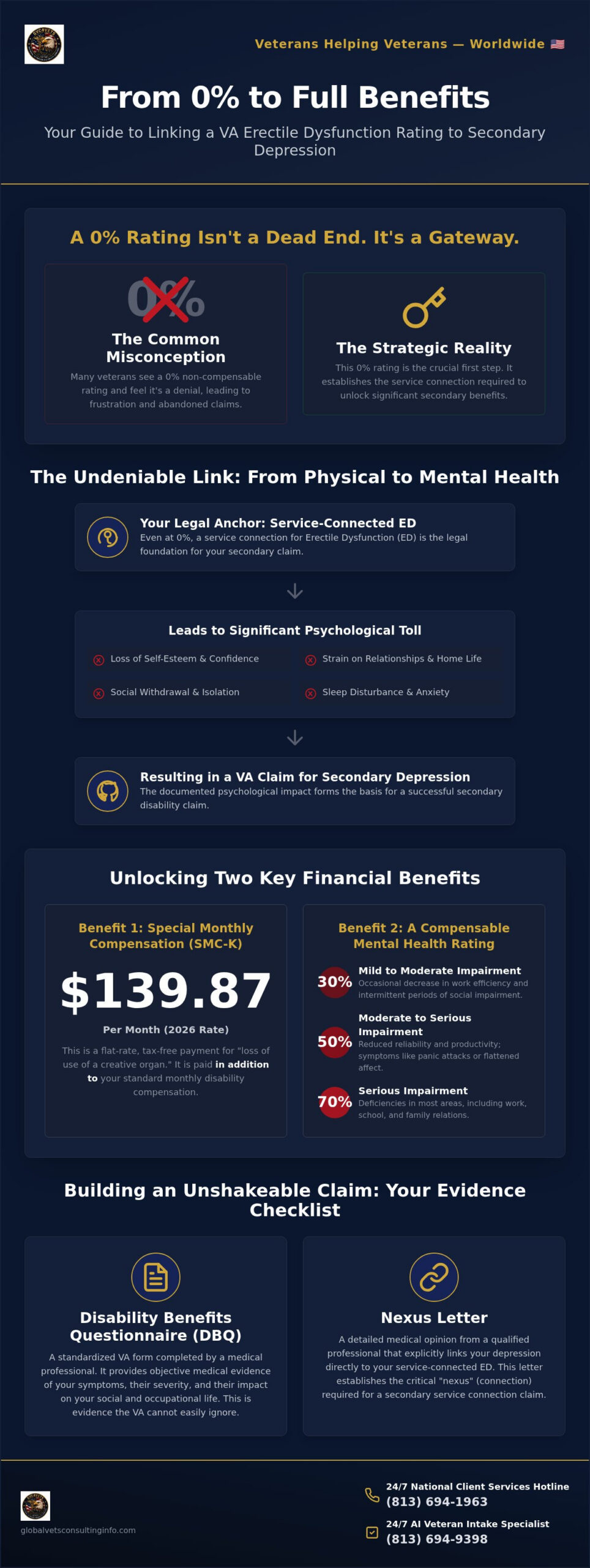
- Learn why a 0% rating for ED is a strategic win that secures the 2026 SMC-K monthly payment of $139.87.
- Discover how standardized Disability Benefits Questionnaires (DBQs) and Nexus Letters provide the medical evidence needed to overcome VA denials.
- Follow a step-by-step 2026 filing strategy to document social and occupational impairment and maximize your earned disability compensation.
The Connection: Understanding Depression Secondary to Erectile Dysfunction
A secondary service connection is established when a disability is caused or aggravated by a primary service-connected condition. For many, a va claim for depression secondary to erectile dysfunction begins with the realization that physical limitations don’t exist in a vacuum. Your service-connected ED acts as the legal anchor for your mental health benefits. 🇺🇸
The VA acknowledges that the “loss of use” of a creative organ carries a significant psychological weight. This connection is often described as a cyclical effect where physical symptoms and mental health struggles feed into one another. Understanding this link is the first step in building a successful VA disability claim for the compensation you’ve earned.
- 📉 Loss of Self-Esteem: Persistent physical limitations often lead to a diminished sense of self-worth and confidence.
- 🤝 Relationship Strain: Chronic stress and communication barriers frequently impact partnerships and home life.
- 🧠 Clinical Depression: Emotional distress that persists over time can evolve into a diagnosable mental health disorder.
- ⚖️ Legal Anchor: Even a 0% rating for ED establishes the service connection needed to bridge these conditions under VA law.
The Role of Medication Side Effects
Many veterans face a “catch-22” where the treatment for one condition worsens another. Antidepressants, specifically SSRIs, are known to have side effects that can aggravate Erectile dysfunction. This creates a difficult cycle: your depression treatment makes your physical symptoms worse, which in turn deepens the depression. Documenting this cycle is a critical component of your dbq for mental health conditions. 💊
Psychological Toll of Physical Limitations
The VA looks for specific indicators that your physical health has impacted your social and occupational life. Under 38 CFR, ED-induced anxiety qualifies as a secondary condition when it stems from a service-connected disability. 🌐
Key symptoms to document:
- 🚪 Social Withdrawal: Avoiding intimacy or isolating from family and friends due to physical symptoms.
- 🛌 Sleep Disturbance: Chronic insomnia or rest issues linked to persistent anxiety.
- ☁️ Persistent Low Mood: Feeling a loss of purpose or constant frustration regarding your physical health.
VA Rating Reality: 0% Ratings and SMC-K Payments in 2026
The VA typically assigns a 0% rating for erectile dysfunction unless there’s evidence of physical deformity or systemic disease. While a non-compensable rating might seem like a denial, it’s actually a strategic starting point for your benefits package. Establishing this service connection is the only way to access Special Monthly Compensation for the loss of use of a creative organ. 🇺🇸
2026 SMC-K Payment Details:
- 💰 Monthly Amount: $139.87
- ✅ Payment Type: Flat-rate add-on
- 📈 Benefit: Paid on top of your standard disability check
While the ED rating stays at 0%, filing a va claim for depression secondary to erectile dysfunction opens the door for a compensable percentage. The VA rates secondary mental health conditions based on how they impact your social and occupational life. These ratings are significantly higher than the 0% assigned to the primary condition.
Common Secondary Depression Ratings:
- 🔹 30% Rating: Occasional decrease in work efficiency and social impairment.
- 🔹 50% Rating: Reduced reliability and productivity with panic attacks or flattened affect.
- 🔹 70% Rating: Deficiencies in most areas, including work, school, and family relations.
How Secondary Ratings Boost Your Total Compensation
Adding a secondary mental health rating is one of the most effective ways to secure a VA rating increase for your overall claim. Even though “VA Math” is complex, a new 30% or 50% rating for depression can move your combined percentage into a higher payment tier. You can follow the va disability claims process step by step to see how these numbers combine. If you’re unsure how to document your symptoms, pursuing medical evidence education is a great way to strengthen your file. 🌐
Evidence Requirements: DBQs and the Nexus Letter
Winning a va claim for depression secondary to erectile dysfunction requires more than just a personal statement. You need two specific documents to bridge the gap: a Mental Health Disability Benefits Questionnaire (DBQ) and a Medical Nexus Letter. These documents serve as the clinical foundation for your claim. While the VA might rely on a brief C&P exam, submitting independent medical evidence from private providers ensures your symptoms are documented thoroughly and accurately.
The VA operates on a specific legal standard called “at least as likely as not.” This means your medical provider must state there’s at least a 50% probability that your depression was caused or aggravated by your service-connected erectile dysfunction. Without this specific phrasing in your nexus letter, the VA can easily deny the connection. You’ve got to provide the rater with a clear, undeniable link between your physical limitations and your mental health.
Why a Professional DBQ is Non-Negotiable
A DBQ is a standardized form that allows a medical professional to detail your social and occupational impairment. Understanding what is a dbq for va claims is the first step in preventing the VA from claiming a lack of evidence. A properly completed form ensures every symptom is checked, leaving no room for a rater to overlook the severity of your condition. It forces the VA to acknowledge the clinical reality of your daily struggles.
The Three Elements of a Strong Nexus
To secure your benefits, your medical evidence must satisfy three distinct criteria:
- Element 1: A current, formal diagnosis of depression or a related mental health condition.
- Element 2: An existing service-connected primary condition, which is your erectile dysfunction.
- Element 3: A clear medical link (the Nexus) that explains how the primary condition led to the secondary one.
If you’re ready to strengthen your medical evidence, get professional DBQ preparation assistance today to ensure your claim is built on solid ground.
Filing Your Secondary Claim: Step-by-Step for 2026
Executing your strategy for a va claim for depression secondary to erectile dysfunction requires a disciplined approach to documentation. The VA rater needs to see a clear chronological path from your physical symptoms to your current mental health state. By following a structured submission process, you ensure that no critical medical evidence is overlooked during the evaluation phase. 🇺🇸
- Step 1: Confirm your Erectile Dysfunction is already service-connected, even at a 0% rating.
- Step 2: Secure a professional Mental Health DBQ to document your current level of impairment.
- Step 3: Obtain a Medical Nexus Letter that explicitly links your depression to your ED.
- Step 4: Submit your claim as a “Secondary Condition” through the VA.gov portal or your chosen VSO.
Avoiding Common VA Claim Denials
Many veterans face denials because they fail to prove their depression was aggravated or caused by the ED specifically. If you’ve encountered a setback, reviewing our guide on how to recover when a va claim denied for lack of evidence can help you identify the missing pieces in your file. Establishing a clear medical timeline is the most effective way to counter “lack of evidence” findings.
Leveraging Professional Support
Global Vets Consulting provides the expertise needed to simplify this administrative burden. We offer immediate assistance through our 24/7 AI Veteran Intake Specialist and our dedicated support team. 📞
🌐 Website: GlobalVetsConsultingInfo.com
📞 24/7 National Client Services Hotline: 800-484-0551
Get the professional DBQ documentation you need to win your claim.
Taking the Next Step Toward Your Earned Benefits
Securing the compensation you’ve earned is about more than just filling out forms; it’s about presenting a clinical narrative the VA cannot ignore. You’ve seen how a 0% rating for ED serves as the anchor for your va claim for depression secondary to erectile dysfunction, potentially unlocking both SMC-K payments and significant mental health ratings. The difference between a denial and an approval often comes down to the quality of your independent medical evidence and the thoroughness of your documentation.
Global Vets Consulting operates as a veteran-owned and operated partner in this process. We specialize in providing the standardized DBQs and educational resources required for accurate VA evaluations. If you need immediate assistance or have questions about your specific situation, our 24/7 National Client Services Hotline is available at 800-484-0551. We’re here to ensure you have the tools necessary to navigate this system with confidence.
Secure Your Professional DBQ for Depression Secondary to ED Today 🇺🇸
You’ve already done the hard work of serving our country. Now, let’s ensure the system works for you. Stay persistent and keep moving forward because your well-being is worth the effort.
Frequently Asked Questions
Can I get VA disability for depression if it’s caused by my erectile dysfunction?
Yes, you can receive disability benefits for depression if it’s proximately caused or aggravated by your service-connected erectile dysfunction. This requires a formal diagnosis and a medical nexus letter linking the two conditions. Successfully filing a va claim for depression secondary to erectile dysfunction allows you to receive a compensable rating based on your level of social and occupational impairment, even if the primary condition is rated at 0%.
How much is the VA rating for erectile dysfunction secondary to depression in 2026?
The VA typically assigns a 0% rating for erectile dysfunction even when it’s secondary to a mental health condition like depression. While the rating itself isn’t compensable, it establishes the service connection required for Special Monthly Compensation. This 0% rating is the legal requirement to receive the SMC-K add-on. If your depression or its medication caused the ED, this connection ensures you receive the additional monthly benefit you’ve earned.
What is the 2026 SMC-K payment amount for erectile dysfunction?
In 2026, the SMC-K payment amount is $139.87 per month. This is a tax-free, flat-rate benefit awarded for the loss of use of a creative organ. This amount is added directly to your standard monthly check and isn’t subject to the same “VA Math” as your percentage-based disability ratings. It remains a consistent add-on that provides financial support regardless of your overall combined disability rating.
Do I need a new C&P exam for a secondary depression claim?
You’ll likely be scheduled for a Compensation and Pension (C&P) exam to evaluate the severity of your depression. However, you can strengthen your position by submitting a private Mental Health DBQ from a qualified professional. Providing independent medical evidence often reduces the VA’s reliance on a single, brief C&P exam. This proactive approach ensures your specific symptoms and limitations are documented accurately before the rater makes a final decision.
What happens if my VA claim for depression is denied for lack of evidence?
If your va claim for depression secondary to erectile dysfunction is denied, you can file a Supplemental Claim by providing new and relevant evidence. This usually involves obtaining a more detailed Medical Nexus Letter or a professional DBQ that clarifies the link between your conditions. Reviewing your denial letter will help you identify the specific evidence gaps the VA identified, allowing you to address them directly with standardized medical documentation.

Article by
Willie Daniel
Willie Daniel is the Founder and Chief Executive Officer (CEO) of Global Vets Consulting (GVC4Vets) – National Veterans Disability Services, a veteran-led educational and medical evidence support organization dedicated to helping veterans better understand VA disability rating increases, DBQ medical evidence, secondary claims education, and C&P examination preparation.
He is a retired U.S. Army Medical Service Corps Officer with more than 27 years of honorable military service, a decorated Iraq combat veteran, and a retired federal official with the U.S. Department of Veterans Affairs. Throughout his military and federal career, Willie Daniel served in leadership, healthcare administration, operational, and veteran-support roles focused on improving services and support systems for servicemembers, veterans, and their families.
Drawing from decades of military leadership, healthcare administration, veteran advocacy, and federal government experience, Willie Daniel brings a practical, veteran-centered perspective to Global Vets Consulting’s educational articles, AI-powered veteran resources, video education initiatives, and outreach programs. His experience navigating military systems, medical documentation processes, and veteran-related administrative operations provides valuable insight into many of the challenges veterans face when seeking to better understand VA disability rating criteria, medical evidence, documentation strategies, and secondary condition education.
Through GVC’s “Veterans Helping Veterans” mission, his focus is on delivering clear, educational, and easy-to-understand information designed to empower veterans with knowledge, resources, and educational tools that may help them make more informed decisions regarding their individual VA disability journeys.
The information provided through GVC is intended for educational and informational purposes only and should not be considered legal or medical advice.
Disclaimer
Disclaimer: Global Vets Consulting, LLC (“GVC”) is a veteran-led educational and medical evidence support organization. GVC is not a law firm, is not a Veterans Service Organization (VSO), and is not affiliated with the U.S. Department of Veterans Affairs (VA) or any government agency.
Global Vets Consulting does not provide legal advice, medical advice, medical treatment, or healthcare services. GVC does not prepare, file, or submit VA disability claims on behalf of veterans. All information provided through this website, blog articles, videos, educational materials, AI tools, dashboards, templates, and communications is intended solely for general educational and informational purposes.
Veterans are encouraged to consult with accredited representatives, licensed attorneys, qualified medical providers, or Veterans Service Organizations regarding their specific legal, medical, or VA-related matters. VA disability decisions, ratings, and outcomes are determined solely by the U.S. Department of Veterans Affairs based on applicable laws, regulations, medical evidence, and individual circumstances. Past results do not guarantee future outcomes.