
Did you know that while over 763,000 veterans receive disability compensation for sleep apnea, it remains one of the most frequently denied claims due to a lack of Sleep Apnea Medical Evidence? It’s incredibly frustrating to know your condition is real, only to have the VA reject your claim because your records don’t speak their specific language. You might feel stuck between a doctor who won’t provide a clear Nexus and a system that demands perfect documentation. We understand that struggle because we’ve been in your boots.
In this guide, you’ll learn exactly how to gather the documentation necessary to prove your claim and secure the VA disability rating you deserve. We’re going to provide a clear checklist of required evidence, explain how to link apnea to other service-connected conditions, and help you understand the 2026 rating criteria. By the end of this article, you’ll have a predictable path forward to turn your clinical diagnosis into a successful VA claim. Our goal is to ensure you have the tools to present a meticulous case that the VA can’t ignore.
Key Takeaways
- Identify the three essential pillars of Sleep Apnea Medical Evidence required to move beyond a simple diagnosis and secure a service connection.
- Learn why a formal sleep study and your Apnea-Hypopnea Index (AHI) score are the non-negotiable foundation for your disability rating.
- Discover the strategic role of a Nexus Letter in linking sleep apnea to existing service-connected conditions like PTSD or asthma.
- Understand how utilizing a professional DBQ ensures your medical documentation is complete and accurate before you submit your claim.
What is the Required Sleep Apnea Medical Evidence for VA Claims? 🇺🇸
Securing a VA disability rating requires shifting your mindset from a clinical diagnosis to a documentation-heavy administrative process. Many veterans assume a doctor’s note is enough, but the VA demands specific Sleep Apnea Medical Evidence to establish service connection. A simple diagnosis focuses on your health; however, a successful claim focuses on the “functional impact” of your condition. This means your records must clearly describe how sleep apnea limits your daily activities and earning capacity. Using a Disability Benefits Questionnaire (DBQ) is the most effective way to ensure your evidence is standardized and complete.
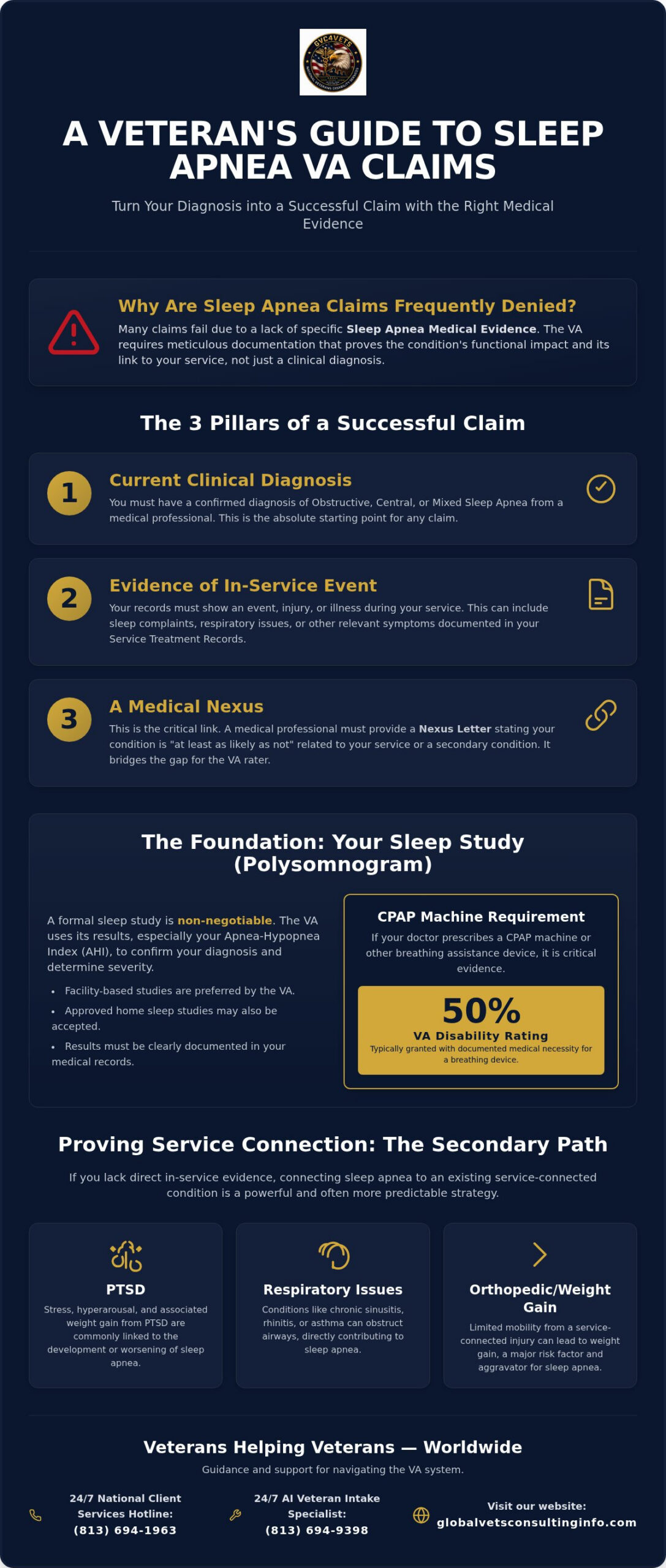
The Three Pillars of a Successful Claim
Your claim’s success depends on three non-negotiable elements. If any of these are missing, your claim will likely be denied for lack of evidence. We’ve seen many claims fail because one of these pillars was weak or missing.
- Pillar 1: A Current Clinical Diagnosis. You must have a confirmed diagnosis of Obstructive, Central, or Mixed Sleep Apnea. If you are researching What is Sleep Apnea? to understand your symptoms, remember that a formal diagnosis is the starting point for all Sleep Apnea Medical Evidence.
- Pillar 2: Evidence of an In-Service Event. You need documentation showing an event, injury, or illness occurred during your military service. This could be a record of a respiratory issue or a sleep complaint documented in your service treatment records.
- Pillar 3: A Medical Nexus. This is the critical link. A medical professional must provide a Nexus Letter stating your condition is “at least as likely as not” related to your service. This provides the logical bridge the VA rater needs to grant your claim.
By focusing on these three areas, you’re building a foundation that is difficult for the VA to dispute. It’s about being meticulous and providing the rater with everything they need to make a favorable decision.
The Sleep Study (Polysomnogram): The Foundation of Evidence
A formal sleep study is the non-negotiable foundation of your Sleep Apnea Medical Evidence. Without it, the VA will likely deny your claim regardless of how many symptoms you report. A polysomnogram is the only clinical evidence the VA accepts for a 0% rating or higher. This test measures your Apnea-Hypopnea Index (AHI), which tracks how many times you stop breathing per hour. While the VA prefers facility-based studies, they’ll accept home sleep studies if the equipment meets specific medical standards. If you’re unsure if your private study qualifies, checking the official diagnostic criteria for sleep apnea can help you verify your results.
What the VA Looks for in Your Sleep Study Results
Your rating percentage depends heavily on the severity of your test results and the prescribed treatment. Currently, the VA grants a 50% rating if your medical records show you require a CPAP or another breathing assistance device. Your doctor must explicitly document this need in your file. Additionally, the Respiratory Disturbance Index (RDI) can provide extra weight to your claim. It captures a broader range of breathing events than the AHI alone, offering a more complete picture of your condition’s severity.
Addressing a Missing In-Service Sleep Study
Many veterans don’t receive a diagnosis until years after they hang up the uniform. If you didn’t have a sleep study while on active duty, you must bridge the gap in your medical history. Buddy Statements from people who witnessed your symptoms in service, like a spouse or a bunkmate, are invaluable. They provide the “lay evidence” that supports your clinical diagnosis. If you’re struggling to organize this documentation, our Sleep Apnea Claims Education can help you build a stronger case.
Proving Service Connection: Secondary Conditions and Nexus Letters
Establishing a direct service connection is often a steep climb if your symptoms surfaced after discharge. Many veterans find a more predictable path by filing a secondary claim. This approach links your sleep apnea to a condition you’ve already service-connected, such as PTSD or chronic sinusitis. You can even link apnea to weight gain caused by a service-connected orthopedic injury that limits your mobility. This creates a logical chain of Sleep Apnea Medical Evidence that raters find easier to approve. If you have already seen a VA claim denied for lack of evidence, focusing on a secondary connection is a proven way to recover.
Secondary Service Connection Examples
PTSD is the most common condition linked to sleep apnea. Medical research shows a strong correlation between mental health struggles and sleep disturbances. Chronic respiratory issues like Rhinitis or Sinusitis are also frequent culprits because they contribute directly to airway obstruction. Your medical records must clearly demonstrate how these primary conditions cause or aggravate your apnea to meet the VA’s standards for Sleep Apnea Medical Evidence.
The Power of a Professional Medical Opinion
A Nexus Letter is the heart of your secondary claim. It must contain the specific “magic words” stating your condition is “at least as likely as not” related to your service. While a C&P examiner might only spend minutes reviewing your file, an Independent Medical Opinion (IMO) provides a comprehensive analysis of your history. This documentation can overturn a negative exam by citing The Sleep Study (Polysomnogram) and relevant medical literature. If you’re ready to strengthen your case, our Secondary VA Claims Education provides the clarity you need to move forward with confidence.
How Professional DBQs Secure Your Sleep Apnea Rating
A DBQ provides the VA with a roadmap of your symptoms and their severity. Standardized documentation is the most effective way to communicate with a VA rater who may only have minutes to review your file. By using professional Sleep Apnea Medical Evidence, you provide the specific data points needed to secure your earned rating. This approach removes the guesswork and reduces the frustration of “VA Math” by presenting your functional impact in a clear, clinical format. Supplementing your VA file with private medical evidence ensures that no detail of your condition is overlooked during the decision process.
The Global Vets Approach to Evidence Education
The Global Vets Consulting approach centers on education and empowerment. We want you to walk into a C&P exam feeling prepared and authoritative. Meticulous documentation isn’t just about paperwork; it’s about ensuring your story is told accurately. When your Sleep Apnea Medical Evidence is complete, it acts as a silent advocate that stays in your file long after the exam is over. Accuracy and thoroughness are your best tools for overcoming a system that often feels confusing or dismissive. Our mission is to provide you with the resources to present a claim that is both clinically sound and administratively perfect.
Next Steps: Gathering Your Medical Records
Gathering your records is the final step in taking control of your claim. Use this checklist to organize your evidence for your next medical appointment or claim submission:
- Confirmed Sleep Study results with AHI and RDI scores
- CPAP or breathing device compliance logs
- A detailed symptoms diary tracking daytime sleepiness and fatigue
- Completed DBQ from a medical professional
📞 Call our 24/7 National Client Services Hotline for immediate guidance on your evidence or visit GlobalVetsConsultingInfo.com today. 🇺🇸
Take Control of Your Sleep Apnea Claim Today
Securing the rating you earned requires more than just clinical notes; it demands a strategic assembly of Sleep Apnea Medical Evidence. You now understand that a formal sleep study is your foundation, while a strong Nexus Letter and a professionally completed DBQ provide the roadmap the VA needs to grant your claim. Whether you’re filing directly or as a secondary condition to PTSD or an orthopedic injury, meticulous documentation is the key to overcoming administrative hurdles. It’s time to stop feeling stuck in a complex system and start moving forward with steady confidence. As a Veteran-Owned & Operated firm, we provide Worldwide support to help you navigate this process with ease. Our 24/7 AI Veteran Intake Specialist is ready to assist you right now. Don’t let your benefits wait any longer. Get the medical evidence you need; Explore our DBQ Education Services today! You’ve served your country with honor, and you deserve a partner who respects that history and fights for your well-being.
Frequently Asked Questions
Can I get a VA rating for sleep apnea without a sleep study?
No, you cannot. A formal sleep study, or polysomnogram, is the absolute foundation of your Sleep Apnea Medical Evidence. The VA requires clinical confirmation through AHI or RDI scores to grant any rating above 0%. Without this diagnostic proof, the rater lacks the clinical data necessary to establish a valid diagnosis and move forward with your claim.
What is the VA rating for sleep apnea with a CPAP machine in 2026?
Under current rules as of August 2026, requiring a breathing assistance device like a CPAP machine generally warrants a 50% disability rating. While the VA proposed changes to this criteria, those updates aren’t final. For a single veteran with no dependents, a 50% rating in 2026 results in a monthly compensation amount of $1,132.90 following the 2.8% COLA increase.
Is a private DBQ better than a VA C&P exam for sleep apnea?
A private Disability Benefits Questionnaire (DBQ) is often more thorough because your doctor can take the time to document your full history. While a C&P examiner might only spend minutes reviewing your file, a private DBQ ensures all specific Sleep Apnea Medical Evidence is standardized and present. This meticulous approach reduces the risk of a rater missing critical symptoms or severity markers.
How do I prove my sleep apnea is secondary to my PTSD?
You must provide a medical Nexus Letter that explains the physiological link between your PTSD and your sleep apnea. Your doctor should cite medical literature showing how PTSD symptoms or medications aggravate airway obstruction. This professional medical opinion must state that your apnea is “at least as likely as not” caused or worsened by your service-connected mental health condition.
What happens if the VA denies my sleep apnea claim for lack of service connection?
If your claim is denied, you should review your decision letter to identify which of the three pillars was missing. Often, the solution involves strengthening your Nexus with an Independent Medical Opinion or adding lay evidence through Buddy Statements. You don’t have to accept a denial as the final word; you simply need more robust documentation to bridge the administrative gap.

Article by
Willie Daniel
Willie Daniel is the Founder and Chief Executive Officer (CEO) of Global Vets Consulting (GVC4Vets) – National Veterans Disability Services, a veteran-led educational and medical evidence support organization dedicated to helping veterans better understand VA disability rating increases, DBQ medical evidence, secondary claims education, and C&P examination preparation.
He is a retired U.S. Army Medical Service Corps Officer with more than 27 years of honorable military service, a decorated Iraq combat veteran, and a retired federal official with the U.S. Department of Veterans Affairs. Throughout his military and federal career, Willie Daniel served in leadership, healthcare administration, operational, and veteran-support roles focused on improving services and support systems for servicemembers, veterans, and their families.
Drawing from decades of military leadership, healthcare administration, veteran advocacy, and federal government experience, Willie Daniel brings a practical, veteran-centered perspective to Global Vets Consulting’s educational articles, AI-powered veteran resources, video education initiatives, and outreach programs. His experience navigating military systems, medical documentation processes, and veteran-related administrative operations provides valuable insight into many of the challenges veterans face when seeking to better understand VA disability rating criteria, medical evidence, documentation strategies, and secondary condition education.
Through GVC’s “Veterans Helping Veterans” mission, his focus is on delivering clear, educational, and easy-to-understand information designed to empower veterans with knowledge, resources, and educational tools that may help them make more informed decisions regarding their individual VA disability journeys.
The information provided through GVC is intended for educational and informational purposes only and should not be considered legal or medical advice.
Disclaimer
Disclaimer: Global Vets Consulting, LLC (“GVC”) is a veteran-led educational and medical evidence support organization. GVC is not a law firm, is not a Veterans Service Organization (VSO), and is not affiliated with the U.S. Department of Veterans Affairs (VA) or any government agency.
Global Vets Consulting does not provide legal advice, medical advice, medical treatment, or healthcare services. GVC does not prepare, file, or submit VA disability claims on behalf of veterans. All information provided through this website, blog articles, videos, educational materials, AI tools, dashboards, templates, and communications is intended solely for general educational and informational purposes.
Veterans are encouraged to consult with accredited representatives, licensed attorneys, qualified medical providers, or Veterans Service Organizations regarding their specific legal, medical, or VA-related matters. VA disability decisions, ratings, and outcomes are determined solely by the U.S. Department of Veterans Affairs based on applicable laws, regulations, medical evidence, and individual circumstances. Past results do not guarantee future outcomes.