

🇺🇸 Global Vets Consulting | Worldwide 🌐
GlobalVetsConsultingInfo.com
📞 24/7 National Client Services Hotline
🤖 24/7 AI Veteran Intake Specialist
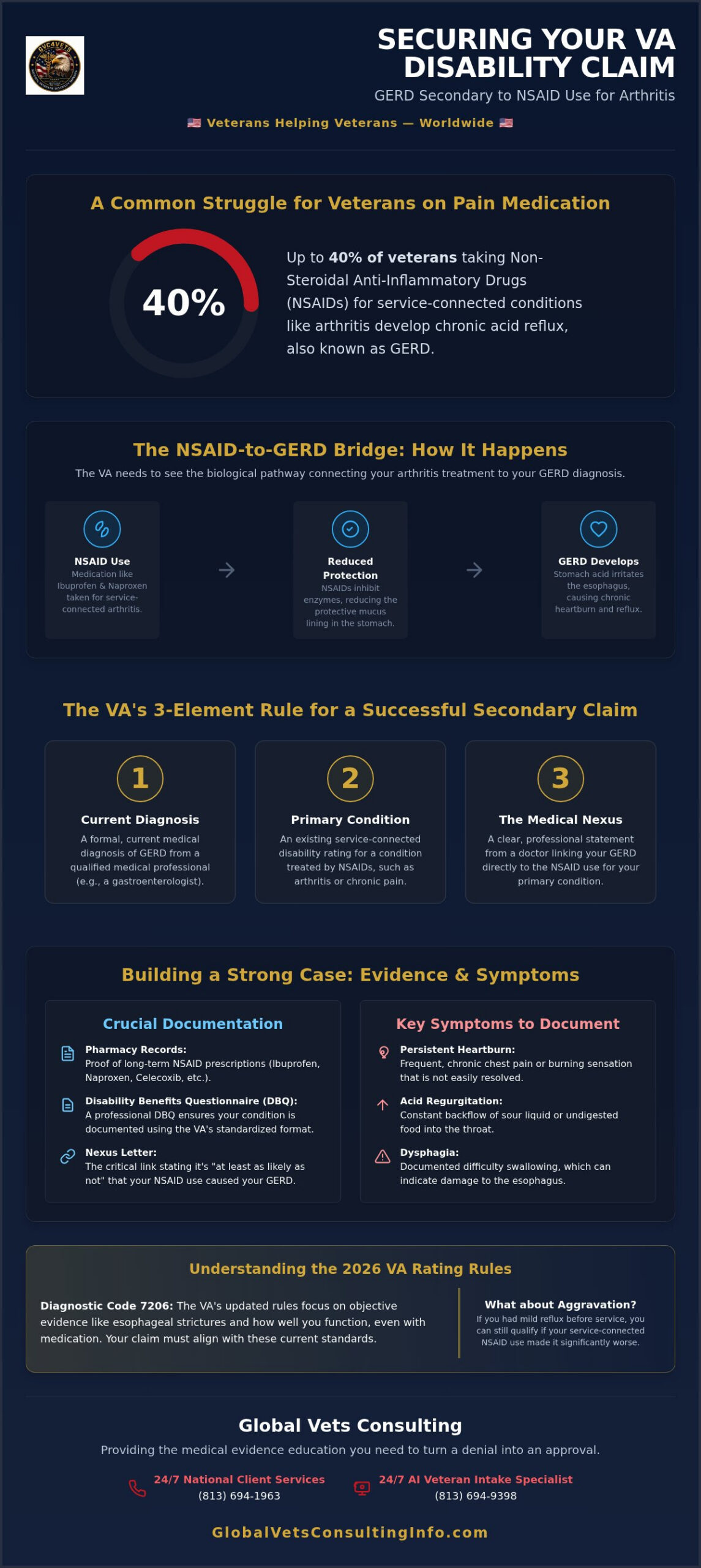
Up to 40% of veterans taking NSAIDs for service-connected pain end up dealing with chronic acid reflux. If you’re managing arthritis, you’ve likely relied on high doses of ibuprofen or naproxen just to keep moving. It’s a tough trade-off when the medicine for your joints starts burning your esophagus, especially for your va claim for gerd secondary to nsaid use for arthritis. We understand the frustration of being denied because the VA doesn’t see the “bridge” between your pills and your stomach pain.
You don’t have to navigate this complex system alone. In this guide, we’ll explain how to link your GERD to your service-connected arthritis medication to secure the rating you deserve. We’ll cover the 2026 rating criteria under Diagnostic Code 7206. We’ll discuss the necessity of a professional DBQ. We’ll also explain the impact of February 2026 rule changes. We provide the medical evidence education you need to turn a denial into an approval.
Key Takeaways
- Understand the biological link between chronic NSAID use for pain management and the development of gastrointestinal conditions like GERD.
- Identify the specific medical evidence and nexus requirements needed for a successful va claim for gerd secondary to nsaid use for arthritis.
- Learn how a professional Disability Benefits Questionnaire (DBQ) provides the standardized documentation the VA uses to determine your rating.
- Follow a step-by-step process to organize your pharmacy records and medical history for a stronger, more accurate claim submission.
The Medical Link: How NSAIDs for Arthritis Cause GERD
🧬 The Biological Mechanism
Non-Steroidal Anti-Inflammatory Drugs (NSAIDs) are the primary tool for managing service-connected arthritis. While they effectively target joint inflammation, they also inhibit COX-1 and COX-2 enzymes. This biological process reduces prostaglandins. These specific chemicals are responsible for producing the protective mucus lining in your stomach. When this barrier fails, stomach acid causes chronic irritation and backflow. The “NSAID-GERD bridge” is the medically recognized pathway that connects your arthritis treatment directly to Gastroesophageal reflux disease. Establishing this link is the foundation of your secondary claim.
💊 Common NSAIDs Prescribed for Veterans
Veterans often rely on these medications for years to maintain their mobility. The following drugs are frequently cited in successful claims:
- Ibuprofen (Motrin): Typically prescribed in high-strength dosages for chronic inflammation.
- Naproxen (Aleve): A long-acting medication that provides relief but increases gastric exposure.
- Celecoxib (Celebrex): A COX-2 inhibitor that can still impact the digestive tract over time.
Regular use of these pills creates a clear path for a va claim for gerd secondary to nsaid use for arthritis. Your pharmacy records serve as critical medical evidence of this long-term exposure.
🩺 Symptoms of GERD the VA Looks For
The VA requires proof that your symptoms are chronic and severe. They are looking for recurring issues that impact your daily life:
- Persistent Heartburn: Frequent chest pain that does not resolve with occasional antacids.
- Acid Regurgitation: The constant backflow of sour liquid or undigested food into the throat.
- Dysphagia: Significant difficulty swallowing, often indicating damage to the esophagus.
Documenting these symptoms as recurring is necessary for your va claim for gerd secondary to nsaid use for arthritis. Precise medical documentation ensures the VA rater understands the full severity of your condition.
VA Criteria for GERD Secondary to Service-Connected Arthritis
📜 The Three-Element Rule
Establishing service connection for a secondary condition follows a specific legal framework. To win your va claim for gerd secondary to nsaid use for arthritis, you must provide three specific pieces of medical evidence:
- Current Diagnosis: A formal medical diagnosis of GERD from a qualified doctor or gastroenterologist.
- Primary Condition: An existing service-connected rating for arthritis, back pain, or other joint conditions.
- The Medical Nexus: Professional documentation linking your arthritis treatment directly to your digestive issues.
⚖️ Understanding Aggravation and 2026 Rules
You don’t need a perfectly clean medical history to succeed. If you had mild reflux before service, you can still qualify through the concept of “aggravation.” This means your service-connected arthritis medication made your pre-existing condition significantly worse. The VA uses 38 CFR § 4.114 and Diagnostic Code 7206 to evaluate these digestive claims in 2026. This updated code focuses on objective findings like esophageal strictures and how well you function while taking medication. Following this structured path ensures your claim is grounded in current VA regulations.
🔗 Proving the ‘Nexus’ Connection
A nexus statement is the most important part of your claim package. It must prove it’s “at least as likely as not” that your NSAIDs caused your gastric issues. Here’s what you need to know about building a strong link:
- Your doctor must explain How NSAIDs Cause GERD by detailing the damage to your esophageal health.
- A va claim denied for lack of evidence usually happens when the “medication bridge” is not clearly documented.
- Providing standardized DBQs ensures your symptoms are recorded using the precise terminology raters expect.
🌐 Getting the right secondary VA claims education is the best way to avoid common filing errors and secure your rating increase. We focus on helping you understand the medical logic required to bridge the gap between your joints and your gut.
Essential Evidence: Using DBQs to Support Your Claim
Securing a successful outcome for a va claim for gerd secondary to nsaid use for arthritis depends on the quality of your medical documentation. The VA uses Disability Benefits Questionnaires (DBQs) to standardize how they evaluate your condition and determine your rating. While the VA may schedule a C&P exam, many veterans find that a private DBQ provides a more thorough and accurate assessment. A private doctor often has more time to review your full history of arthritis treatment than a rushed examiner. Understanding what is a dbq for va claims is the first step in ensuring your symptoms are captured with the technical precision the VA requires.
Key Elements of a Gastrointestinal DBQ
Your DBQ must specifically address the criteria under Diagnostic Code 7206. It is not enough to simply mention heartburn; a licensed medical professional needs to document the frequency and severity of your reflux episodes. They should also look for complications like hiatal hernias or esophageal strictures. These objective findings are critical for higher ratings under the 2026 schedule. If your medical records show you require procedures like esophageal dilation, this evidence must be clearly stated to avoid a lowball rating.
The Role of an Independent Medical Opinion
An Independent Medical Opinion (IMO) serves as the medical logic the VA rater needs to grant service connection. It bridges the gap between your arthritis treatment and your current GERD diagnosis. The doctor will review your pharmacy records and explain how chronic NSAID intake weakened your esophageal defenses. This professional opinion reinforces your va claim for gerd secondary to nsaid use for arthritis by providing a clear, evidence-based nexus statement. Without this specific medical reasoning, the rater may struggle to see the connection between your joint pain and your digestive health.
If you are ready to document your condition with precision, you can get professional DBQ preparation assistance today to ensure your claim is supported by strong evidence.
Filing Your Claim: Steps to Secure a Secondary Rating
Securing your benefits requires a methodical approach that leaves no room for ambiguity. To successfully file a va claim for gerd secondary to nsaid use for arthritis, you should follow a logical, step-by-step progression to ensure your evidence is undeniable. First, obtain a formal diagnosis of GERD from your primary care physician or a gastroenterologist. Next, gather your pharmacy records. These must show long-term, consistent use of NSAIDs prescribed for your service-connected arthritis. Finally, secure a professional DBQ and a Nexus Letter that explicitly links your medication to your gastric condition. Once your evidence is organized, submit your claim as a secondary service connection through the VA disability claims process.
Preparing for the C&P Exam
The Compensation and Pension (C&P) exam is a pivotal moment in your claim journey. When you speak with the examiner, you must be completely honest about your “worst days” rather than how you feel at that specific moment. Detail the frequency of your acid reflux and any difficulty swallowing. It’s also a best practice to bring physical copies of your private DBQ and nexus letter to the appointment. Having these documents as a reference helps you stay focused on the medical facts and ensures the examiner has the full picture of your condition.
Maximizing Your Combined Rating
A new rating for GERD doesn’t just provide a single benefit; it can significantly impact your overall va disability rating increase. Because the VA uses a combined rating table, adding a secondary condition like GERD can push your total percentage into a higher compensation bracket. Don’t wait for your symptoms to worsen before taking action. Documenting the connection between your arthritis treatment and your digestive health is a vital step toward securing the full compensation you’ve earned through your service.
Secure the Rating Your Health Requires
You’ve seen how long-term arthritis medication can directly lead to chronic acid reflux. Success with a va claim for gerd secondary to nsaid use for arthritis depends on proving this “medication bridge” with precise medical documentation. Under the 2026 rules, documenting specific evidence like esophageal strictures and functional limitations is more important than ever. As a veteran-owned and operated team, we provide specialized secondary claims education to help you navigate these complex administrative hurdles. Our 24/7 National Client Services Hotline is always available to help you obtain the high-quality evidence you need to succeed. You served with honor; now it’s time to ensure your benefits reflect the full scope of your service-connected conditions. Don’t let a lack of documentation stand between you and your earned compensation. We’re ready to stand by your side as a reliable ally in this process.
🇺🇸 Get the Medical Documentation You Need-Contact Global Vets Consulting Today
Frequently Asked Questions
Can I get VA disability for GERD if I already have a rating for arthritis?
Yes, you can receive a separate rating for GERD as a secondary condition. The VA recognizes that treatments for primary conditions often cause new health issues. By filing a va claim for gerd secondary to nsaid use for arthritis, you’re documenting that your service-connected joint pain treatment led to digestive damage. This allows you to increase your combined disability percentage beyond your current arthritis rating while securing the medical benefits you’ve earned.
What is the maximum VA rating for GERD in 2026?
The maximum rating for GERD under the updated Diagnostic Code 7206 is 80%. As of May 2024, the VA evaluates esophageal conditions based on strictures and the need for medical procedures like dilations. Ratings range from 0%, 10%, 30%, 50%, and 80%. Note that the February 2026 rule change means the VA now considers your functionality while on medication when determining your final percentage during the evaluation process.
Do I need a Nexus Letter for a secondary GERD claim?
Yes, a Nexus Letter is a critical piece of medical evidence for any secondary claim. It provides a formal statement from a medical professional linking your GERD to your service-connected arthritis medication. The letter must state that your condition is “at least as likely as not” caused by your NSAID use. Without this specific medical logic, the VA rater may deny the connection between your digestive health and your service-connected joints.
How do I prove my arthritis medication caused my acid reflux?
You prove this link through a “medication bridge” in your medical records. This involves gathering pharmacy history showing long-term NSAID use and doctor’s notes documenting when your reflux symptoms began. When filing your va claim for gerd secondary to nsaid use for arthritis, high-quality DBQs are essential. These documents explain the biological mechanism where NSAIDs reduce the prostaglandins that protect your stomach lining, leading to chronic esophageal irritation and damage.
What happens if the VA denies my secondary GERD claim?
If your claim is denied, you have several options to appeal the decision. You can file a Higher-Level Review if you believe the rater made an error; or a Supplemental Claim if you have new medical evidence. Often, denials occur because the nexus between the NSAIDs and GERD wasn’t clear. Obtaining a professional DBQ or a more detailed Nexus Letter can help address these evidentiary gaps and secure your approval.

Article by
Willie Daniel
Willie Daniel is the Founder and Chief Executive Officer (CEO) of Global Vets Consulting (GVC4Vets) – National Veterans Disability Services, a veteran-led educational and medical evidence support organization dedicated to helping veterans better understand VA disability rating increases, DBQ medical evidence, secondary claims education, and C&P examination preparation.
He is a retired U.S. Army Medical Service Corps Officer with more than 27 years of honorable military service, a decorated Iraq combat veteran, and a retired federal official with the U.S. Department of Veterans Affairs. Throughout his military and federal career, Willie Daniel served in leadership, healthcare administration, operational, and veteran-support roles focused on improving services and support systems for servicemembers, veterans, and their families.
Drawing from decades of military leadership, healthcare administration, veteran advocacy, and federal government experience, Willie Daniel brings a practical, veteran-centered perspective to Global Vets Consulting’s educational articles, AI-powered veteran resources, video education initiatives, and outreach programs. His experience navigating military systems, medical documentation processes, and veteran-related administrative operations provides valuable insight into many of the challenges veterans face when seeking to better understand VA disability rating criteria, medical evidence, documentation strategies, and secondary condition education.
Through GVC’s “Veterans Helping Veterans” mission, his focus is on delivering clear, educational, and easy-to-understand information designed to empower veterans with knowledge, resources, and educational tools that may help them make more informed decisions regarding their individual VA disability journeys.
The information provided through GVC is intended for educational and informational purposes only and should not be considered legal or medical advice.
Disclaimer
Disclaimer: Global Vets Consulting, LLC (“GVC”) is a veteran-led educational and medical evidence support organization. GVC is not a law firm, is not a Veterans Service Organization (VSO), and is not affiliated with the U.S. Department of Veterans Affairs (VA) or any government agency.
Global Vets Consulting does not provide legal advice, medical advice, medical treatment, or healthcare services. GVC does not prepare, file, or submit VA disability claims on behalf of veterans. All information provided through this website, blog articles, videos, educational materials, AI tools, dashboards, templates, and communications is intended solely for general educational and informational purposes.
Veterans are encouraged to consult with accredited representatives, licensed attorneys, qualified medical providers, or Veterans Service Organizations regarding their specific legal, medical, or VA-related matters. VA disability decisions, ratings, and outcomes are determined solely by the U.S. Department of Veterans Affairs based on applicable laws, regulations, medical evidence, and individual circumstances. Past results do not guarantee future outcomes.