
What if the most critical 15 minutes of your disability claim journey aren’t actually about the questions the doctor asks you? Many veterans walk into a VA C&P Exam feeling like they’re stepping into a trap, fearing that a brief encounter will somehow erase years of documented service-connected pain. It’s a valid concern; a compensation and pension exam is a forensic evaluation, which is fundamentally different from a standard doctor visit where the goal is treatment. This distinction often causes unnecessary stress and confusion for those who have already sacrificed so much.
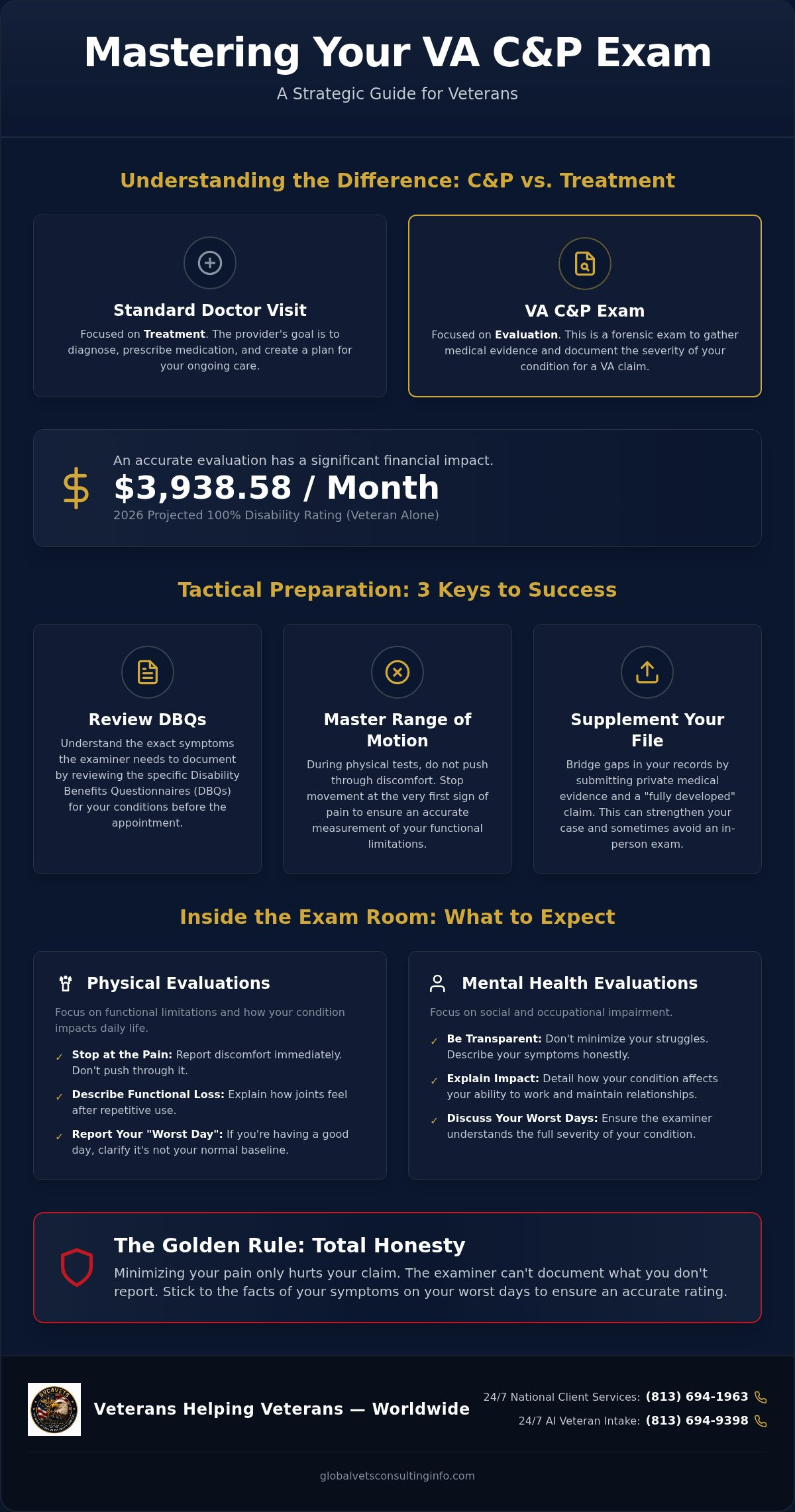
We believe you should feel confident and prepared when you walk through that door. You’ve earned your benefits, and with the 2026 cost-of-living adjustment raising a 100% disability rating to $3,938.58 per month for a veteran alone, the financial impact of a fair evaluation is significant. This guide provides the strategies you need to ensure your medical evidence accurately reflects your conditions. We’ll walk through essential preparation steps, the importance of using private DBQs to supplement your file, and how to navigate the process now that the VA’s interim medication rule has been rescinded.
Key Takeaways
- Understand that the exam is a forensic medical evaluation designed to verify service connection rather than a standard treatment appointment.
- Learn how to review specific Disability Benefits Questionnaires (DBQs) before your appointment to identify the exact symptoms the examiner needs to document.
- Master the “Range of Motion” portion of a physical VA C&P Exam by knowing exactly when to stop movement based on your pain thresholds.
- Discover how supplementing your file with private medical evidence can bridge gaps in your records and help secure an accurate disability rating.
What is a VA C&P Exam and Why is it Required in 2026?
The Compensation and Pension (C&P) exam is a forensic medical evaluation used by the Department of Veterans Affairs. Its primary purpose is to verify your service connection and determine the severity of your symptoms. Unlike a standard checkup, this appointment focuses on gathering medical evidence for your VA disability claim. 🇺🇸
The VA typically orders these exams for several strategic reasons:
- Filling Record Gaps: To address missing information in your service treatment records.
- Establishing a Nexus: To obtain a fresh medical opinion linking your current diagnosis to your time in service.
- Evaluating Severity: To document how much your condition interferes with your daily life.
- Specialized Reviews: To conduct a VA C&P Exam for PTSD or other complex mental health conditions.
It’s vital to remember that this appointment is not for medical treatment. The examiner won’t give you prescriptions or a plan for care. You might see a provider at a VA facility, but the VA also uses these third-party contractors:
- VES (Veterans Evaluation Services)
- QTC Health Services
- OptumServe
Does Every Veteran Need a C&P Exam?
Not every claim requires you to travel to a clinic. The VA uses the ACE (Acceptable Clinical Evidence) process to review records without an in-person visit when the medical evidence is already sufficient. 🌐
You can often satisfy the VA’s requirement for evidence by taking these steps:
- Submit a private DBQ for your VA claim from your own doctor.
- Provide “fully developed” evidence that clearly shows your functional limitations.
- Ensure all private medical records are uploaded to your file via VA.gov before the evaluation starts.
The Role of the DBQ in Your Exam
During the VA C&P Exam, the examiner follows a specific template to ensure they capture the right data. A DBQ is the standardized template the VA uses to translate medical symptoms into a disability percentage. By reviewing these forms ahead of time, you can better understand how to describe your symptoms accurately to support a VA rating increase.
Inside the Exam Room: What to Expect During Your Appointment
Preparation is your best defense against the anxiety of the unknown. When you step into your appointment, the examiner has likely already reviewed your electronic file. Their goal is to verify the medical evidence and determine how your symptoms align with VA rating criteria. According to Official VA Claim Exam Information, this interaction is a forensic evaluation, not a typical doctor’s visit. 🇺🇸
Physical evaluations focus on functional limitations. The examiner will use a goniometer to measure your joint range of motion. To ensure an accurate report, follow these guidelines:
- Stop at the pain: Do not push through discomfort to show strength. Stop the moment you feel the first sign of pain.
- Functional loss: Describe how your joints feel after repetitive use, not just during the single movement in the office.
- Worst-day reality: If you’re having a “good day” during the VA C&P Exam, clarify that this isn’t your normal baseline.
Mental health evaluations shift the focus toward social and occupational impairment. The provider wants to know how your condition impacts your ability to work and maintain relationships. Don’t minimize your struggles; be prepared to discuss your symptoms with total transparency. 🌐
Common Questions Examiners Ask
Expect direct questions that help the VA categorize your level of disability. Be ready to answer:
- 📞 How does this condition interfere with your ability to perform your daily job duties?
- 📞 When did these symptoms first begin, and what in-service event caused them?
- 📞 Have your symptoms worsened since your last evaluation or since leaving the service?
The Importance of Total Honesty
Honesty is the most critical factor in securing a fair VA rating increase. Minimizing your pain only hurts your claim in the long run. Keep these points in mind:
- Don’t “tough it out”: If a movement hurts, say it hurts immediately. The examiner can’t document pain you don’t report.
- Accurate reporting: There’s a major difference between “malingering” and accurately reporting your most severe symptoms.
- Focus on facts: Stick to the symptoms you experience on your worst days to provide a complete picture of your disability.
Tactical Preparation: How Veterans Can Set Themselves Up for Success
Preparation is the primary way to reduce anxiety and ensure your examiner has the facts needed for a favorable report. According to official VA guidance on C&P exams, the evidence you present during this window is vital for your final rating. Being organized allows you to advocate for yourself effectively. 🇺🇸
Use this tactical checklist to prepare for your appointment:
- 📄 Study the DBQ: Download and review the Disability Benefits Questionnaire for your specific condition to understand the rating criteria.
- 📝 Prepare a ‘Cheat Sheet’: List your medications, dates of major flare-ups, and specific symptoms so you don’t forget them under pressure.
- 👥 Bring a Witness: A spouse or close friend can testify to symptoms you might accidentally downplay or forget to mention.
- 💊 Medication Log: Keep a record of how your prescriptions affect your daily functioning and any side effects you experience.
If you need help organizing your documentation, our C&P Examination Preparation Education can give you the edge you need to succeed.
Reviewing Your Medical Evidence
Your medical records are the backbone of your VA C&P Exam. Organizing them properly ensures the examiner can see the full history of your service connection. 🌐
- Upload early: Ensure all private medical records are submitted via VA.gov well before your exam date.
- Stay organized: Learn how to file a VA claim successfully by keeping your records in chronological order.
- Evidence check: Verify that your file contains a clear diagnosis and evidence of an in-service event.
The ‘Worst Day’ Rule
Many veterans make the mistake of describing how they feel on a “good” day, which creates an incomplete picture of their disability. You must shift your mindset to focus on your most severe flare-ups. You should describe your functional limitations based on your worst day of the month to provide a full picture of the disability. 📞
The Power of Private Evidence: Supplementing the C&P Exam
A standard medical evaluation is often insufficient for veterans dealing with complex or chronic conditions. While the VA relies on its contracted examiners to provide a snapshot of your health, private medical evidence offers the necessary depth to tell your full story. Proactively submitting high-quality documentation ensures that the rater has a complete picture before they even review the results of your VA C&P Exam. This strategy shifts the focus from a brief, potentially rushed appointment to a comprehensive record of your service-connected struggles.
Private DBQs are one of the most effective tools in a veteran’s arsenal. When a qualified provider completes these forms, they serve as “fully developed” evidence that the VA is legally required to consider during the adjudication process. Global Vets Consulting specializes in helping veterans secure the Disability Benefits Questionnaires (DBQ) needed to substantiate their claims with precision. If a C&P examiner’s report comes back as unfavorable or contains inaccuracies, your private DBQ becomes the primary tool for a Higher-Level Review (HLR) or a formal appeal.
What to Do After a Bad C&P Exam
If you leave your appointment feeling like the examiner was rude, unprofessional, or ignored your physical limitations, you must act quickly. Your first step is to request a copy of the exam results through a FOIA request to see exactly what was documented. You can also challenge the validity of the exam if the provider committed M21-1 violations, such as failing to use a goniometer for joint measurements or neglecting to review your relevant medical history. Reporting these issues to the VA immediately helps protect your right to a fair evaluation.
Final Steps for a Rating Increase
Securing the compensation you’ve earned often requires a combination of clinical evidence and tactical persistence. You can use your exam results and private documentation to apply for a VA rating increase that reflects the true severity of your symptoms. We’re here to guide you through every step of this complex administrative process.
🌐 Visit GlobalVetsConsultingInfo.com to learn more about our DBQ preparation services. 🇺🇸
Take Command of Your Disability Rating Journey
Success in your claim depends on bridging the gap between a brief clinical encounter and the reality of your daily life. By utilizing the “worst day” rule and arriving with organized notes, you ensure that your medical evidence speaks louder than a 15-minute appointment. Remember that a private DBQ is your strongest tool for providing the depth the VA needs to assign an accurate percentage. If you encounter an unfavorable VA C&P Exam report, your proactive documentation becomes the foundation for a successful appeal or Higher-Level Review.
Global Vets Consulting is veteran-owned and operated since 2021. We provide expert DBQ preparation and education to help you substantiate your service-connected conditions with confidence. 🇺🇸
🌐 GlobalVetsConsultingInfo.com
📞 24/7 National Client Services Hotline
Secure your medical evidence today with Global Vets Consulting. You’ve served your country with honor; now it’s time to ensure the system works for you. We’re ready to stand with you as you pursue the rating you’ve earned.
Frequently Asked Questions
What happens if I miss my VA C&P exam?
Missing your appointment without a valid reason often leads to an immediate denial of your disability claim because the VA considers it a failure to report. If you realize you can’t make it, you must call the VA or the specific contractor, such as VES or QTC, to reschedule as soon as possible. Providing evidence of “good cause” for your absence is the only way to prevent a negative decision based on a missed appointment.
Can I bring my own doctor’s DBQ to the C&P exam?
You can certainly bring a copy of your private DBQ to the appointment, but the examiner isn’t legally required to review it during your time together. The most effective strategy is to upload your private medical evidence to your file via VA.gov before the appointment. This ensures your documentation is part of the official record the examiner is tasked with reviewing before you ever walk through the door.
How long does it take to get a decision after a C&P exam in 2026?
As of May 2026, the average time to complete a VA disability-related claim is approximately 80 days from the date of filing. Once your VA C&P Exam is finished, the examiner typically submits their report within a few weeks. If you submitted a Fully Developed Claim with all your evidence upfront, you might see a decision in as little as 30 days, though complex cases can take longer.
What should I do if the C&P examiner didn’t use a goniometer for my physical exam?
You should immediately report this procedural error to the VA by filing a statement in support of your claim. VA Manual M21-1 requires examiners to use a goniometer to measure your range of motion accurately. If the provider simply “eyeballed” your movements, the exam is technically insufficient. Documenting this failure right away helps you request a new, fair evaluation before a rating decision is made.
Is a C&P exam required for secondary service connection claims?
The VA almost always orders a VA C&P Exam for secondary claims to establish a clear medical link between your primary disability and the new condition. The examiner’s primary goal is to provide a “nexus” opinion on whether the secondary issue is “at least as likely as not” caused by your service-connected disability. Providing your own independent medical evidence can help guide the examiner toward a favorable conclusion during this process.

Article by
Willie Daniel
Willie Daniel is the Founder and Chief Executive Officer (CEO) of Global Vets Consulting (GVC4Vets) – National Veterans Disability Services, a veteran-led educational and medical evidence support organization dedicated to helping veterans better understand VA disability rating increases, DBQ medical evidence, secondary claims education, and C&P examination preparation.
He is a retired U.S. Army Medical Service Corps Officer with more than 27 years of honorable military service, a decorated Iraq combat veteran, and a retired federal official with the U.S. Department of Veterans Affairs. Throughout his military and federal career, Willie Daniel served in leadership, healthcare administration, operational, and veteran-support roles focused on improving services and support systems for servicemembers, veterans, and their families.
Drawing from decades of military leadership, healthcare administration, veteran advocacy, and federal government experience, Willie Daniel brings a practical, veteran-centered perspective to Global Vets Consulting’s educational articles, AI-powered veteran resources, video education initiatives, and outreach programs. His experience navigating military systems, medical documentation processes, and veteran-related administrative operations provides valuable insight into many of the challenges veterans face when seeking to better understand VA disability rating criteria, medical evidence, documentation strategies, and secondary condition education.
Through GVC’s “Veterans Helping Veterans” mission, his focus is on delivering clear, educational, and easy-to-understand information designed to empower veterans with knowledge, resources, and educational tools that may help them make more informed decisions regarding their individual VA disability journeys.
The information provided through GVC is intended for educational and informational purposes only and should not be considered legal or medical advice.
Disclaimer
Disclaimer: Global Vets Consulting, LLC (“GVC”) is a veteran-led educational and medical evidence support organization. GVC is not a law firm, is not a Veterans Service Organization (VSO), and is not affiliated with the U.S. Department of Veterans Affairs (VA) or any government agency.
Global Vets Consulting does not provide legal advice, medical advice, medical treatment, or healthcare services. GVC does not prepare, file, or submit VA disability claims on behalf of veterans. All information provided through this website, blog articles, videos, educational materials, AI tools, dashboards, templates, and communications is intended solely for general educational and informational purposes.
Veterans are encouraged to consult with accredited representatives, licensed attorneys, qualified medical providers, or Veterans Service Organizations regarding their specific legal, medical, or VA-related matters. VA disability decisions, ratings, and outcomes are determined solely by the U.S. Department of Veterans Affairs based on applicable laws, regulations, medical evidence, and individual circumstances. Past results do not guarantee future outcomes.