
Reaching your tenth anniversary with a disability rating feels like crossing a finish line, but it isn’t the impenetrable shield many veterans believe it to be. You might be asking, what is the va 10 year rule, and whether it finally guarantees your financial security. While this milestone offers a critical layer of protection for your service connection under 38 C.F.R. § 3.957, it doesn’t automatically freeze your rating percentage if the VA finds evidence of sustained medical improvement.
It’s natural to feel anxious about upcoming C&P exams or the possibility of a rating reduction after you’ve fought so hard for your benefits. We understand that your disability compensation isn’t just a check. It’s the foundation of your stability. This article will help you discover how the 10-year rule protects your status and teach you how to secure your hard-earned benefits for the long haul. We’ll examine exactly what happens at the 10-year mark, the specific evidence needed to prevent a decrease, and how to maintain peace of mind as you navigate the 2026 VA landscape.
Understand what is the va 10 year rule and how 38 C.F.R. § 3.957 prevents the VA from severing a service connection that has been active for a decade.
Learn why this rule protects the existence of your service connection but does not necessarily freeze your specific rating percentage if medical evidence shows improvement.
Compare the 5, 10, and 20-year rules to see how the VA classifies stabilized versus continuous ratings for long-term financial security.
Discover how providing standardized medical evidence through DBQs helps you maintain your current rating during future re-examinations and administrative reviews.
Understanding the VA 10-Year Rule: Definition and Core Protections
The VA 10-year rule, found in 38 CFR § 3.957, provides a layer of security that every veteran should understand. This regulation prevents the VA from severing a service connection once it has been active for a full decade. It effectively acts as a statute of limitations for the VA to admit a mistake in granting service connection. For those of us who rely on these payments for stability, this milestone represents a significant shift toward long-term peace of mind within the broader VA disability benefits system.
Reaching the 10-year mark means the VA acknowledges the permanent “fact” of your disability’s origin. They can’t go back and claim your injury didn’t happen in service or wasn’t related to your time in uniform. However, it’s vital to differentiate between the connection itself and the actual dollar amount you receive each month. Understanding what is the va 10 year rule helps you realize that while your status is safe, your medical documentation must still reflect your current needs to prevent a decrease.
Service Connection vs. Rating Percentage: What’s Actually Safe?
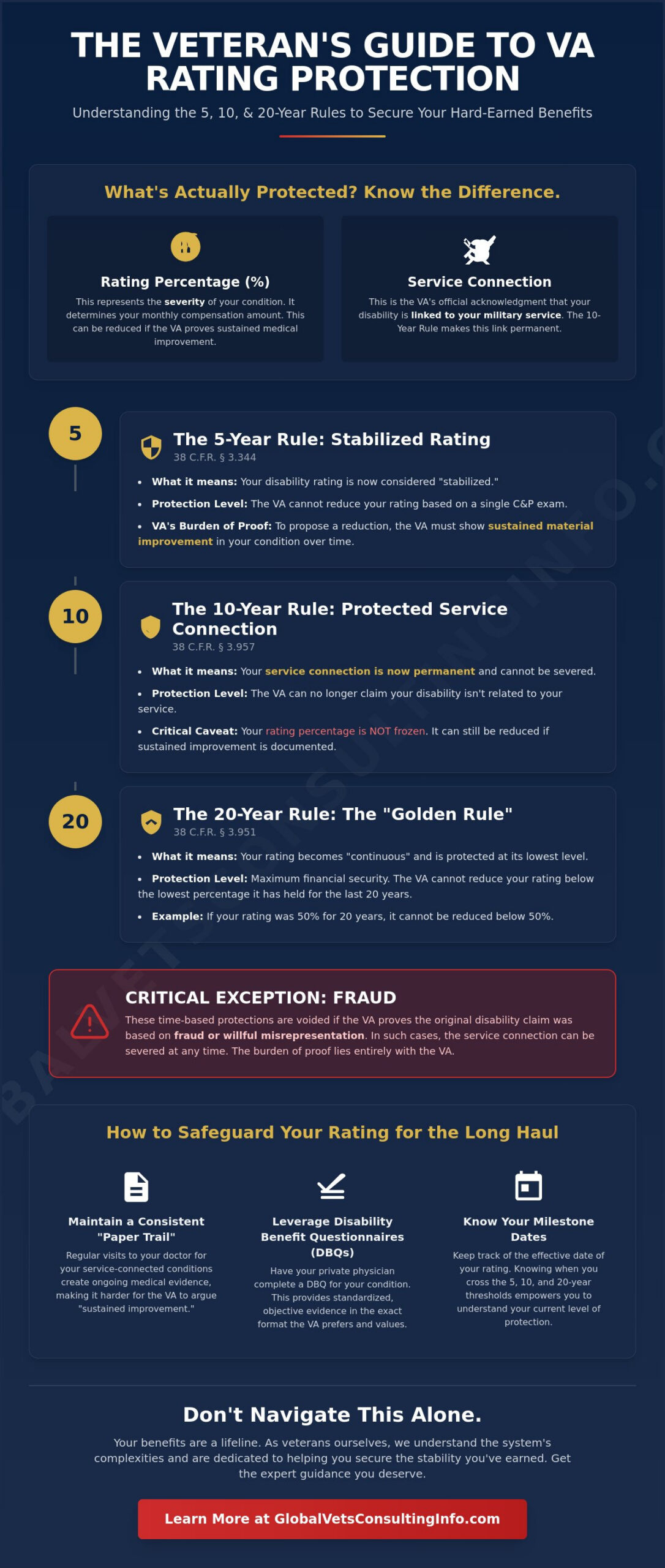
Even after 10 years, your rating percentage isn’t entirely “locked in.” The VA can still propose a reduction if they demonstrate sustained medical improvement. For example, if you’re rated at 50% for a condition but a new exam shows your symptoms have decreased significantly, the VA could try to drop you to 30%. While they can’t take away the service connection entirely, they can still adjust the severity level. This is why maintaining a consistent paper trail of medical evidence remains necessary even after a decade of benefits.
The Fraud Exception: When the 10-Year Rule Doesn’t Apply
Protection isn’t absolute. If the VA finds evidence of fraud or “willful misrepresentation” in your original claim, the 10-year rule won’t protect you. If a veteran intentionally lied about their service history or symptoms to secure a rating, the VA has the authority to sever that connection at any time. Fortunately, the VA carries the burden of proof in these cases. They must prove fraud occurred; you don’t have to prove your innocence unless they present compelling evidence of dishonesty.
The 5, 10, and 20-Year Rules: A Comparison of Rating Protections
The VA doesn’t grant total security all at once. Instead, they use a tiered system of protection that rewards the longevity of your claim. This process begins with the 5-year rule, which classifies your rating as “stabilized.” At this point, the VA can’t reduce your percentage based on a single exam; they must prove your condition has improved over time through a sustained medical history. This rule is found in 38 C.F.R. § 3.344 and serves as your first major hurdle toward permanent benefits.
While we’ve discussed what is the va 10 year rule as the milestone for permanent service connection, the journey doesn’t end there. The 10-year mark ensures they can’t cut your connection, but the 20-year rule is the “Golden Rule” of the system. Once you hit 20 years, your rating percentage becomes continuous under 38 C.F.R. § 3.951. Unless fraud is involved, the VA cannot reduce the rating below the lowest level it has held during that two-decade period, providing the highest level of financial security.
The VA Disability Compensation program uses these rules to provide a predictable path for veterans. By understanding these tiers, you can better anticipate how the VA views your file. Each milestone adds a new layer of defense against unexpected administrative changes, creating a ladder of protection that safeguards your benefits over time.
Stabilized Ratings and the ‘Material Improvement’ Standard
To reduce a stabilized rating, the VA must meet the “material improvement” standard. This isn’t just a minor change in your symptoms. It requires clear evidence that your ability to function in daily life or work has significantly and permanently improved. If your medical records show consistent symptoms and ongoing treatment, it’s much harder for the VA to justify a reduction. Maintaining your current rating percentage depends on your ability to document your condition’s persistence through regular medical visits.
Navigating the Path to 20-Year Permanence
Reaching the 20-year mark requires a long-term strategy. You should monitor your rating effective dates closely to ensure you aren’t hit with a reduction just before a milestone. Reviewing the VA disability claims process step by step can help you stay organized. If you’re concerned about an upcoming re-examination, our team at Global Vets Consulting provides educational resources to help you prepare your evidence properly and protect your hard-earned benefits.
How to Safeguard Your Rating Against VA Reductions and Re-examinations
Re-examinations are often the biggest source of stress for veterans. Even if you understand what is the va 10 year rule, you might still receive a notice for a Routine Future Exam (RFE). The VA schedules these when they believe a condition has a high likelihood of improvement. To protect your rating, you must maintain “Continuous Medical Evidence” in your file. This means seeing your doctor regularly even when your symptoms aren’t flaring up. If you stop seeking treatment, the VA may assume you’ve recovered.
Keeping a personal symptom log is a powerful way to support your claim. Share these notes with your medical providers so they can be entered into your official records. When you go into a C&P exam, this documentation serves as your shield. You aren’t just telling the examiner how you feel that day; you’re providing a historical record of your struggle. This consistency makes it much harder for the VA to justify a reduction.
Conditions Most Likely to be Re-evaluated
Certain conditions are flagged for re-evaluation more than others. Cancers in remission or mental health conditions like PTSD are frequently scheduled for RFEs because the VA views them as “subject to improvement.” In contrast, conditions labeled as “Permanent and Total” (P&T) are generally exempt. Understanding your specific designation helps you stay ahead of the curve. While the protections in 38 C.F.R. § 3.957 secure your service connection after a decade, they don’t stop the VA from checking if your symptoms have lessened.
Your Rights During a VA Rating Reduction Proposal
If you receive a proposal to reduce your rating, you have specific legal rights. You have a 60-day window to submit new evidence and a 30-day window to request a hearing. This period is critical for gathering updated medical records or DBQs that prove your condition remains severe. We believe in the “Veterans Helping Veterans” spirit. You don’t have to face this bureaucratic process alone.
If you’re worried about an upcoming exam, our C&P examination preparation education can help you understand what to expect and how to present your medical evidence clearly to protect your benefits.
Strengthening Your Medical Evidence: How DBQs Support Long-Term Ratings
The legal protections we’ve discussed provide a safety net, but medical evidence is what keeps that net from tearing. While understanding what is the va 10 year rule gives you confidence in your service connection, a Disability Benefits Questionnaire (DBQ) provides the standardized data the VA requires to justify your current rating level. These forms are designed to capture the exact severity of your symptoms in a format that VA raters can easily process, reducing the risk of administrative errors or overlooked details.
Relying solely on a standard C&P exam can be risky. These exams are often brief and may not capture the full scope of a chronic condition that fluctuates over time. Obtaining a private DBQ allows you to work with a provider who can take the time to document your medical history thoroughly. This proactive approach ensures that your file reflects the reality of your daily life, making it much harder for the VA to claim you’ve experienced “material improvement.”
The Role of Private DBQs in Maintaining Your Rating
Standardized evidence is especially critical for conditions that the VA frequently re-evaluates. For instance, using a DBQ for mental health conditions can show the VA that your symptoms remain persistent and impactful, even after years of treatment. Additionally, learning how to use a DBQ for a VA disability rating increase can help you secure higher benefits while your 10-year clock continues to run toward permanent protection.
Partnering with Global Vets Consulting for Your Documentation Needs
Global Vets Consulting operates with a “Veterans Helping Veterans” mission. We understand the stress of navigating this system because we’ve seen the challenges firsthand. Global Vets Consulting specializes in professional DBQ preparation to ensure your medical status is accurately reflected in your VA file. We streamline the process of gathering the necessary medical evidence for veterans nationwide 🌐.
Don’t wait for a reduction proposal to arrive in the mail. Securing your evidence today is the best way to ensure your financial stability for the long haul. If you have questions about your current rating or need help preparing for a re-examination, reach out to us for support.
- 🇺🇸 Website: GlobalVetsConsultingInfo.com
- 📞 24/7 National Client Services Hotline: Call us anytime for assistance
- 🌎 Service Area: Worldwide support for all U.S. Veterans
Take Control of Your VA Disability Rating Today
Mastering the details of what is the va 10 year rule is a vital step toward safeguarding your financial future. You’ve earned these benefits through your service, and reaching this decade-long milestone provides critical protection for your service connection. However, your monthly compensation still relies on the strength of your medical evidence. Maintaining a consistent record of your symptoms ensures that the VA has a clear, accurate picture of your health during any administrative review or re-examination.
We are a veteran-owned and operated team dedicated to helping our peers navigate the complexities of the VA system. With nationwide support for all disability claims and a 24/7 AI Veteran Intake Specialist available, we make it easy to gather the documentation you need. Don’t leave your stability to chance or wait for a reduction proposal to take action. Secure your medical evidence now to protect what you’ve worked so hard to achieve.
Secure Your VA Benefits—Get Your DBQ Documentation Started with Global Vets Consulting Today!
You stood the watch for our country; now let us help you stand your ground. 🇺🇸
Frequently Asked Questions
Can the VA reduce my 100% P&T rating after 10 years?
No, the VA generally does not re-evaluate 100% P&T ratings unless you open a new claim or there is evidence of fraud. While the 10-year rule protects the service connection itself, your Permanent and Total status removes the requirement for routine future exams. You should still maintain your medical records to show your condition remains severe, but the VA typically considers these ratings closed to further review.
What is the difference between the 10-year rule and the 20-year rule?
The 10-year rule protects the service connection from being severed, while the 20-year rule makes the rating percentage permanent. Under the 10-year rule, the VA cannot say your injury isn’t service connected, but they can still reduce the percentage if they find medical improvement. After 20 years, they cannot reduce the percentage at all. This comparison is key to understanding what is the va 10 year rule in the context of long term security.
Does the 10-year rule apply to my dependents’ benefits?
Yes, the 10-year rule indirectly supports your dependents by ensuring the service connection remains intact for survivor benefits like DIC. If a veteran has been service connected for 10 years or more, the VA cannot sever that connection after their death except in cases of fraud. This legal protection ensures your family has a clearer path to the benefits they’ve earned through your service and sacrifice.
Can the VA sever my service connection for a condition I’ve had for 12 years?
No, the VA cannot sever a service connection that has been in place for 12 years unless the original rating was based on fraud. Once you pass the 10-year milestone, your service connection is legally protected under federal regulations. While the VA might still attempt to reduce your rating percentage if your health improves, the fact that the condition is service connected is permanent and cannot be overturned.
How do I know if my VA disability rating is ‘protected’?
You can determine if your rating is protected by checking the effective date on your award letter and looking for specific designations. Protection happens in stages: five years for stabilization, 10 years for service connection protection, and 20 years for percentage permanence. Understanding what is the va 10 year rule helps you track these milestones. You should also check if your rating is labeled Permanent and Total, which typically exempts you from routine future exams.

Article by
Willie Daniel
Willie Daniel is the Founder and Chief Executive Officer (CEO) of Global Vets Consulting (GVC) – National Veterans Disability Services, a veteran-led educational and medical evidence support organization dedicated to helping veterans better understand VA disability rating increases, DBQ medical evidence, secondary claims education, and C&P examination preparation.
He is a retired U.S. Army Medical Service Corps Officer with more than 27 years of honorable military service, a decorated Iraq combat veteran, and a retired federal official with the U.S. Department of Veterans Affairs. Throughout his military and federal career, Willie Daniel served in leadership, healthcare administration, operational, and veteran-support roles focused on improving services and support systems for servicemembers, veterans, and their families.
Drawing from decades of military leadership, healthcare administration, veteran advocacy, and federal government experience, Willie Daniel brings a practical, veteran-centered perspective to Global Vets Consulting’s educational articles, AI-powered veteran resources, video education initiatives, and outreach programs. His experience navigating military systems, medical documentation processes, and veteran-related administrative operations provides valuable insight into many of the challenges veterans face when seeking to better understand VA disability rating criteria, medical evidence, documentation strategies, and secondary condition education.
Through GVC’s “Veterans Helping Veterans” mission, his focus is on delivering clear, educational, and easy-to-understand information designed to empower veterans with knowledge, resources, and educational tools that may help them make more informed decisions regarding their individual VA disability journeys.
The information provided through GVC is intended for educational and informational purposes only and should not be considered legal or medical advice.
Disclaimer
Disclaimer: Global Vets Consulting, LLC (“GVC”) is a veteran-led educational and medical evidence support organization. GVC is not a law firm, is not a Veterans Service Organization (VSO), and is not affiliated with the U.S. Department of Veterans Affairs (VA) or any government agency.
Global Vets Consulting does not provide legal advice, medical advice, medical treatment, or healthcare services. GVC does not prepare, file, or submit VA disability claims on behalf of veterans. All information provided through this website, blog articles, videos, educational materials, AI tools, dashboards, templates, and communications is intended solely for general educational and informational purposes.
Veterans are encouraged to consult with accredited representatives, licensed attorneys, qualified medical providers, or Veterans Service Organizations regarding their specific legal, medical, or VA-related matters. VA disability decisions, ratings, and outcomes are determined solely by the U.S. Department of Veterans Affairs based on applicable laws, regulations, medical evidence, and individual circumstances. Past results do not guarantee future outcomes.