

Imagine reaching a point where the VA can no longer reduce your disability rating, regardless of how many times they update their rating schedules or change their internal policies. For many veterans, the fear of an unexpected reduction or a stressful re-examination for a stable condition is a constant source of anxiety. You’ve likely spent years worrying about complex VA math or wondering if your next C&P exam will result in a lower monthly payment. Many veterans ask, what is the va 20 year rule, and how does it actually function as a permanent shield for your hard-earned benefits?
We understand that navigating the VA system feels like a long journey where the rules can shift without warning, such as the medication rule changes seen in early 2026. That’s why we’re here to help you understand how 38 C.F.R. § 3.951(b) provides the ultimate peace of mind once your rating has been in effect for 20 years. This article explains how this rule protects your compensation from everything except proven fraud. You’ll learn how to calculate your specific protection date and discover a clear strategy to maintain the medical evidence necessary to safeguard your rating until you reach this critical milestone.
- Learn exactly what is the va 20 year rule and how it prevents the VA from reducing a disability rating that has been active for two decades.
- Understand how the 20 year clock starts on the effective date of each specific rating level, meaning different conditions may reach protection at different times.
- Identify the limited exceptions to this rule, primarily focusing on cases where the VA can prove a rating was originally obtained through intentional fraud.
- Discover how to use medical evidence and private DBQs to protect your current rating during C&P exams while you wait for your 20 year milestone.
Understanding the VA Disability 20-Year Rule (38 C.F.R. § 3.951)
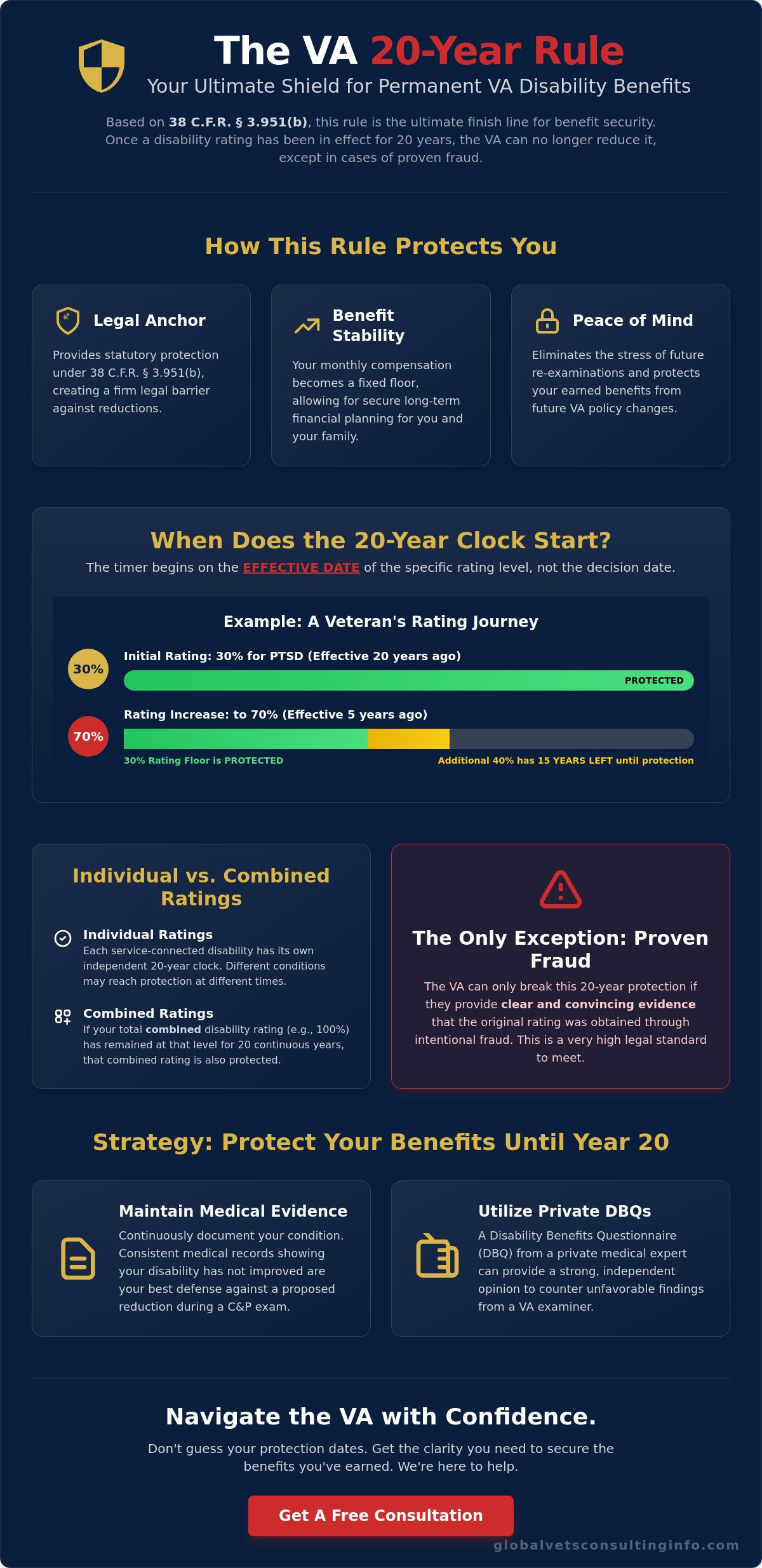
The 20-year rule is the ultimate finish line for veteran benefit security. Once your disability rating has been in effect for two decades, the U.S. Department of Veterans Affairs considers it continuous and permanent. You might wonder, what is the va 20 year rule in a legal sense? It’s a federal mandate that stops the VA from lowering your rating unless they can prove fraud. This regulation provides the highest level of protection available in the VA system.
🇺🇸 Key Elements of the 20-Year Rule:
- Legal Anchor: 38 C.F.R. § 3.951(b) provides the specific statutory protection for your rating.
- Benefit Stability: Your monthly compensation becomes a fixed floor for your long-term financial planning.
- Gold Standard: This rule ensures that your earned outcomes are shielded from future policy shifts.
Continuous vs. Protected Ratings
In the VA system, continuous means your rating hasn’t dropped for the full 20-year period. This creates a firm legal barrier that protects your hard-earned benefits from downward adjustments.
- 🌐 Legal Shield: The VA cannot cross this line to reduce your pay based on new medical evidence or updated rating schedules.
- 🇺🇸 Permanent Status: Once you reach this milestone, the VA essentially recognizes your condition as permanent for compensation purposes.
Why This Rule Matters for Your Peace of Mind
Reaching this milestone eliminates the constant worry of future reductions. It allows you to focus on your health and your family without the threat of unexpected paperwork or re-examinations. Understanding what is the va 20 year rule helps you transition from a defensive mindset to a place of long-term security for yourself and your survivors. It provides a reliable income stream that you can count on for the rest of your life.
When Does the 20-Year Protection Timer Actually Start?
The 20-year clock begins on the effective date of the specific rating level assigned by the VA. This date is critical because it marks the official start of your journey toward permanent protection. If you received retroactive pay for a claim, your 20-year timer might be further along than you realize. The legal framework found in 38 C.F.R. § 3.951 confirms that the clock begins on the effective date, not the date the decision was mailed or when you received your first payment. Understanding what is the va 20 year rule in the context of your specific timeline helps you identify exactly when your benefits become untouchable.
The Impact of Rating Increases
It’s vital to remember that each rating level has its own independent timer. If your rating has fluctuated over the years, the clock doesn’t reset for the entire condition, only for the new increase. For example, if you were rated at 30% for 20 years and then received a VA rating increase to 70% five years ago, your 30% floor is protected. However, the additional 40% won’t reach protected status for another 15 years. Tracking these staggered dates is essential for long-term planning.
Does the Rule Apply to Combined Ratings?
This is a common point of confusion when veterans ask what is the va 20 year rule. The protection also applies to your combined disability rating. If your total combined rating has stayed at 100% for 20 years, that 100% level is legally protected even if the individual percentages for your conditions changed during that time. To ensure you have the most accurate picture of your status, we recommend organizing your records by these specific dates:
- 🇺🇸 Locate the effective date for every service-connected condition.
- 🇺🇸 Identify any ratings that have remained unchanged for 20 years.
- 🇺🇸 Note the effective date of your current combined rating.
If you’re feeling overwhelmed by the paperwork or unsure of your specific protection dates, seeking veteran benefits education can provide the clarity you need to move forward with confidence.
Exceptions to the Rule: When Your Rating Isn’t Protected
While 38 C.F.R. § 3.951 offers a massive shield, it isn’t entirely perfect. The VA can only break your protection if they prove the original rating was based on fraud. This is a high legal bar that requires the VA to provide clear evidence of deliberate deception. Understanding what is the va 20 year rule in terms of these limits helps you stay compliant and secure.
🇺🇸 Key Risks to Your Rating Protection:
- Intentional Fraud: Falsifying medical records or misrepresenting symptoms during the VA disability claims process.
- Burden of Proof: The VA must demonstrate a deliberate attempt to deceive, not just a simple medical disagreement.
- High Threshold: Reductions are rare after 20 years because the legal requirements for the VA are so strict.
The ‘Danger Zone’: Years 1 through 19
You are most vulnerable to rating reductions before hitting the 20-year milestone. During this period, the VA can still schedule routine future exams (RFEs) to check for condition improvement.
- 🌐 Partial Protection: The 5-year and 10-year rules offer some stability but lack the absolute shield of the 20-year rule.
- 🇺🇸 Re-exam Anxiety: Scheduled exams can result in a proposal to reduce if medical evidence shows your condition has improved.
- 🌐 Evidence Maintenance: Consistent documentation is required to defend your rating until it reaches protected status.
What the VA Considers ‘Fraud’
Fraud involves a deliberate attempt to gain benefits through dishonesty. It’s essential to provide honest, thorough documentation from your very first DBQ for mental health or physical condition. This meticulousness protects you from future scrutiny and helps you reach the 20-year mark safely.
🇺🇸 Static vs. RFE Status:
- Static Disabilities: These are conditions the VA deems permanent, often removing the need for future exams.
- Routine Future Exams: These disabilities are expected to improve and require regular re-evaluations.
If you’re unsure if your conditions are listed as static, it’s time to take control of your file. Contact Global Vets Consulting today to review your status and build a strategy for permanent protection. Knowing what is the va 20 year rule for your specific ratings is the first step toward long-term peace of mind.
How Medical Evidence Protects Your Benefits Until Year 20
Reaching the 20-year milestone is a marathon, not a sprint. To cross that finish line, you must successfully defend your rating during any scheduled C&P examinations the VA might trigger. Consistent medical evidence is your best deterrent against a VA proposal to reduce your rating. Understanding what is the va 20 year rule is only half the battle; the other half is maintaining a proactive defense of your benefits during the years when you’re most vulnerable to re-examinations. Global Vets Consulting provides the high-quality medical documentation needed to substantiate the severity of your conditions, ensuring your file is never left to chance.
The Power of the Disability Benefits Questionnaire (DBQ)
A properly completed DBQ is a veteran’s most effective shield because it mirrors the VA’s own rating criteria, leaving no room for interpretation by raters. DBQs are the primary tool used by the VA to determine if a condition has improved or stayed the same during a review. By using a private DBQ for a VA disability rating increase or maintenance, you ensure your symptoms are accurately documented by a professional who listens to your story. This level of technical accuracy makes it much harder for the VA to justify a reduction in your compensation.
Taking Control of Your Evidence Today
Waiting for the VA to schedule an exam often puts you at a disadvantage, as you’re forced into a reactive position. Taking control of your medical evidence today allows you to frame the narrative of your health with precision. Global Vets Consulting specializes in streamlining the medical evidence gathering process, helping you build a file that stands up to scrutiny. Don’t leave your financial security to a random exam date. We’re ready to help you navigate the system with confidence and expertise.
- 🇺🇸 Global Vets Consulting: Worldwide Support
- 🌐 Website: GlobalVetsConsultingInfo.com
- 🤖 Immediate Help: Connect with our 24/7 AI Veteran Intake Specialist today
Securing your future means acting before the VA sends a reduction letter. Whether you’re at year five or year fifteen, knowing what is the va 20 year rule and having the evidence to back it up is the only way to ensure total peace of mind.
Secure Your Financial Future and Earned Benefits
Navigating the path to permanent protection doesn’t have to be a solo mission. By understanding what is the va 20 year rule, you have identified the ultimate finish line for your disability benefits. Now, the focus shifts to maintaining the professional documentation needed to reach that 20-year mark without a reduction. Whether you are tracking effective dates or defending a stable rating during a C&P exam, having a reliable partner ensures your symptoms are never minimized by the system.
🇺🇸 Global Vets Consulting: Worldwide Support
- 🌐 Website: Get the medical evidence you need to protect your rating—Contact Global Vets Consulting
- 📞 24/7 National Client Services Hotline: Connect with us anytime for immediate assistance.
- 🇺🇸 Veteran-Owned & Operated: Serving the community since 2021 with specialized DBQ preparation.
You’ve already done the hard work of serving our country. Now, let us help you protect the benefits you’ve earned. We are committed to providing the technical accuracy and supportive guidance required to secure your financial future for the long haul. Stay proactive, stay informed, and move forward with steady confidence.
Frequently Asked Questions
Can the VA reduce a 100% P&T rating after 20 years?
The VA cannot reduce a 100% P&T rating once it has been in effect for 20 years, except in cases of proven fraud. While P&T status already indicates your conditions aren’t expected to improve, the 20-year rule provides a statutory shield that prevents the VA from even attempting a reduction. This creates a double layer of security for your monthly compensation and your family’s long-term financial stability.
What is the difference between the 5, 10, and 20-year rules?
These rules offer increasing levels of protection based on the time your rating has been active. The 5-year rule prevents a reduction based on a single medical exam if the rating is stabilized. The 10-year rule protects the service connection itself from being severed. Understanding what is the va 20 year rule is vital because it’s the only regulation that makes the specific rating percentage permanent and untouchable.
Does the 20-year rule apply if my condition improves?
Yes, the 20-year rule applies even if your medical condition shows signs of improvement after the milestone is reached. Once you hit this 20-year mark, the VA is legally barred from reducing your rating level based on medical changes. This is why the rule is considered the ultimate protection for veterans. It ensures your compensation remains steady regardless of how your health fluctuates as you age.
How do I find the effective date for my 20-year timer?
You can find your effective date by reviewing your VA Rating Decision letters or requesting a copy of your “Codesheet” from your C-File. The timer for each specific rating level starts on its individual effective date, not necessarily the date the claim was filed. If you’ve received multiple increases over the years, you will have several different 20-year timers running simultaneously for each condition in your file.
Can the VA re-examine me after I’ve had my rating for 20 years?
The VA generally stops all routine future examinations once a rating reaches the 20-year mark. Since the rating is legally protected from reduction, there is no administrative reason for the VA to waste resources on a re-exam. However, if you file a new claim for a secondary condition, the VA may still review your records. Knowing what is the va 20 year rule helps you understand that while your protected rating is safe, new claims always invite a fresh look at your evidence.

Article by
Willie Daniel
Willie Daniel is the Founder and Chief Executive Officer (CEO) of Global Vets Consulting (GVC) – National Veterans Disability Services, a veteran-led educational and medical evidence support organization dedicated to helping veterans better understand VA disability rating increases, DBQ medical evidence, secondary claims education, and C&P examination preparation.
He is a retired U.S. Army Medical Service Corps Officer with more than 27 years of honorable military service, a decorated Iraq combat veteran, and a retired federal official with the U.S. Department of Veterans Affairs. Throughout his military and federal career, Willie Daniel served in leadership, healthcare administration, operational, and veteran-support roles focused on improving services and support systems for servicemembers, veterans, and their families.
Drawing from decades of military leadership, healthcare administration, veteran advocacy, and federal government experience, Willie Daniel brings a practical, veteran-centered perspective to Global Vets Consulting’s educational articles, AI-powered veteran resources, video education initiatives, and outreach programs. His experience navigating military systems, medical documentation processes, and veteran-related administrative operations provides valuable insight into many of the challenges veterans face when seeking to better understand VA disability rating criteria, medical evidence, documentation strategies, and secondary condition education.
Through GVC’s “Veterans Helping Veterans” mission, his focus is on delivering clear, educational, and easy-to-understand information designed to empower veterans with knowledge, resources, and educational tools that may help them make more informed decisions regarding their individual VA disability journeys.
The information provided through GVC is intended for educational and informational purposes only and should not be considered legal or medical advice.
Disclaimer
Disclaimer: Global Vets Consulting, LLC (“GVC”) is a veteran-led educational and medical evidence support organization. GVC is not a law firm, is not a Veterans Service Organization (VSO), and is not affiliated with the U.S. Department of Veterans Affairs (VA) or any government agency.
Global Vets Consulting does not provide legal advice, medical advice, medical treatment, or healthcare services. GVC does not prepare, file, or submit VA disability claims on behalf of veterans. All information provided through this website, blog articles, videos, educational materials, AI tools, dashboards, templates, and communications is intended solely for general educational and informational purposes.
Veterans are encouraged to consult with accredited representatives, licensed attorneys, qualified medical providers, or Veterans Service Organizations regarding their specific legal, medical, or VA-related matters. VA disability decisions, ratings, and outcomes are determined solely by the U.S. Department of Veterans Affairs based on applicable laws, regulations, medical evidence, and individual circumstances. Past results do not guarantee future outcomes.