
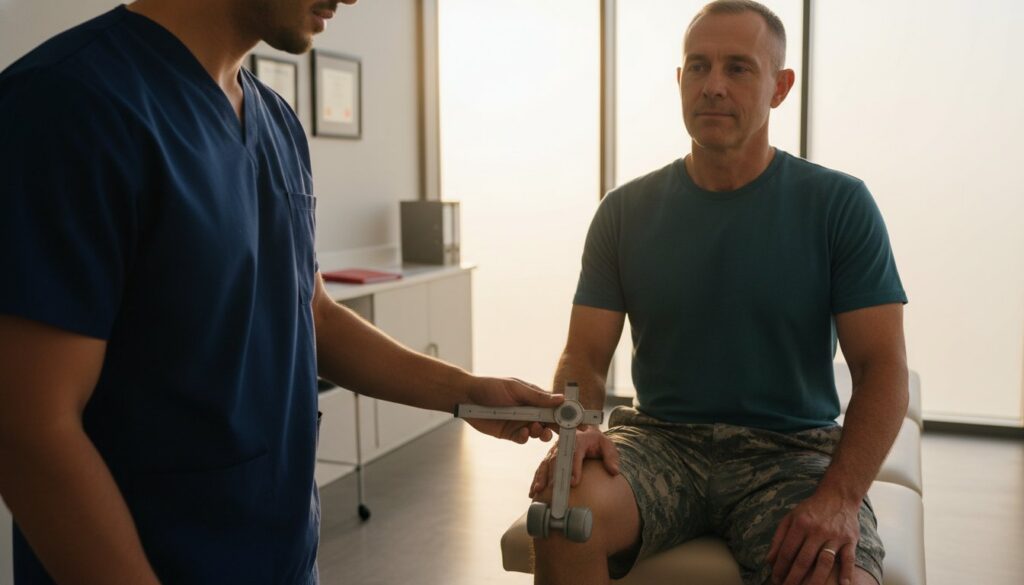
Your VA rating for knee flexion isn’t actually based on how far you can bend your leg on a good day, but rather on how your movement fails during your worst flare-ups. It’s common to feel anxious that a C&P examiner might rush through your range of motion test, resulting in a rating that misses the mark. You’ve earned the right to a fair evaluation that accounts for your daily pain and mobility struggles. This guide shows you how to accurately document your condition on a dbq for limitation of knee flexion so you can secure the VA disability rating you deserve.
We will explore how Diagnostic Code 5260 works and explain why objective measurements are the key to a successful claim. You’ll find a clear breakdown of the 2026 compensation rates, where a 30% rating for flexion limited to 15 degrees now provides $552.47 monthly. We also preview the latest requirements for VA Form 21-0960M-9 to help you build a case that survives VA scrutiny. By understanding the process, you can move forward with a predictable path toward the benefits that support your quality of life.
Key Takeaways
- Master the specific measurement thresholds under Diagnostic Code 5260 to predict your disability rating with greater accuracy.
- Learn how to use a dbq for limitation of knee flexion to document functional loss and ensure your rating accounts for your inability to perform daily tasks.
- Understand the “Worst Day” principle and how to ensure your examiner properly estimates your range of motion during painful flare-ups.
- Discover why private medical evidence can offer a more comprehensive and meticulous view of your condition compared to a rushed C&P examination.
Understanding the VA Rating for Limitation of Knee Flexion
The VA evaluates your ability to bend your leg using Diagnostic Code 5260. This code focuses specifically on “limitation of flexion,” which is the clinical term for how much you can pull your heel toward your thigh. During your C&P exam, the provider uses a tool called a goniometer to measure your Range of motion. These measurements are then recorded on the dbq for limitation of knee flexion to determine your monthly compensation level.
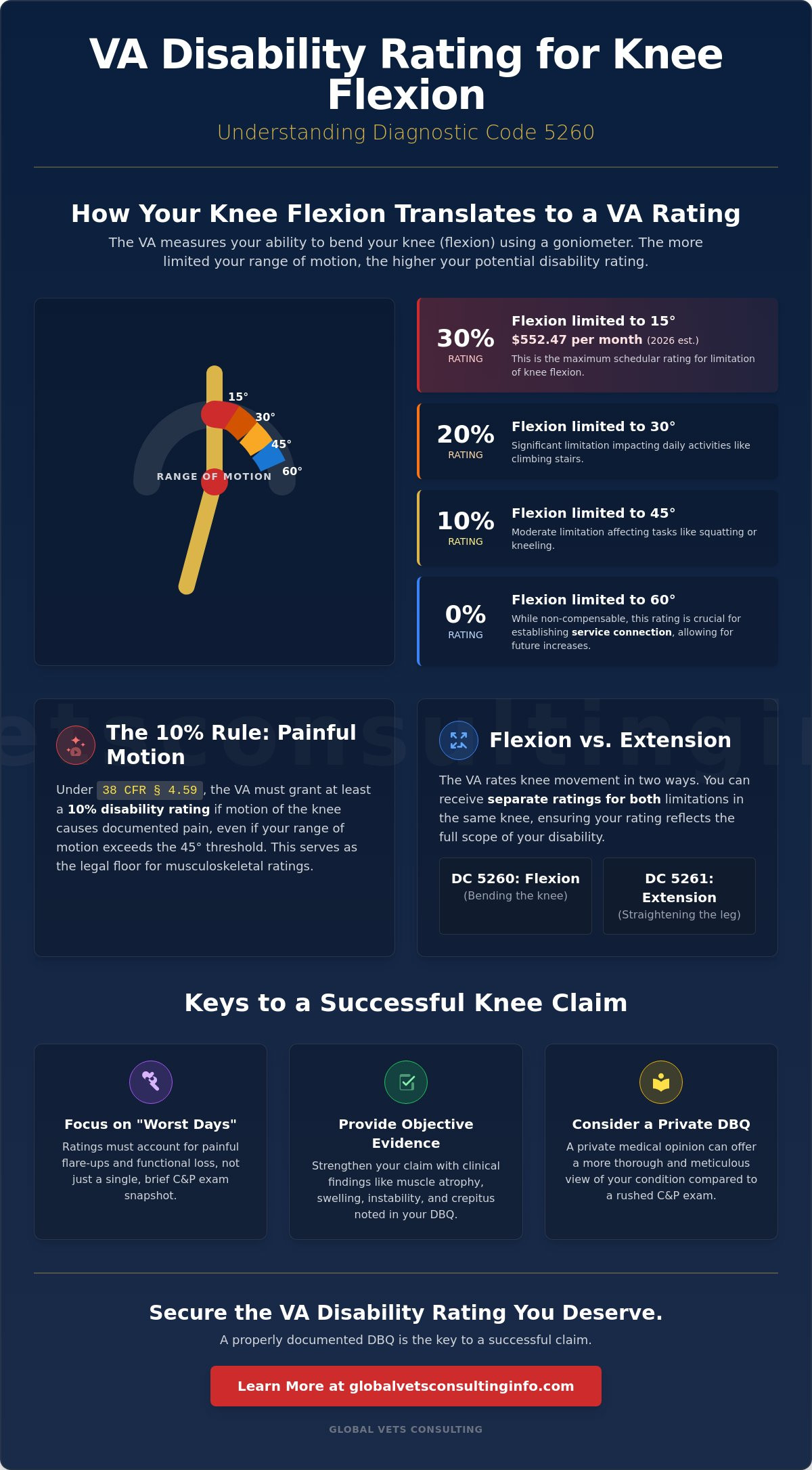
The rating scale is built on specific thresholds of movement. If your flexion is limited to 15 degrees, you qualify for a 30% rating. A limit of 30 degrees results in a 20% rating, while a limit of 45 degrees warrants 10%. If your movement is limited to 60 degrees, the VA assigns a 0% rating. While a 0% rating doesn’t result in a monthly check, it’s a vital win because it officially establishes service connection. This makes it much easier to apply for an increase later if your condition worsens or to link secondary conditions to your knee injury.
The 10% Rule: Pain with Motion
Many veterans worry they’ll receive nothing if their knee still bends relatively well. However, 38 CFR § 4.59 dictates that the VA must acknowledge painful motion as a disability. Pain with motion serves as the legal floor for musculoskeletal ratings, ensuring you receive at least a 10% rating if movement causes documented discomfort. It’s essential that your provider checks the “pain” box on the dbq for limitation of knee flexion, even if your degrees of movement appear normal during the test.
Diagnostic Code 5260 vs. 5261
It’s helpful to distinguish between the two primary ways the VA rates knee movement. DC 5260 applies to flexion, or bending the knee, while DC 5261 applies to extension, which is your ability to straighten your leg. You can actually receive separate ratings for both flexion and extension in the same knee. This approach ensures your disability rating reflects the full scope of your physical limitations rather than just one direction of movement.
The Anatomy of a Knee Flexion DBQ
Understanding the specific sections of the official Disability Benefits Questionnaire (DBQ) for knee conditions is essential for a successful claim. The form, officially known as VA Form 21-0960M-9, acts as a roadmap for the examiner to document your physical limitations. While the degrees of movement are central, the form also requires details on your medical history, diagnostic testing, and the overall impact on your health. To ensure your dbq for limitation of knee flexion is thorough, you must ensure every section accurately reflects your daily struggle with mobility.
The “Remarks” section is perhaps the most powerful tool in your medical documentation. This area allows your physician to go beyond the checkboxes and provide a detailed narrative. It’s the ideal space to link your current knee condition to your service history or explain how compensatory movements have led to secondary issues. A well written remarks section provides the context that raw data points often lack.
Documenting Functional Loss and Impairment
The VA’s definition of disability rests on the loss of working capacity, as outlined in 38 CFR § 4.40 and § 4.45. This means your rating shouldn’t just reflect a number on a goniometer. It must account for functional loss. If your knee “gives way,” feels weak, or lacks stability during normal activities, these are clinical signs of impairment. If you’re unsure how to communicate these limitations, musculoskeletal claims education can help you identify the specific terms that resonate with VA standards.
Clinical Findings vs. Subjective Complaints
Success requires that your subjective reports of pain align perfectly with objective clinical findings. Examiners look for physical evidence like muscle atrophy, swelling, or crepitus (grating sounds in the joint) to support your claims. When your doctor documents these observable signs on the dbq for limitation of knee flexion, it creates a high level of credibility. This objective evidence serves as the foundation for a rating that reflects your actual physical state.
Capturing Flare-Ups and Range of Motion Patterns
A C&P exam is often just a brief snapshot in time. However, your knee doesn’t function the same way every day. The VA’s legal standard for rating requires the examiner to account for your “worst day” through the principle of functional loss. If you aren’t currently experiencing a flare-up during your appointment, the provider is required to estimate your functional loss based on your medical history and reported symptoms. This estimation is a critical part of a dbq for limitation of knee flexion, as it ensures your rating reflects your actual level of impairment rather than a temporary moment of comfort.
According to the VA’s Schedule of Ratings, the severity of your condition is judged by how much your movement is restricted. Pushing through the pain during a range of motion test is a frequent mistake that can result in an inaccurately low rating. You should stop moving the moment you feel pain, discomfort, or resistance. This allows the examiner to record the exact point where your functional movement ends, which is essential for an honest evaluation.
The Repetitive Motion Test
Examiners are required to test your range of motion after at least three repetitions to see if your movement decreases with use. This test reveals how repetitive motion leads to fatigue, weakness, or increased pain throughout the day. If you’re new to this process, reading our guide on What is a DBQ? can provide the foundational context you need to understand these requirements. Documenting decreased endurance after repeated bending is often the evidence needed to move into a higher rating bracket.
Estimating Functional Manifestations
The form includes specific questions regarding weakness and a lack of endurance. If an examiner checks “not indicated” or “cannot determine” without a valid reason, it can significantly weaken your claim. You must be vocal about how your knee behaves after a long day of standing or walking. Providing a clear picture of these functional manifestations helps ensure the dbq for limitation of knee flexion serves as a reliable piece of evidence. To feel more confident before your appointment, you can explore our C&P examination preparation education to learn how to communicate your symptoms effectively.
Private DBQ vs. C&P Exam: Securing Accurate Evidence
Many veterans find the standard C&P exam frustrating because it often feels rushed and impersonal. A typical examiner might only spend 15 to 20 minutes with you, which is rarely enough time to capture the nuances of chronic pain and the range of motion patterns we discussed in previous sections. This time constraint can lead to “provider bias,” where the examiner relies on a single, quick measurement rather than a comprehensive assessment of your physical reality. A private dbq for limitation of knee flexion offers a reliable alternative that ensures your limitations are documented with the care and time they deserve.
Global Vets Consulting streamlines the medical documentation process by providing specialized education on medical evidence. We help you understand how to approach your evaluation so that the resulting paperwork is both thorough and compliant with VA standards. Bringing your own evidence to the table shifts the dynamic of your claim from a passive hope for accuracy to an active demonstration of your physical state. This meticulous approach builds a foundation of trust and clarity that is difficult for the VA to overlook.
Preventing Denials with Meticulous Documentation
An Independent Medical Opinion (IMO) serves as a vital companion to your dbq for limitation of knee flexion. While the DBQ records your current physical state, an IMO provides the clinical reasoning that connects your knee limitations to your military service. If you already have a service connection but find your mobility is decreasing, you can learn how to use a DBQ for a VA disability rating increase. Closing the evidence gap before the VA makes a decision is the most effective way to prevent a low rating or a total denial.
Next Steps for Your Knee Claim
Your first step is to review your current medical records for any specific knee flexion data or mentions of functional loss. Look for recorded measurements from past physical therapy or orthopedic visits to see how they compare to the 2026 rating thresholds. After you’ve gathered your history, contacting a professional service for DBQ preparation education is a logical next move. At Global Vets Consulting, we offer veteran-owned expertise and a partnership-driven approach to help you secure the benefits you’ve earned through your service. Don’t leave your rating to a rushed exam when you can present a case built on meticulous evidence.
Take Charge of Your Knee Disability Claim
Securing a rating that reflects your actual physical struggle requires more than just showing up to an appointment. You now understand that the VA’s legal standards prioritize your worst days and functional limitations over a single, “best case” measurement. By focusing on objective clinical findings and ensuring your flare-ups are properly estimated, you build a case that stands up to scrutiny. A meticulously prepared dbq for limitation of knee flexion is the most effective tool you have to bridge the gap between your daily pain and the benefits you’ve earned.
Global Vets Consulting has been veteran-owned and operated since 2021. We specialize in musculoskeletal DBQ preparation, focusing on the level of detail necessary to prevent common VA denials. Our team understands the intricacies of the system and works as your partner to ensure your documentation is accurate and comprehensive. Get the accurate DBQ documentation your claim deserves with Global Vets Consulting. You’ve served your country with honor, and now it’s time to ensure the system works for you with the steady confidence of a well-prepared claim.
Frequently Asked Questions
What is the maximum VA rating for limitation of knee flexion?
The maximum rating is 30% under Diagnostic Code 5260. This applies when your flexion is limited to 15 degrees or less. In 2026, this translates to a monthly payment of $552.47 for a veteran with no dependents. If your knee is completely frozen, it’s rated under a different code, but for simple limitation of motion, 30% is the ceiling.
Can I get a 10% rating for knee pain even if my range of motion is normal?
Yes, you can qualify for a 10% rating based on painful motion under 38 CFR § 4.59. Even if your measurements show a full 135 to 140 degrees of movement, the examiner must document any pain you feel. This “pain with motion” rule ensures that veterans aren’t penalized for having flexible joints that still cause significant daily discomfort and functional loss.
How does the VA measure knee flexion during a C&P exam?
The examiner uses a goniometer to measure the exact angle of your knee as you bend it toward your body. They will record the point where pain begins or where movement stops, which is then entered into the dbq for limitation of knee flexion. The provider should also perform a repetitive motion test, measuring your range of motion after at least three repetitions to see if your movement decreases.
What happens if the C&P examiner doesn’t use a goniometer?
If an examiner estimates your range of motion by sight rather than using a goniometer, your exam may be considered inadequate. VA regulations require the use of this tool to ensure objective and accurate measurements. If this happens, you should document the oversight immediately. Providing a private dbq for limitation of knee flexion from your own doctor can serve as a powerful counter to a rushed or technically flawed C&P exam.
Should I get a private DBQ if I already have a C&P exam scheduled?
Submitting a private DBQ before your scheduled C&P exam is a proactive way to ensure your file contains comprehensive evidence. A private physician often has more time to document your “worst day” symptoms and functional manifestations that a brief C&P appointment might miss. This additional documentation requires the VA to consider all medical evidence, making it much harder for them to issue a denial based on a single rushed snapshot.

Article by
Willie Daniel
Willie Daniel is the Founder and Chief Executive Officer (CEO) of Global Vets Consulting (GVC) – National Veterans Disability Services, a veteran-led educational and medical evidence support organization dedicated to helping veterans better understand VA disability rating increases, DBQ medical evidence, secondary claims education, and C&P examination preparation.
He is a retired U.S. Army Medical Service Corps Officer with more than 27 years of honorable military service, a decorated Iraq combat veteran, and a retired federal official with the U.S. Department of Veterans Affairs. Throughout his military and federal career, Willie Daniel served in leadership, healthcare administration, operational, and veteran-support roles focused on improving services and support systems for servicemembers, veterans, and their families.
Drawing from decades of military leadership, healthcare administration, veteran advocacy, and federal government experience, Willie Daniel brings a practical, veteran-centered perspective to Global Vets Consulting’s educational articles, AI-powered veteran resources, video education initiatives, and outreach programs. His experience navigating military systems, medical documentation processes, and veteran-related administrative operations provides valuable insight into many of the challenges veterans face when seeking to better understand VA disability rating criteria, medical evidence, documentation strategies, and secondary condition education.
Through GVC’s “Veterans Helping Veterans” mission, his focus is on delivering clear, educational, and easy-to-understand information designed to empower veterans with knowledge, resources, and educational tools that may help them make more informed decisions regarding their individual VA disability journeys.
The information provided through GVC is intended for educational and informational purposes only and should not be considered legal or medical advice.
Disclaimer
Disclaimer: Global Vets Consulting, LLC (“GVC”) is a veteran-led educational and medical evidence support organization. GVC is not a law firm, is not a Veterans Service Organization (VSO), and is not affiliated with the U.S. Department of Veterans Affairs (VA) or any government agency.
Global Vets Consulting does not provide legal advice, medical advice, medical treatment, or healthcare services. GVC does not prepare, file, or submit VA disability claims on behalf of veterans. All information provided through this website, blog articles, videos, educational materials, AI tools, dashboards, templates, and communications is intended solely for general educational and informational purposes.
Veterans are encouraged to consult with accredited representatives, licensed attorneys, qualified medical providers, or Veterans Service Organizations regarding their specific legal, medical, or VA-related matters. VA disability decisions, ratings, and outcomes are determined solely by the U.S. Department of Veterans Affairs based on applicable laws, regulations, medical evidence, and individual circumstances. Past results do not guarantee future outcomes.

