

Did you know that as of early 2026, nearly 80% of initial migraine claims are denied despite veterans suffering from debilitating symptoms? It’s frustrating to feel like a C&P examiner rushed through your appointment, especially when you need a professional dbq for increase in migraine frequency to prove your condition has worsened. You know the pain is more frequent, but the VA’s technical definition of “prostrating” often feels like a moving target designed to keep your rating low.
You deserve a rating that reflects your daily reality. This guide provides a clear path to the 50% rating by highlighting which boxes on the DBQ matter most, including how to document “severe economic inadaptability” with precision. We’ll show you how to transform your symptoms into the professional medical evidence the VA cannot ignore. By following this methodical approach, you’ll learn how to secure the maximum compensation you’ve earned through your service and gain the peace of mind you deserve.
Key Takeaways
- Learn the specific criteria for Diagnostic Code 8100 and why the 30% threshold requires documenting at least one prostrating attack every month.
- Discover how to accurately complete a dbq for increase in migraine frequency by focusing on Section 4 to prove your increased attack rate to the VA.
- Master the use of migraine logs and buddy letters to provide the three to six months of evidence needed to demonstrate severe economic inadaptability.
- Understand why professional DBQ preparation often outperforms rushed C&P exams when you’re fighting for a 50% rating increase.
Understanding Frequency Thresholds for a Migraine Rating Increase
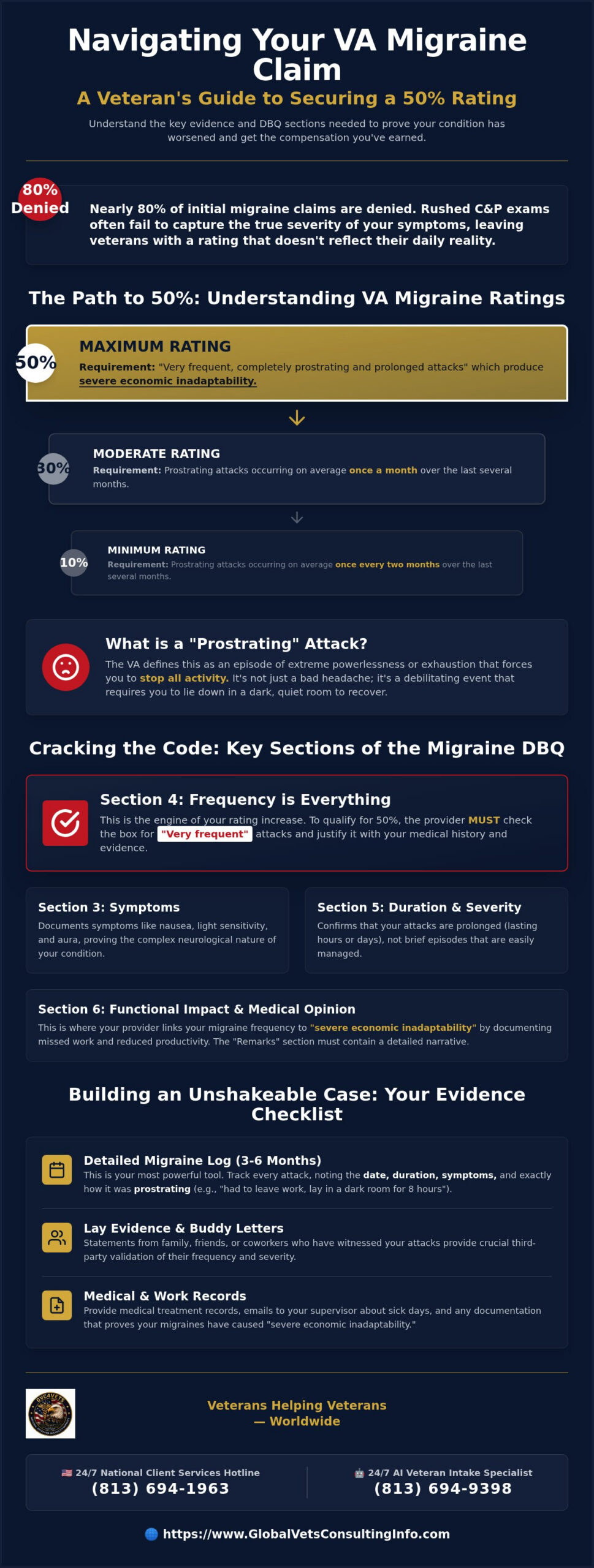
The VA evaluates migraines under Diagnostic Code 8100, which serves as the official roadmap for your rating. For many veterans, this neurological disorder worsens over time, making it necessary to submit a dbq for increase in migraine frequency. The primary factor the VA reviews is frequency. While a 10% rating requires one prostrating attack every two months, the 30% threshold demands a pattern of at least one attack per month. To reach the 50% maximum, the criteria become much stricter. You must demonstrate very frequent, completely prostrating, and prolonged attacks that result in severe economic inadaptability. This means your migraines don’t just hurt; they actively prevent you from maintaining a normal work schedule or income level.
What Counts as a ‘Prostrating’ Attack in 2026?
The VA defines a prostrating attack as one that causes extreme powerlessness and requires you to stop all activity. It’s not just a “bad headache” that you can work through with aspirin. If you have to lie down in a dark, quiet room for several hours or days to recover, that is prostrating. Your documentation must clearly distinguish these debilitating episodes from milder symptoms to satisfy the 2026 rating criteria. Examiners look for evidence that the pain is so intense it forces you to seek total isolation and rest.
The Shift from 10% to 50%: Timing Matters
Consistency is vital when filing for an increase. The VA typically looks for a sustained pattern over “several months” rather than a single bad week. If your symptoms spiked recently but haven’t persisted, the rater might view it as a temporary flare-up. Using a professional dbq for increase in migraine frequency helps you map out this timeline accurately. You need to show that your increased frequency is your new baseline. Proving that the condition’s impact on your life and work is permanent and severe is the only way to secure that 50% compensation level. It’s about showing the long-term trend, not just a snapshot of a bad day.
Key Sections of the Migraine DBQ for Increasing Your Rating
Understanding the structure of VA Form 21-0960C-8 is essential for a successful claim. Section 3 tracks specific symptoms like nausea, light sensitivity, and aura. These boxes validate the debilitating nature of the condition and prove it is a complex neurological issue. Section 5 documents the duration and severity of each episode. It confirms that your attacks are prolonged rather than brief. However, the most critical data for your dbq for increase in migraine frequency lives in the frequency and functional impact sections.
Section 4: The Frequency Checkbox Strategy
Section 4 is the engine of your increase. For a 50% rating, the medical provider must check the box for “very frequent” attacks. This choice is not a mere suggestion. The provider must justify this selection by referencing your treatment records and personal history. If the form lacks specific details on how often these prostrating attacks occur, the VA may default to a lower rating. This section must clearly state that attacks average at least once a month and are completely prostrating over a sustained period of time.
Medical Opinion and Functional Impact
Section 6 focuses on functional impact. It links your migraines to your inability to work and perform daily tasks. This is where “severe economic inadaptability” is proven through documented missed shifts or reduced productivity. The Remarks section should contain a detailed narrative. A doctor must state that the veteran’s increased frequency of prostrating attacks is at least as likely as not caused by their service-connected condition. Professional medical evidence education ensures these sections are filled out with the technical precision the VA requires. Accuracy here prevents the rater from overlooking the severity of your worsening symptoms.
Evidence Strategies to Prove Increased Frequency and Economic Impact
A successful dbq for increase in migraine frequency depends on consistent lay evidence that supports your medical records. The most effective tool is a detailed migraine log maintained for at least three to six months. This record should track the following data points:
- Frequency: Exactly how many times per month the attacks occur.
- Duration: How many hours or days each episode lasts.
- Prostrating Nature: Specific symptoms that force you into a dark room for total rest.
Presenting this data to a medical provider bridges the gap between your pain and the objective data required for a 50% rating. It’s vital to integrate this log into your claim file to build a Fully Developed Claim that the VA can’t easily ignore.
Proving Economic Inadaptability for 50%
Economic inadaptability occurs when your migraines interfere with your ability to maintain gainful employment. To secure a 50% increase, you’ve got to show the VA that your attacks are not just frequent but also prolonged. Documentation of missed work days or statements from your employer can be powerful. If your VA claim denied for lack of evidence in the past, focusing on these work-related impacts is often the missing piece.
The Role of Buddy Letters in Frequency Claims
Buddy letters provide a third-party perspective on your condition. Spouses can testify to how often you’re confined to a dark room, while coworkers can verify times you had to leave your station. 🇺🇸 If you need help organizing evidence for your dbq for increase in migraine frequency, our team at Global Vets Consulting provides the education you need. You can also reach our 24/7 National Client Services Hotline for immediate support in navigating these requirements.
Securing Your Rating Increase with Professional DBQ Preparation 🌎
Many veterans find that a standard C&P exam lasts only a few minutes; this is rarely enough time to explain the complex ways your condition has worsened. A private dbq for increase in migraine frequency offers a significant advantage because it allows for a comprehensive review of your symptoms without the pressure of a rushed government appointment. By using a private questionnaire, you ensure that the specific frequency and prostrating nature of your attacks are documented with the precision the VA requires for a 50% rating.
The Global Vets Consulting Advantage
Our approach is rooted in a “Veterans Helping Veterans” ethos. We know the system is complex, and we’re dedicated to simplifying it for you. We don’t just provide a form; we offer Independent Medical Evidence Education to help you understand exactly what the VA is looking for in a successful increase claim. Learning how to use a dbq for a va disability rating increase is essential for any veteran currently stuck at a 10% or 30% rating. We ensure every frequency checkbox is backed by the medical evidence you’ve gathered, such as your migraine logs and buddy letters.
Getting Started with Your Increase Claim
Transitioning to the 50% maximum rating requires a clear, step-by-step strategy. Our intake process is designed to reduce your anxiety and provide a predictable path forward. 🇺🇸
- Immediate Support: Contact our 24/7 AI Veteran Intake Specialist or call our National Client Services Hotline.
- Evidence Review: We help you organize your prostrating attack history and work-related impacts.
- Meticulous Documentation: We ensure your dbq for increase in migraine frequency is filled out with professional authority.
Don’t let worsening symptoms go uncompensated. Visit GlobalVetsConsultingInfo.com today to learn more about our educational resources. Our team is ready to provide the steady guidance you need to secure your earned benefits and achieve the rating increase you deserve.
Take Control of Your VA Rating Increase Today
Securing a 50% rating for migraines requires more than just describing your pain; it demands a strategic presentation of medical evidence. You’ve learned that Diagnostic Code 8100 hinges on the frequency of prostrating attacks and their impact on your ability to work. By using a meticulous dbq for increase in migraine frequency, you can bridge the gap between your daily struggles and the VA’s strict requirements. This documentation ensures that every missed work day and every hour spent in a dark room is accounted for in your claim file.
As a veteran-owned and operated team specialized in secondary migraine claims, we understand the weight of this process. You don’t have to navigate the bureaucracy alone. Ready for your 50% rating? Get your professional Migraine DBQ today at Global Vets Consulting. Our 24/7 National Client Services Hotline is available at (727) 350-8387 to provide immediate support. Take the next step toward the compensation you’ve earned; we’re here to guide you every step of the way. 🇺🇸
Frequently Asked Questions
How many migraines a month do I need for a 50% VA rating?
To reach a 50% rating, you must experience very frequent, completely prostrating, and prolonged attacks. This typically means averaging at least one debilitating episode every month. The VA also requires evidence of severe economic inadaptability, such as missed work or reduced productivity. Submitting a dbq for increase in migraine frequency provides the structured medical evidence needed to prove your symptoms meet this high threshold for maximum compensation.
Can the VA reduce my rating if I apply for an increase in migraine frequency?
The VA can propose a rating reduction if your medical evidence shows significant improvement. Whenever you request an increase, the rater re-evaluates the entire condition based on current symptoms. It’s essential to submit meticulous documentation that accurately reflects your worsening frequency. This proactive approach ensures your claim focuses on your actual level of disability and helps prevent the VA from misinterpreting your medical history as showing improvement.
Do I need a new Nexus Letter for a migraine rating increase?
A new Nexus Letter isn’t required if your migraines are already service-connected. The goal of an increase claim is to prove your condition has worsened, not to re-establish the service connection. Your focus should be on documenting the increased frequency and severity of your attacks. A professional dbq for increase in migraine frequency is the most effective way to show the rater that your symptoms now align with a higher rating percentage.
What is the difference between a prostrating and a non-prostrating migraine on a DBQ?
A prostrating migraine is a debilitating episode that causes extreme powerlessness and requires you to cease all activity. These attacks often force you to lie down in a dark room for several hours. Non-prostrating migraines are painful but don’t result in total incapacitation. Because the VA only bases ratings on prostrating attacks, your medical evidence must clearly distinguish these episodes to ensure you receive the 30% or 50% rating you deserve.
How long does it take for the VA to process a migraine increase claim in 2026?
Most veterans see a decision on their increase claim within 120 to 150 days in 2026. This timeline can vary based on the complexity of your file and the current backlog at your regional office. You can often shorten this wait by filing a Fully Developed Claim. Including a completed private questionnaire helps the VA process your request faster by providing the specific medical data they need to make an immediate rating decision.

Article by
Willie Daniel
Willie Daniel is the Founder and Chief Executive Officer (CEO) of Global Vets Consulting (GVC4Vets) – National Veterans Disability Services, a veteran-led educational and medical evidence support organization dedicated to helping veterans better understand VA disability rating increases, DBQ medical evidence, secondary claims education, and C&P examination preparation.
He is a retired U.S. Army Medical Service Corps Officer with more than 27 years of honorable military service, a decorated Iraq combat veteran, and a retired federal official with the U.S. Department of Veterans Affairs. Throughout his military and federal career, Willie Daniel served in leadership, healthcare administration, operational, and veteran-support roles focused on improving services and support systems for servicemembers, veterans, and their families.
Drawing from decades of military leadership, healthcare administration, veteran advocacy, and federal government experience, Willie Daniel brings a practical, veteran-centered perspective to Global Vets Consulting’s educational articles, AI-powered veteran resources, video education initiatives, and outreach programs. His experience navigating military systems, medical documentation processes, and veteran-related administrative operations provides valuable insight into many of the challenges veterans face when seeking to better understand VA disability rating criteria, medical evidence, documentation strategies, and secondary condition education.
Through GVC’s “Veterans Helping Veterans” mission, his focus is on delivering clear, educational, and easy-to-understand information designed to empower veterans with knowledge, resources, and educational tools that may help them make more informed decisions regarding their individual VA disability journeys.
The information provided through GVC is intended for educational and informational purposes only and should not be considered legal or medical advice.
Disclaimer
Disclaimer: Global Vets Consulting, LLC (“GVC”) is a veteran-led educational and medical evidence support organization. GVC is not a law firm, is not a Veterans Service Organization (VSO), and is not affiliated with the U.S. Department of Veterans Affairs (VA) or any government agency.
Global Vets Consulting does not provide legal advice, medical advice, medical treatment, or healthcare services. GVC does not prepare, file, or submit VA disability claims on behalf of veterans. All information provided through this website, blog articles, videos, educational materials, AI tools, dashboards, templates, and communications is intended solely for general educational and informational purposes.
Veterans are encouraged to consult with accredited representatives, licensed attorneys, qualified medical providers, or Veterans Service Organizations regarding their specific legal, medical, or VA-related matters. VA disability decisions, ratings, and outcomes are determined solely by the U.S. Department of Veterans Affairs based on applicable laws, regulations, medical evidence, and individual circumstances. Past results do not guarantee future outcomes.