
The VA doesn’t have a “waiting period” for worsening health, yet thousands of veterans leave money on the table because they fear filing too often. You’ve likely felt the frustration of a condition that’s clearly getting worse while your monthly check stays the same. It’s exhausting to manage increasing pain or mental health hurdles when the system feels designed to keep you stuck. Many veterans ask how often should you file for a va increase to avoid “poking the bear” or risking a potential reduction.
The truth is that frequency matters far less than the strength of your medical evidence. This guide will show you why the calendar isn’t your enemy and how to use strategic timing to secure the higher tier you deserve. We’ll explore how the confirmed 2.8% COLA increase for 2026 impacts your bottom line and provide a step-by-step roadmap for using Disability Benefits Questionnaires to prove your case. You’ll learn how to protect your current rating while ensuring your compensation finally reflects your daily reality.
Key Takeaways
- There is no legal limit on filing frequency; you can request a VA rating increase the moment your service-connected condition deteriorates.
- Learn how to use an Intent to File (ITF) to lock in your effective date and maximize back pay while you gather necessary medical evidence.
- Discover why professional Disability Benefits Questionnaires (DBQs) are the most effective way to submit a Fully Developed Claim and avoid standard processing delays.
- Stop wondering how often should you file for a va increase and start focusing on the “Evidence Threshold” by comparing your current symptoms to specific 2026 VA rating criteria.
The ‘Whenever’ Rule: When Can You Legally File for a VA Rating Increase?
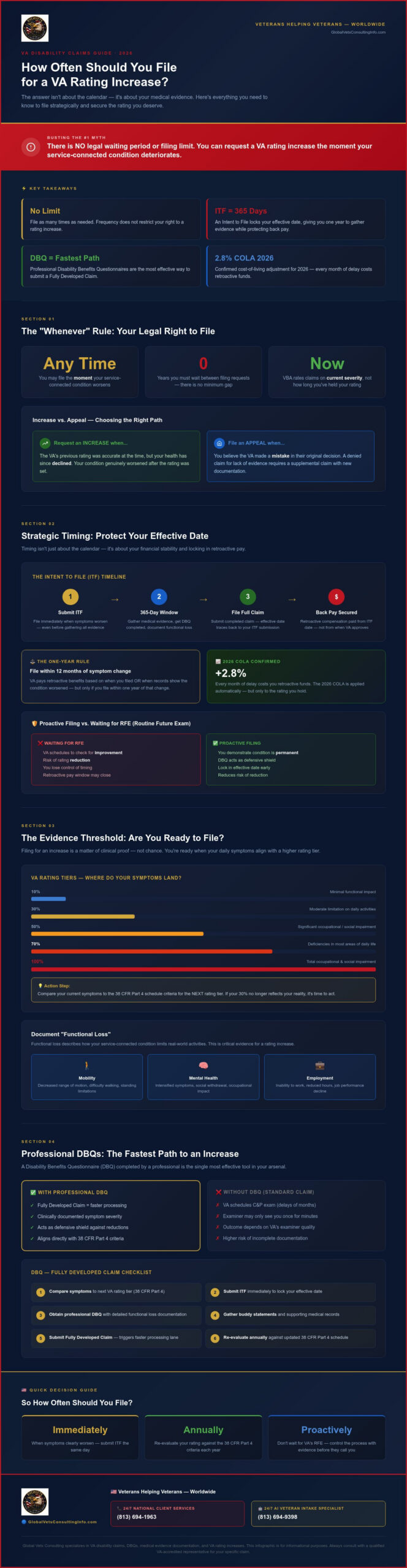
The law is clear: you can file for a rating increase the moment your service-connected condition gets worse. Many veterans ask how often should you file for a va increase because they’ve heard rumors about “waiting periods” or “magic numbers.” You don’t need to wait for a 5 or 10-year anniversary to request a review. The Veterans Benefits Administration (VBA) processes claims based on the current severity of your symptoms, not how long you’ve held your current rating.
Waiting for a specific milestone often costs veterans thousands in lost compensation. If your mobility has decreased or your mental health symptoms have intensified since your last exam, the system is designed to accommodate those changes immediately. You might worry about “poking the bear” and losing your current benefits. Filing with robust medical evidence, such as a Disability Benefits Questionnaire (DBQ), creates a defensive shield. It proves your condition meets or exceeds your current percentage, making a reduction highly unlikely.
Increase vs. Appeal: Choosing the Right Path
Understanding the difference between an increase and an appeal is vital for your strategy. You should request an increase when the VA’s previous rating was accurate at the time, but your health has since declined. If you believe the VA made a mistake in their original decision, an appeal or supplemental claim is the proper route. For instance, a VA claim denied for lack of evidence usually requires a supplemental claim with new documentation rather than a standard increase request. Choosing the right path ensures the VA reviews your file under the correct criteria, leading to a faster and more predictable result.
Strategic Timing: Why Frequency Matters for Your Effective Date
Timing isn’t just about the calendar; it’s about your financial stability. When veterans ask how often should you file for a va increase, they’re often worried about administrative red tape. However, the real concern should be your effective date. The VA typically pays retroactive benefits based on when you filed your claim or when your medical records show the condition worsened, provided you file within one year of that change. This “One-Year Rule” makes it imperative to document your symptoms as they happen.
You don’t need to have all your evidence ready today to protect your start date. Submitting an Intent to File (ITF) acts as a placeholder, giving you 365 days to gather medical evidence while locking in your potential back pay. This is especially critical in 2026, as the confirmed 2.8% COLA increase means every month of delay results in a larger loss of retroactive funds. If you’re unsure about your current documentation, the team at Global Vets Consulting can guide you through the process.
Maximizing Back Pay and Effective Dates
An Effective Date is the foundation of your retroactive pay, marking the start of your increased monthly compensation. Following the official guidance on when to file an increased claim ensures you don’t miss out on the 2026 cost-of-living adjustments that are applied automatically to your benefits.
Don’t wait for a Routine Future Exam (RFE) to come to you. The VA often schedules these to see if a condition has improved, which can lead to a rating reduction. By filing for an increase proactively, you demonstrate that your condition is permanent or worsening. Many successful veterans re-evaluate their rating annually against the 38 CFR Part 4 schedule. Doing so keeps your benefits aligned with both the law and your physical reality, providing a clear answer to how often should you file for a va increase based on your specific health journey.
The Evidence Threshold: How to Know if You Are Ready to File
Filing for an increase isn’t a game of chance; it’s a matter of clinical proof. When you consider how often should you file for a va increase, the answer depends entirely on your medical documentation. You are ready to file the moment your daily symptoms align with the criteria for a higher rating tier in the VA Schedule for Rating Disabilities. Start by objectively comparing your current physical or mental limitations to the legal requirements for the next percentage level. If your 30% rating no longer reflects your reality, it’s time to act.
A critical part of this threshold is documenting “functional loss.” This term describes how your service-connected condition specifically interferes with your ability to work, move, or care for yourself. You should also review your health for secondary conditions. It’s common for a primary disability, like a knee injury, to cause secondary issues like back pain or depression. Filing for an increase while simultaneously adding secondary claims can provide a more accurate reflection of your total disability. Ensure your records speak the VA’s technical language to avoid unnecessary denials.
Using DBQs for Mental Health and Physical Increases
For veterans dealing with psychological challenges, a DBQ for mental health conditions is the most effective tool to document worsening anxiety or PTSD. The VA focuses on the frequency, severity, and duration of your symptoms. Standard hospital notes often miss these nuances, but a DBQ captures the specific data points raters need to see. If your current medical evidence doesn’t highlight your most difficult days, your claim may stall.
Don’t leave your financial future to a rushed 15-minute C&P exam. You can get professional help with your medical evidence to ensure your claim is fully developed and ready for a favorable decision.
How Professional DBQs Speed Up the Increase Process in 2026
The VA’s standard claims process is often slowed by the time it takes for the agency to gather medical records and schedule examinations. You can bypass much of this administrative delay by submitting a Fully Developed Claim (FDC). By including a private Disability Benefits Questionnaire from the start, you provide the rater with every piece of evidence they need to make a decision immediately. This proactive approach is the best answer to how often should you file for a va increase, as it focuses on the quality of the submission rather than just the frequency of requests.
Global Vets Consulting ensures your documentation reflects your worst days, not just a 15-minute snapshot from a rushed C&P examiner who doesn’t know your history. This accuracy is vital when transitioning from a 70% rating to 100%, especially if you’re pursuing Total Disability Individual Unemployability (TDIU). We maintain a commitment to constant availability through the following resources:
- 🇺🇸 24/7 National Client Services Hotline for immediate support
- 🤖 24/7 AI Veteran Intake Specialist to start your documentation process
- 🌐 GlobalVetsConsultingInfo.com for comprehensive educational resources
Taking Control of the C&P Exam Process
A private dbq for va disability rating increase acts as a powerful piece of counter-evidence in your file. If a VA-contracted examiner provides a negative or incomplete report, your private medical evidence can often override their findings by providing a more comprehensive clinical picture. Our “Veterans Helping Veterans” ethos means we understand the specific nuances raters look for in 2026, including how the confirmed 2.8% COLA adjustment affects your potential back pay. We prioritize meticulousness to give you peace of mind throughout the entire process.
Securing the Compensation You Earned in 2026
Your health doesn’t follow a rigid schedule, and neither should your disability claim. You’ve learned that the answer to how often should you file for a va increase isn’t found on a calendar, but in the clinical strength of your medical evidence. By comparing your symptoms to current rating criteria and using an Intent to File, you lock in your effective date and the confirmed 2026 COLA adjustments. Professional DBQs serve as your evidence weapon, allowing you to bypass administrative delays with a Fully Developed Claim.
Don’t let a rushed C&P exam determine your financial stability. We are veteran-owned and operated, specializing in the documentation required to reflect the true severity of your conditions. Our 24/7 National Client Services Hotline and intake specialists are available whenever you’re ready to start. You’ve done the hard work; let us help you secure the results you deserve.
Get Your Professional DBQ for a VA Increase Today 🇺🇸
Frequently Asked Questions
Can the VA reduce my rating if I file for an increase?
Yes, the VA has the right to review your entire disability file when you request an increase. If their records or a C&P exam show your condition has significantly improved, they may propose a reduction. However, filing with strong medical evidence like a private DBQ protects you. It proves your symptoms still meet current rating criteria, making a reduction much harder for the VA to justify.
How long does it take for the VA to process a rating increase in 2026?
Most Fully Developed Claims for an increase are processed within 90 to 120 days in 2026. Standard claims often take longer because the VA must spend time gathering evidence on your behalf. Submitting a private DBQ speeds up the process because the rater has all necessary clinical data from day one. This allows them to move your file toward a final decision without waiting for third-party exam results.
Do I need a new Nexus Letter for a VA rating increase?
You generally don’t need a new Nexus Letter for an increase if the condition is already service-connected. A Nexus Letter proves your disability was caused by military service. Since the VA has already conceded service connection, your focus should be on medical evidence that proves the current severity of your symptoms. A DBQ is the primary tool used by raters to measure that severity and determine your compensation.
What is the best evidence to submit for a VA increase claim?
The best evidence is a completed Disability Benefits Questionnaire (DBQ) that uses the VA’s specific clinical language. This documentation should clearly outline your functional loss and how your symptoms interfere with daily tasks or work. When you’re deciding how often should you file for a va increase, wait until your medical records show a consistent pattern of worsening symptoms that match a higher rating tier.
How many times can I file for an increase for the same condition?
There’s no legal limit on the number of times you can file for an increase for the same condition. You can request a review every time your health deteriorates. If you’re wondering how often should you file for a va increase, the answer is whenever your symptoms permanently worsen. As long as you provide new medical evidence, the VA is required to evaluate the current state of your disability.

Article by
Willie Daniel
Willie Daniel is the Founder and Chief Executive Officer (CEO) of Global Vets Consulting (GVC4Vets) – National Veterans Disability Services, a veteran-led educational and medical evidence support organization dedicated to helping veterans better understand VA disability rating increases, DBQ medical evidence, secondary claims education, and C&P examination preparation.
He is a retired U.S. Army Medical Service Corps Officer with more than 27 years of honorable military service, a decorated Iraq combat veteran, and a retired federal official with the U.S. Department of Veterans Affairs. Throughout his military and federal career, Willie Daniel served in leadership, healthcare administration, operational, and veteran-support roles focused on improving services and support systems for servicemembers, veterans, and their families.
Drawing from decades of military leadership, healthcare administration, veteran advocacy, and federal government experience, Willie Daniel brings a practical, veteran-centered perspective to Global Vets Consulting’s educational articles, AI-powered veteran resources, video education initiatives, and outreach programs. His experience navigating military systems, medical documentation processes, and veteran-related administrative operations provides valuable insight into many of the challenges veterans face when seeking to better understand VA disability rating criteria, medical evidence, documentation strategies, and secondary condition education.
Through GVC’s “Veterans Helping Veterans” mission, his focus is on delivering clear, educational, and easy-to-understand information designed to empower veterans with knowledge, resources, and educational tools that may help them make more informed decisions regarding their individual VA disability journeys.
The information provided through GVC is intended for educational and informational purposes only and should not be considered legal or medical advice.
Disclaimer
Disclaimer: Global Vets Consulting, LLC (“GVC”) is a veteran-led educational and medical evidence support organization. GVC is not a law firm, is not a Veterans Service Organization (VSO), and is not affiliated with the U.S. Department of Veterans Affairs (VA) or any government agency.
Global Vets Consulting does not provide legal advice, medical advice, medical treatment, or healthcare services. GVC does not prepare, file, or submit VA disability claims on behalf of veterans. All information provided through this website, blog articles, videos, educational materials, AI tools, dashboards, templates, and communications is intended solely for general educational and informational purposes.
Veterans are encouraged to consult with accredited representatives, licensed attorneys, qualified medical providers, or Veterans Service Organizations regarding their specific legal, medical, or VA-related matters. VA disability decisions, ratings, and outcomes are determined solely by the U.S. Department of Veterans Affairs based on applicable laws, regulations, medical evidence, and individual circumstances. Past results do not guarantee future outcomes.