
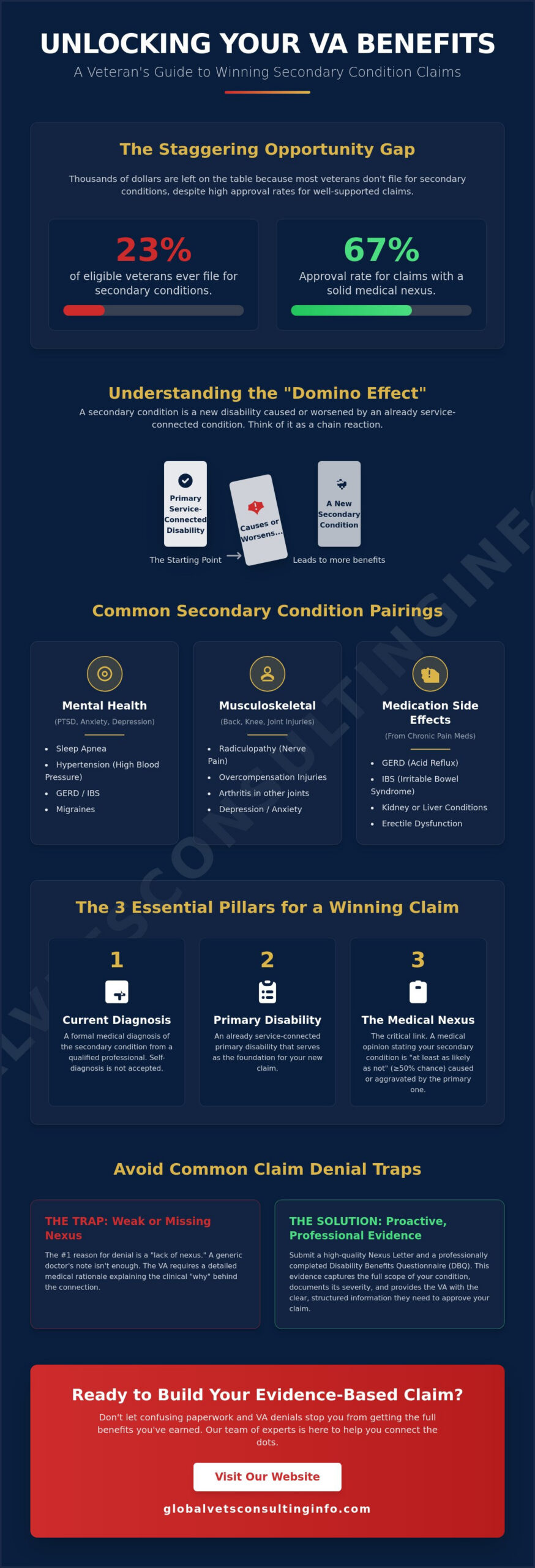
Did you know that only 23% of eligible veterans ever file for secondary conditions, even though these claims have a 67% approval rate when supported by a solid medical nexus? It’s a staggering gap that leaves thousands of dollars on the table for families who deserve support for the full scope of their service-related health issues. You might already understand the general concept of how to connect secondary conditions to primary disabilities, but the reality of “VA math” and strict nexus requirements often leads to frustrating denials that claim a lack of service connection.
We understand the exhaustion that comes with fighting for the ratings you earned. This guide provides the exact roadmap you need to navigate the May 2026 M21-1 manual updates, including the broadened “but-for” causation standard established by the Spicer v. McDonough court case. You’ll learn how to gather the precise medical evidence and independent opinions required to build a successful claim. We will walk through the three pillars of secondary service connection and the specific steps to increase your monthly compensation through a structured, evidence-based approach that turns medical confusion into clear results.
Key Takeaways
- Understand the “Domino Effect” where an existing service-connected disability causes or worsens a new condition, opening the door for additional benefits.
- Identify the three essential pillars of evidence, focusing on the requirement for a formal medical diagnosis that cannot be self-reported.
- Learn the exact medical evidence requirements for how to connect secondary conditions to primary disabilities to avoid a “lack of nexus” denial.
- Discover how to avoid the common “C&P Exam Trap” by using professional DBQs that capture the full clinical scope of your secondary condition.
- Follow a logical, step-by-step process to pinpoint which primary conditions are impacting your health and secure a successful VA rating increase.
Understanding Secondary Service Connection: The ‘Domino Effect’ in VA Claims
🇺🇸 A secondary service connection is essentially a medical domino effect. It occurs when a disability is either caused or worsened by an already service-connected primary condition. Our mission at Global Vets Consulting is to ensure you understand how to connect secondary conditions to primary disabilities so you receive the full compensation you earned. We speak from a “Veterans Helping Veterans” perspective, knowing exactly how a single service injury can spiral into multiple chronic health issues over time.
The VA requires proof that the primary condition is the “proximate cause” of the secondary one. This involves understanding the difference between direct causation and clinical aggravation. Under the May 1, 2026 updates to the M21-1 manual following the Spicer v. McDonough case, the VA now looks closer at functional impairment. This means they must consider if a primary disability interfered with or delayed the treatment of other conditions. While you might receive care through the Veterans Health Administration, winning a VA disability claim requires specific medical evidence that bridges these clinical points.
🌐 Common Secondary Condition Pairings for Veterans
- Mental Health (PTSD/Anxiety): These conditions often lead to Sleep Apnea, Hypertension, or Gastrointestinal issues due to chronic stress or medication side effects.
- Musculoskeletal Issues (Back/Knee): Injuries here frequently cause Radiculopathy or overcompensation injuries in other joints as your body shifts its weight to avoid pain.
- Medication Side Effects: Chronic use of NSAIDs for service-connected pain can lead to GERD or IBS, which are eligible for a VA rating increase when properly documented.
🇺🇸 Why Secondary Claims Are Essential for a Rating Increase
Many veterans hit a “rating plateau” because they don’t account for the full scope of their health. Secondary claims allow you to move past these plateaus by documenting the total impact of your service. This is a critical part of how to use a dbq for a va disability rating increase in 2026. At Global Vets Consulting, we operate Worldwide to provide the education you need to secure your earned outcomes at GlobalVetsConsultingInfo.com. By identifying these links, you ensure your claim reflects your actual level of impairment and daily functional loss.
The Three Essential Pillars for Linking Secondary Conditions
Winning a VA disability claim for a secondary condition isn’t about luck; it’s about medical architecture. To understand how to connect secondary conditions to primary disabilities, you must satisfy three specific requirements that the VA Rater looks for in every file. These requirements are grounded in federal law under 38 C.F.R. § 3.310, which dictates how the VA handles disabilities that are proximately due to service-connected issues. If you miss even one of these pillars, the entire claim will likely fail.
First, you need a current medical diagnosis of the secondary condition. You cannot self-diagnose or rely on a “maybe” from a physician. Second, you must have an existing service-connected primary disability already on your record. Finally, you need the “Medical Nexus.” This is the professional bridge that connects the two conditions. The legal threshold for this link is the “at least as likely as not” standard. This means a qualified medical professional must state there is at least a 50% probability that your primary condition caused or aggravated the secondary one. This standard is the baseline for success in the 2026 claims environment.
The Role of the Medical Nexus Letter
A high-quality Nexus letter is more than a simple note. It must provide a detailed medical rationale, cite peer-reviewed medical literature, and include a definitive statement linking the conditions. Many veterans find their va claim denied for lack of evidence because their doctor wrote a generic letter that lacked the specific terminology the VA requires. The rationale must explain the clinical “why” behind the connection to satisfy the rater’s need for evidence.
Using DBQs to Document Severity and Connection
Disability Benefits Questionnaires (DBQs) are the structured tools the VA uses to evaluate your claim’s merit. These forms ensure that the doctor captures the exact data points, such as functional impairment and clinical findings, that a rater needs to assign a percentage. If you are unsure about the basics, start with our guide on what is a dbq for va claims? to understand how these documents support your case. Investing time in secondary VA claims education is the best way to ensure your evidence is meticulous before you submit your application.
Step-by-Step: How to Document Your Secondary Claim Evidence
Establishing a successful claim requires a methodical approach to medical documentation. You aren’t just filing paperwork; you are building a chronological argument for the VA Disability Compensation program. Understanding how to connect secondary conditions to primary disabilities involves a specific sequence of actions that ensures your evidence is undeniable by the time it reaches a rater’s desk.
The first step is identifying the “domino.” You must pinpoint exactly which service-connected primary condition is realistically impacting your health elsewhere. Once identified, you need to secure a formal diagnosis from a qualified professional. A self-diagnosis or a simple mention in a clinic note won’t suffice. Next, you must gather lay evidence, which includes your personal statement describing the progression of your symptoms. Finally, you must obtain professional medical documentation, such as a Nexus letter and a DBQ, to provide the clinical bridge the VA requires. This four-step process creates a clear path from your service-connected disability to your current health struggle.
Gathering Lay Evidence: Your Personal Statement
Your personal statement is your opportunity to speak directly to the rater. Focus on the progression of your symptoms from the primary condition to the secondary one. Instead of just listing symptoms, emphasize “functional loss.” Describe what you can no longer do in your daily life because of this new condition. Does your secondary radiculopathy prevent you from standing for more than ten minutes? Does your GERD, secondary to pain medication, interfere with your sleep or work? This specific detail provides the context that medical records alone might miss, making it harder for the VA to ignore the real-world impact of your secondary condition.
The Final Submission Checklist
Consistency is the hallmark of a winning claim. Before you hit submit, review your entire package against the va disability claims process step by step to ensure you haven’t missed a critical administrative requirement. Verify that your medical records, DBQs, and Nexus letters are all uploaded correctly to VA.gov. If you need assistance gathering the right documents, our experts specialize in Secondary VA Claims Education to help you build a bulletproof evidence bundle before you file.
Securing Your Increase: Why Professional DBQs are the Key to Success
🇺🇸 Relying on a standard C&P exam for a secondary claim is often a gamble. These appointments frequently last only 15 minutes, which is rarely enough time for an examiner to review the complex medical history required to understand how to connect secondary conditions to primary disabilities. This “C&P Exam Trap” is a leading cause of denials because the brief evaluation often fails to capture the intricate clinical links between your conditions. To secure the rating you deserve, you need a private Disability Benefits Questionnaire (DBQ) that provides a thorough, meticulous evaluation of your symptoms and functional loss.
📞 Global Vets Consulting is here to help you bridge that gap. As a mission-driven organization of veterans helping veterans, we offer a 24/7 National Client Services Hotline to ensure you are never alone in this process. Our 24/7 AI Veteran Intake Specialist at GlobalVetsConsultingInfo.com is ready to assist you in gathering the medical evidence education needed to build a bulletproof claim. We focus on technical accuracy and peer-to-peer support to ensure your DBQs meet the exact standards VA Raters are looking for in 2026.
🌐 Professional Accuracy for Complex Links
🇺🇸 Secondary links like Sleep Apnea secondary to PTSD or Hypertension secondary to chronic pain require sophisticated medical rationale to overcome VA scrutiny. We help you reduce rater friction by ensuring your documentation is completed on standardized forms that highlight your functional impairment and daily struggles. Our services are available Worldwide, providing a clear, predictable path forward for veterans everywhere. We prioritize your peace of mind by ensuring your evidence is rock-solid before you submit your application.
📞 Take the Next Step Toward Your Rating Increase
🇺🇸 Don’t leave your secondary claim to chance; ensure your medical evidence is professional and comprehensive. Our team is standing by to provide the education and resources you need to succeed. Contact our 24/7 National Client Services Hotline or visit us online to get started today.
🌐 Worldwide
💻 Visit Global Vets Consulting for Professional DBQ Support
Take Control of Your Disability Rating Today
You’ve served your country with honor, and it’s time your disability rating reflects the total impact of that service. Identifying the “domino effect” of your health is the first step toward a successful claim. Mastering how to connect secondary conditions to primary disabilities requires more than just a diagnosis; it demands a meticulous medical nexus and high-quality documentation that satisfies the 2026 “but-for” causation standards. By focusing on functional impairment and securing a professional medical bridge, you can move past rating plateaus and secure the compensation you’ve earned.
Global Vets Consulting is veteran-owned and operated since 2021, and we specialize in high-quality DBQ documentation designed to withstand VA scrutiny. We understand the administrative friction you face, which is why our 24/7 AI Veteran Intake Specialist is available to help you begin the process at any time. Don’t leave your secondary claim to the uncertainty of a 15-minute C&P exam. We’re dedicated to helping you secure the benefits you deserve through accurate, professional evidence.
Get the Professional DBQ Evidence You Need for Your Secondary Claim 🇺🇸
You’ve done the hard work of serving. Now, let us help you build the medical evidence required to finish the mission and secure your peace of mind. You’re not alone in this fight.
Frequently Asked Questions
Can a secondary condition be rated higher than the primary condition?
🇺🇸 Yes, a secondary condition can absolutely be rated higher than the primary disability it stems from. The VA assigns ratings based on the current severity of symptoms and functional impairment for each specific diagnosis rather than its origin. For example, a veteran might have a 10% rating for Tinnitus that eventually leads to a 30% or 50% secondary rating for Migraines if the frequency and prostrating nature of the attacks meet those higher criteria.
Do I need a new Nexus letter if I already have a diagnosis for my secondary condition?
📞 You almost always need a fresh Nexus letter even if you already have a formal diagnosis in your records. A diagnosis simply confirms that a health issue exists, but it doesn’t explain how to connect secondary conditions to primary disabilities to the VA’s satisfaction. The Nexus letter provides the clinical rationale and scientific evidence required to prove that your primary service-connected disability was the “but-for” cause of your secondary health struggle.
What is the ‘at least as likely as not’ standard in VA secondary claims?
🌐 This is the legal threshold of proof required to grant service connection, meaning there is at least a 50% probability that your secondary condition was caused or aggravated by your primary disability. This standard is much lower than the “beyond a reasonable doubt” requirement used in criminal courts. When the medical evidence is balanced equally, the VA is legally required to give the veteran the “benefit of the doubt” and approve the claim.
How many secondary conditions can I link to a single primary disability?
🇺🇸 There is no regulatory limit on the number of secondary conditions you can link to a single primary disability. A single service-connected condition like PTSD can serve as the medical foundation for multiple secondary claims, such as Sleep Apnea, Hypertension, and GERD. As long as you provide the essential pillars of evidence for each link, the VA must evaluate each secondary claim on its own medical merits and combined impact.
Does the VA automatically connect secondary conditions like radiculopathy to back pain?
📞 The VA never automatically connects conditions, even when the relationship between them is medically common. While radiculopathy is a frequent result of a service-connected back injury, you must still file a formal claim and provide medical evidence to establish the link. Using a professional DBQ ensures the rater has the technical data needed to understand how to connect secondary conditions to primary disabilities without relying on the uncertainty of a brief C&P exam.

Article by
Willie Daniel
Willie Daniel is the Founder and Chief Executive Officer (CEO) of Global Vets Consulting (GVC) – National Veterans Disability Services, a veteran-led educational and medical evidence support organization dedicated to helping veterans better understand VA disability rating increases, DBQ medical evidence, secondary claims education, and C&P examination preparation.
He is a retired U.S. Army Medical Service Corps Officer with more than 27 years of honorable military service, a decorated Iraq combat veteran, and a retired federal official with the U.S. Department of Veterans Affairs. Throughout his military and federal career, Willie Daniel served in leadership, healthcare administration, operational, and veteran-support roles focused on improving services and support systems for servicemembers, veterans, and their families.
Drawing from decades of military leadership, healthcare administration, veteran advocacy, and federal government experience, Willie Daniel brings a practical, veteran-centered perspective to Global Vets Consulting’s educational articles, AI-powered veteran resources, video education initiatives, and outreach programs. His experience navigating military systems, medical documentation processes, and veteran-related administrative operations provides valuable insight into many of the challenges veterans face when seeking to better understand VA disability rating criteria, medical evidence, documentation strategies, and secondary condition education.
Through GVC’s “Veterans Helping Veterans” mission, his focus is on delivering clear, educational, and easy-to-understand information designed to empower veterans with knowledge, resources, and educational tools that may help them make more informed decisions regarding their individual VA disability journeys.
The information provided through GVC is intended for educational and informational purposes only and should not be considered legal or medical advice.
Disclaimer
Disclaimer: Global Vets Consulting, LLC (“GVC”) is a veteran-led educational and medical evidence support organization. GVC is not a law firm, is not a Veterans Service Organization (VSO), and is not affiliated with the U.S. Department of Veterans Affairs (VA) or any government agency.
Global Vets Consulting does not provide legal advice, medical advice, medical treatment, or healthcare services. GVC does not prepare, file, or submit VA disability claims on behalf of veterans. All information provided through this website, blog articles, videos, educational materials, AI tools, dashboards, templates, and communications is intended solely for general educational and informational purposes.
Veterans are encouraged to consult with accredited representatives, licensed attorneys, qualified medical providers, or Veterans Service Organizations regarding their specific legal, medical, or VA-related matters. VA disability decisions, ratings, and outcomes are determined solely by the U.S. Department of Veterans Affairs based on applicable laws, regulations, medical evidence, and individual circumstances. Past results do not guarantee future outcomes.