
What if the difference between a denial and the maximum rating you deserve isn’t your diagnosis, but knowing exactly how to establish service connection for mental health? You’ve likely felt the mounting anxiety that comes with an upcoming C&P exam or the deep frustration of trying to decipher “VA math” after a previous denial. It’s exhausting to fight a bureaucratic system when you’re already carrying the weight of a mental health condition. We understand that this process feels like a mission without a map, but you don’t have to navigate it alone.
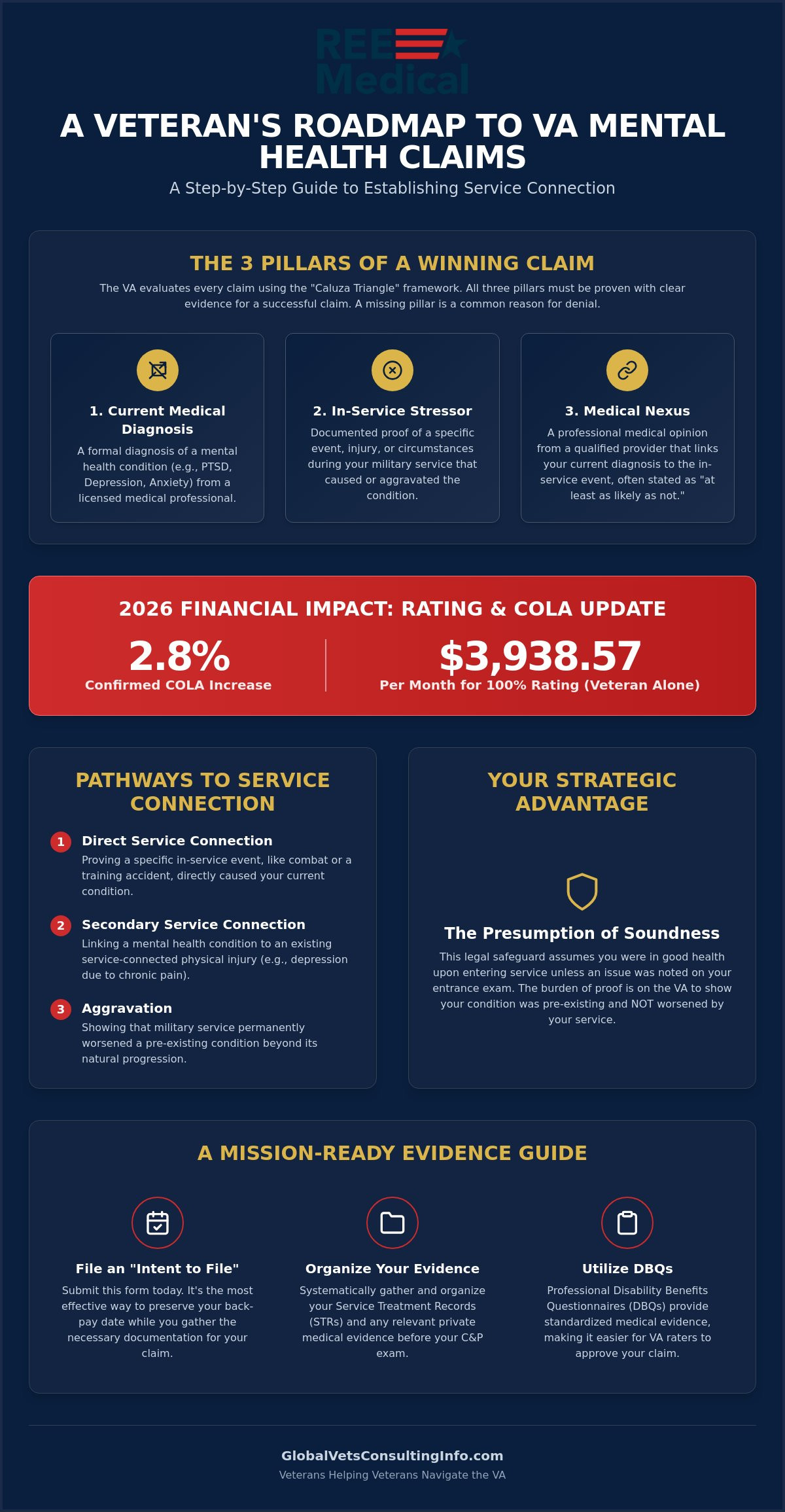
In this guide, you’ll learn the precise steps to prove your condition is service-connected by focusing on the three essential pillars: a current diagnosis, a documented in-service event, and a strong medical nexus. We’ll walk you through the 2026 updates, including the confirmed 2.8% COLA increase that brings a 100% rating for a veteran alone to $3,938.57 per month. By the end of this article, you’ll have a clear, step-by-step roadmap to gather the medical evidence and DBQs required to secure the VA rating increase you’ve earned through your service.
Key Takeaways
- Master the “Caluza Triangle” framework to ensure your claim includes a formal diagnosis, a documented in-service event, and a clear medical nexus.
- Learn exactly how to establish service connection for mental health by organizing your Service Treatment Records and private medical evidence before your C&P exam.
- Discover why submitting an “Intent to File” today is the most effective way to preserve your backpay date while you gather supporting documentation.
- Identify how professional Disability Benefits Questionnaires (DBQs) provide the standardized medical evidence needed to overcome common VA claim denials.
Understanding Service Connection for Mental Health Conditions 🇺🇸
Service connection is the foundation of every successful VA disability claim. It acts as the formal link between your current diagnosis and your time in uniform. When you’re researching how to establish service connection for mental health, you’ll find that the VA looks for specific evidence that your military service caused or contributed to your current condition. Without this bridge, even the most severe diagnosis won’t result in the compensation you’ve earned.
There are three primary ways to secure this link through the VA system:
- Direct Service Connection: This requires proving that a specific in-service event, such as combat exposure or a training accident, triggered your symptoms.
- Secondary Service Connection: This involves linking a mental health condition to an existing service-connected physical injury. A common example is developing depression secondary to chronic back pain or a limited range of motion.
- Aggravation: If you had a condition before enlisting, you can still qualify by proving military service made that condition permanently worse beyond its natural progression.
For those seeking VA benefits for PTSD or other disorders, documenting these links with medical evidence is the most important part of the mission. Each path requires a different strategy, but the goal remains the same: proving your service changed your mental health.
The Presumption of Soundness Explained
The Presumption of Soundness is a legal safeguard that assumes you were in good health when you entered the military unless a condition was specifically noted on your entrance physical exam. This rule is a powerful tool for veterans because it shifts the burden of proof back to the VA. If the government wants to deny your claim based on a pre-existing issue, they must prove with clear evidence that the condition existed before service and wasn’t worsened by your duties. Understanding this presumption is a critical step in learning how to establish service connection for mental health because it protects your right to benefits for conditions that surfaced during your time in service.
The Three Essential Elements for a Winning VA Claim
The VA uses a rigid framework to evaluate every mental health claim, often referred to as the “Caluza Triangle.” To understand how to establish service connection for mental health, you must prove three distinct points with clear evidence. If any side of this triangle is missing, the VA will likely deny the claim, regardless of the severity of your symptoms. This structure is designed to ensure you meet the basic VA Eligibility Requirements while providing a clear path for raters to follow.
- Element 1: Current Medical Diagnosis. You must have a formal diagnosis of a mental health condition, such as PTSD, Depression, or Anxiety, from a licensed provider.
- Element 2: In-Service Stressor. You need to document a specific event or period of time during your service that caused or aggravated the condition. This includes combat action, training accidents, or the cumulative strain of high-tempo service life.
- Element 3: Medical Nexus. This is the most critical piece. It is the professional medical opinion that links your current diagnosis to the in-service event, typically using the phrase “at least as likely as not.”
Why a Diagnosis Alone Isn’t Enough
Many veterans are caught off guard when a formal diagnosis still results in a claim denial. It’s a common trap to believe that a doctor’s note is enough, but a diagnosis is only one-third of the battle. The VA doesn’t compensate you for having a condition; they compensate you for conditions that are service-connected. Utilizing a dbq for mental health conditions helps bridge the gap between your clinical symptoms and the VA’s legal requirements. These forms standardize your medical evidence, making it easier for raters to see the connection you’ve built. Exploring mental health ratings education can help you refine this documentation to ensure your claim is mission-ready.
How to Establish Service Connection: A Step-by-Step Evidence Guide
Moving from understanding the “Caluza Triangle” to taking action requires a tactical approach. To begin, submit an “Intent to File” (VA Form 21-0966) immediately. This simple step preserves your potential backpay date while you take the time needed to build your evidence packet. Understanding the different Types of VA Disability Claims is essential here, as it ensures you’re filing under the correct category for your specific timeline and service history. Knowing how to establish service connection for mental health involves more than just filling out a form; it’s about building a bulletproof evidence file.
Next, gather your Service Treatment Records (STRs) and any private medical records. These documents provide the historical context for your claim. Once your records are in hand, secure a professional Disability Benefits Questionnaire (DBQ) to document the current severity and frequency of your symptoms. Finally, draft a Statement in Support of Claim. Don’t focus on your “average” days. Instead, provide a detailed account of your “worst days” to give the rater a clear picture of your functional impairment.
The Power of Buddy Letters and Lay Evidence
Statements from fellow veterans, spouses, or close friends can validate in-service stressors that might not be fully documented in your STRs. When asking for these buddy letters, tell your supporters to focus on “observable changes” they saw in your behavior. Did you become withdrawn after a deployment? Did your temper flare up after a specific training accident? These observations provide the human context that clinical records sometimes miss, strengthening the link between your service and your current struggles.
Organizing Your Medical Evidence
The va disability claims process step by step requires meticulous organization to be successful. Arrange your medical records in chronological order. This helps the VA rater see the clear progression from your time in service to your current diagnosis. If you need help gathering this evidence, reach out for independent medical evidence education to ensure your packet is complete and ready for review.
Reducing Claim Anxiety with Professional Documentation Support
When you’re trying to figure out how to establish service connection for mental health, the sheer volume of paperwork and the pressure of the C&P exam can feel overwhelming. Many veterans find their va claim denied for lack of evidence simply because their medical records didn’t speak the VA’s specific language. This frustration is common, but it’s also avoidable. By focusing on professional documentation and education, you can replace confusion with a clear, predictable path toward the rating you’ve earned.
Global Vets Consulting specializes in providing the documentation and education veterans need to navigate this complex system. We offer C&P examination preparation education to help you walk into your appointment with clarity and confidence. Learning how to establish service connection for mental health is much easier when you have a partner who understands the intricacies of the bureaucratic process. Our goal is to ensure your medical evidence is thorough, accurate, and ready for a rater’s review.
What is a DBQ and Why Does It Matter?
Understanding what is a dbq is essential because this form is the actual tool the VA uses to rate your disability. While the VA often schedules its own exams, private DBQs provide a standardized way for doctors to report your symptoms directly to VA standards. These private evaluations are frequently more thorough than a rushed C&P exam, which might only last fifteen or twenty minutes. A detailed DBQ ensures that every symptom and functional impairment is documented correctly, reducing the risk of a low rating or an outright denial. If you’re ready to strengthen your evidence packet, explore our mental health ratings education resources to see how professional documentation makes the difference.
🇺🇸 Global Vets Consulting
📞 24/7 National Client Services Hotline: 813-722-1114
🌐 GlobalVetsConsultingInfo.com
🤖 24/7 AI Veteran Intake Specialist Available Worldwide
Take Command of Your VA Claim Today
Proving your mental health claim is a strategic mission that requires the right tools and evidence. You’ve learned that the Caluza Triangle is your blueprint, requiring a formal diagnosis, a documented in-service stressor, and a strong medical nexus. By organizing your records chronologically and utilizing buddy letters to provide human context, you’ve already taken the first steps toward a successful outcome. These elements are the foundation of a claim that stands up to VA scrutiny.
Understanding how to establish service connection for mental health is the key to unlocking the benefits you earned through your service. You don’t have to navigate this complex system by yourself. Global Vets Consulting is a veteran-owned and operated team of specialists dedicated to helping you secure professional Disability Benefits Questionnaires (DBQ) and medical evidence education. With our 24/7 AI Veteran Intake Specialist available worldwide, we’re ready to support your mission at any hour of the day or night.
Ready to secure the documentation your claim deserves? Contact Global Vets Consulting Today. You stood the watch for us; now let us stand with you as you secure your future.
Frequently Asked Questions
Can I get service connection for mental health if I never saw a doctor while on active duty?
Yes, you can still establish service connection even without active duty medical records. The VA recognizes that many service members didn’t seek help due to stigma or mission requirements. You’ll need to provide alternative evidence, such as buddy letters from fellow veterans or family members and a strong medical nexus, to prove how to establish service connection for mental health through lay evidence that validates your in-service stressor.
What is the difference between direct and secondary service connection for mental health?
Direct service connection links your mental health condition to a specific event that occurred during your military service. Secondary service connection occurs when a mental health condition is caused or aggravated by an already service-connected physical disability. For example, if your service-connected chronic back pain leads to severe depression, you can claim that depression as a secondary condition, which counts toward your total VA rating and monthly compensation.
How long does it take the VA to process a mental health service connection claim in 2026?
While processing times vary, the VA handled a record 2 million disability claims in a single fiscal year recently, which has led to high volume in 2026. On average, you should expect the process to take between 120 and 160 days from your filing date. Submitting fully developed claims with professional DBQs and organized medical evidence can help prevent unnecessary delays caused by the VA requesting additional information or clarification.
What happens if the VA denies my mental health claim due to a pre-existing condition?
If you are denied because of a pre-existing condition, you can use the “aggravation” rule to prove your service made the condition permanently worse. The Presumption of Soundness generally assumes you were healthy upon entry unless a condition was noted on your entrance exam. If the VA fails to prove the condition wasn’t aggravated by service, you may still be eligible for a service-connected rating for the increased severity of the condition.
Do I need a Nexus Letter if I already have a DBQ for my mental health claim?
While a DBQ documents the current severity of your symptoms, a Nexus Letter is often necessary to provide the formal medical link to your service. A professional nexus statement explicitly connects your current diagnosis to an in-service stressor or event. Combining a thorough DBQ with a clear medical nexus is the most effective way to demonstrate how to establish service connection for mental health and secure an accurate rating from the rater.

Article by
Willie Daniel
Willie Daniel is the Founder and Chief Executive Officer (CEO) of Global Vets Consulting (GVC) – National Veterans Disability Services, a veteran-led educational and medical evidence support organization dedicated to helping veterans better understand VA disability rating increases, DBQ medical evidence, secondary claims education, and C&P examination preparation.
He is a retired U.S. Army Medical Service Corps Officer with more than 27 years of honorable military service, a decorated Iraq combat veteran, and a retired federal official with the U.S. Department of Veterans Affairs. Throughout his military and federal career, Willie Daniel served in leadership, healthcare administration, operational, and veteran-support roles focused on improving services and support systems for servicemembers, veterans, and their families.
Drawing from decades of military leadership, healthcare administration, veteran advocacy, and federal government experience, Willie Daniel brings a practical, veteran-centered perspective to Global Vets Consulting’s educational articles, AI-powered veteran resources, video education initiatives, and outreach programs. His experience navigating military systems, medical documentation processes, and veteran-related administrative operations provides valuable insight into many of the challenges veterans face when seeking to better understand VA disability rating criteria, medical evidence, documentation strategies, and secondary condition education.
Through GVC’s “Veterans Helping Veterans” mission, his focus is on delivering clear, educational, and easy-to-understand information designed to empower veterans with knowledge, resources, and educational tools that may help them make more informed decisions regarding their individual VA disability journeys.
The information provided through GVC is intended for educational and informational purposes only and should not be considered legal or medical advice.
Disclaimer
Disclaimer: Global Vets Consulting, LLC (“GVC”) is a veteran-led educational and medical evidence support organization. GVC is not a law firm, is not a Veterans Service Organization (VSO), and is not affiliated with the U.S. Department of Veterans Affairs (VA) or any government agency.
Global Vets Consulting does not provide legal advice, medical advice, medical treatment, or healthcare services. GVC does not prepare, file, or submit VA disability claims on behalf of veterans. All information provided through this website, blog articles, videos, educational materials, AI tools, dashboards, templates, and communications is intended solely for general educational and informational purposes.
Veterans are encouraged to consult with accredited representatives, licensed attorneys, qualified medical providers, or Veterans Service Organizations regarding their specific legal, medical, or VA-related matters. VA disability decisions, ratings, and outcomes are determined solely by the U.S. Department of Veterans Affairs based on applicable laws, regulations, medical evidence, and individual circumstances. Past results do not guarantee future outcomes.