
Why does the VA often treat years of low energy and “functional” sadness as a minor issue just because you aren’t in a constant state of crisis? If you’ve lived with the heavy, invisible weight of dysthymia for a long time, you know that “mild” is a misleading label. It’s frustrating when a C&P examiner spends only a few minutes with you and misses the chronic fatigue that makes keeping a job feel like an exhausting uphill battle. You’ve earned a va rating for persistent depressive disorder that accurately reflects how this condition impacts your daily life, not just how you look on a single good day. 🇺🇸
We understand that the marathon of chronic depression requires a different approach to evidence than a single acute episode. We’re here to help you master the current rating criteria and prepare for the 2026 compensation environment. You’ll learn how to use a Disability Benefits Questionnaire (DBQ) to capture the true persistence of your symptoms and secure a rating that matches your level of impairment. This guide provides the clear, actionable steps you need to move from a low rating to the compensation you’ve rightfully earned for your service.
Key Takeaways
- Understand why the insidious nature of Persistent Depressive Disorder often leads to low ratings and how to properly define your chronic symptoms for the VA.
- Master the General Rating Formula for Mental Disorders to determine where your symptoms land on the 0% to 100% va rating for persistent depressive disorder scale.
- Learn how to overcome the “Snapshot Problem” of brief C&P exams by establishing a clear medical nexus and documenting your symptoms over the long term.
- Discover how a private Disability Benefits Questionnaire (DBQ) serves as powerful medical evidence to capture the true occupational and social impairment of your condition.
- Gain actionable insights on preparing for your claim to ensure your final rating accurately reflects the chronic challenges you face every day.
What is Persistent Depressive Disorder (Dysthymia) in Veterans?
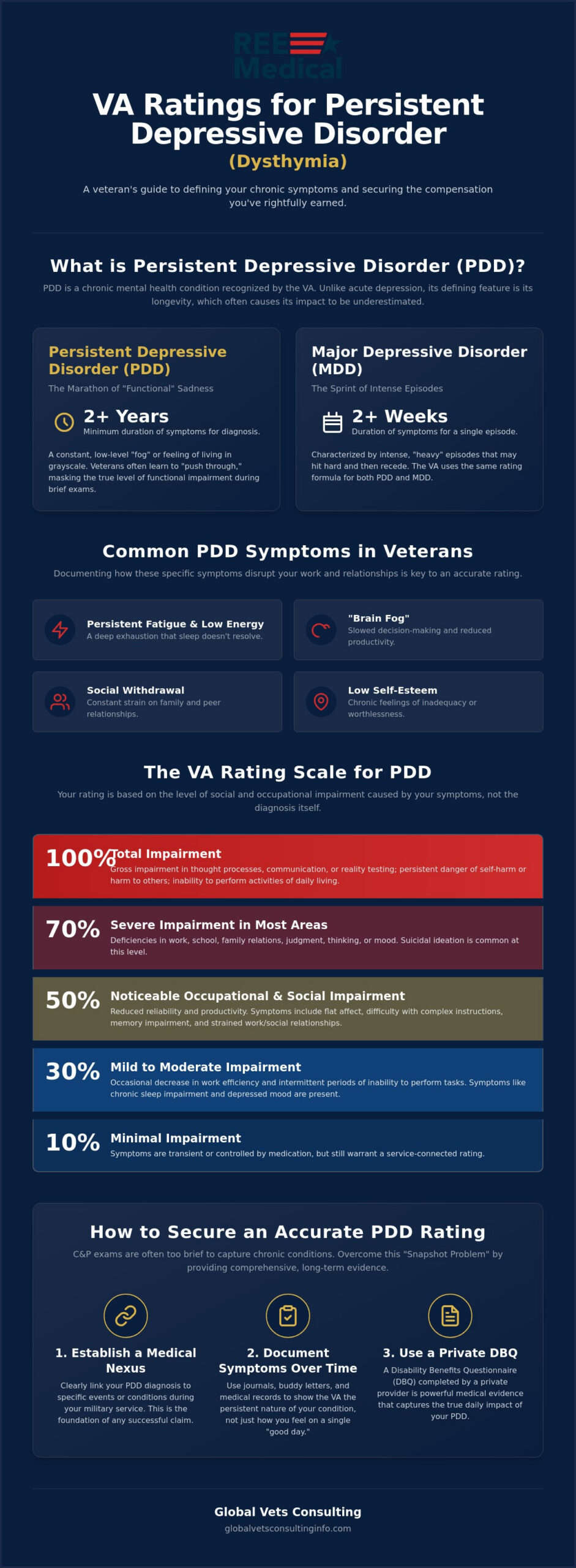
Persistent Depressive Disorder, formerly known as Dysthymia, is a chronic mental health condition that the VA recognizes under Diagnostic Code 9433. Unlike acute episodes of depression that might hit hard and then recede, PDD is defined by its longevity. To receive a diagnosis, symptoms must be present for at least two years. This long-term nature is exactly why securing an accurate va rating for persistent depressive disorder is often a challenge for veterans who have learned to “push through” the pain.
The insidious nature of this condition means it often flies under the radar during standard medical screenings. While Major Depressive Disorder (MDD) is characterized by intense, “heavy” episodes, PDD is more of a constant, low-level fog. Many veterans describe it as living life in grayscale. Because you might still be able to show up for work, examiners sometimes underestimate the profound functional impairment caused by years of unrelenting sadness and low motivation.
PDD vs. Major Depressive Disorder (MDD)
It’s a common misconception that the VA rates these conditions differently because one seems “milder.” In reality, the VA uses the same General Rating Formula for Mental Disorders for both. The primary distinction is the timeline. While MDD requires symptoms to persist for only two weeks to qualify as an episode, PDD requires a two-year history. You can find more detailed clinical information on Persistent Depressive Disorder (Dysthymia) to help you understand how these diagnostic criteria differ.
Common Symptoms of PDD in the Veteran Community
When pursuing a va rating for persistent depressive disorder, you must document how specific symptoms disrupt your ability to work and maintain relationships. Common indicators include:
- Persistent fatigue and low energy that sleep doesn’t fix.
- “Brain fog” that slows down decision-making and productivity.
- Chronic low self-esteem or feelings of inadequacy.
- Social withdrawal that puts a constant strain on your family and peer groups.
These symptoms are not just “personality traits.” They are medical indicators of a service-connected condition that deserves recognition. Even if your symptoms feel less severe than a major crisis, their constant presence creates a significant burden on your occupational and social life.
VA Rating Schedule for Persistent Depressive Disorder (0% to 100%)
The VA evaluates your claim using the General Rating Formula for Mental Disorders. This legal framework doesn’t focus on the specific name of your condition as much as it focuses on your level of functional impairment. When determining your va rating for persistent depressive disorder, the VA looks at how your chronic low mood disrupts your ability to work and interact with others. Ratings are assigned at 0%, 10%, 30%, 50%, 70%, or 100%.
- 0% and 10% Ratings: These are typically assigned when symptoms are transient or well-controlled by continuous medication. It’s important to note that proposed 2026 changes aim to establish a 10% minimum for any service-connected mental health condition, acknowledging that even “mild” symptoms carry a burden.
- 30% Rating: You may qualify here if you experience occasional decreases in work efficiency or intermittent periods of inability to perform tasks. Common symptoms at this level include chronic sleep impairment and a generally depressed mood that interferes with social life.
- 100% Rating: This is reserved for total occupational and social impairment. Symptoms often include gross impairment in communication, persistent delusions, or a complete inability to care for oneself.
The 50% Rating: Occupational and Social Impairment
A 50% rating represents a significant tipping point where your symptoms cause noticeable productivity loss. At this level, you might struggle with a “flat affect,” appearing emotionally distant or indifferent to those around you. This emotional numbness often leads to difficulty following complex instructions and strained relationships with coworkers. If you experience occasional panic attacks or find it hard to stay focused on daily tasks, you are likely meeting the criteria for this level. Understanding these specific markers is vital when seeking VA rating increase education to ensure your evidence matches your reality.
The 70% Rating: Deficiencies in Most Areas
The 70% threshold is a major jump because it indicates your mental health is causing deficiencies in most areas of life. You aren’t just struggling with low energy; you are dealing with near-continuous panic, obsessive rituals, or suicidal ideation. Socially, you might find yourself completely isolated because the effort to maintain relationships feels impossible. The 70% threshold is the point where a veteran can no longer reliably hold a 9-to-5 job due to the severity of their symptoms. 🇺🇸
Securing the correct va rating for persistent depressive disorder depends on how well you can bridge the gap between your daily struggles and these legal definitions. If your rating doesn’t reflect your actual impairment, it’s time to look closer at your medical documentation.
Proving Service Connection for Your PDD Claim
Proving service connection requires three specific pillars. First, you need a current diagnosis. According to the National Institute of Mental Health, PDD is characterized by its long-term nature, which makes the second pillar—an in-service event—and the third pillar—a medical nexus—even more critical. You can view the full evidence timeline in our guide on the VA Disability Claims Process Step by Step.
A major hurdle in securing a va rating for persistent depressive disorder is what we call the “Snapshot Problem.” A typical C&P exam lasts about 15 to 20 minutes. It’s nearly impossible for an examiner to accurately gauge a condition defined by a two-year duration in such a short window. They often see you on a day you’ve “manned up” for the appointment, missing the chronic fatigue and low motivation that plague your normal life. This is why buddy statements from family or fellow veterans are vital; they provide the long-term context an examiner cannot see.
PDD as a Secondary Condition
Many veterans discover that PDD is often secondary to chronic physical pain or tinnitus. The constant ringing in your ears or the grind of a service-connected back injury can easily lead to a persistent, low-grade depression. When filing a secondary claim, using a DBQ for Mental Health Conditions ensures that the relationship between your physical and mental health is clearly documented for the rater.
The Role of the Medical Nexus Letter
This document serves as the professional bridge between your military service and your current diagnosis. To win your va rating for persistent depressive disorder, the letter must state it is “at least as likely as not” that your service caused or aggravated your condition. This specific phrasing is the gold standard for VA approval. If you’re struggling to connect the dots, we provide independent medical evidence education to help you build a stronger case. 🇺🇸
How a Private DBQ Secures Your PDD Rating Increase
A Disability Benefits Questionnaire (DBQ) is the most powerful piece of medical evidence you can provide to the VA. While VA medical records often contain brief, generic notes from various providers, a private DBQ allows a doctor who understands your long-term history to document your condition thoroughly. This level of detail is essential when fighting for an accurate va rating for persistent depressive disorder. A private medical provider can take the time to evaluate how your “grayscale” life translates into specific functional limitations. For a deeper look at strategic implementation, read How to Use a DBQ for a VA Disability Rating Increase.
Capturing Occupational Impairment Correcty
The DBQ doesn’t just ask how you feel; it asks how you function in the real world. It provides specific sections to document your ability to work and interact with others. For veterans with PDD, accurate documentation of social isolation is critical. Since your symptoms might be seen as “less severe” than a major crisis, the DBQ acts as rebuttal evidence to a rushed C&P exam. It ensures that your decreased productivity and emotional withdrawal are recorded as medical facts rather than subjective complaints. Securing a proper va rating for persistent depressive disorder requires a detailed roadmap of your daily life.
Global Vets Consulting Worldwide: Your Partner in Evidence
At Global Vets Consulting Worldwide, our mission is “Veterans Helping Veterans” 🇺🇸. We understand the frustration of having a claim overlooked because the medical evidence was incomplete. Professional DBQ preparation is a proactive step that helps prevent VA claims denied for lack of evidence. We act as your steady guide through the bureaucratic maze, ensuring every piece of your medical history is accounted for. You don’t have to navigate this process alone.
Get the medical evidence you need for your PDD claim at Global Vets Consulting.
Take Control of Your Path to an Accurate VA Rating
Navigating the VA system for a chronic condition like PDD requires a strategy that looks beyond a single medical appointment. You now understand that the “Snapshot Problem” of a short C&P exam often fails to capture the true weight of your symptoms over time. By focusing on the three pillars of service connection and utilizing a private DBQ, you provide the rater with a comprehensive view of your occupational and social impairment. This level of detail is exactly what’s needed to secure a fair va rating for persistent depressive disorder.
Global Vets Consulting has been veteran-owned and operated since 2021. We specialize in Disability Benefits Questionnaires (DBQ) and independent medical evidence education to ensure your claim is built on a foundation of facts. Our team understands your journey because we’ve walked it ourselves. If you’re ready to bridge the gap between your daily struggles and the compensation you’ve earned, we are here to support you every step of the way.
Secure your professional DBQ for Persistent Depressive Disorder today and reach out to our 24/7 National Client Services Hotline if you need immediate assistance. You’ve served your country with honor; it’s time to ensure the system honors that service with the rating you deserve.
Frequently Asked Questions
Can I get a 100% VA rating for Persistent Depressive Disorder?
Yes, you can receive a 100% rating, but you must demonstrate total occupational and social impairment. This usually involves symptoms like a persistent danger of hurting yourself or others, or a complete inability to care for your basic needs. While PDD is often labeled as “milder” than major depression, the chronic nature can lead to this maximum rating if your functional impact is extreme and documented thoroughly by medical professionals.
What is the difference between Dysthymia and PDD in VA claims?
There is no practical difference between Dysthymia and PDD in the eyes of the VA. PDD is simply the modern clinical name for what was previously called Dysthymic Disorder in older medical manuals. The VA uses the same Diagnostic Code 9433 to evaluate both labels, so your claim remains valid and your evidence will be considered regardless of which specific term your doctor uses in your medical records.
Does the VA consider TDIU for veterans with PDD?
The VA does consider TDIU for veterans with PDD if the condition prevents them from holding a steady job. If your va rating for persistent depressive disorder is 60% or 70% but your symptoms make working impossible, you may qualify for Total Disability Based on Individual Unemployability. This allows you to be paid at the 100% rate even if your individual disability rating hasn’t reached that level yet.
How much medical evidence do I need to increase my PDD rating?
You need comprehensive medical evidence that clearly documents your current level of social and occupational impairment. This includes recent treatment records, buddy statements, and a detailed Disability Benefits Questionnaire (DBQ). The goal is to show the VA that your symptoms have worsened since your last evaluation and now meet the criteria for a higher percentage. Consistency in your treatment records is key to proving the chronic nature of the condition.
Will my PDD rating be combined with my PTSD rating?
Your PDD rating will not be added to a PTSD rating; instead, the VA assigns a single rating for all mental health conditions. This is to avoid “pyramiding,” which is the practice of rating the same symptom twice. The VA looks at the total severity of all your mental health symptoms and assigns one va rating for persistent depressive disorder or other conditions based on that combined impact on your life.

Article by
Willie Daniel
Willie Daniel is the Founder and Chief Executive Officer (CEO) of Global Vets Consulting (GVC) – National Veterans Disability Services, a veteran-led educational and medical evidence support organization dedicated to helping veterans better understand VA disability rating increases, DBQ medical evidence, secondary claims education, and C&P examination preparation.
He is a retired U.S. Army Medical Service Corps Officer with more than 27 years of honorable military service, a decorated Iraq combat veteran, and a retired federal official with the U.S. Department of Veterans Affairs. Throughout his military and federal career, Willie Daniel served in leadership, healthcare administration, operational, and veteran-support roles focused on improving services and support systems for servicemembers, veterans, and their families.
Drawing from decades of military leadership, healthcare administration, veteran advocacy, and federal government experience, Willie Daniel brings a practical, veteran-centered perspective to Global Vets Consulting’s educational articles, AI-powered veteran resources, video education initiatives, and outreach programs. His experience navigating military systems, medical documentation processes, and veteran-related administrative operations provides valuable insight into many of the challenges veterans face when seeking to better understand VA disability rating criteria, medical evidence, documentation strategies, and secondary condition education.
Through GVC’s “Veterans Helping Veterans” mission, his focus is on delivering clear, educational, and easy-to-understand information designed to empower veterans with knowledge, resources, and educational tools that may help them make more informed decisions regarding their individual VA disability journeys.
The information provided through GVC is intended for educational and informational purposes only and should not be considered legal or medical advice.
Disclaimer
Disclaimer: Global Vets Consulting, LLC (“GVC”) is a veteran-led educational and medical evidence support organization. GVC is not a law firm, is not a Veterans Service Organization (VSO), and is not affiliated with the U.S. Department of Veterans Affairs (VA) or any government agency.
Global Vets Consulting does not provide legal advice, medical advice, medical treatment, or healthcare services. GVC does not prepare, file, or submit VA disability claims on behalf of veterans. All information provided through this website, blog articles, videos, educational materials, AI tools, dashboards, templates, and communications is intended solely for general educational and informational purposes.
Veterans are encouraged to consult with accredited representatives, licensed attorneys, qualified medical providers, or Veterans Service Organizations regarding their specific legal, medical, or VA-related matters. VA disability decisions, ratings, and outcomes are determined solely by the U.S. Department of Veterans Affairs based on applicable laws, regulations, medical evidence, and individual circumstances. Past results do not guarantee future outcomes.