
Did you know that for many veterans, the difference between a 0% and a 50% rating comes down to a single checkbox on a form? In 2026, a 50% rating for sleep apnea provides approximately $1,133 per month in tax-free compensation, yet many claims fail because the medical evidence lacks specific VA terminology. It’s common to feel overwhelmed by complex criteria when your financial stability depends on a sleep apnea dbq being filled out correctly.
You’ve likely felt the frustration of trying to translate your nightly struggle for breath into the rigid language of a government document. It’s stressful to face a C&P exam feeling like the examiner might miss the severity of your condition. We believe you deserve a predictable path forward based on facts and clinical accuracy. This guide will show you how a properly completed sleep apnea dbq serves as the critical evidence needed to win your VA claim.
We’ll provide a clear path toward a 50% or 100% rating by explaining exactly what the VA looks for in your medical documentation. You’ll learn how to navigate the current rating schedule and ensure your symptoms are recorded with the precision required for a successful outcome.
Key Takeaways
- Understand how a properly completed sleep apnea dbq serves as the clinical foundation for your VA claim by documenting the true severity of your condition.
- Identify the specific medical evidence required to meet the 2026 rating criteria, ranging from asymptomatic cases to those involving persistent hypersomnolence.
- Learn why a private medical evaluation often provides a more comprehensive and accurate record of your symptoms than a standard C&P exam.
- Discover a methodical, step-by-step approach to gathering medical evidence that reduces anxiety and provides a clear path toward your earned benefits.
What is a Sleep Apnea DBQ and Why is it Critical? 🌐
A Disability Benefits Questionnaire (DBQ) is a standardized form designed to capture the specific medical evidence needed for a VA disability claim. Understanding what is a dbq for va claims is the first step to your claim. The sleep apnea dbq specifically documents the severity of respiratory sleep disorders to ensure your rating reflects your actual health status. This document serves as the primary tool for VA rating decisions by translating clinical findings into a numerical percentage.
Before looking at the paperwork, it helps to understand the clinical side of your condition. What is Sleep Apnea? provides a comprehensive overview of how these breathing interruptions impact your long-term health. The VA relies on this standardized data to determine how your condition affects your daily life and ability to work.
The Role of the DBQ in 2026 VA Claims
In 2026, the VA uses the DBQ to assign a percentage rating based on documented symptoms. There is a clear shift toward prioritizing standardized private medical evidence over generic doctor notes. A structured sleep apnea dbq ensures that every required data point, from sleep study results to the necessity of a CPAP machine, is clearly visible to the rater. This precision reduces the chance of a rater overlooking critical evidence during their review.
Direct vs. Secondary Service Connection
You can document sleep apnea as a primary condition if it started during your time in service. However, many veterans find success by claiming it as secondary to other service-connected issues like PTSD, sinusitis, or rhinitis. Regardless of the path, the DBQ must clearly state the “nexus” or medical link between your current diagnosis and your military service. Precise documentation of this link is what turns a medical diagnosis into a successful VA rating increase.
Understanding the 2026 VA Rating Schedule for Sleep Apnea
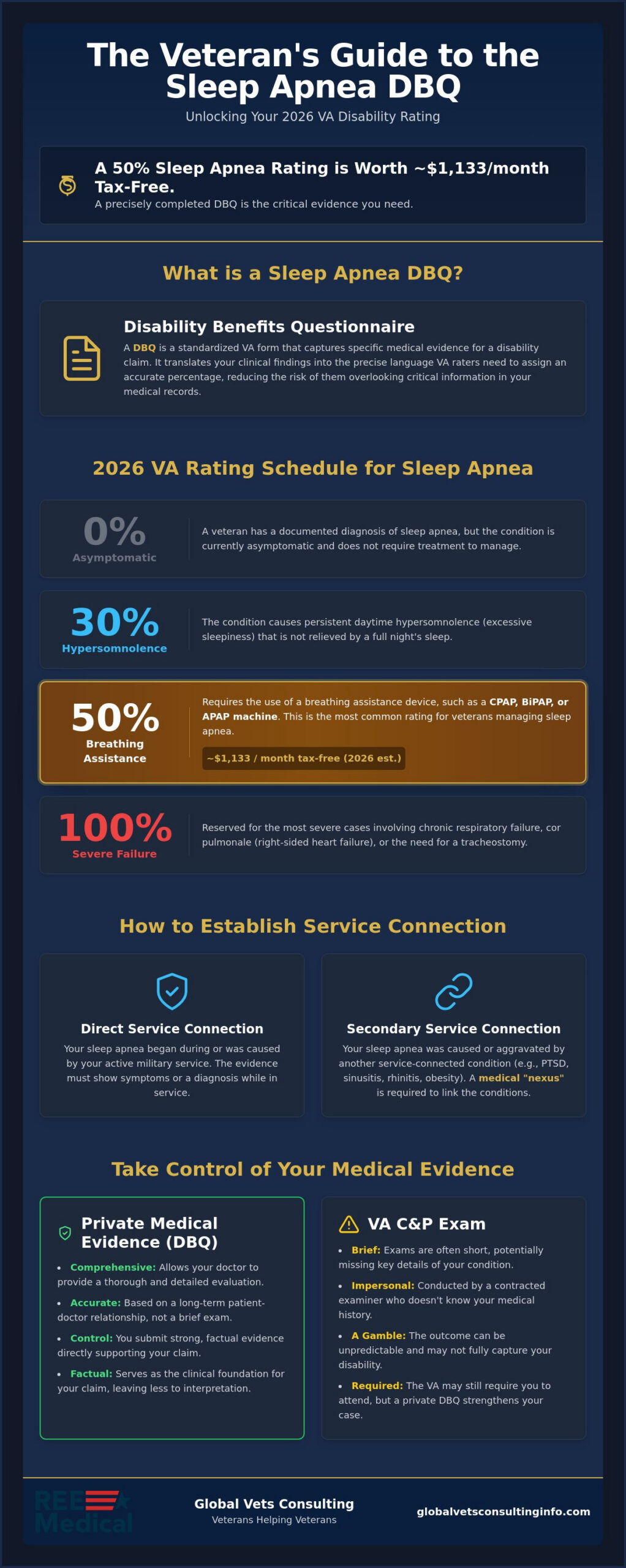
The VA assigns ratings based on the severity of your symptoms and the medical intervention required to manage them. As of July 2026, the 2026 VA Rating Schedule for Sleep Apnea remains focused on four primary tiers of disability:
- 0% Rating: You have a documented diagnosis, but you’re currently asymptomatic and don’t require continuous treatment.
- 30% Rating: Your sleep apnea dbq shows persistent daytime hypersomnolence, meaning you experience excessive sleepiness even after a night of rest.
- 50% Rating: This is the most frequent rating for veterans who require a breathing assistance device, such as a CPAP machine, to maintain an open airway.
- 100% Rating: Reserved for the most severe cases involving chronic respiratory failure, the need for a tracheostomy, or cor pulmonale.
For a single veteran in 2026, a 50% rating corresponds to approximately $1,133 per month in tax-free compensation. This level of support is often life-changing, but it depends entirely on the clinical evidence found within your medical file.
The ‘CPAP Factor’ on Your DBQ
The most critical part of the documentation for many is the section detailing your treatment. Your doctor must explicitly check the box indicating you require the use of a breathing assistance device. It isn’t enough to just have a prescription; the VA needs to see that the device is a medical necessity. The form should specify the device type, whether it’s a CPAP, BiPAP, or APAP, to ensure technical accuracy.
Documenting Functional Impairment
A diagnosis alone doesn’t tell the whole story of your service-connected struggle. You need to describe how poor sleep leads to cognitive fog or safety risks during your shift. Using a dbq for va disability rating increase helps bridge the gap between a 30% and 50% rating by focusing on these functional limitations. If you’re struggling to translate your symptoms into the VA’s required language, our veteran-led consulting team can help you understand the evidence gathering process.
Private DBQs vs. VA C&P Exams: Taking Control 📞
Relying solely on a VA-contracted C&P examiner can be a gamble for your disability claim. These exams are often brief, sometimes lasting only 15 to 20 minutes, which isn’t always enough time to capture the full scope of a complex respiratory condition. A private sleep apnea dbq provides a more comprehensive view of your medical history over time because it’s completed by a doctor who understands your long-term symptoms. If your va claim denied for lack of evidence, a privately completed questionnaire is often your strongest rebuttal tool to correct the record.
You must ensure your private physician is familiar with VA-specific terminology to avoid technical denials. The VA rater looks for specific clinical markers that a general practitioner might overlook. By taking control of the evidence-gathering process, you shift the narrative from a rushed examination to a well-documented medical case. If you’re ready to secure the evidence you’ve earned, explore our educational resources on independent medical evidence today.
What Makes a Private DBQ ‘Bulletproof’?
A high-quality questionnaire requires more than just a signature. It must have a clinical sleep study, also known as a polysomnogram, attached as supporting evidence. This objective data is the gold standard for getting a sleep apnea diagnosis that the VA will accept. Additionally, the form needs a clear rationale that links your diagnosis to your military service records through a formal medical nexus statement.
The Importance of Meticulous Documentation
Incomplete forms are one of the most common reasons for claim deferrals. Every checkbox on the sleep apnea dbq must be addressed, even if the answer is “none” or “not applicable.” This level of thoroughness significantly reduces the need for follow-up VA examinations because the rater has all the necessary information at their fingertips. When your medical evidence is precise and complete, the rater can move directly to assigning your percentage without requesting additional clarifications.
How Global Vets Consulting Supports Your Mission 🇺🇸
Global Vets Consulting operates with a sense of duty to those who served. We understand that navigating the VA system often feels like a cold transaction. That’s why our “Veterans Helping Veterans” approach prioritizes clarity and peace of mind over high-pressure tactics. You’re never just a claim number to us. To ensure you have immediate support when you need it most, we’ve integrated a 24/7 AI Veteran Intake Specialist to assist you at any hour of the day or night. We act as a steady guide through the administrative maze, offering a predictable path toward the benefits you’ve earned.
Our Step-by-Step Documentation Process
Our process is methodical and intentional. We move from broad concepts of support to specific, actionable steps that build a strong case. We begin with a detailed intake to understand your unique service history and current health challenges. This leads to the professional preparation of your sleep apnea dbq, where we focus on technical accuracy and compliance. We emphasize thoroughness to ensure the form reflects your true medical status and functional limitations. This meticulous documentation reduces anxiety by providing the VA with a clear roadmap of your condition, which helps prevent unnecessary delays or requests for clarification.
Ready to Take the Next Step?
You don’t have to face the bureaucratic system alone. Our team provides the expert education needed to streamline the evidence-gathering process. We focus on precision to help you achieve the earned outcomes you deserve for your service. Whether you’re seeking a rating increase or filing a secondary claim, we’re here to provide a reliable partnership.
- 📞 24/7 National Client Services Hotline: Call us anytime for a personalized consultation.
- 🌐 GlobalVetsConsultingInfo.com: Access educational resources designed to empower your journey.
- 🇺🇸 24/7 AI Veteran Intake Specialist: Get immediate assistance through our website.
Your health and financial stability are too important to leave to chance. Secure your Sleep Apnea DBQ with Global Vets Consulting and take control of your VA claim journey today.
Take Control of Your VA Rating Journey
Success in your VA claim requires moving beyond a simple diagnosis to provide the rater with a clear clinical roadmap. You now understand that a properly completed sleep apnea dbq is the most influential piece of evidence in your file. By documenting the exact nature of your functional impairment and the medical necessity of your treatment, you provide the rater with the specific facts needed to assign an accurate percentage. Taking control of your medical evidence is the most effective way to replace confusion with a predictable path forward.
Global Vets Consulting has been veteran-owned and operated since 2021. We specialize in professional DBQ preparation that focuses on technical accuracy and compliance. Our team provides a reliable partnership, ensuring you aren’t just a number in a crowded bureaucratic system. We offer a 24/7 National Client Services Hotline so you always have access to the support you deserve, regardless of your time zone.
Don’t leave your financial future to the results of a rushed examination. Start Your Sleep Apnea Claim with Global Vets Consulting today and experience the difference of a partnership built on integrity. You’ve earned these benefits through your service; it’s time to secure them with clinical precision.
Frequently Asked Questions
Can a private doctor fill out a Sleep Apnea DBQ for my VA claim?
Yes, any licensed private physician can complete a sleep apnea dbq for your disability claim. The VA specifically allows private medical evidence to support your case as long as the form is filled out by a qualified professional with access to your relevant medical history. This often provides a more detailed and accurate look at your symptoms than a standard government exam performed by a contractor who doesn’t know your long-term health history.
Do I still have to attend a C&P exam if I submit a private DBQ?
Submission of a private DBQ doesn’t automatically waive the requirement for a C&P exam, but it can significantly influence the outcome. In some cases, the VA may conduct an “ACE review,” which is a records-only evaluation based on your submitted evidence without requiring an in-person visit. If you are called for an in-person exam, your private documentation serves as a critical baseline that the government examiner must address in their final report.
What is the most common VA disability rating for sleep apnea in 2026?
The 50% rating is the most frequent award for veterans who require a breathing assistance device like a CPAP or BiPAP machine. As of July 2026, this rating provides approximately $1,133 per month in tax-free compensation for a single veteran. Other available ratings include 0% for asymptomatic cases, 30% for persistent daytime sleepiness, and 100% for conditions involving chronic respiratory failure or the need for a tracheostomy.
What evidence do I need to link sleep apnea to my military service?
You need three specific pieces of evidence: a formal diagnosis, a clinical sleep study (polysomnogram), and a medical nexus statement. The nexus must link your condition to your active duty service or show it is secondary to another service-connected disability like PTSD or rhinitis. Without a clear link established in your sleep apnea dbq, the VA is likely to deny the claim regardless of how severe your symptoms are.
How do I submit my completed Sleep Apnea DBQ to the VA?
You can submit your completed documentation through the VA.gov portal using the “Direct Upload” tool for the fastest processing. Alternatively, you can mail your physical forms to the VA Evidence Intake Center in Janesville, Wisconsin, or have a representative upload them through their secure systems. Ensuring your submission is complete and includes all supporting sleep study data is essential to avoid lengthy administrative delays in the review process.

Article by
Willie Daniel
Willie Daniel is the Founder and Chief Executive Officer (CEO) of Global Vets Consulting (GVC) – National Veterans Disability Services, a veteran-led educational and medical evidence support organization dedicated to helping veterans better understand VA disability rating increases, DBQ medical evidence, secondary claims education, and C&P examination preparation.
He is a retired U.S. Army Medical Service Corps Officer with more than 27 years of honorable military service, a decorated Iraq combat veteran, and a retired federal official with the U.S. Department of Veterans Affairs. Throughout his military and federal career, Willie Daniel served in leadership, healthcare administration, operational, and veteran-support roles focused on improving services and support systems for servicemembers, veterans, and their families.
Drawing from decades of military leadership, healthcare administration, veteran advocacy, and federal government experience, Willie Daniel brings a practical, veteran-centered perspective to Global Vets Consulting’s educational articles, AI-powered veteran resources, video education initiatives, and outreach programs. His experience navigating military systems, medical documentation processes, and veteran-related administrative operations provides valuable insight into many of the challenges veterans face when seeking to better understand VA disability rating criteria, medical evidence, documentation strategies, and secondary condition education.
Through GVC’s “Veterans Helping Veterans” mission, his focus is on delivering clear, educational, and easy-to-understand information designed to empower veterans with knowledge, resources, and educational tools that may help them make more informed decisions regarding their individual VA disability journeys.
The information provided through GVC is intended for educational and informational purposes only and should not be considered legal or medical advice.
Disclaimer
Disclaimer: Global Vets Consulting, LLC (“GVC”) is a veteran-led educational and medical evidence support organization. GVC is not a law firm, is not a Veterans Service Organization (VSO), and is not affiliated with the U.S. Department of Veterans Affairs (VA) or any government agency.
Global Vets Consulting does not provide legal advice, medical advice, medical treatment, or healthcare services. GVC does not prepare, file, or submit VA disability claims on behalf of veterans. All information provided through this website, blog articles, videos, educational materials, AI tools, dashboards, templates, and communications is intended solely for general educational and informational purposes.
Veterans are encouraged to consult with accredited representatives, licensed attorneys, qualified medical providers, or Veterans Service Organizations regarding their specific legal, medical, or VA-related matters. VA disability decisions, ratings, and outcomes are determined solely by the U.S. Department of Veterans Affairs based on applicable laws, regulations, medical evidence, and individual circumstances. Past results do not guarantee future outcomes.