
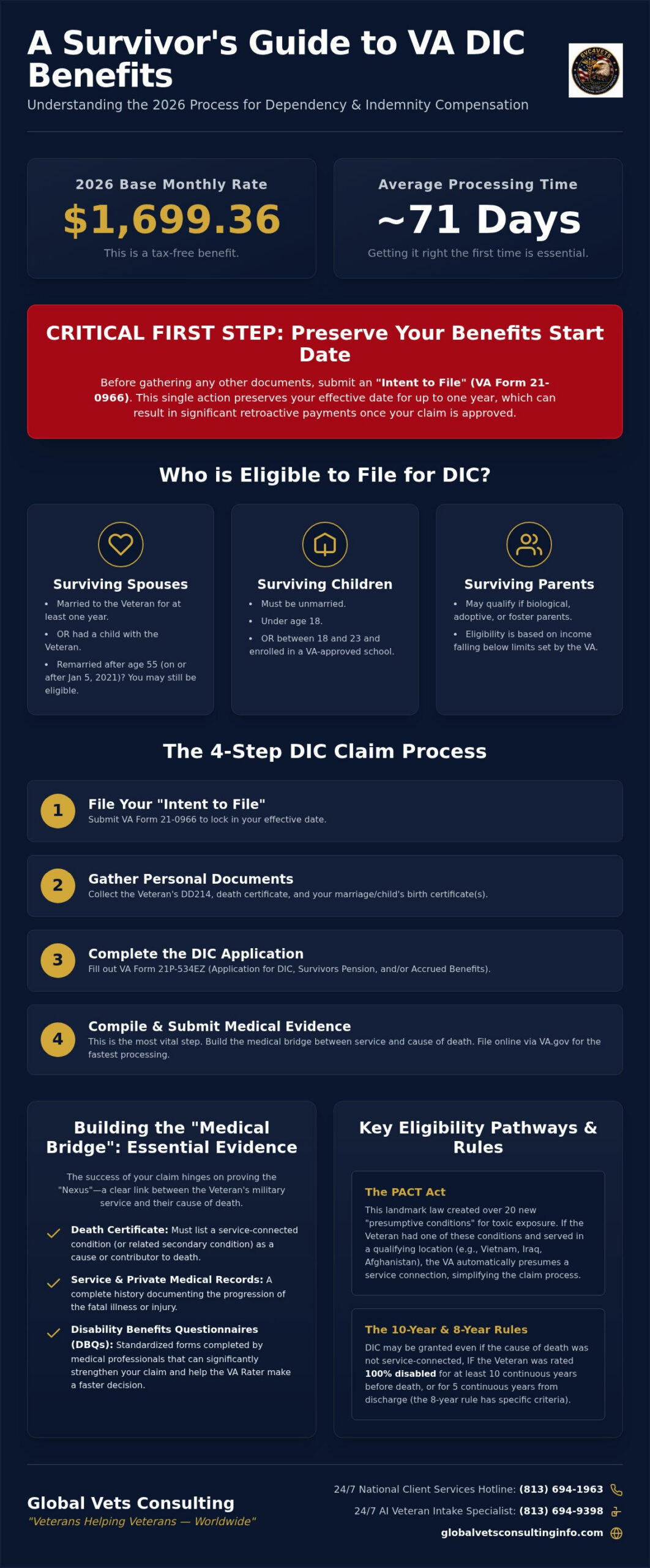
Filing for Dependency and Indemnity Compensation (DIC) isn’t just about filling out a form; it’s about building a medical bridge between your loved one’s service and their cause of death. You likely feel the weight of this responsibility while navigating the heavy fog of loss and complex VA terminology. It’s natural to feel anxious that a lack of medical evidence needed for a dic claim could lead to a denial, especially when your family’s financial security depends on it. With the average claim taking about 71 days to process in 2026, getting it right the first time is essential for your peace of mind.
This guide will show you exactly how to secure the benefits your Veteran earned and ensure a successful outcome. We’ll clarify the latest 2026 eligibility rules, including the $1,699.36 base monthly rate and the impact of the PACT Act on toxic exposure claims. You’ll learn a methodical approach to gathering documentation, from service records to Disability Benefits Questionnaires, so you can move forward with confidence and achieve the financial stability and recognition your family deserves.
Key Takeaways
- Understand the 2026 eligibility requirements for tax-free monthly DIC benefits, ensuring the Veteran’s death is recognized as service-connected.
- Learn why submitting an “Intent to File” (VA Form 21-0966) is a critical first step to preserve your effective date and maximize potential retroactive payments.
- Identify the specific medical evidence needed for a dic claim to bridge the gap between service records and the cause of death listed on the death certificate.
- Navigate common obstacles like the “Nexus” problem by understanding how to link secondary conditions to a Veteran’s primary service-connected disability.
- Discover how standardized Disability Benefits Questionnaires (DBQs) can strengthen your application and help the VA Rater process your claim more efficiently.
Understanding VA DIC Benefits and Eligibility in 2026
Dependency and Indemnity Compensation (DIC) is a tax-free monthly benefit designed to support survivors of service members and Veterans. This program, overseen by the Veterans Benefits Administration (VBA), honors the Veteran’s service by providing financial security to their family. The primary requirement is that the Veteran’s death must be service-connected; however, specific rules allow for benefits even if the cause of death wasn’t directly related to service.
For many families, the medical evidence needed for a dic claim is the deciding factor in a successful application. If a Veteran was rated totally disabled for a specific period before their death, the “10-year rule” or “8-year rule” may apply. These rules grant eligibility if the Veteran held a 100% rating for the 10 years leading up to their passing, or at least five continuous years from their discharge date. 2026 is a critical year for survivors to re-examine their status, as recent legislative expansions have opened doors for claims that were once impossible to win.
Who is Eligible to File for DIC?
Eligibility extends to several categories of survivors, each with specific requirements:
- Surviving Spouses: You must have been married for at least one year or have a child with the Veteran. Remarriage doesn’t necessarily disqualify you. If you remarried on or after January 5, 2021, and were 55 or older, you remain eligible.
- Surviving Children: Children must be unmarried and under age 18. This age limit extends to 23 if they’re enrolled in a VA-approved educational program.
- Surviving Parents: Parents may qualify if their income falls below a certain threshold set by the VA.
PACT Act Presumptions for Survivors
The PACT Act has significantly changed how the VA views toxic exposure. This law added over 20 new presumptive conditions, ranging from various cancers to respiratory illnesses. PACT Act presumptions remove the burden of proof for survivors by automatically linking specific toxic exposures to certain medical conditions, streamlining the path to approval. This shift means that the evidence needed for a dic claim is often much simpler to provide for those who served in specific locations like Vietnam, Iraq, or Afghanistan.
Step-by-Step: How to File a Claim for DIC
Securing your benefits begins with a strategic approach to the VA Dependency and Indemnity Compensation (DIC) application process. Many survivors rush to file the main application without realizing they can lock in an earlier effective date. By submitting an Intent to File (VA Form 21-0966) first, you preserve your right to benefits from that date for up to one year. This simple step can result in significant retroactive payments once your claim is approved.
After protecting your effective date, you must gather personal documents that establish your eligibility. This includes the Veteran’s death certificate, your marriage certificate, and the Veteran’s DD214. Once these are ready, you’ll complete VA Form 21P-534EZ. This form is the primary application for surviving spouses and children. The most critical phase follows: compiling the medical evidence needed for dic claim success. You must demonstrate a clear link between the Veteran’s service-connected conditions and their ultimate cause of death to satisfy VA requirements.
Choosing Your Filing Method
You have several options for submitting your paperwork. Filing online via VA.gov is the fastest method in 2026, as it bypasses traditional mail delays and enters the system immediately for processing. Alternatively, you can mail your claim to the Pension Management Center (PMC). If the administrative burden feels too heavy during this difficult time, you can access our educational resources to better understand your path forward. Working with a knowledgeable guide ensures that no technical details are overlooked.
Essential Documentation Checklist
Accuracy is your best defense against claim denials. When you prepare your submission, ensure your package includes the following items:
- The Veteran’s death certificate, which must clearly state the service-connected cause of death or a related secondary condition.
- Complete service treatment records and all relevant private medical records that document the progression of the illness.
- Standardized medical evidence that bridges the gap between military service and the Veteran’s passing.
For a broader look at the logistical side of these applications, you can review the va disability claims process step by step to see how the VA manages incoming documentation and evidence reviews.
Common Obstacles When Filing for DIC
Filing a claim often reveals hidden hurdles that can delay your financial support. One of the most frequent issues is the “Nexus” problem. This occurs when a Veteran’s death certificate lists a primary cause of death that doesn’t match their service-connected disabilities. For example, if a Veteran dies of heart failure, but their service-connected condition was diabetes, the VA may not automatically see the connection. You must provide the specific medical evidence needed for a dic claim to show how the service-connected illness contributed to or accelerated the cause of death.
Secondary service connections present another layer of complexity. If you’re trying to prove a link between two conditions, the documentation must be airtight. Incomplete DD214s or missing service records can also stall the process for months. If you’ve already received a rejection letter, don’t lose hope. You can learn how to move forward by reading our guide on what to do when a VA claim denied for lack of evidence occurs.
Addressing the Cause of Death Discrepancy
VA raters look for more than just the primary cause of death. They also consider “contributory” causes listed in Part II of the death certificate. If the service-connected disability played a significant role in the Veteran’s passing, you may still qualify for benefits. Understanding the VA DIC eligibility and evidence requirements is vital here, as it helps you identify which medical records will bridge the gap between a primary and contributory cause.
The Burden of Evidence for Survivors
The VA requires survivors to prove that the Veteran’s death was related to their service. This often leads to denials when a clear medical link is missing from the initial filing. To succeed, your evidence needed for a dic claim must meet the “at least as likely as not” standard, meaning there’s a 50% or greater chance that the service-connected condition caused or contributed to the death. If you need help gathering this critical documentation, you can get expert assistance with your medical evidence today to ensure your claim is fully developed.
Strengthening Your Claim with Medical Evidence and DBQs
Submitting a standard claim often leaves the VA Rater to hunt through hundreds of pages of disorganized records. This is where a Disability Benefits Questionnaire (DBQ) becomes your most powerful tool. A DBQ provides the standardized medical evidence needed for a dic claim by summarizing the Veteran’s condition in a format the VA already understands. Using these forms allows you to submit a Fully Developed Claim (FDC), which signals to the VA that you’ve provided all necessary proof upfront. This approach often results in a faster decision compared to the 71-day average seen in mid-2026.
Independent medical evidence bridges the gap between a Veteran’s service and their final cause of death. These documents translate complex medical histories into the specific language of service connection. If you’re unsure about the technical details of these forms, it’s helpful to learn what is a dbq for va claims and how they can prevent common evidence-based denials before you file.
How Global Vets Consulting Supports Survivors
Global Vets Consulting operates with a mission-driven “Veterans Helping Veterans” philosophy. We recognize that grieving families face immense stress while trying to navigate complex bureaucratic systems. Our team focuses on providing access to the standardized medical documentation required to evaluate service connection clearly. By specializing in DBQ preparation, we help you gather the specific evidence needed for a dic claim without the frustration of guessing what the VA rater wants to see. This structured approach reduces anxiety and provides a predictable path forward during a difficult time.
Taking the Next Step Toward Your Benefits
Success in the VA system rewards those who are proactive. You shouldn’t wait for the VA to send a request for more information; providing comprehensive medical evidence at the start is the best way to secure your family’s future. If you need immediate guidance, our 24/7 National Client Services Hotline is available to support you through the initial intake process. You can get the professional medical evidence you need with Global Vets Consulting and take the first step toward the financial stability and recognition your family deserves.
Securing Your Family’s Financial Future
Navigating the VA system after the loss of a Veteran is a heavy task, but you don’t have to carry it alone. You’ve learned how to protect your effective date with an Intent to File and how to overcome common obstacles like cause-of-death discrepancies. The most vital step is ensuring you have the precise medical evidence needed for a dic claim to avoid unnecessary denials or delays. By focusing on standardized documentation like DBQs, you provide the VA with a clear, undeniable link between service and eligibility.
Global Vets Consulting is a Veteran-owned and operated organization dedicated to simplifying this complex process. We provide specialized DBQ medical evidence support to help families achieve the stability and recognition they’ve earned. If you’re ready to move forward, our 24/7 National Client Services Hotline is standing by to help you navigate the requirements with confidence. 🇺🇸 Contact our 24/7 Veteran Intake Specialist to start your DBQ process today. Your loved one’s service deserves to be honored, and we’re here to ensure you receive every benefit available to you.
Frequently Asked Questions
How long do I have to file a claim for DIC after a Veteran dies?
You can file a claim for DIC at any time after a Veteran’s death as there’s no official deadline. However, if you submit your application within one year of the date of death, the VA can backdate your benefits to that date. Filing after the one-year mark means your payments will typically start from the date the VA receives your claim. It’s best to submit an “Intent to File” immediately to preserve your effective date.
Can I still get DIC if I remarry after the Veteran’s death?
You can continue to receive DIC benefits if you remarry on or after January 5, 2021, and were at least 55 years old at the time of the marriage. For those who remarried before that date, the age threshold was 57. If you remarry before reaching these age requirements, your benefits will generally stop. You may be able to have them restored later if that marriage ends due to death, divorce, or annulment.
What is the difference between DIC and a VA Survivors Pension?
DIC is a tax-free benefit for survivors of Veterans whose death was service-connected and isn’t based on your financial status. In contrast, the VA Survivors Pension is a needs-based benefit for low-income survivors of wartime Veterans whose death was not related to their service. The evidence needed for a dic claim focuses on the medical link to service, whereas pension claims focus on the Veteran’s wartime service and your current household income.
What happens if the Veteran’s death certificate doesn’t list their service-connected disability?
If the death certificate doesn’t list a service-connected condition, you must provide supplemental medical evidence to bridge the gap. This often involves obtaining a medical nexus letter or a Disability Benefits Questionnaire (DBQ) from a qualified professional. This documentation provides the critical evidence needed for a dic claim by explaining how a service-connected disability contributed to or accelerated the Veteran’s cause of death, even if it wasn’t the primary cause listed by the coroner.
Can I file for DIC online or do I have to mail the paperwork?
You have the option to file for DIC benefits online through the VA’s QuickSubmit tool or the VA.gov portal, which is the fastest way to get your claim into the system. You can also mail your application to the Pension Management Center or deliver it in person to a VA regional office. Choosing the digital route allows you to track your status more easily and reduces the risk of document loss during transit.

Article by
Willie Daniel
Willie Daniel is the Founder and Chief Executive Officer (CEO) of Global Vets Consulting (GVC4Vets) – National Veterans Disability Services, a veteran-led educational and medical evidence support organization dedicated to helping veterans better understand VA disability rating increases, DBQ medical evidence, secondary claims education, and C&P examination preparation.
He is a retired U.S. Army Medical Service Corps Officer with more than 27 years of honorable military service, a decorated Iraq combat veteran, and a retired federal official with the U.S. Department of Veterans Affairs. Throughout his military and federal career, Willie Daniel served in leadership, healthcare administration, operational, and veteran-support roles focused on improving services and support systems for servicemembers, veterans, and their families.
Drawing from decades of military leadership, healthcare administration, veteran advocacy, and federal government experience, Willie Daniel brings a practical, veteran-centered perspective to Global Vets Consulting’s educational articles, AI-powered veteran resources, video education initiatives, and outreach programs. His experience navigating military systems, medical documentation processes, and veteran-related administrative operations provides valuable insight into many of the challenges veterans face when seeking to better understand VA disability rating criteria, medical evidence, documentation strategies, and secondary condition education.
Through GVC’s “Veterans Helping Veterans” mission, his focus is on delivering clear, educational, and easy-to-understand information designed to empower veterans with knowledge, resources, and educational tools that may help them make more informed decisions regarding their individual VA disability journeys.
The information provided through GVC is intended for educational and informational purposes only and should not be considered legal or medical advice.
Disclaimer
Disclaimer: Global Vets Consulting, LLC (“GVC”) is a veteran-led educational and medical evidence support organization. GVC is not a law firm, is not a Veterans Service Organization (VSO), and is not affiliated with the U.S. Department of Veterans Affairs (VA) or any government agency.
Global Vets Consulting does not provide legal advice, medical advice, medical treatment, or healthcare services. GVC does not prepare, file, or submit VA disability claims on behalf of veterans. All information provided through this website, blog articles, videos, educational materials, AI tools, dashboards, templates, and communications is intended solely for general educational and informational purposes.
Veterans are encouraged to consult with accredited representatives, licensed attorneys, qualified medical providers, or Veterans Service Organizations regarding their specific legal, medical, or VA-related matters. VA disability decisions, ratings, and outcomes are determined solely by the U.S. Department of Veterans Affairs based on applicable laws, regulations, medical evidence, and individual circumstances. Past results do not guarantee future outcomes.