
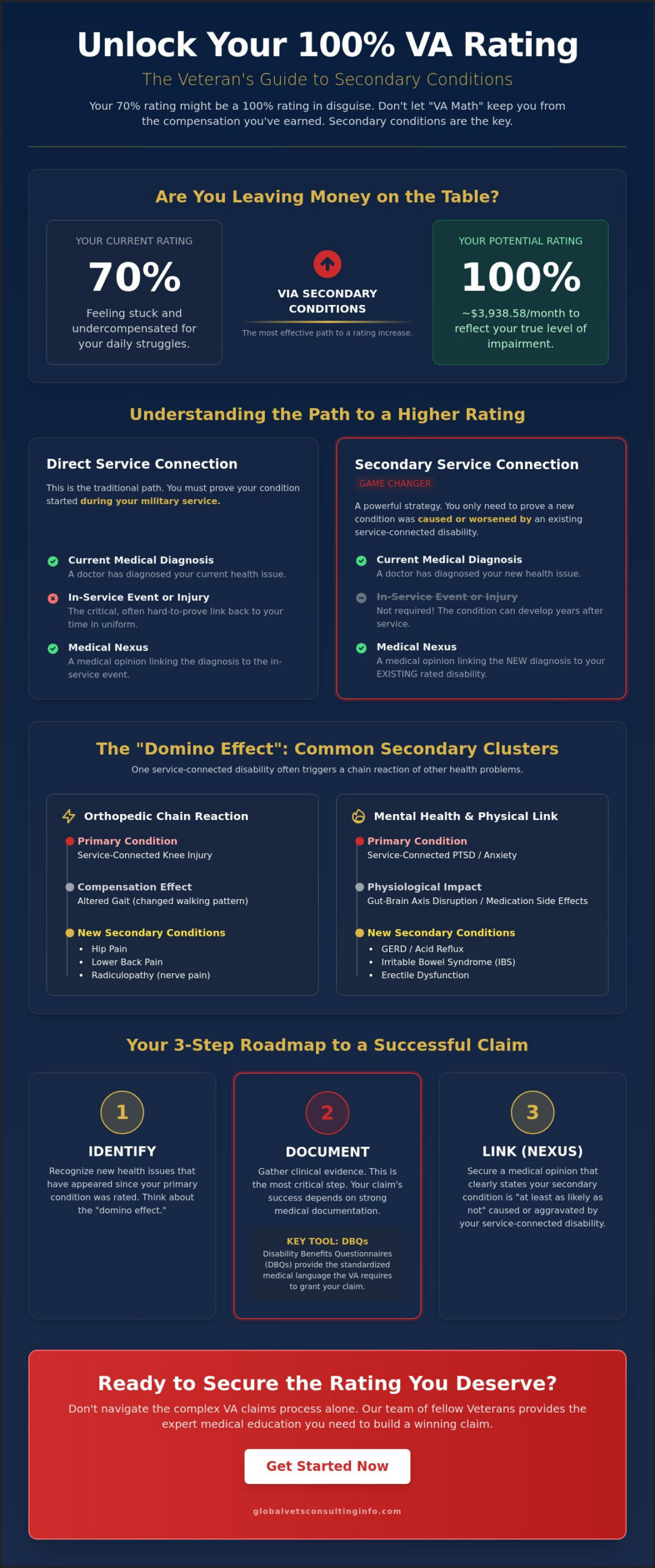
Your 70% rating might actually be a 100% rating in disguise, but you’ll never see that $3,938.58 monthly check if you only focus on your primary disabilities. It’s frustrating to feel stuck at a lower percentage while your health continues to decline because of injuries you sustained in service. You shouldn’t have to struggle with “VA Math” or feel anxious about a lack of medical evidence when your daily life is clearly impacted. Identifying the right secondary conditions to increase va rating is the most effective way to ensure your compensation reflects your true level of functional impairment.
In this guide, you’ll learn exactly how to identify, document, and link secondary conditions to your service-connected disabilities to achieve the VA rating you earned. We’ll explore the “domino effect” where a primary condition like a knee injury leads to back pain or how tinnitus can trigger mental health challenges. You’ll discover a simplified way to gather clinical evidence through Disability Benefits Questionnaires (DBQs) and independent medical education. This article provides a clear roadmap to help you navigate the 2026 rating criteria, reduce your stress during the claims process, and secure the financial support your service deserves.
Key Takeaways
- Understand how secondary service connection allows you to link new health issues to existing disabilities without needing to prove they began during your military service.
- Identify high-value disability clusters, such as orthopedic conditions leading to radiculopathy or mental health struggles causing sleep apnea and digestive issues.
- Learn how to strategically document secondary conditions to increase va rating by focusing on functional impairment and clinical evidence.
- Discover the critical role of Disability Benefits Questionnaires (DBQs) in providing the standardized medical language required to satisfy VA rating criteria.
- Master a logical, step-by-step approach to gathering medical evidence and securing the higher monthly compensation you have earned through your service.
Understanding Secondary Service Connection for a VA Rating Increase
Many veterans feel stuck at a specific percentage because they believe every claim requires proof of an incident from their time in uniform. This is a common misconception. Understanding how to use secondary conditions to increase va rating is often the missing piece to reaching a 100% disability rating. A secondary condition is any health issue that is proximately due to, or the result of, an existing service-connected disability. The most significant advantage here is that you don’t need to prove the condition started during your military service. You only need to show that your current rated disability caused or worsened the new one.
The Veterans Benefits Administration (VBA) processes millions of claims every year, and they recognize that the human body works as an interconnected system. If one part is damaged, other systems often compensate and eventually fail. These secondary ratings are added to your primary rating using “VA Math” to determine your total combined percentage. Even a 10% or 20% secondary rating can be the catalyst that pushes your monthly compensation into a higher bracket, providing the financial support you’ve earned through your service. To understand exactly how much each percentage increase is worth, review the 2026 va disability rates and monthly compensation pay charts to see the real dollar impact of adding secondary conditions.
Direct vs. Secondary Service Connection
Direct service connection requires three distinct elements: a current medical diagnosis, an event or injury that happened while you were on active duty, and a medical nexus linking the two. Secondary connection is different because it bypasses the “in-service event” requirement. You only need a current diagnosis and evidence that the condition is linked to an existing rating. This makes it a powerful tool for veterans who developed new health problems years after they hung up the uniform. If your combined secondary conditions still leave you unable to maintain substantially gainful employment, you may also qualify for total disability individual unemployability, which can provide 100% compensation even without a 100% schedular rating.
Aggravation: When Primary Injuries Make Other Issues Worse
You can also qualify for secondary conditions to increase va rating under the legal theory of “aggravation.” This applies when a primary service-connected injury makes a non-service-connected issue worse than it would have been on its own. Aggravation is a clinical worsening beyond the natural progression of a disease. If your service-connected knee injury causes an altered gait that leads to a new hip problem, that is a secondary condition. If it simply makes a pre-existing hip issue more painful and limiting, that is aggravation. Both paths lead to the same result: a higher combined rating and increased benefits.
Common Secondary Conditions That Can Boost Your Combined Rating
Many veterans don’t realize their disabilities often travel in packs. Instead of looking at each diagnosis in isolation, it’s more effective to view them as condition clusters. This organized approach helps you identify secondary conditions to increase va rating by seeing how one injury triggers a chain reaction across your body. Whether it’s a physical compensation or a chemical reaction to medication, these links are the key to a more accurate disability picture.
The ‘Invisible’ Link: Mental Health and Digestive Issues
Chronic stress, anxiety, and PTSD don’t just stay in your mind; they manifest physically. The gut-brain axis is a medical reality where psychological trauma leads to conditions like GERD or irritable bowel syndrome (IBS). If you’re taking SSRIs or other medications for a service-connected mental health condition, you might also experience secondary side effects like erectile dysfunction or further digestive distress. Documenting these as secondary claims is vital for a complete medical record. You can explore these connections further through our secondary VA claims education resources.
Orthopedic Chains: The Kinetic Link
Your body naturally compensates for pain. If you have a service-connected foot or knee injury, you’ve likely changed the way you walk to avoid discomfort. This altered gait places unnatural stress on your hips and lower back, eventually causing new, compensable injuries. A common example is radiculopathy secondary to back conditions, where nerve pain radiates down your legs due to degenerative disc disease. When you’re ready to start the official VA disability claim process, ensure these kinetic links are clearly documented by a medical professional.
Neurological conditions also serve as a root for several secondary issues. For instance, a Traumatic Brain Injury (TBI) is frequently linked to migraines, seizures, and chronic sleep disturbances. By identifying these secondary conditions to increase va rating, you ensure the VA recognizes the full scope of your health challenges. This methodical grouping turns a confusing list of symptoms into a clear, evidence-based strategy for your claim. Veterans whose combined neurological and physical conditions prevent them from holding steady employment should also explore total disability individual unemployability (TDIU) as a pathway to the full 100% compensation rate.
Step-by-Step: How to Increase VA Disability Percentage
Filing for a rating increase isn’t just about telling the VA you feel worse. It requires a methodical approach that mirrors the way the VA processes evidence. If you want to use secondary conditions to increase va rating, you must follow a specific sequence to ensure your claim isn’t immediately deferred or denied due to a lack of clinical data. This process moves you from identifying potential links to submitting a fully developed claim that is ready for a rater’s decision.
- Step 1: Identify your primary service-connected disabilities and list any new symptoms or health issues that have developed as a result.
- Step 2: Obtain a formal medical diagnosis from a healthcare provider for the secondary condition. A “complaint” of pain is not a diagnosis.
- Step 3: Secure medical evidence, specifically a Nexus Letter and a Disability Benefits Questionnaire (DBQ), that explicitly states the link between your conditions.
- Step 4: File your claim on VA.gov as either an “increased” claim for existing conditions or a “secondary” claim for new ones.
Identifying Your ‘Low-Hanging Fruit’ Claims
The easiest place to start is by reviewing your previous rating decisions. Often, a C&P examiner might have noted symptoms like “difficulty sleeping” or “recurrent heartburn” during an exam for a different condition, but they weren’t officially rated. These notes are gold mines for secondary claims. Understanding how to use a DBQ for a VA rating increase can help you turn these overlooked symptoms into a successful claim for additional compensation.
Gathering the ‘Big Three’ Evidence Pieces
To win a claim for secondary conditions to increase va rating, you need three specific pieces of evidence. First is the Diagnosis, which provides a clear medical name for your condition. Second is the Nexus, which is a medical opinion stating your secondary issue is “at least as likely as not” caused by your primary disability. Finally, the DBQ provides the standardized clinical language the VA needs to determine the severity of your symptoms. If you need assistance understanding these requirements, our team provides secondary VA claims education to help you prepare your evidence package correctly.
Why Medical Evidence (DBQs) is the Key to Winning Secondary Claims
The success of your claim doesn’t depend on how much pain you’re in, but on how well that pain is documented. It’s vital to remember that the VA rater assigned to your file is an administrative professional, not a doctor. They aren’t there to diagnose you or guess the severity of your symptoms; they’re there to “check the boxes” based on the evidence you provide. Utilizing secondary conditions to increase va rating requires a shift from telling your story to providing standardized clinical data that a rater can easily process.
Disability Benefits Questionnaires (DBQs) are the answer key to the VA’s rating schedule. These forms use the exact clinical language and measurement criteria the VA requires to assign a percentage. When you submit private DBQs, you can often file a “Fully Developed Claim” (FDC). This signals to the VA that you’ve already gathered the necessary medical evidence, which frequently leads to faster processing times compared to standard claims where the VA must hunt for records themselves. Once your claim is approved, you can reference the updated 2026 va disability rates pay charts to confirm your new monthly compensation amount. 🌐
The Role of the Nexus in Secondary Claims
A medical nexus acts as the clinical bridge that connects your primary service-connected injury to your secondary rating. Without this bridge, even a clear diagnosis will likely be denied because the rater can’t “link” it to your service. For a successful claim, your medical evidence must state that your secondary condition is “at least as likely as not” caused or aggravated by your primary disability. This specific phrase is the evidentiary standard required for approval in the VA system.
Global Vets Consulting: Your Partner in Evidence 🇺🇸
Navigating the 2026 VA requirements for medical documentation is a complex task that you shouldn’t have to face alone. At Global Vets Consulting, we specialize in secondary VA claims education and independent medical evidence resources. There’s a significant difference between a generic note from a primary care doctor and a professional DBQ designed to meet VA standards. We help you ensure your evidence is thorough, accurate, and ready for review.
We’re committed to a “Veterans Helping Veterans” mission, providing the tools you need to secure the compensation you’ve earned. If you’re ready to take the next step in your claims journey, we’re here to help. 🌎
📞 24/7 National Client Services Hotline: [Insert Number]
💻 Visit us online: GlobalVetsConsultingInfo.com
Secure Your Earned Benefits with Confidence
Leveraging secondary conditions to increase va rating is a strategic way to ensure your monthly compensation reflects the full reality of your health. By focusing on how your primary disabilities cause or aggravate other conditions, you move beyond the frustration of a stagnant rating. Success in 2026 depends on providing the VA with standardized clinical evidence that speaks the rater’s language. A clear medical nexus and a thoroughly prepared DBQ are the most effective tools for turning a confusing claim into an approved increase.
Global Vets Consulting has been veteran-owned and operated since 2021. We specialize in medical evidence education and DBQ preparation to simplify this complex administrative process for our fellow veterans. Our 24/7 AI Veteran Intake Specialist is available right now to help you identify the next steps in your journey. Start your VA rating increase journey with Global Vets Consulting today!
You served with honor and dedication. It’s time to ensure the system works for you so you can focus on your health and your family with peace of mind.
Frequently Asked Questions
Can I claim sleep apnea secondary to PTSD in 2026?
Yes, you can claim sleep apnea as a secondary condition to PTSD if a medical professional provides a clear nexus linking the two. While the VA has proposed changes to sleep apnea ratings, the current criteria involving the use of a CPAP machine remain in effect as of May 2026. You’ll need a formal diagnosis and evidence showing how your PTSD symptoms, such as weight gain from medication or sleep disturbances, contribute to your sleep apnea.
What is the ‘Nexus’ and why do I need one for a secondary claim?
A Nexus is the clinical link that proves your secondary condition was caused or aggravated by your primary service-connected disability. You need this because the VA won’t assume a connection exists, even if the relationship seems obvious to you. For secondary conditions to increase va rating, the Nexus must state that the new condition is “at least as likely as not” due to the primary one. Without this medical opinion, your claim will likely face a denial.
How many secondary conditions can I link to one primary disability?
There is no legal limit to the number of secondary conditions you can link to a single primary disability. For example, a single back injury could lead to secondary radiculopathy in both legs, hip pain, and even digestive issues from pain medication. Each condition requires its own medical diagnosis and Nexus Letter. We recommend focusing on the conditions that have the most documented impact on your daily functional abilities to build the strongest case.
Will filing for a secondary condition trigger a re-evaluation of my primary rating?
Filing any new claim, including one for secondary conditions, gives the VA the authority to review your entire disability file. While a re-evaluation is possible, it shouldn’t discourage you if your primary condition is stable or worsening. Ensure your medical evidence is current and accurately reflects your symptoms before you submit. This proactive approach helps protect your existing rating while you pursue the higher monthly compensation you’ve earned through your service.
How does ‘VA Math’ work when adding secondary conditions to my rating?
VA Math uses a combined rating table where each new percentage is taken from the “remaining efficient” part of your body. If you have a 70% rating, the VA considers you 30% “non-disabled,” so a new 10% secondary rating would only add 3% to your total, rounding to 73%. This unique calculation is why identifying multiple secondary conditions to increase va rating is often necessary to reach the next ten-percent bracket or move toward the 100% rating level.

Article by
Willie Daniel
Willie Daniel is the Founder and Chief Executive Officer (CEO) of Global Vets Consulting (GVC) – National Veterans Disability Services, a veteran-led educational and medical evidence support organization dedicated to helping veterans better understand VA disability rating increases, DBQ medical evidence, secondary claims education, and C&P examination preparation.
He is a retired U.S. Army Medical Service Corps Officer with more than 27 years of honorable military service, a decorated Iraq combat veteran, and a retired federal official with the U.S. Department of Veterans Affairs. Throughout his military and federal career, Willie Daniel served in leadership, healthcare administration, operational, and veteran-support roles focused on improving services and support systems for servicemembers, veterans, and their families.
Drawing from decades of military leadership, healthcare administration, veteran advocacy, and federal government experience, Willie Daniel brings a practical, veteran-centered perspective to Global Vets Consulting’s educational articles, AI-powered veteran resources, video education initiatives, and outreach programs. His experience navigating military systems, medical documentation processes, and veteran-related administrative operations provides valuable insight into many of the challenges veterans face when seeking to better understand VA disability rating criteria, medical evidence, documentation strategies, and secondary condition education.
Through GVC’s “Veterans Helping Veterans” mission, his focus is on delivering clear, educational, and easy-to-understand information designed to empower veterans with knowledge, resources, and educational tools that may help them make more informed decisions regarding their individual VA disability journeys.
The information provided through GVC is intended for educational and informational purposes only and should not be considered legal or medical advice.
Disclaimer
Disclaimer: Global Vets Consulting, LLC (“GVC”) is a veteran-led educational and medical evidence support organization. GVC is not a law firm, is not a Veterans Service Organization (VSO), and is not affiliated with the U.S. Department of Veterans Affairs (VA) or any government agency.
Global Vets Consulting does not provide legal advice, medical advice, medical treatment, or healthcare services. GVC does not prepare, file, or submit VA disability claims on behalf of veterans. All information provided through this website, blog articles, videos, educational materials, AI tools, dashboards, templates, and communications is intended solely for general educational and informational purposes.
Veterans are encouraged to consult with accredited representatives, licensed attorneys, qualified medical providers, or Veterans Service Organizations regarding their specific legal, medical, or VA-related matters. VA disability decisions, ratings, and outcomes are determined solely by the U.S. Department of Veterans Affairs based on applicable laws, regulations, medical evidence, and individual circumstances. Past results do not guarantee future outcomes.