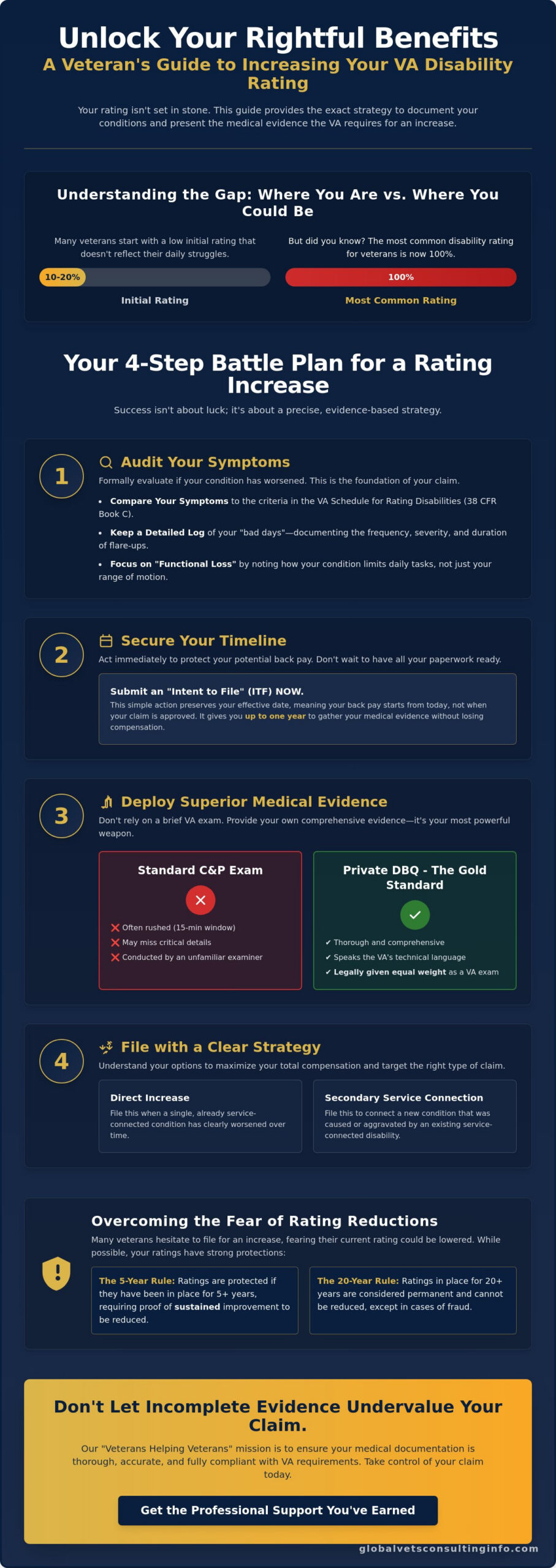
Did you know that among all veterans receiving compensation in 2025, the most common rating is now 100%? While many start with a low 10% or 20% award, the latest data shows that a significant number of your peers eventually secure the full benefits they earned. If you feel stuck with a number that doesn’t reflect your daily reality, you’re not alone in your frustration. Learning how to increase VA disability rating levels isn’t about luck or gaming the system; it’s about the precision of your medical evidence.
It’s exhausting to deal with confusing combined ratings and the anxiety of a C&P exam when your symptoms are clearly worsening. We understand that an underrated claim feels like a dismissal of your service and your daily struggles. In this guide, we’ll show you the exact strategy to document your conditions and present the medical evidence the VA requires for an increase. You’ll discover how to use Disability Benefits Questionnaires (DBQs) and secondary claims to ensure your monthly compensation finally matches your true level of disability.
Key Takeaways
- Learn how to audit your current symptoms against the VA Schedule for Rating Disabilities to determine if you meet the criteria for a higher percentage tier.
- Understand why a private Disability Benefits Questionnaire (DBQ) serves as the “gold standard” of medical evidence compared to a brief C&P exam.
- Discover the strategic difference between filing a direct increase and identifying secondary service connections to maximize your total compensation.
- Master the medical evidence strategies required to successfully Increase VA Disability Rating levels through precise and professional documentation.
- See how a “Veterans Helping Veterans” approach ensures your claim documentation is thorough, accurate, and fully compliant with VA requirements.
Evaluating Your Current Symptoms: When to Seek a VA Disability Increase
A “claim for increase” is a formal request to the U.S. Department of Veterans Affairs to re-evaluate a condition that has already been service-connected. If your symptoms have worsened since your last decision, you shouldn’t settle for an outdated percentage. To successfully increase VA disability rating levels, you must first audit your current health against the VA Schedule for Rating Disabilities (38 CFR Book C). This legal document lists the specific medical criteria required for each percentage tier. If your current symptoms match the next higher tier, it’s time to act.
Don’t wait until you have all your paperwork to start. Submit an “Intent to File” (ITF) immediately. This simple step preserves your effective date, meaning once your claim is approved, you’ll receive back pay from the day you filed the ITF. This gives you up to one year to gather medical evidence without losing money. Understanding “VA Math” is also vital. Because the VA uses a combined rating system, a 10% increase in one condition might be the push needed to move your total rating from 80% to 90%.
Identifying Worsening Symptoms and Functional Loss
You need to track your bad days. Keep a personal log that documents the frequency, severity, and duration of your flare-ups. For musculoskeletal and neurological claims, focus on “functional loss.” This means documenting how your condition limits your range of motion or your ability to perform daily tasks, even if you can technically “do” the movement.
The Risk of Rating Reductions
Many veterans hesitate to file because they fear the VA will lower their current rating. While the VA has the right to re-examine you, ratings are generally protected if they have been in place for 5 years, requiring proof of sustained improvement, or 20 years, at which point they are considered permanent except in cases of fraud. Taking a strategic approach to an increase VA disability rating request reduces this risk by ensuring your evidence is undeniable.
The Power of Private Medical Evidence: Why DBQs are Essential
You shouldn’t rely on a stranger to capture the full scope of your daily pain during a fifteen-minute window. This is exactly why understanding what is a dbq is vital for your success. A Disability Benefits Questionnaire (DBQ) is a standardized medical form designed to ensure that a physician captures the specific information the VA needs to assign a rating. It’s the “gold standard” of medical evidence because it forces the rater to look at your symptoms through the lens of the VA’s own criteria.
While the VA often relies on Compensation and Pension (C&P) exams, these are frequently rushed and incomplete. A private medical evaluation provides a thorough assessment that a standard C&P exam might miss. By submitting a private DBQ, you provide the rater with clear language, such as “at least as likely as not,” which establishes service connection or severity. Legally, the VA is required to give private medical evidence the same weight as their own exam results. You can read more about how these determinations are made in the VA’s guide About Disability Ratings.
Bridging the Evidence Gap with Professional Documentation
Personal statements and “buddy letters” from family members provide helpful context about your daily life. However, they aren’t a substitute for clinical data. To Increase VA Disability Rating percentages, you need documentation that translates your pain into the technical language of 38 CFR. Standardized DBQs ensure that no symptom is overlooked by the rater during their review, providing a predictable path toward a fair decision.
Common Evidence Failures
It’s a heartbreaking reality that many veterans see their va claim denied for lack of evidence. This usually happens because there’s a “missing link” between the diagnosis and the specific rating level requested. A private DBQ bridges this gap by providing the exact measurements or symptom frequencies required for the next tier. If you’re struggling to gather these documents, Global Vets Consulting offers the educational resources you need to Increase VA Disability Rating outcomes through professional documentation.
Strategic Filing: Direct Increases vs. Secondary Service Connection
Strategic filing is the difference between a claim that drags on for months and one that successfully moves the needle on your compensation. While a direct increase focuses on a worsening service-connected condition, secondary service connection addresses new disabilities caused or aggravated by your existing ones. For instance, if your service-connected knee injury led to weight gain that eventually caused sleep apnea, that’s a secondary link. To Increase VA Disability Rating outcomes, you must follow a methodical four-step process that accounts for these connections.
First, audit your current health to identify these secondary impacts. Second, obtain a medical nexus letter or a private DBQ that explicitly links the new condition to the primary one. Third, submit a Fully Developed Claim (FDC) to expedite the rater’s review. Finally, review your documentation thoroughly before any scheduled C&P exam to ensure your testimony matches the medical record. For more official guidance on the mechanics of submission, review the How to File a VA Disability Claim page provided by the VA.
Common Secondary Conditions for Rating Increases
Many veterans overlook the psychological toll of chronic physical pain. A dbq for mental health conditions is frequently used for secondary claims like depression or anxiety caused by a musculoskeletal injury. Other common examples include radiculopathy secondary to degenerative disc disease or migraines secondary to tinnitus. These connections are clinically documented and recognized by the rater when supported by the right medical evidence. This strategy is essential for any veteran looking to Increase VA Disability Rating totals through secondary connections.
The Fully Developed Claim (FDC) Advantage
The FDC is the fastest path to a decision in 2026 because it tells the VA you have no more evidence to submit. By providing everything upfront, you bypass the lengthy “evidence gathering” phase of the va disability claims process step by step. This proactive approach reduces the administrative burden on the VA and puts your file in front of a rater sooner. If you want to ensure your documentation is ready for an FDC, Global Vets Consulting provides the education needed to build a rock-solid case.
Maximizing Your Compensation: How Professional Documentation Secures Your Benefits
Global Vets Consulting streamlines the process of obtaining the necessary medical evidence to support your claim. Our “Veterans Helping Veterans” approach ensures that every piece of documentation is thorough, accurate, and fully compliant with current standards. We understand that you aren’t just looking for a number; you’re looking for the resources you earned through your service. While we are not a law firm and do not provide legal representation, we offer the essential medical evidence education that often makes the difference between a denial and an approval.
The financial impact of a successful Increase VA Disability Rating request is substantial. For instance, moving from a 70% rating to a 100% rating can increase your monthly compensation by thousands of dollars. In 2026, a veteran rated at 100% receives approximately $3,934.75 per month. Beyond the monthly check, reaching the 100% threshold often unlocks critical secondary benefits. These include property tax exemptions in many states, enrollment in CHAMPVA for your dependents, and dental care through the VA. We focus on ensuring your medical reality is documented so you don’t leave these benefits on the table.
Why Precision Matters in VA Paperwork
Precision is the foundation of a successful claim. One missed checkbox on a DBQ or a failure to mention a specific functional limitation can mean the difference between a 30% and 50% rating. Professional review ensures that your symptoms are translated into the specific technical language required by the rater. We help you bridge the gap between how you feel and what the bureaucracy needs to see to grant an Increase VA Disability Rating.
Taking the Next Step Toward Your 100% Rating
Don’t wait for your conditions to become completely debilitating before you take action. The system is complex, but you don’t have to face it alone. Whether you need education on mental health ratings or musculoskeletal claims, immediate support is available to help you understand the evidence requirements for your specific situation.
🇺🇸 Global Vets Consulting
🌐 GlobalVetsConsultingInfo.com
📞 24/7 National Client Services Hotline
🤖 24/7 AI Veteran Intake Specialist
Secure the Rating Your Service Deserves
You’ve served your country with honor, and it’s time to ensure the system reflects the reality of your health. We’ve explored how auditing your symptoms against the rating schedule and utilizing private medical evidence can transform your claim. Identifying secondary conditions is often the missing piece that leads to a maximum rating and the benefits you’ve earned. When you’re ready to Increase VA Disability Rating levels, precision and professional preparation are your best allies.
Don’t navigate this complex process alone. As a veteran-owned and operated team, we specialize in DBQ preparation and medical evidence education to help you succeed. Our mission is to provide the clarity and documentation needed to win your claim. We’re here to support you around the clock through our 24/7 National Client Services Hotline and modern intake specialist tools.
🇺🇸 Get the Medical Evidence You Need to Increase Your Rating at GlobalVetsConsultingInfo.com
Take the first step today. You earned these benefits through your sacrifice, and we’re here to help you secure them with confidence and peace of mind.
Frequently Asked Questions
Can the VA lower my disability rating if I ask for an increase?
Yes, the VA has the right to re-evaluate your condition when you file for an increase, but ratings are generally protected by specific time-based rules. If you’ve held a rating for five years, the VA must show sustained improvement before they can reduce it. After twenty years, a rating is considered permanent and cannot be lowered except in cases of fraud. Most veterans find that a well-documented Increase VA Disability Rating request carries minimal risk when symptoms clearly match a higher tier.
How long does a VA rating increase claim take in 2026?
While individual timelines vary, the VA is currently processing claims at a record-breaking pace, having handled over 2.5 million claims in the most recent fiscal year. Most veterans filing a Fully Developed Claim (FDC) can expect a decision faster than those in the standard lane. Providing all medical evidence and DBQs upfront reduces the time spent in the evidence-gathering phase. This streamlined approach is the most efficient way to secure your updated compensation in 2026.
Do I need a new C&P exam if I submit a private DBQ?
The VA may still order a Compensation and Pension (C&P) exam even if you submit a private Disability Benefits Questionnaire (DBQ), but they are legally required to consider your private evidence with equal weight. A thoroughly completed private DBQ often provides the rater with enough information to make a decision without a new exam. If a C&P is ordered, your private documentation serves as a critical baseline to ensure the VA examiner doesn’t overlook your worsening symptoms or functional loss.
What is the most common reason for a VA rating increase denial?
The most frequent reason for denial is a lack of medical evidence that specifically matches the criteria for the next percentage tier. Many veterans show that their condition is worsening but fail to provide the clinical measurements or frequency of flare-ups required by the VA Schedule for Rating Disabilities. Without a clear link between your symptoms and the legal rating requirements, the rater cannot grant the increase. Professional documentation and DBQ education are designed to prevent this specific failure.
Can I claim a new condition as secondary to an existing one for an increase?
You can certainly claim a new condition as secondary if it was caused or aggravated by an existing service-connected disability. This is a powerful strategy to Increase VA Disability Rating totals when your primary injury leads to new health issues. For example, if your service-connected back pain causes nerve issues in your legs, you can file for radiculopathy as a secondary claim. This approach ensures your total combined rating accurately reflects the full impact of your service on your daily life.

Article by
Willie Daniel
Willie Daniel is the Founder and Chief Executive Officer (CEO) of Global Vets Consulting (GVC) – National Veterans Disability Services, a veteran-led educational and medical evidence support organization dedicated to helping veterans better understand VA disability rating increases, DBQ medical evidence, secondary claims education, and C&P examination preparation.
He is a retired U.S. Army Medical Service Corps Officer with more than 27 years of honorable military service, a decorated Iraq combat veteran, and a retired federal official with the U.S. Department of Veterans Affairs. Throughout his military and federal career, Willie Daniel served in leadership, healthcare administration, operational, and veteran-support roles focused on improving services and support systems for servicemembers, veterans, and their families.
Drawing from decades of military leadership, healthcare administration, veteran advocacy, and federal government experience, Willie Daniel brings a practical, veteran-centered perspective to Global Vets Consulting’s educational articles, AI-powered veteran resources, video education initiatives, and outreach programs. His experience navigating military systems, medical documentation processes, and veteran-related administrative operations provides valuable insight into many of the challenges veterans face when seeking to better understand VA disability rating criteria, medical evidence, documentation strategies, and secondary condition education.
Through GVC’s “Veterans Helping Veterans” mission, his focus is on delivering clear, educational, and easy-to-understand information designed to empower veterans with knowledge, resources, and educational tools that may help them make more informed decisions regarding their individual VA disability journeys.
The information provided through GVC is intended for educational and informational purposes only and should not be considered legal or medical advice.
Disclaimer
Disclaimer: Global Vets Consulting, LLC (“GVC”) is a veteran-led educational and medical evidence support organization. GVC is not a law firm, is not a Veterans Service Organization (VSO), and is not affiliated with the U.S. Department of Veterans Affairs (VA) or any government agency.
Global Vets Consulting does not provide legal advice, medical advice, medical treatment, or healthcare services. GVC does not prepare, file, or submit VA disability claims on behalf of veterans. All information provided through this website, blog articles, videos, educational materials, AI tools, dashboards, templates, and communications is intended solely for general educational and informational purposes.
Veterans are encouraged to consult with accredited representatives, licensed attorneys, qualified medical providers, or Veterans Service Organizations regarding their specific legal, medical, or VA-related matters. VA disability decisions, ratings, and outcomes are determined solely by the U.S. Department of Veterans Affairs based on applicable laws, regulations, medical evidence, and individual circumstances. Past results do not guarantee future outcomes.