
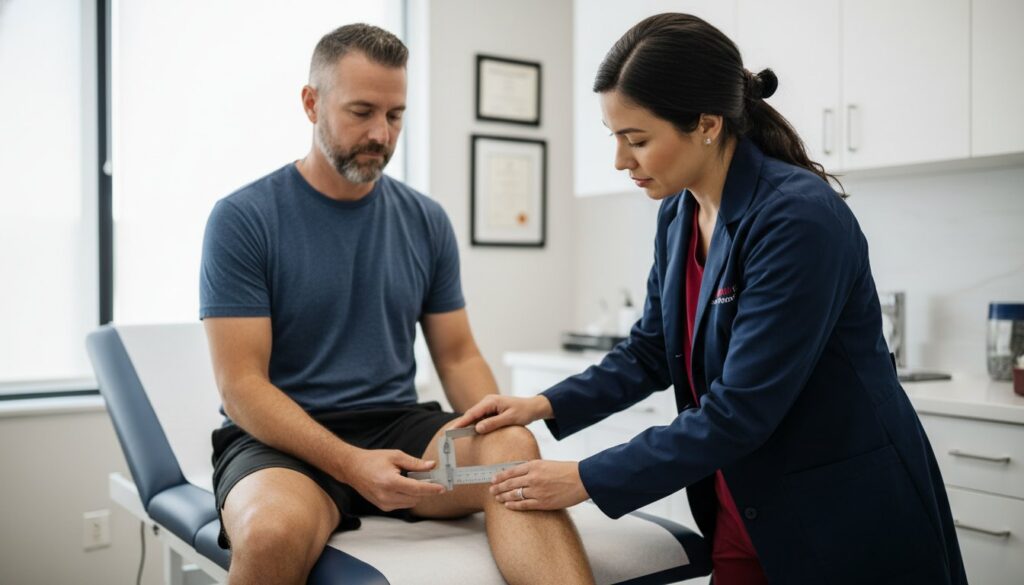
What if the most critical factor in your VA claim isn’t the pain you feel every day, but the specific degrees of movement recorded on a single piece of paper? You know your knee condition limits your mobility, yet proving that to a bureaucratic system often feels like an uphill battle. It’s natural to feel anxious that a short C&P exam might miss the reality of your daily struggle. Using a professional dbq for knee pain allows you to take control of your medical evidence by ensuring every limitation is documented with the precision the VA requires.
You’ve worked hard for your country, and you deserve a rating that reflects the true impact of your service-connected injuries. This guide will teach you how to accurately document your condition to secure the VA rating you’ve earned under the 2026 cost-of-living adjustments. We’ll explore the specific range of motion requirements the VA uses to determine your percentage, the importance of the updated October 2025 forms, and how to prepare for your examination with steady confidence. By the end of this article, you’ll have a clear, step-by-step understanding of how to turn your clinical symptoms into a successful disability claim.
Key Takeaways
- Identify why the standardized dbq for knee pain is the most critical tool for documenting musculoskeletal functional loss and securing your 2026 rating increase.
- Understand how precise Range of Motion (ROM) measurements using a goniometer provide the objective evidence the VA requires to assign a fair disability percentage.
- Compare the benefits of obtaining a private DBQ versus attending a standard C&P exam to determine which path offers the most thorough documentation for your condition.
- Learn how to support your claim by integrating diagnostic imaging and ensuring your examiner conducts a comprehensive review of your official C-File.
- Follow a structured submission process that aligns your medical evidence with VA requirements to reduce anxiety and achieve a predictable, earned outcome.
Understanding the DBQ for Knee and Lower Leg Conditions
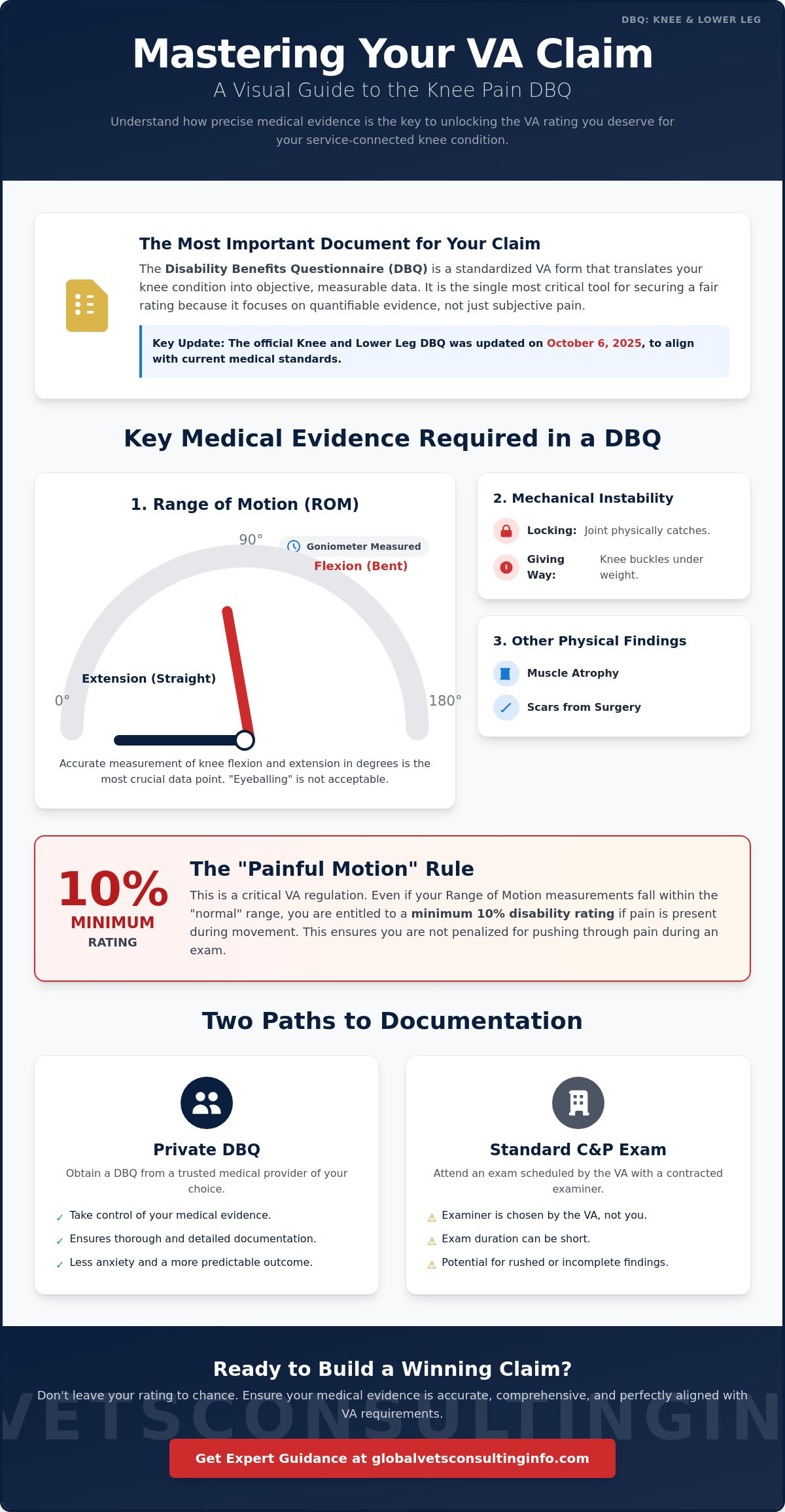
Establishing a successful claim requires more than just telling the VA your knee hurts. A Disability Benefits Questionnaire (DBQ) is a standardized evidence tool designed to capture the exact medical data raters use to evaluate your condition. In 2026, the dbq for knee pain remains the single most important document for musculoskeletal claims because it requires the examiner to record objective measurements rather than just subjective complaints. The VA updated the Knee and Lower Leg DBQ on October 6, 2025, to ensure that ratings align with current medical standards and precise anatomical findings.
To better understand what this process looks like in practice, watch this helpful overview of the examination:
Whether you suffer from patellar tendonitis, a meniscus tear, or degenerative arthritis, the dbq for knee pain serves as the bridge between your diagnosis and your monthly compensation. The form specifically addresses mechanical issues and joint stability. For example, if you have a meniscus tear, the form will ask about “locking” or “giving way,” which are specific indicators of functional loss that can lead to higher ratings. This structured format helps establish a clear service connection by linking your current physical limitations to your military records.
The Connection Between Medical Evidence and VA Ratings
VA raters don’t just guess your percentage. They follow the 38 CFR Part 4 Schedule for Rating Disabilities, which acts as a legal blueprint for compensation. This schedule links specific physical findings to percentage tiers, such as the common 10% or 30% ratings for knee conditions. A diagnosis alone isn’t enough to secure these benefits. You must demonstrate a functional limitation, which is the inability to perform the normal working movements of the body with ordinary speed and accuracy. The DBQ captures this by recording your pain during motion and any instability that requires assistive devices, ensuring your rating reflects your actual level of impairment.
Key Medical Evidence Required in a Knee Pain DBQ
The VA relies on quantifiable data to process your claim. When completing a dbq for knee pain, the most critical measurement is your Range of Motion (ROM). Examiners must use a device called a goniometer to measure the exact degrees of your knee’s flexion (bending) and extension (straightening). If an examiner merely “eyeballs” your movement, the resulting data may be inaccurate, potentially leading to a lower rating than your condition warrants. You can review the official VA DBQ forms to see exactly how these measurements are categorized and recorded.
Beyond simple movement, the form requires documentation of mechanical instability. This includes specific symptoms like “locking,” where the joint physically catches, or “giving way,” which refers to the knee buckling under your weight. These findings are vital because they demonstrate functional loss that impacts your safety and stability. The questionnaire also accounts for physical changes like muscle atrophy, which indicates long-term disuse of the limb, and scar tissue from previous surgeries that might restrict your movement. Accuracy here is paramount, as these details provide the rater with a full picture of your physical limitations.
The Painful Motion Rule and Functional Loss
One of the most misunderstood aspects of VA law regarding a dbq for knee pain is the “Painful Motion” rule. Even if your range of motion is technically within a normal range, you are entitled to a minimum 10% disability rating if pain is present during movement. This ensures that veterans aren’t penalized for pushing through the pain during an exam. When describing your symptoms, it’s helpful to frame them as “functional loss.” This means explaining how your knee pain prevents you from performing daily tasks, such as the difficulty of climbing stairs or the inability to walk for extended periods without rest.
Secondary Conditions Linked to Knee Pain
Knee issues rarely exist in isolation. Many veterans find that their knee pain is actually a result of radiculopathy secondary to back condition, where nerve issues in the spine affect the lower extremities. Additionally, a service-connected knee injury often leads to an altered gait. This “overcompensation” factor can cause secondary issues in your opposite knee, hips, or ankles as your body tries to shield the injured joint. Documenting these connections is essential for a comprehensive rating. If you feel your knee condition has caused additional physical strain, exploring musculoskeletal claims education can provide the clarity needed to proceed with confidence.
How to Get Your Knee DBQ Completed: Private Doctor vs. C&P Exam
You have two distinct paths for completing your medical documentation. The first is a Compensation and Pension (C&P) exam scheduled by the VA at no cost to you. While convenient, these exams are often brief, sometimes lasting only 15 minutes. This brevity can lead to an incomplete picture of your condition. Alternatively, choosing a private DBQ for your VA claim allows you to work with a provider who can dedicate the necessary time to review your full medical history. Regardless of the path you choose, the examiner must use the VA Form 21-0960M-9, Knee and Lower Leg Conditions DBQ to ensure the data is standardized for the rater.
A common concern for veterans in 2026 is whether the VA still accepts evidence from private physicians. The answer is a definitive yes. By law, the VA is required to consider DBQs from non-VA providers. However, the effectiveness of a dbq for knee pain depends heavily on consistency. Your questionnaire must align with your existing treatment records. If your medical file shows years of chronic instability and physical therapy, a private DBQ that mirrors these findings carries significant weight. Discrepancies between your daily reality and your documentation are a primary reason for claim denials.
Documenting Your “Worst Day” and Flare-Ups
One of the biggest mistakes veterans make during an exam is describing how they feel at that exact moment. If you’re having a “good day” when you walk into the clinic, you might inadvertently downplay your symptoms. You must communicate the severity of your “worst day.” Your dbq for knee pain should reflect your limitations during a flare-up. VA regulations require examiners to comment on how your Range of Motion (ROM) is affected by repetitive use over time. If your knee locks after walking half a mile, that functional loss must be recorded to ensure an accurate rating.
Securing the right evidence is the foundation of a successful claim. If you need help understanding how to present your medical history effectively, explore our C&P Examination Preparation Education to ensure you’re ready for your appointment.
Step-by-Step: Submitting Your Knee DBQ for a Higher Rating
A successful claim submission depends on the organization and completeness of your evidence package. Before you upload your dbq for knee pain, you must gather all relevant diagnostic imaging, such as X-rays or MRIs, to provide objective proof of your condition’s severity. These images serve as concrete anchors for the findings recorded on your questionnaire. It’s equally vital to verify that your examiner has reviewed your entire claims folder, known as the C-File. The VA often questions the validity of a private exam if the doctor hasn’t explicitly noted that they reviewed your historical service records and treatment history on the form itself.
Once your documentation is ready, the most efficient path is to upload the completed document directly to VA.gov. This is a key step when pursuing a DBQ for VA disability rating increase. Providing a fully developed claim reduces the administrative burden on the VA and speeds up the decision process. At Global Vets Consulting, we streamline the medical documentation process for veterans by providing professional education on Disability Benefits Questionnaires (DBQ) and VA Rating Increases. Our mission is to ensure you feel empowered and prepared throughout every stage of your claim journey.
Final Review Checklist Before Submission
Meticulousness during the final review can prevent months of delays. Use this checklist to ensure your dbq for knee pain is ready for rater scrutiny:
- Confirm every single checkbox is marked; an empty box can be interpreted as an incomplete exam.
- Ensure the medical rationale is clear and directly links your current symptoms to your service or a secondary condition.
- If a nexus is required, verify the examiner used the specific “at least as likely as not” or “more likely than not” legal language.
- Check that the Range of Motion measurements are recorded in degrees and reflect your functional loss during flare-ups.
A comprehensive and technically accurate DBQ provides the VA with a clear path to approval, significantly reducing the likelihood of a frustrating remand or denial.
Secure the VA Rating You Deserve
Documenting your knee condition requires a strategic approach that prioritizes objective evidence over subjective pain. You’ve learned that a successful dbq for knee pain depends on precise range of motion measurements and a clear connection to your military service. By focusing on functional loss and ensuring your medical records are consistent, you’ll significantly improve your chances of a favorable outcome. The bureaucratic system is complex, but with the right preparation, you can navigate it with steady confidence.
Taking control of your medical evidence is the most effective way to reduce anxiety about your claim. Global Vets Consulting is veteran-owned and operated, and we specialize in the latest 2026 VA documentation standards. We provide a streamlined evidence-gathering process designed to help you present a fully developed claim to the VA. Don’t leave your compensation to chance by relying on a rushed examination.
Get the Professional DBQ Documentation You Need for Your Knee Claim. You’ve already put in the hard work during your service. Now it’s time to ensure your benefits reflect that commitment. We’re here to serve as your reliable partner in this journey.
Frequently Asked Questions
Can I fill out my own DBQ for knee pain?
No, a DBQ must be completed and signed by a licensed medical professional to be considered valid evidence by the VA. While you can provide your doctor with your medical history and descriptions of your flare-ups, the clinical measurements and diagnostic conclusions require a professional’s expertise. Submitting a self-completed dbq for knee pain will lead to the VA rejecting the document as non-credible medical evidence.
What is the highest VA rating for knee pain?
The highest rating depends on the specific diagnostic code applied to your condition, but most single-knee limitations are capped between 30% and 60%. For example, the most common rating for limitation of flexion is 10%, though severe cases can reach 30%. If you undergo a total knee replacement, you’re entitled to a temporary 100% rating for four months following the surgery, which then settles at a 30% permanent minimum rating after reevaluation.
Does the VA require a C&P exam if I submit a private DBQ?
The VA often schedules a C&P exam even after receiving a private dbq for knee pain, though they aren’t legally required to do so if your submission is “sufficient for rating purposes.” If your private documentation is thorough and includes all necessary goniometer measurements, a rater may decide your claim without an additional exam. You should always attend any VA-scheduled appointment to ensure your claim remains active and isn’t denied for a failure to report.
How much does it cost to get a private knee DBQ?
Fees for private medical evaluations vary significantly based on the provider’s specialization and the depth of the medical record review required. It’s important to remember that the VA does not reimburse veterans for any costs associated with obtaining private medical evidence. You should verify pricing directly with independent medical professionals who understand the specific documentation standards required for VA musculoskeletal claims in 2026.
What happens if my DBQ and my C&P exam results contradict each other?
When medical opinions conflict, the VA rater must determine which document has more “probative value” based on the evidence provided. A private DBQ often carries more weight if it’s supported by years of treatment records and a more detailed examination than a standard C&P appointment. If the evidence from both exams is equally balanced in terms of credibility, the VA is legally obligated to apply the “benefit of the doubt” rule and find in your favor.

Article by
Willie Daniel
Willie Daniel is the Founder and Chief Executive Officer (CEO) of Global Vets Consulting (GVC) – National Veterans Disability Services, a veteran-led educational and medical evidence support organization dedicated to helping veterans better understand VA disability rating increases, DBQ medical evidence, secondary claims education, and C&P examination preparation.
He is a retired U.S. Army Medical Service Corps Officer with more than 27 years of honorable military service, a decorated Iraq combat veteran, and a retired federal official with the U.S. Department of Veterans Affairs. Throughout his military and federal career, Willie Daniel served in leadership, healthcare administration, operational, and veteran-support roles focused on improving services and support systems for servicemembers, veterans, and their families.
Drawing from decades of military leadership, healthcare administration, veteran advocacy, and federal government experience, Willie Daniel brings a practical, veteran-centered perspective to Global Vets Consulting’s educational articles, AI-powered veteran resources, video education initiatives, and outreach programs. His experience navigating military systems, medical documentation processes, and veteran-related administrative operations provides valuable insight into many of the challenges veterans face when seeking to better understand VA disability rating criteria, medical evidence, documentation strategies, and secondary condition education.
Through GVC’s “Veterans Helping Veterans” mission, his focus is on delivering clear, educational, and easy-to-understand information designed to empower veterans with knowledge, resources, and educational tools that may help them make more informed decisions regarding their individual VA disability journeys.
The information provided through GVC is intended for educational and informational purposes only and should not be considered legal or medical advice.
Disclaimer
Disclaimer: Global Vets Consulting, LLC (“GVC”) is a veteran-led educational and medical evidence support organization. GVC is not a law firm, is not a Veterans Service Organization (VSO), and is not affiliated with the U.S. Department of Veterans Affairs (VA) or any government agency.
Global Vets Consulting does not provide legal advice, medical advice, medical treatment, or healthcare services. GVC does not prepare, file, or submit VA disability claims on behalf of veterans. All information provided through this website, blog articles, videos, educational materials, AI tools, dashboards, templates, and communications is intended solely for general educational and informational purposes.
Veterans are encouraged to consult with accredited representatives, licensed attorneys, qualified medical providers, or Veterans Service Organizations regarding their specific legal, medical, or VA-related matters. VA disability decisions, ratings, and outcomes are determined solely by the U.S. Department of Veterans Affairs based on applicable laws, regulations, medical evidence, and individual circumstances. Past results do not guarantee future outcomes.