

Your medical records tell the VA what your diagnosis is, but they rarely explain how that condition actually stops you from living your life. A well-crafted spouse statement for va claim acts as the essential functional bridge between a doctor’s technical notes and the daily reality of your disability. It’s frustrating when a 15-minute C&P exam fails to capture your worst days, leaving you feeling like the system is ignoring your struggle. You’re right to feel anxious about filling out federal forms like VA Form 21-10210, especially when the stakes for your family’s future are so high.
We’ve seen how navigating these bureaucratic hurdles feels overwhelming, but you don’t have to do it alone. This article will teach you exactly how to leverage a spouse statement to provide the critical buddy evidence needed to win your claim. We’ll provide a clear framework for documenting functional loss, using the latest 2026 VA standards and digital submission tools to ensure your story is heard. By the end of this guide, you’ll know how to transform personal observations into a powerful tool for a higher VA rating and the validation you deserve.
Key Takeaways
- Identify the specific paperwork required for submitting a spouse statement for va claim to ensure your evidence is filed correctly on the official VA Form 21-10210.
- Learn how to document functional loss by shifting the focus from medical jargon to the specific, real-world limitations the veteran faces in their daily routine.
- Understand the critical distinction between clinical DBQs and lay evidence, and why both are necessary to provide the human element in a VA rating increase.
- Discover how to avoid common pitfalls by replacing vague descriptions with precise, observable facts that capture the reality of the veteran’s worst days.
The Power of a Spouse Statement for Your VA Claim
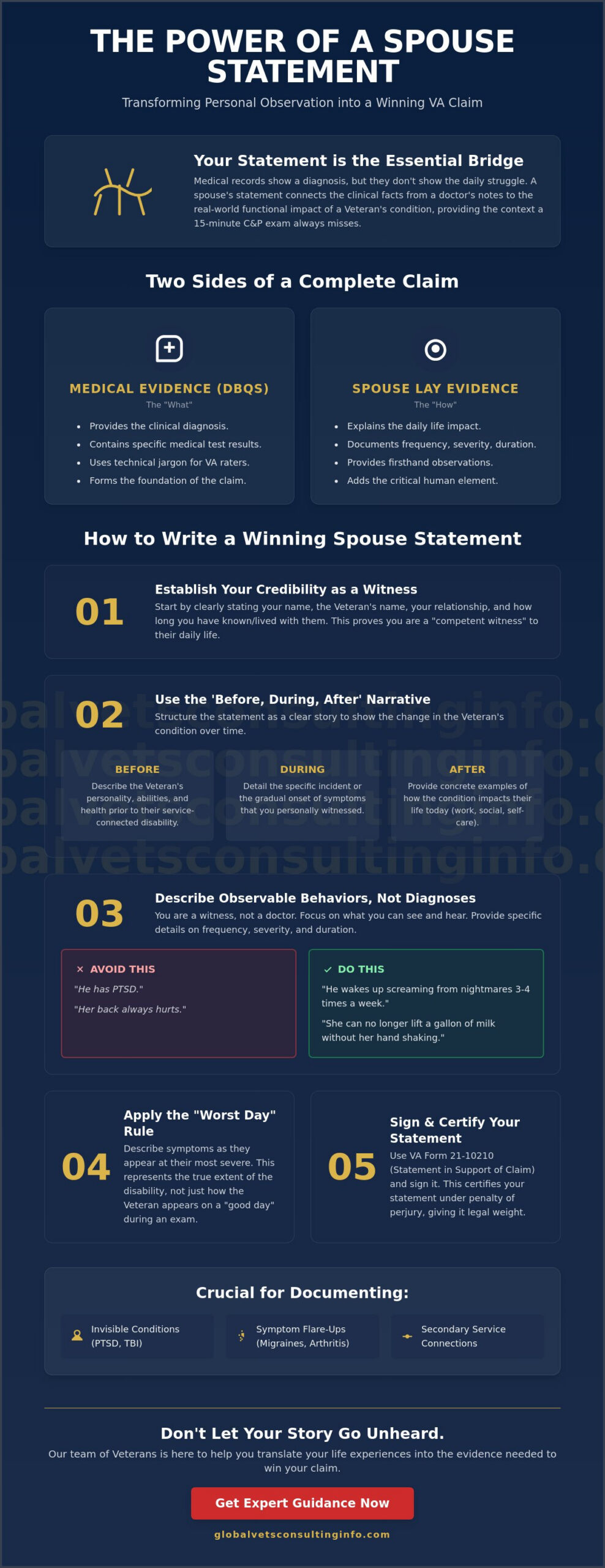
A spouse statement for va claim is officially documented on VA Form 21-10210, also known as a Statement in Support of Claim. While your medical records provide the clinical diagnosis, this form provides the necessary context that a 15 minute Compensation and Pension (C&P) exam simply cannot capture. Your spouse is with you 24/7. They see the flare ups, the night terrors, and the physical limitations that occur long after you’ve left the doctor’s office. Lay evidence is the primary way to document the frequency, severity, and duration of your symptoms for the Veterans Benefits Administration (VBA).
The VA operates under a competency rule, which is a powerful tool in your favor. This rule states that your spouse is a competent witness to anything they personally observe. They don’t need a medical degree to describe how you struggle to walk down the stairs or how your mental health affects your ability to interact with your children. Their firsthand observations carry weight because they provide a continuous record of your functional loss over time. This evidence helps the rater understand that your condition isn’t just a collection of symptoms on a page, but a daily struggle that impacts your quality of life.
When to Use VA Form 21-10210
Submit this form when you need to bridge the gap between medical data and daily reality. It’s essential for invisible conditions like PTSD, Traumatic Brain Injury (TBI), and migraines where symptoms aren’t always visible on a standard medical scan. Whether you’re seeking a VA rating increase or pursuing secondary service connection, this evidence provides the human element raters need to see. You can learn more about where this fits into your overall strategy in our VA disability claims process step by step guide.
How to Write a Winning Spouse Statement: A Step-by-Step Guide
Writing a spouse statement for va claim requires more than just a heartfelt letter. You need a structured approach to ensure your evidence carries weight with the rater. Start by clearly establishing your relationship and the length of time you’ve observed the veteran’s daily life. This foundation proves you are a competent witness to their struggles. Establishing this timeline is the first step in building a credible narrative that the VA can’t easily dismiss.
The most critical element is documenting functional loss. You must explain what the veteran can no longer do today that they could do before their service-connected disability. This isn’t just about pain; it’s about the loss of ability. For example, instead of saying “his back hurts,” explain that “he can no longer bend down to tie his own shoes.” Always apply the “Worst Day” rule. Describe the symptoms as they appear at their most severe, as this represents the true extent of the disability. Finally, ensure you sign and certify the statement under penalty of perjury. You can use the official VA Form 21-4138 (Statement in Support of Claim) to provide this testimony. If you’re unsure how to align your statement with clinical evidence, exploring medical evidence education can provide the clarity you need.
The ‘Before, During, After’ Narrative Structure
A compelling statement follows a clear timeline. Begin with the “Before” by describing the veteran’s health or personality prior to the service-connected event. Next, detail the “During” phase, focusing on the specific incident or the gradual onset of symptoms you witnessed. End with the “After,” providing concrete examples of how the condition currently impacts their work, social life, and ability to perform self-care tasks. This structure helps the rater see the progression of the disability.
Describing Observable Behaviors vs. Diagnoses
Avoid the common mistake of trying to diagnose the veteran. A spouse should never state “he has PTSD” or “he has a herniated disc.” Instead, describe what you actually see. Use specific details regarding frequency, severity, and duration. Rather than using medical labels, write “he wakes up screaming three times a week” or “she cannot lift a gallon of milk without visible tremors.” This focus on observable behavior makes your statement an invaluable piece of lay evidence that complements technical medical records.
Lay Evidence vs. Medical Documentation (DBQs)
Medical evidence is the backbone of your file, but it doesn’t tell the whole story. While Disability Benefits Questionnaires (DBQs) provide the clinical diagnosis and specific severity markers required by law, they often lack the personal context of your daily life. A spouse statement for va claim serves as the “human” element, providing the daily impact data that technical checkboxes miss. The strongest claims utilize a pincer movement approach: a private DBQ to establish medical facts and a spouse statement to confirm how those facts manifest in your home. You can learn more about the clinical side in our guide on What is a DBQ?.
Relying solely on medical records can be risky because doctors see you for minutes, while your spouse sees you for years. If your medical records are silent on how your condition prevents you from sleeping or maintaining social relationships, the VA may view your disability as less severe than it truly is. Combining professional medical evidence education with a detailed spouse statement for va claim ensures there are no holes in your narrative. This partnership between clinical data and personal testimony creates a comprehensive picture for the rater.
Why a Statement Can Prevent a ‘Lack of Evidence’ Denial
The VA frequently denies claims when medical records are “silent” regarding the daily impact of a condition. A doctor might note that you have limited range of motion, but they won’t document that you can’t pick up your toddler or perform basic household chores. This is where a spouse statement fills the gap between infrequent doctor visits. It provides a continuous record of symptoms that medical professionals simply can’t observe. If you’ve already faced a rejection, read our advice on VA claim denied for lack of evidence to learn how to recover.
Ready to strengthen your evidence? Contact us for VA rating increase education today to ensure your claim is fully supported by both medical and lay evidence.
Avoiding Common Pitfalls and Submitting Your Statement
Even a well intentioned spouse statement for va claim can fall short if it lacks precision. One of the most frequent mistakes is being too vague. When you write that a veteran has “a lot of pain,” the VA rater has no way to quantify that struggle or assign a correct rating. Instead, you should be specific by stating, “he can only stand for 10 minutes before the sharp pain in his lower back forces him to sit down.” This level of detail provides a measurable standard that aligns with the VA’s own rating criteria.
Another common pitfall is exaggerating symptoms. While you must focus on the “worst day” scenario to show the true extent of the disability, staying honest is essential for maintaining your credibility. If a rater detects inconsistencies between the lay evidence and medical records, it could jeopardize the entire claim. Don’t forget to mention how the veteran’s condition affects your life as a spouse. Documenting the caregiver burden, such as needing to assist with daily hygiene or managing their complex medication schedule, provides further evidence of the veteran’s functional loss. Once the statement is complete, upload it directly to the VA.gov portal alongside your claim or appeal for the most efficient processing.
Final Checklist Before Submitting Form 21-10210
- Verify that all identifying information, including the Social Security Number and VA File Number, is 100% accurate to avoid administrative delays.
- Ensure the statement is legible. We strongly recommend submitting a typed document rather than a handwritten one to prevent any misinterpretation by the rater.
- Check that the observations in your spouse statement for va claim directly support the symptoms and severity markers found in your dbq for mental health conditions or other medical evidence.
Next Steps: Building Your Total Evidence Package
A spouse statement is a powerful piece of the puzzle, but it works best when backed by solid medical evidence. Global Vets Consulting provides the independent medical evidence education you need to secure professional DBQs that mirror your spouse’s daily observations. We understand the intricacies of the bureaucratic system and are dedicated to helping you build a comprehensive evidence package that the VA cannot ignore.
Call our 24/7 National Client Services Hotline for immediate assistance with your evidence gathering. We are ready to help you navigate this path with steady confidence. 🌎
🇺🇸 24/7 AI Veteran Intake Specialist: GlobalVetsConsultingInfo.com
Take the Next Step Toward Your Deserved VA Rating
Securing the benefits you’ve earned requires a precise and thorough approach to evidence. You now understand that a winning spouse statement for va claim focuses on observable behaviors and functional loss rather than medical diagnoses. By bridging the gap between your daily struggles and clinical data, you provide the VA with a clear map of your disability’s true impact. This human element, when paired with high-quality medical evidence, creates a narrative that is difficult to ignore.
We are here to help you complete that evidence puzzle. Global Vets Consulting is veteran owned and operated since 2021, specializing in detailed DBQ preparation and medical evidence education. Our team understands the system because we’ve lived it. Whether you need assistance with mental health ratings or musculoskeletal claims, we provide the steady guidance you need to move forward with confidence.
Reach out to our 24/7 AI Veteran Intake Specialist at our website to begin your journey toward a successful rating increase. You’ve served your country with honor; now let us help you secure the benefits you deserve. 🇺🇸
Frequently Asked Questions
Can my wife write a buddy statement for my VA claim?
Yes, your wife is a competent lay witness and can definitely write a buddy statement to support your claim. The VA values these statements because your spouse sees the daily reality of your disability that a doctor might miss during a short exam. Her testimony provides a continuous record of your symptoms, making it an essential piece of evidence for establishing the severity of your condition in your official file.
What form do I use for a spouse statement for a VA claim?
You should use VA Form 21-10210, also known as the Lay/Witness Statement, to submit a formal spouse statement for va claim. While the VA previously accepted these on Form 21-4138, the 21-10210 is now the standard document for third-party testimony. It includes a specific section for the witness to certify their relationship to you and the length of time they’ve observed your condition, ensuring the evidence is processed correctly.
How long should a spouse statement be for a VA disability claim?
A spouse statement should typically be between one and two pages long. It’s more important to be concise and specific than to provide a lengthy narrative. Focus on three to five clear examples of functional loss rather than filling pages with general complaints. Use bullet points if necessary to ensure the rater can easily identify the key symptoms and their impact on your ability to work or perform daily tasks.
Does a spouse statement need to be notarized for the VA?
No, a spouse statement doesn’t need to be notarized to be accepted by the VA. The official forms, such as VA Form 21-10210, contain a pre-printed statement where the witness signs under penalty of perjury. This certification provides the necessary legal weight for the evidence to be considered valid. Simply ensuring the form is signed and dated correctly is sufficient for the Veterans Benefits Administration to review the testimony.
Can a spouse statement help with a VA rating increase?
Yes, a spouse statement for va claim is a powerful tool when you’re pursuing a VA rating increase. It provides the necessary proof of worsening symptoms that your medical records might not yet reflect in detail. By documenting the increased frequency or severity of your flare ups, your spouse helps the rater understand that your condition now meets a higher disability percentage. This lay evidence effectively justifies the need for an adjusted rating.
Article by
Willie Daniel
Willie Daniel is the Founder and Chief Executive Officer (CEO) of Global Vets Consulting (GVC) – National Veterans Disability Services, a veteran-led educational and medical evidence support organization dedicated to helping veterans better understand VA disability rating increases, DBQ medical evidence, secondary claims education, and C&P examination preparation.
He is a retired U.S. Army Medical Service Corps Officer with more than 27 years of honorable military service, a decorated Iraq combat veteran, and a retired federal official with the U.S. Department of Veterans Affairs. Throughout his military and federal career, Willie Daniel served in leadership, healthcare administration, operational, and veteran-support roles focused on improving services and support systems for servicemembers, veterans, and their families.
Drawing from decades of military leadership, healthcare administration, veteran advocacy, and federal government experience, Willie Daniel brings a practical, veteran-centered perspective to Global Vets Consulting’s educational articles, AI-powered veteran resources, video education initiatives, and outreach programs. His experience navigating military systems, medical documentation processes, and veteran-related administrative operations provides valuable insight into many of the challenges veterans face when seeking to better understand VA disability rating criteria, medical evidence, documentation strategies, and secondary condition education.
Through GVC’s “Veterans Helping Veterans” mission, his focus is on delivering clear, educational, and easy-to-understand information designed to empower veterans with knowledge, resources, and educational tools that may help them make more informed decisions regarding their individual VA disability journeys.
The information provided through GVC is intended for educational and informational purposes only and should not be considered legal or medical advice.
Disclaimer
Disclaimer: Global Vets Consulting, LLC (“GVC”) is a veteran-led educational and medical evidence support organization. GVC is not a law firm, is not a Veterans Service Organization (VSO), and is not affiliated with the U.S. Department of Veterans Affairs (VA) or any government agency.
Global Vets Consulting does not provide legal advice, medical advice, medical treatment, or healthcare services. GVC does not prepare, file, or submit VA disability claims on behalf of veterans. All information provided through this website, blog articles, videos, educational materials, AI tools, dashboards, templates, and communications is intended solely for general educational and informational purposes.
Veterans are encouraged to consult with accredited representatives, licensed attorneys, qualified medical providers, or Veterans Service Organizations regarding their specific legal, medical, or VA-related matters. VA disability decisions, ratings, and outcomes are determined solely by the U.S. Department of Veterans Affairs based on applicable laws, regulations, medical evidence, and individual circumstances. Past results do not guarantee future outcomes.

